








 X
 Facebook
 LinkedIn
 Google News
 Telegram
 Instagram
 RSS Feed



Introduction
Bitunix Review 2027: Futures Trading, Fees, Security, KYC, and Trading Experience
Bitunix is a cryptocurrency exchange established in 2021, with a strong focus on perpetual futures, advanced trading tools, and competitive execution costs. The platform also supports spot trading, copy trading, automated strategies, and crypto earning products, but its main appeal lies in derivatives. With extensive USDT-margined futures markets, TradingView integration, customizable charts, and leverage of up to 200x on eligible contracts, Bitunix provides a trading environment designed for investors who actively manage positions rather than simply buy and hold cryptocurrency.
Trading fees strengthen its competitive position. Standard futures commissions start at 0.02% maker and 0.06% taker, while spot fees begin at 0.08% and 0.10%, respectively. Higher trading volumes or qualifying account balances unlock additional discounts. Bitunix also offers practical execution tools, including futures grid trading, copy trading, and Fixed Risk order sizing, which calculates position size using a selected entry price, stop-loss level, and intended loss amount. These features can simplify trade management, although leverage, funding payments, slippage, and liquidation risk remain significant considerations.
Security and accessibility require closer examination. Bitunix publishes Merkle-tree-based Proof of Reserves and provides account protection measures, but cryptocurrency held on the exchange remains under centralized custody. Identity verification is required to unlock withdrawals under its updated KYC framework, while trading access and available services vary by jurisdiction. The exchange also has a shorter operating history than established competitors such as Kraken and Coinbase, making the strength of its security practices, reserve transparency, and customer protections important factors when evaluating the platform.
Who Is Bitunix Best Suited For?
Bitunix is best suited to intermediate and experienced cryptocurrency traders who regularly use perpetual futures, monitor funding rates, manage leveraged positions, and seek competitive trading fees. Its customizable interface, TradingView integration, risk-based position sizing, and automated strategies are particularly useful for short-term traders who want detailed execution controls without relying entirely on external software.
The exchange is less suitable for complete beginners, investors prioritizing straightforward local banking services, or those seeking a primary destination for long-term cryptocurrency storage. Its derivatives-focused environment requires familiarity with margin, liquidation, and the mechanics of crypto perpetual futures. Customers should also confirm country eligibility and verification requirements before depositing funds, particularly because Bitunix restricts access in several major markets, including the United States, Canada, and France.
Bitunix Overview
| Category | Details |
|---|---|
| Established | 2021 |
| Exchange Type | Centralized spot and derivatives exchange |
| Primary Focus | Perpetual futures and active trading |
| Markets | More than 1,200 trading pairs promoted across products |
| Maximum Advertised Leverage | Up to 200x on selected contracts |
| Base Spot Fees | 0.08% maker / 0.10% taker |
| Base Futures Fees | 0.02% maker / 0.06% taker |
| Trading Tools | Ultra charts, TradingView integration, TP/SL, trailing stops, alerts, copy trading, APIs |
| Earn Products | Flexible and fixed-term Easy Earn; not equivalent to native onchain staking |
| Identity Verification | KYC tiers; unverified accounts can face restrictions, including withdrawals |
| Asset Transparency | Merkle-based proof-of-reserves portal |
| Best Suited For | Active crypto futures traders comfortable managing leverage and exchange custody |
| Overall Editorial Score | 7.8/10 |
Who Is Bitunix Best Suited For?
Bitunix is best suited to traders who already understand perpetual funding, margin maintenance, stop execution, and the consequences of leverage. It provides a substantial working environment for active futures strategies and short-term altcoin exposure, especially when those users appreciate chart-based execution and a competitive fee schedule.
It is a weaker match for someone making a first cryptocurrency purchase, needing broad local banking and regulatory protections, or intending to store most of a long-term portfolio on an exchange. The platform’s derivatives strengths do not remove the need for independent custody planning and country-specific eligibility checks.
Services & Products
What Products and Services Does Bitunix Offer?
Bitunix is primarily a derivatives-focused cryptocurrency exchange, but its product range extends beyond perpetual futures. The platform combines spot trading, automated investment strategies, copy trading, cryptocurrency earning products, fiat purchasing services, and a Visa payment card. It has also expanded into traditional financial markets through stock-linked futures and contracts for difference (CFDs), allowing eligible customers to trade additional asset classes through dedicated derivatives interfaces.
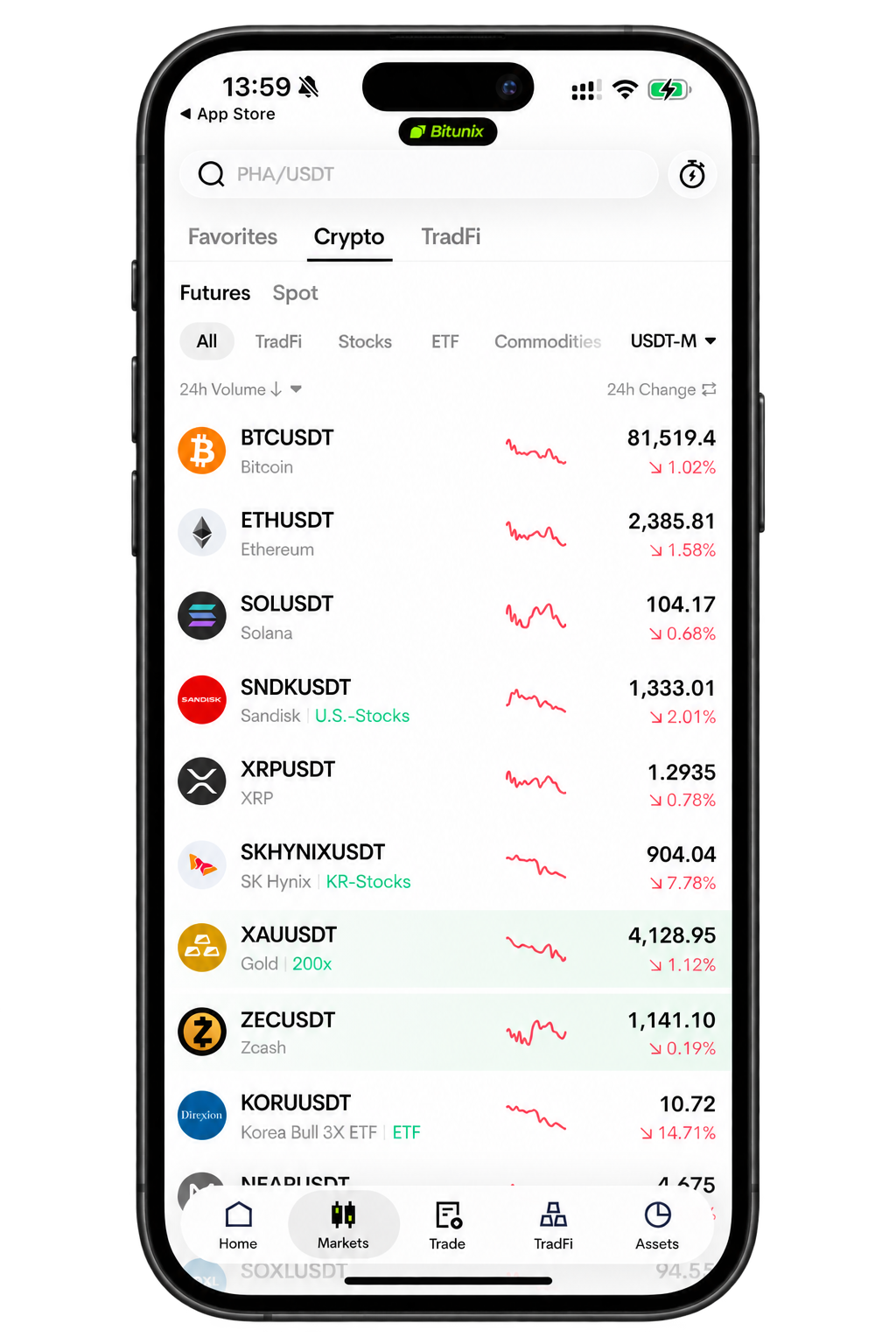
Bitunix advertises more than 1,200 trading pairs across its supported markets, providing considerable variety for traders interested in both established cryptocurrencies and newer tokens. However, this figure includes different trading products rather than representing 1,200 unique cryptocurrencies available for spot purchases and withdrawals. Liquidity, maximum leverage, funding conditions, and network support also differ between markets, making the individual trading pair more important than the total selection advertised.
The platform’s strongest functionality remains concentrated in leveraged trading, technical analysis, and execution management. Spot trading, earning products, and payment services provide additional flexibility, but Bitunix is better suited to investors comfortable managing different account balances and product-specific risks than those seeking a conventional fiat-first cryptocurrency brokerage.
Perpetual Futures: Bitunix’s Main Trading Product
Perpetual futures form the core of Bitunix’s trading environment, allowing eligible users to open leveraged long and short positions without purchasing the underlying cryptocurrency. These contracts have no scheduled expiry date and use periodic funding payments to help maintain alignment between futures prices and their underlying reference markets. Bitunix supports USDT-margined, USDC-margined, and coin-margined perpetual contracts, providing several ways to manage collateral and settle trading profits or losses.
USDT-margined and USDC-margined contracts use their respective stablecoins as collateral and settlement currencies, making account performance relatively straightforward to measure in dollar-denominated terms. Coin-margined contracts work differently because both margin and realized profit or loss are denominated in the underlying cryptocurrency. A trader holding Bitcoin, for example, can use BTC as collateral for a coin-margined position without first converting it into stablecoins. However, collateral denominated in a volatile cryptocurrency can lose value at the same time as the position moves against the trader, increasing liquidation exposure.
Bitunix supports maximum leverage of up to 200x on selected perpetual contracts, including certain BTC and ETH markets. This is a product-specific ceiling rather than a limit available across every pair or position size. Larger positions can be subject to lower maximum leverage and higher maintenance-margin requirements, while the available settings also depend on the collateral arrangement. At 100x leverage, a price movement of approximately 1% against a fully utilized position can consume an amount equivalent to its initial margin before accounting for trading fees, maintenance requirements, and liquidation mechanics.
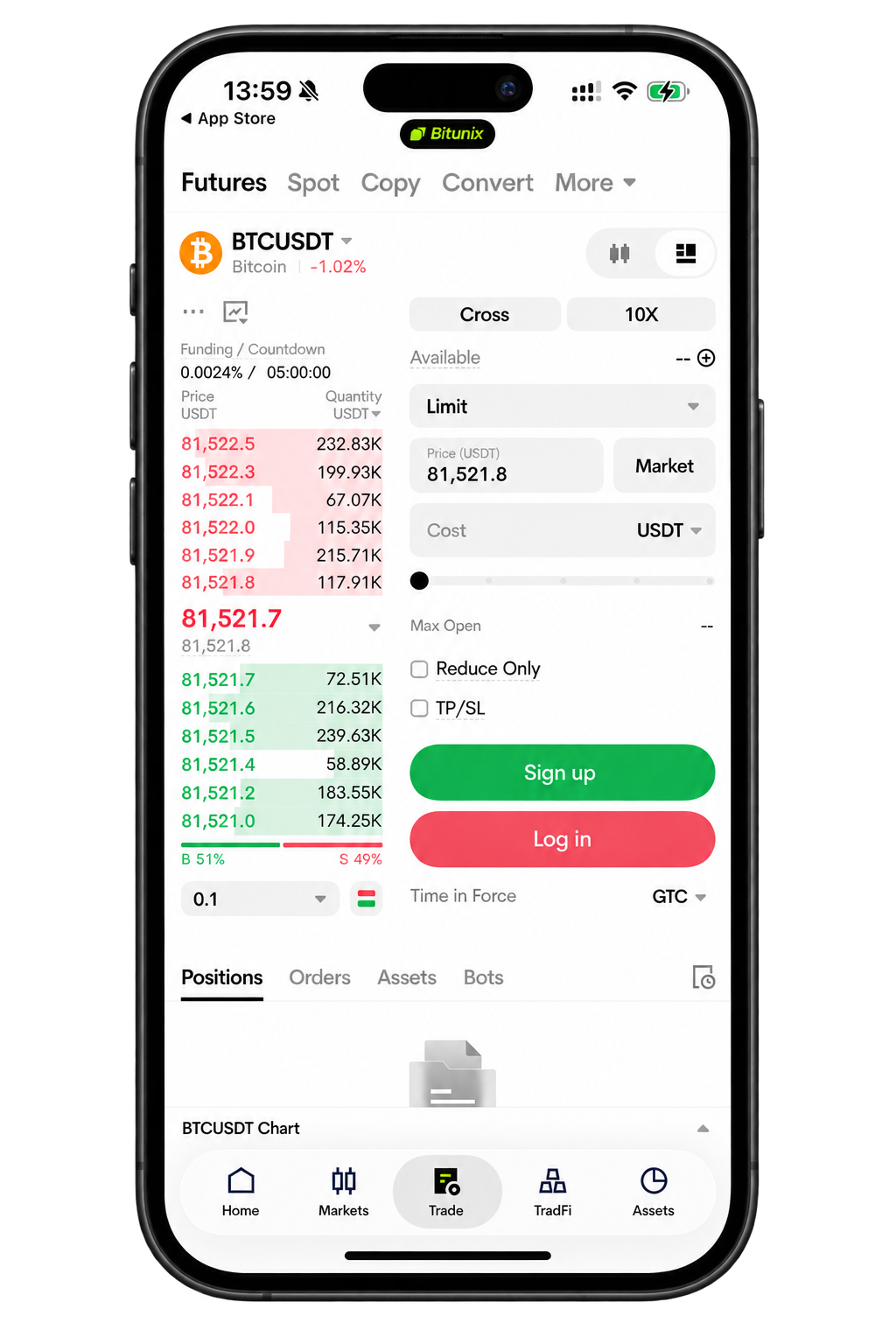
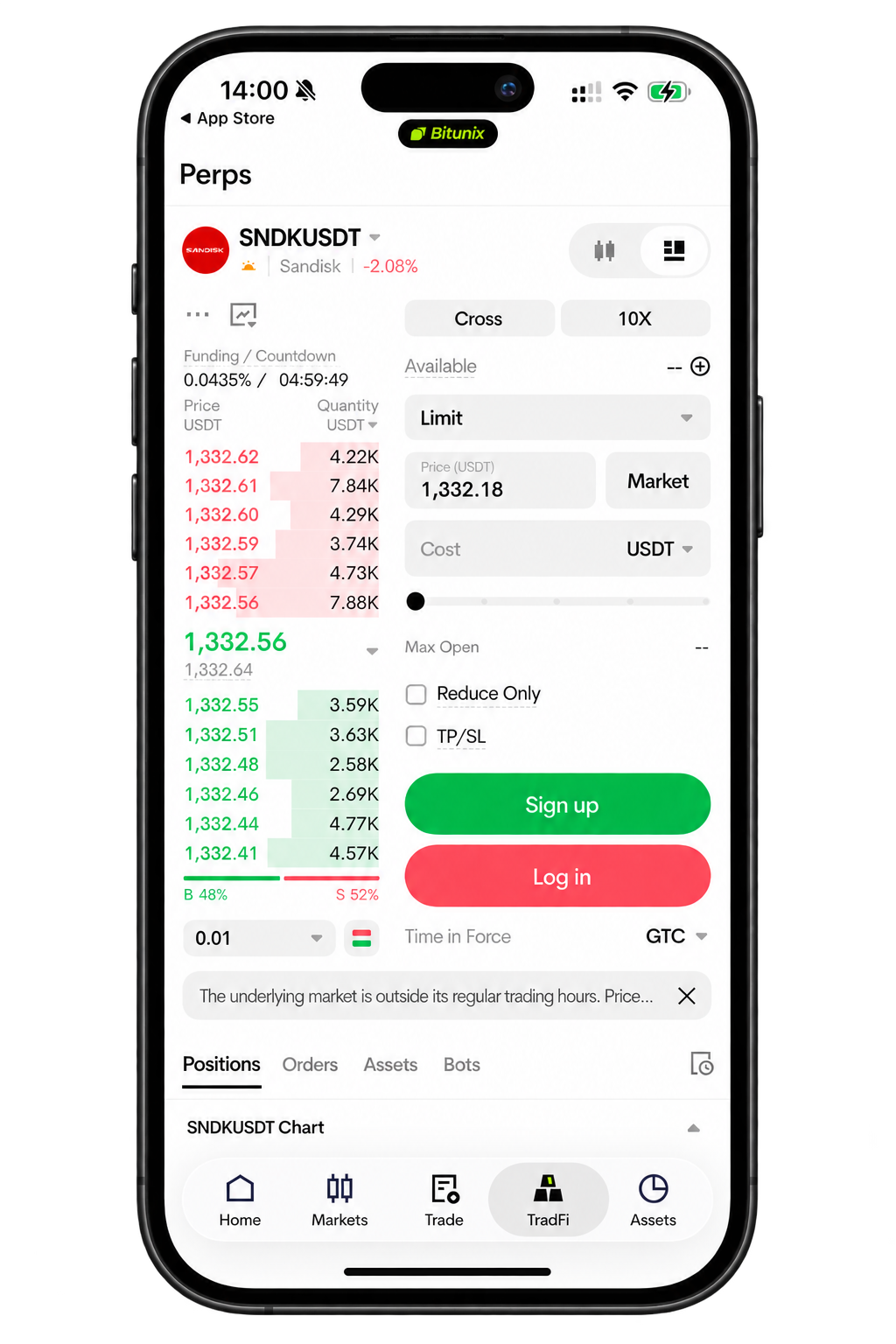
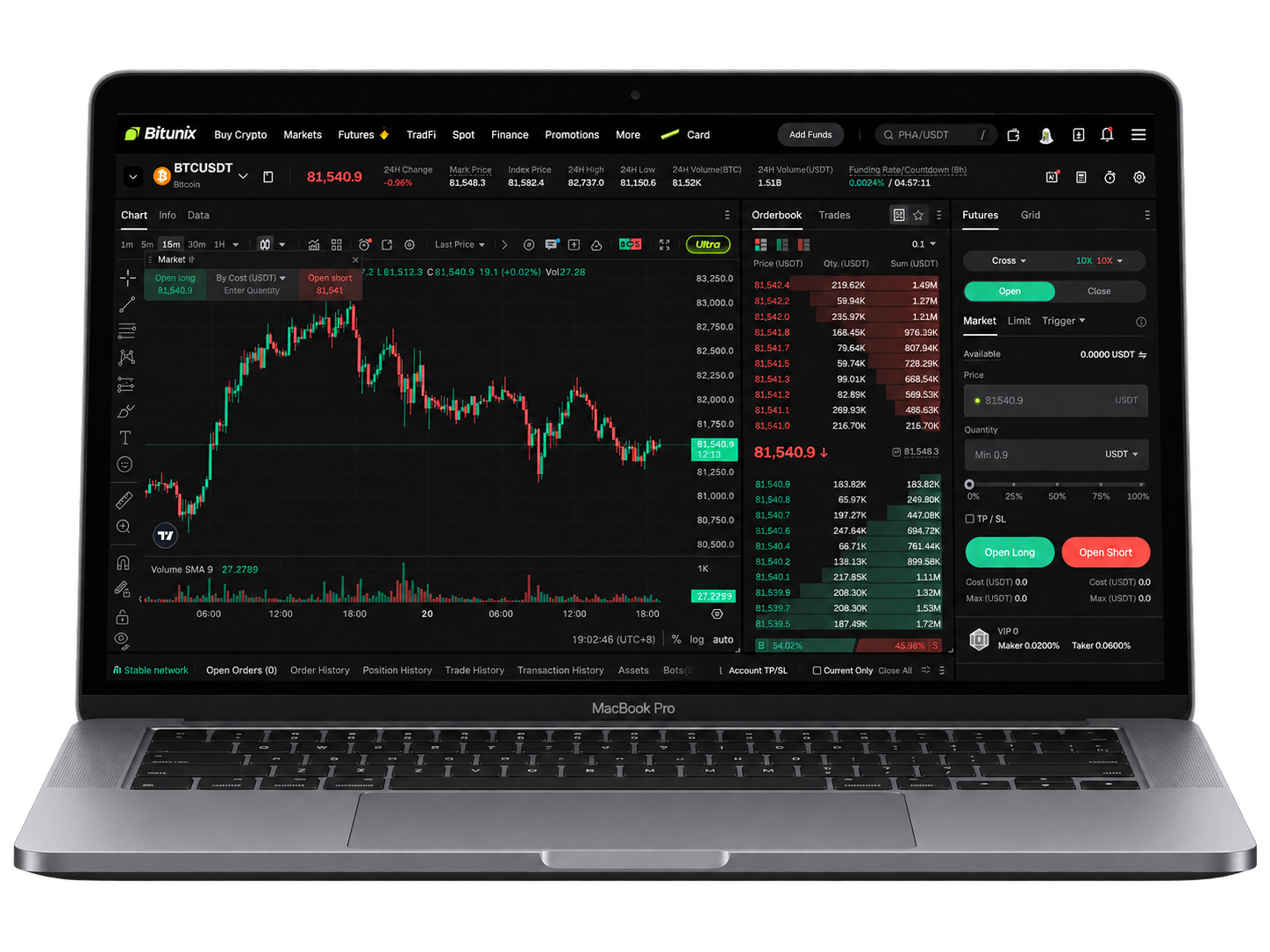
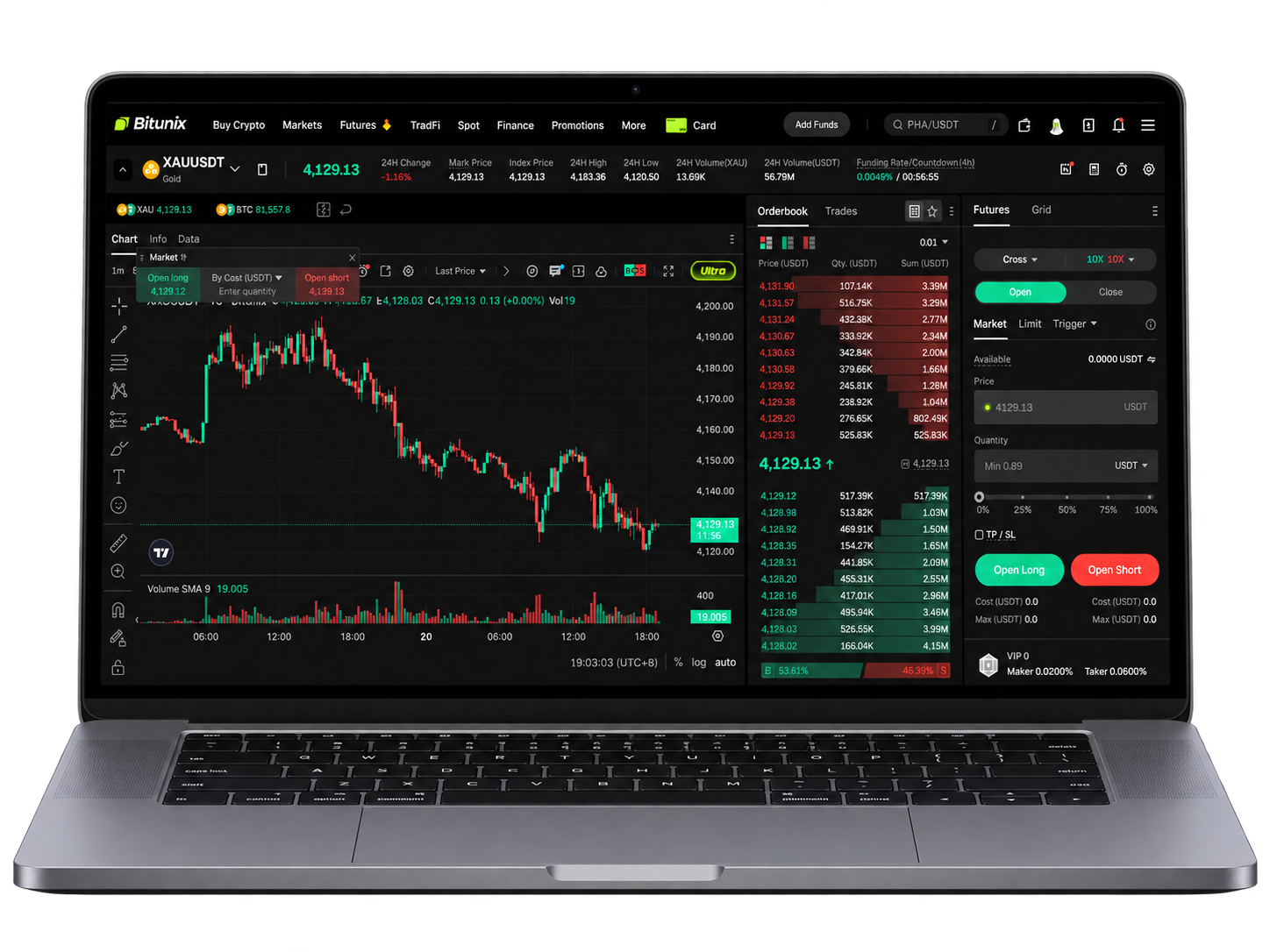
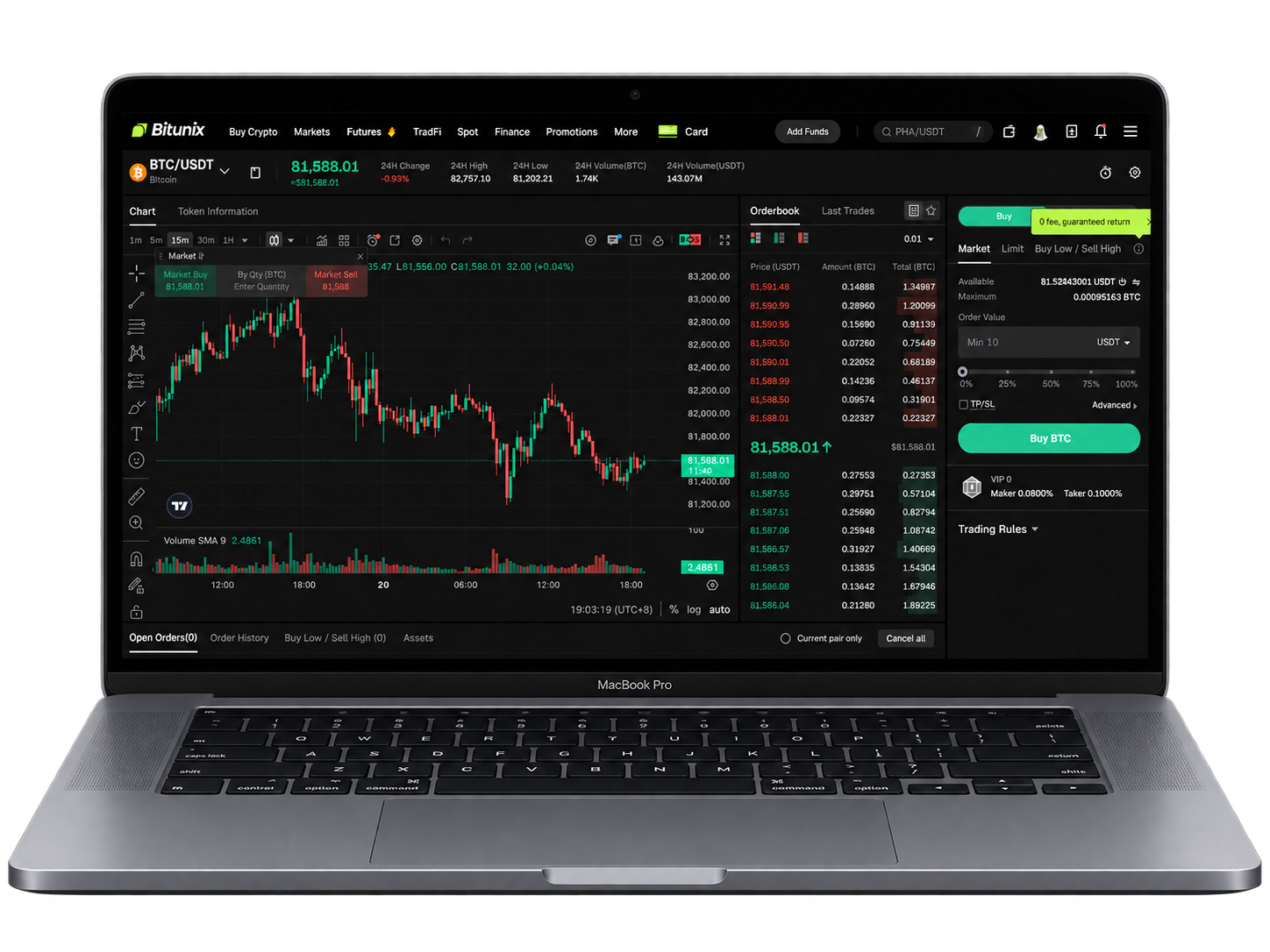
The futures terminal combines charts, order books, market depth, position information, and order controls in a trading environment designed for frequent execution. Market and limit orders are complemented by conditional entries, trailing stops, and take-profit or stop-loss instructions, while Multi-Trade functionality supports traders who need to manage several positions or strategies simultaneously. The platform also provides advanced chart-based trading tools, allowing supported orders and protective levels to be managed directly from the price chart.
Despite the available functionality, execution quality remains dependent on market conditions. Liquid BTC and ETH contracts generally offer a different trading experience from smaller altcoin perpetuals, where wider spreads and limited resting orders can make large positions more expensive to enter or exit. Funding payments, trading commissions, and slippage also influence returns independently of the direction of the underlying cryptocurrency. Traders using crypto perpetual futures should evaluate the total cost of maintaining a position rather than focusing only on its advertised leverage.
Leverage, Margin Modes, and Liquidation Protection
Bitunix supports isolated and cross-margin arrangements, alongside a multi-assets collateral mode for eligible futures products. Isolated margin assigns collateral to an individual position, limiting the funds initially allocated to that trade. Cross margin allows eligible positions to draw on a broader pool of available collateral, potentially delaying liquidation but also exposing a larger portion of the account balance to adverse market movements.
Its multi-assets mode provides additional flexibility by allowing supported cryptocurrencies, including BTC, ETH, SOL, XRP, BNB, DOGE, USDC, and USDT, to contribute to the margin available for USDT-settled futures. The platform applies asset-specific valuation discounts when calculating usable collateral, reflecting differences in volatility and liquidity. A trader holding BTC and ETH may therefore use part of their combined value to support eligible positions without converting the entire balance into USDT. However, a decline in collateral prices can reduce usable margin even when the futures position itself has not moved significantly.
The distinction becomes particularly important during rapid market declines. Cross-margin arrangements can expose several positions to the same deterioration in account equity, while multi-asset collateral introduces additional sensitivity to the prices of the assets securing those trades. Traders must account for maintenance-margin tiers, liquidation prices, and the possibility that different positions or collateral assets become correlated during market stress. Understanding why leveraged crypto positions get liquidated is essential before selecting higher exposure.
Bitunix provides several tools for managing these risks, including Fixed Risk, partial take-profit and stop-loss settings, and position-level monitoring. Fixed Risk allows users to calculate position sizing around a selected entry, stop level, and intended loss amount, helping translate a trading plan into an appropriate order size. However, the calculation is based on expected execution conditions and cannot guarantee that an ordinary stop order will close at the selected price during extreme volatility.
The exchange also offers a separate Guaranteed Stop Loss feature on supported contracts, including BTCUSDT, ETHUSDT, SOLUSDT, and XRPUSDT. Unlike a conventional stop-market order, this paid protection is designed to provide execution at the specified stop price when its conditions are met, with the applicable charge calculated according to the position and selected protection settings. Traders should distinguish this feature from standard stop-loss and take-profit orders, which remain exposed to slippage or failed execution depending on the order type. Availability, fees, and eligibility should be checked before treating Guaranteed Stop Loss as part of a trading strategy.
Ultra Charting, Super Alert, and Trading Tools
Bitunix has invested heavily in its technical trading interface, particularly through the Ultra charting environment. The platform supports multi-chart layouts with up to 16 charts displayed simultaneously, alongside extensive technical indicators, drawing tools, and customizable analysis panels. Traders can monitor several cryptocurrency pairs, compare timeframes, and manage open positions without repeatedly switching between separate trading pages.
Chart Trading allows supported orders, stop-loss levels, and profit targets to be adjusted through the price chart, while fixed-risk position sizing provides a more structured approach to calculating exposure before execution. Multi-Trade adds flexibility for users managing several orders or positions, making the desktop environment especially relevant to short-term traders who monitor multiple markets. These tools can improve efficiency, although their effectiveness depends on the trader’s understanding of execution settings and the consequences of changing orders while positions are open.
The platform’s Super Alert system extends beyond conventional price notifications by supporting technical indicators, candlestick conditions, drawing-based levels, and combinations of multiple market signals. Traders can configure alerts around their preferred technical setups and receive notifications when the specified conditions are met. This provides greater flexibility than monitoring fixed price thresholds alone, particularly for strategies based on moving averages, momentum indicators, or chart patterns.
Demo Trading offers an additional environment for exploring supported futures functionality without committing real capital. It can help users become familiar with order placement, margin settings, and chart-based management, although simulated execution cannot fully reproduce live liquidity, funding, or trading behavior under stress.
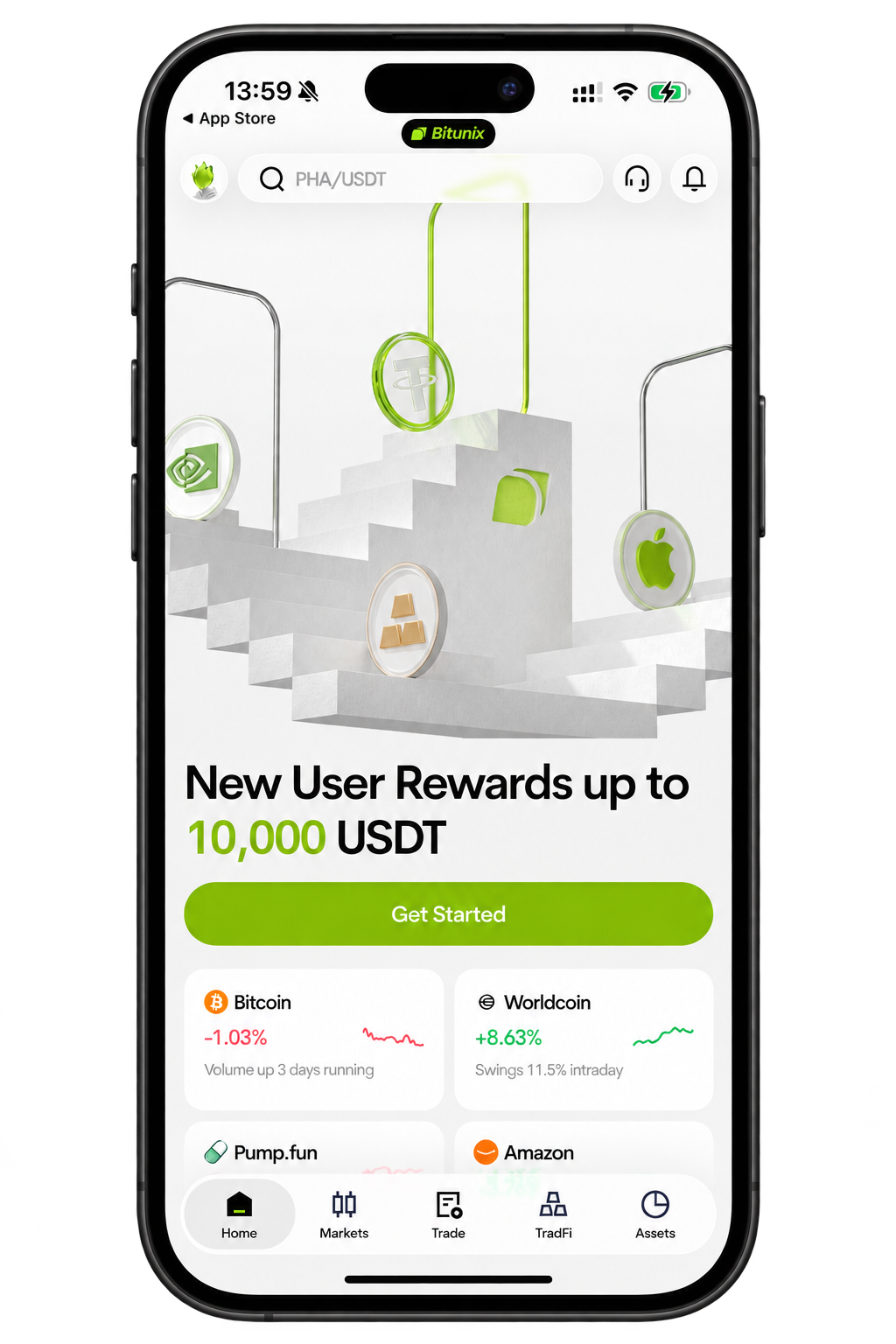
Bitunix’s mobile application provides access to supported spot and derivatives markets, account balances, orders, charting, and position management. Mobile trading is particularly useful for monitoring open positions and responding to market movements, while the desktop terminal remains better suited to detailed technical analysis and simultaneous management of several trading setups. The consistency between its charting tools, alerts, and order controls gives Bitunix a more specialized trading experience than platforms focused primarily on simple cryptocurrency purchases.
Futures Grid and Spot Auto-Invest
Bitunix also offers automated strategies that serve different investment objectives. Futures Grid is designed for traders seeking to execute repeated transactions within a predetermined price range, while Spot Auto-Invest provides a recurring cryptocurrency purchasing system for investors who prefer gradual accumulation.
Futures Grid automatically places buy and sell orders at configured price intervals within a selected perpetual futures market. Users define the trading range, number of grid levels, strategy direction, and leverage, after which the system manages eligible orders according to those parameters. A long-oriented grid may attempt to capture repeated upward movements within a range, while short-oriented configurations can be used for different market expectations.
The strategy is most relevant when prices fluctuate repeatedly within the selected boundaries. A sustained move beyond the configured range can leave the strategy holding an unfavorable position, while leverage increases the possibility of liquidation. Grid profits must also be assessed alongside unrealized losses, funding payments, and trading fees, since frequent profitable fills do not necessarily mean the overall position is profitable.
Spot Auto-Invest follows a different approach, allowing users to schedule recurring cryptocurrency purchases through supported spot markets. Investors can select eligible assets, contribution amounts, allocation ratios, and purchase frequencies, including daily, weekly, or monthly schedules. This supports dollar-cost averaging without requiring a new manual order for every investment. Purchases remain subject to ordinary spot trading fees and cryptocurrency price volatility, but the strategy avoids the leverage and liquidation exposure associated with futures grid trading.
These automation tools broaden Bitunix’s appeal beyond discretionary futures trading. However, the distinction between them is substantial: Auto-Invest accumulates cryptocurrency through ordinary spot purchases, whereas Futures Grid continuously trades leveraged contracts according to a predetermined strategy.
Copy Trading: Following Futures Strategies
Bitunix offers futures copy trading, allowing users to replicate eligible lead traders’ positions through either fixed-amount or proportional allocation settings. Fixed-amount copying assigns a predetermined amount of margin to each replicated trade, while fixed-ratio copying adjusts the follower’s position size according to the lead trader’s relative allocation. Both methods reduce the need for manual order entry, although copied transactions remain subject to market execution, available collateral, and the follower’s configured limits.
The platform provides account-level strategy stop-loss controls and optional take-profit or stop-loss settings for individual copied positions. Its published copy trading rules currently impose a maximum leverage of 10x for copied contracts, which is considerably lower than the maximum leverage available in some ordinary Bitunix futures markets. Users can also configure capital limits and stop following a strategy when specified account conditions are met.
Copying another trader does not guarantee identical results. Differences in execution timing, available liquidity, margin balances, and applicable fees can cause follower performance to diverge from the lead account. A successful lead trader may also have open positions carrying substantial unrealized losses that are not immediately apparent from a headline return figure.
Costs include normal futures trading fees, funding payments, and profit sharing where applicable. Bitunix’s standard published profit-sharing ratio is 10%, with settlement generally conducted weekly on qualifying realized profits. The exchange does not impose a separate copy trading service fee under its published rules, but execution costs and profit sharing can materially reduce the follower’s net return.
Selecting a lead trader should involve examining maximum drawdown, leverage, position concentration, trading history, and the consistency of realized returns. Copy trading can simplify execution, but investors remain exposed to the underlying strategy and should not interpret automated replication as professional management or guaranteed profitability.
Bitunix Easy Earn: Flexible and Fixed-Term Crypto Savings
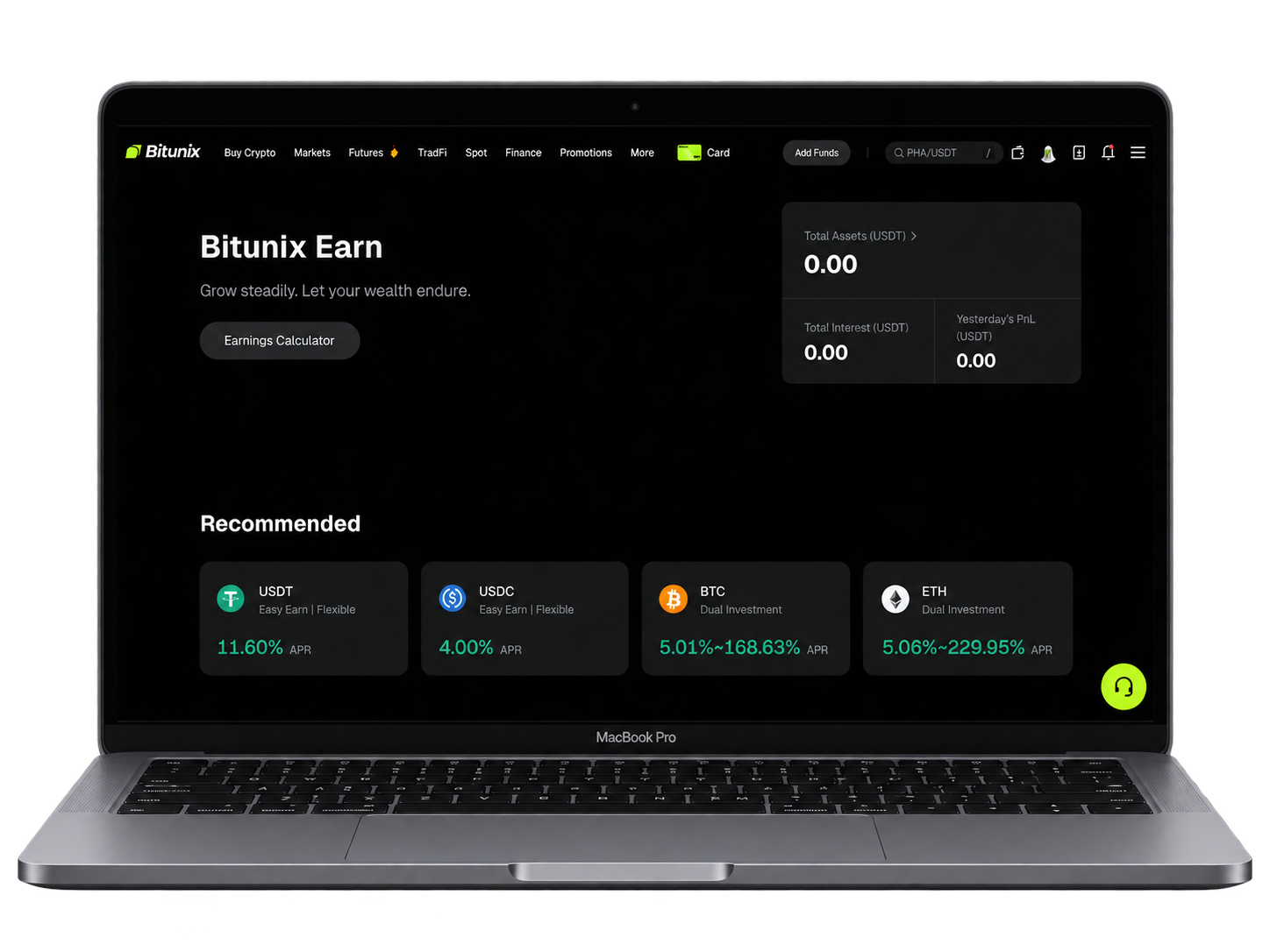
Bitunix Easy Earn provides a way for eligible customers to generate returns on supported cryptocurrency balances through flexible and fixed-term earning products. The service is separate from perpetual futures and does not require users to manage leveraged positions, but the underlying funds remain subject to Bitunix’s custody and product-specific terms.
Flexible Easy Earn allows users to subscribe and redeem supported assets without a fixed holding period. Interest is calculated according to the applicable annualized rate, with the platform’s current product rules describing hourly accrual and automatic reinvestment. Returns can fluctuate as market conditions change, making flexible products more suitable for customers who prioritize access to their balances rather than locking in a particular rate for an extended period.
Fixed-Term Easy Earn provides subscriptions with predetermined durations, such as seven, 14, or 30 days, and rates established for the relevant holding period. Assets are normally committed until maturity, when the applicable principal and earnings are returned according to the product’s settlement schedule. Standard fixed-term subscriptions generally do not permit early redemption, although certain special offers may allow it with forfeiture of accrued interest or additional conditions. Investors should review the individual subscription terms before assuming that locked funds can be recovered immediately.
An important consideration is how advertised returns translate into customer earnings. Bitunix’s published Easy Earn rules allocate 15% of generated interest to a risk reserve, with the remaining 85% distributed to participating users. This means investors should distinguish between the underlying annualized yield used for calculations and the amount they ultimately receive. The reserve arrangement does not establish that Easy Earn balances are insured or guaranteed against every form of loss.
Easy Earn should also not be confused with direct proof-of-stake delegation. Depositing Bitcoin or USDT into an exchange earning product does not mean those assets are generating native blockchain staking rewards. Customers rely on the platform’s earning arrangements, redemption procedures, and continued ability to meet its obligations. Bitunix provides a convenient service for temporarily idle cryptocurrency, but its product selection and underlying arrangements do not make it equivalent to a dedicated self-custody staking platform.
Dual Investment: Buy Low and Sell High Products
Bitunix offers Dual Investment, a structured cryptocurrency product that combines a predetermined yield rate with settlement based on the future price of an underlying asset. Users choose between Buy Low and Sell High arrangements, selecting an eligible cryptocurrency, target price, and maturity date. The applicable annualized yield is established at subscription, while the asset received at settlement depends on the relationship between the market price and the selected target.
Under a Buy Low arrangement, a customer generally commits USDT with the intention of acquiring a specified cryptocurrency if its price reaches or falls below the selected settlement level. A Sell High arrangement works in the opposite direction, allowing customers to commit an existing cryptocurrency position that may be converted into USDT if the relevant settlement conditions are met. In either case, the product settles automatically according to its terms rather than requiring the customer to place a manual trade at maturity.
The key risk is that Dual Investment is not principal-protected in value terms. Although the quoted yield is fixed for the subscription period, the final settlement currency can change, potentially leaving the investor holding an asset worth less than the original investment. A Buy Low product may acquire cryptocurrency during a substantial price decline, while Sell High can convert an appreciating asset at a target price below the prevailing market. Once subscribed, positions generally cannot be canceled or redeemed before maturity.
Dual Investment is therefore better understood as a structured trading and yield strategy than as conventional cryptocurrency savings. Its potential return must be evaluated alongside the settlement conditions, market exposure, and restricted liquidity, particularly when headline annualized yields appear unusually attractive.
Bitunix Card: Visa Payments and Crypto Cashback
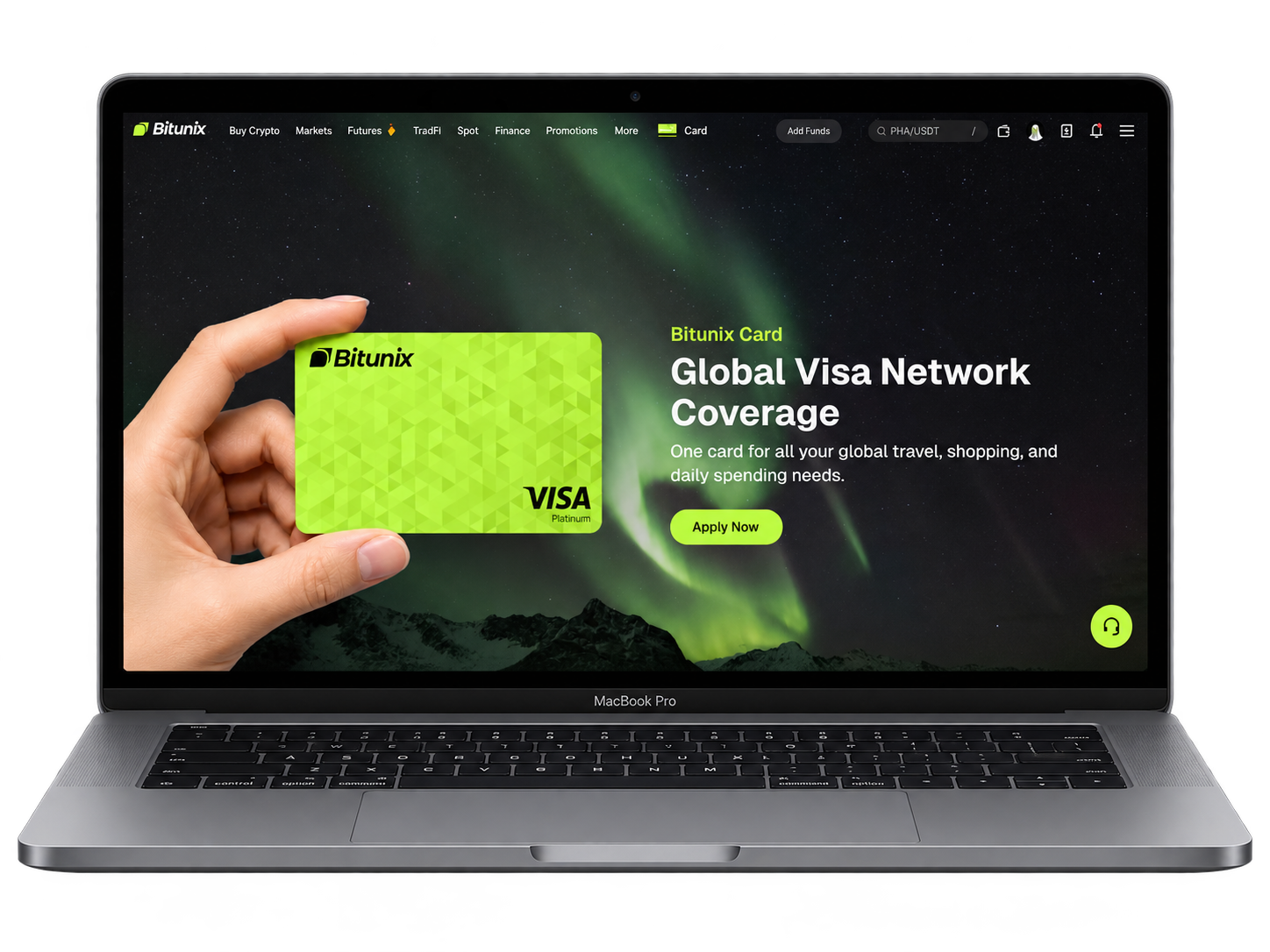
The Bitunix Card extends the platform into everyday cryptocurrency spending through a Visa-powered payment product. Eligible users can fund a dedicated card account with USDT transferred from their Bitunix balances and use the card for supported merchant transactions. The necessary conversion into fiat currency occurs during payment processing, allowing customers to spend cryptocurrency without first making a separate withdrawal to a bank account.
Bitunix’s virtual card is intended for online purchases, subscriptions, and eligible digital-wallet payments, with support for compatible services such as Apple Pay and Google Pay subject to regional and provider requirements. The company also documents a physical-card option, although its card program continues to describe the virtual card as the initial rollout. Physical-card issuance should therefore be confirmed for the customer’s location rather than assumed to be universally available.
The card is advertised with no issuance, monthly maintenance, annual, or cryptocurrency conversion fee. Other transaction charges can still apply, including payment-network or foreign-currency fees, small-transaction charges under applicable conditions, and merchant-imposed costs. Exact fees depend on the published card terms and should be reviewed before relying on the product for international spending.
Eligible users can also receive cashback on qualifying purchases, with rewards linked to monthly spending or Bitunix VIP status. The published program offers rates ranging from 1% to a maximum of 8%, with different monthly caps and qualification thresholds. The highest advertised cashback rate is not available to every cardholder, and excluded transaction categories, refunds, and other conditions can reduce actual earnings.
Card applications require identity verification, and activation of the virtual card involves transferring at least 10 USDTinto the card account. This is a funding requirement rather than a card issuance fee, with the transferred balance remaining available for eligible spending. The Bitunix Card improves the platform’s practical utility beyond trading, but it remains a custodial spending service governed by card-provider rules, regional availability, and applicable conversion conditions.
TradFi Futures and CFD Trading
Bitunix has expanded into traditional financial market exposure through products referencing stocks, exchange-traded funds, commodities, precious metals, indices, and foreign-exchange markets. These services broaden the range of assets available to cryptocurrency traders, but they operate through derivatives rather than direct ownership of shares, commodities, or currencies.
Its TradFi futures offering includes selected USDT-settled contracts referencing companies such as Tesla, NVIDIA, and Apple, along with certain ETFs and commodity-related markets. Eligible users can open long or short positions and apply leverage according to the contract’s risk limits. However, these instruments do not provide shareholder voting rights, ownership of physical commodities, or ordinary stock dividends. Pricing and liquidity can also behave differently when the underlying traditional financial market is closed, even if the cryptocurrency-based contract remains available for trading.
Bitunix additionally operates a separate CFD trading service for eligible jurisdictions. Contracts for difference allow traders to speculate on price changes in supported markets, including forex, commodities, precious metals, stock indices, and equities, without acquiring the underlying assets. The service uses a dedicated CFD account and its own collateral and risk-management framework, with contract values denominated in the platform’s designated settlement unit.
CFD access requires identity verification and acceptance of the applicable risk disclosures, with regional eligibility determined separately from ordinary Bitunix spot and futures trading. Leverage, trading costs, margin requirements, and liquidation conditions depend on the selected instrument. A customer with access to cryptocurrency perpetuals should not assume they are automatically eligible for stock-linked contracts or CFDs.
These products make Bitunix more versatile for experienced traders following several markets, but they introduce additional financial risks and regulatory distinctions. Trading a leveraged contract referencing NVIDIA or gold is fundamentally different from owning the underlying security or commodity, particularly when contracts are settled through an exchange rather than a traditional securities brokerage.
Fiat Purchases, P2P Trading, and Crypto Conversion
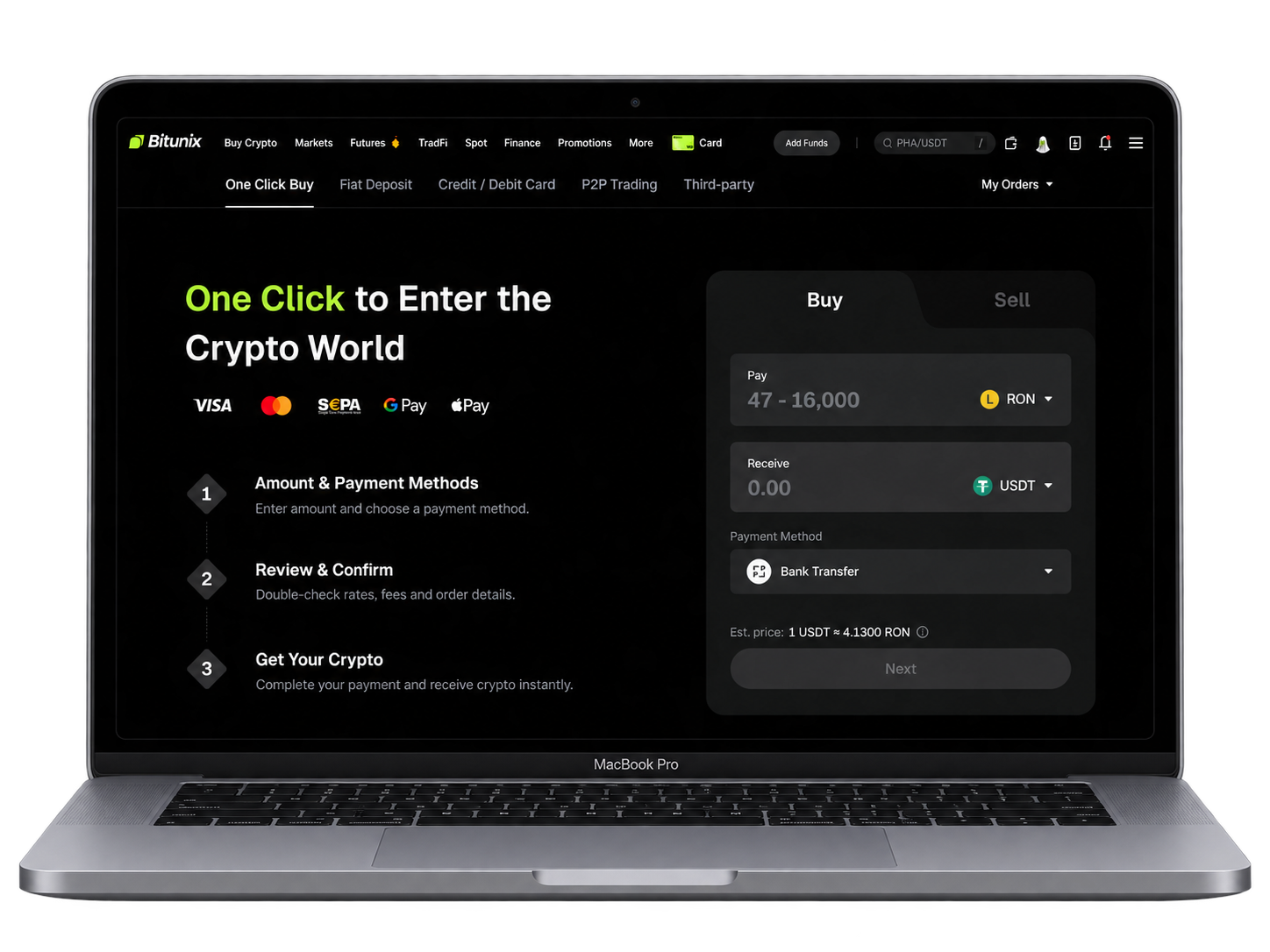
Bitunix provides several ways to acquire cryptocurrency without first transferring digital assets from another exchange. Its fiat purchasing services include supported credit and debit cards, third-party payment providers, one-click purchasing, and peer-to-peer trading. Available methods vary by country and may require identity verification before a transaction can proceed.
Direct card purchases support Visa and Mastercard through eligible payment arrangements, with support for more than 30 fiat currencies and selected major cryptocurrencies, including BTC, ETH, USDT, and USDC. Payment limits, processing charges, and conversion rates depend on the provider and transaction. Purchasing cryptocurrency through a card may be convenient for immediate funding, but the final quote should be compared with the cost of acquiring the same asset through the exchange’s spot market.
Bitunix also operates a P2P marketplace where users can buy or sell supported cryptocurrency directly with other customers using eligible local payment methods. The platform provides transaction management and escrow arrangements for supported orders, although users remain exposed to payment fraud, disputes, and the possibility of misleading payment confirmations. Bitunix requires KYC for P2P trading and imposes a T+1 withdrawal restriction on cryptocurrency obtained through supported P2P purchases.
The Convert feature offers another route for exchanging supported cryptocurrencies without manually placing an order through the spot terminal. It is more convenient for straightforward asset conversions, although users should examine the quoted rate and resulting amount rather than assuming that a simplified transaction provides the same execution as a competitive limit order.
Fiat purchasing and conversion improve Bitunix’s accessibility, but its funding ecosystem is not identical to that of a conventional bank-connected cryptocurrency brokerage. Payment methods, withdrawal routes, and compliance requirements remain jurisdiction-dependent, making it important to confirm the available options before depositing substantial funds.
Token Splash, Rewards, and VIP Benefits
Bitunix also provides promotional and loyalty programs intended to encourage trading activity and participation in selected token launches. Token Splash allows eligible customers to earn rewards from participating projects by completing specified deposit or spot trading tasks. Reward allocations depend on campaign rules, qualifying activity, and any per-user limits, with token availability and eligibility determined separately for each event.
The exchange’s Rewards Hub provides additional incentives through deposit promotions, first-trade tasks, fee vouchers, and futures bonuses. These rewards may reduce eligible trading expenses or provide promotional collateral, but they have their own usage restrictions and cannot automatically be treated as unrestricted withdrawable cryptocurrency. Users should review the settlement, expiration, and withdrawal conditions before assigning promotional balances the same value as ordinary account funds.
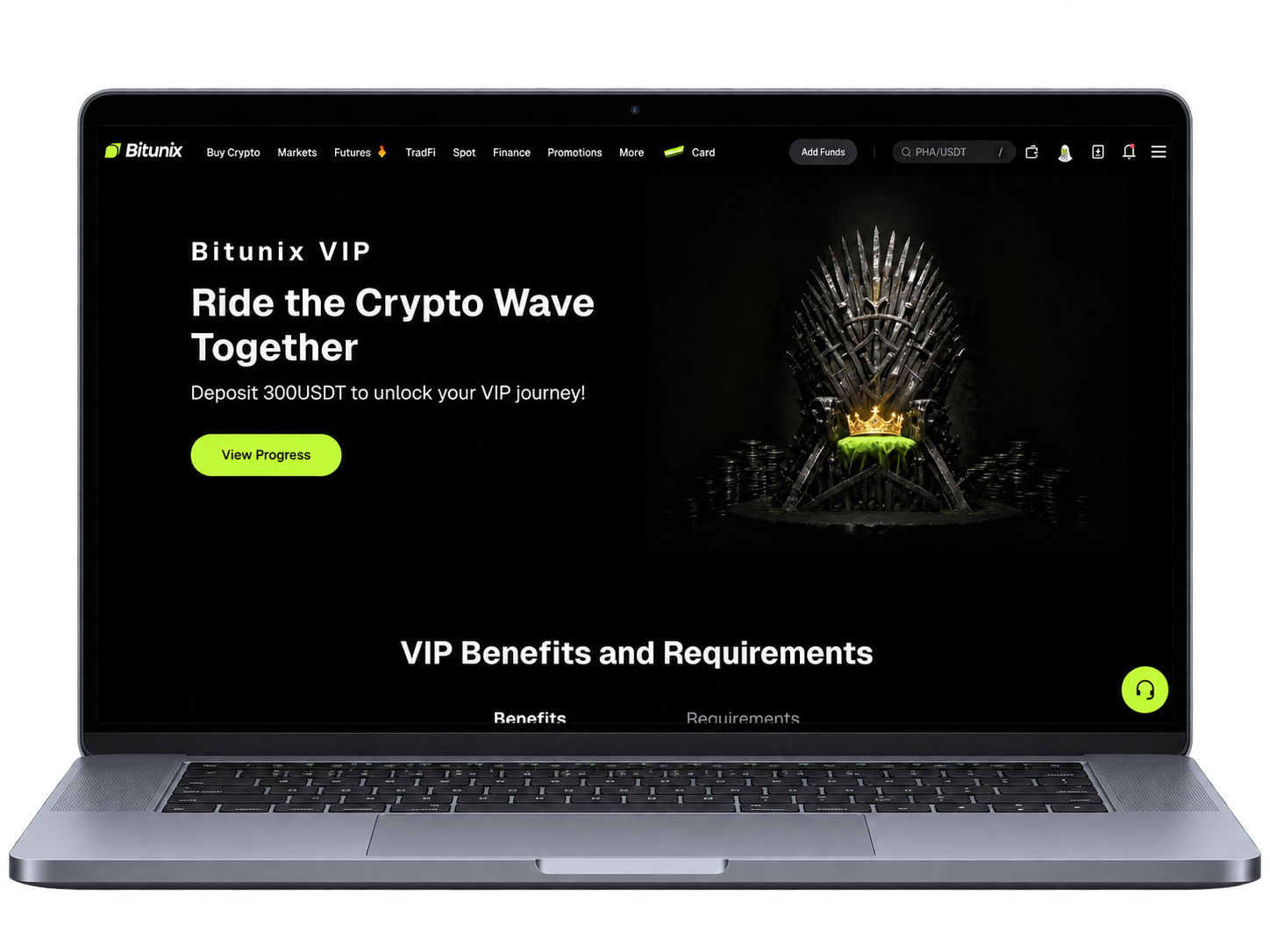
The Bitunix VIP program offers progressively lower spot and futures trading fees based on qualifying trading volume or asset holdings. Higher tiers may also include cashback benefits, preferential earning products, dedicated account assistance, and access to Guaranteed Stop Loss vouchers. The published maximum card cashback reaches 8% at the highest VIP levels, while futures maker fees can fall to zero for qualifying top-tier accounts.
These programs can improve the economics of frequent trading, but the benefits depend on meeting substantial qualification requirements. Fee discounts are generally more relevant than promotional rewards when assessing the long-term value of an exchange, particularly for traders executing high volumes or maintaining leveraged positions.
Overall, Bitunix offers a broader range of financial services than a futures-only exchange, with automation, structured investment products, fiat access, and cryptocurrency payments complementing its derivatives platform. Its strongest differentiation remains the combination of advanced charting, flexible collateral management, and specialist trading tools, while the newer services introduce additional opportunities alongside their own fees, eligibility rules, and financial risks.
Fees
Bitunix Fees Explained
Bitunix offers competitive trading fees across its spot and perpetual futures markets, with discounts available through a nine-tier VIP program. Standard spot fees start at 0.08% maker and 0.10% taker, while futures trading costs 0.02% maker and 0.06% taker. Higher-volume traders can qualify for reduced rates based on their 30-day trading activity or eligible account balances, with the largest discounts reserved for VIP 8 users.
Trading commissions are only part of the overall cost. Perpetual futures positions may incur periodic funding payments, copy trading can involve profit-sharing charges, and cryptocurrency withdrawals carry network-dependent fees. Fiat purchases also have their own pricing arrangements through supported payment providers. The tables below show Bitunix’s published fees as of October 2026.
Bitunix Trading and Transaction Fees
| Fee Type | Standard Fee | Details |
|---|---|---|
| Spot Trading Maker | 0.08% | Standard VIP 0 rate for orders adding liquidity |
| Spot Trading Taker | 0.10% | Standard VIP 0 rate for orders removing liquidity |
| Futures Trading Maker | 0.02% | Standard VIP 0 rate on executed contract value |
| Futures Trading Taker | 0.06% | Standard VIP 0 rate on executed contract value |
| VIP Spot Trading | From 0.0048% maker / 0.018% taker | Lowest published rates at VIP 8 |
| VIP Futures Trading | From 0% maker / 0.026% taker | Lowest published rates at VIP 8 |
| Perpetual Futures Funding | Variable | Periodic payments between long and short positions; usually every eight hours, but some contracts have different intervals |
| Futures Copy Trading | Standard futures trading fees | Copied positions incur ordinary execution charges |
| Copy Trading Profit Sharing | 10% default; varies by lead trader | Percentage of eligible profitable results shared with the lead trader |
| P2P Trading | 0% platform fee | Payment-provider charges and differences between merchant quotes may apply |
| Cryptocurrency Deposits | Free | Bitunix charges no crypto deposit fee; the sending platform or network may impose charges |
| Cryptocurrency Withdrawals | Variable | Depends on the cryptocurrency, blockchain network, and displayed withdrawal charge |
| Internal Bitunix Transfers | Free | Eligible transfers between Bitunix accounts do not incur onchain transaction fees |
| Credit/Debit Card Purchases | Variable | Payment-provider charges and quoted exchange rates depend on the transaction |
| Third-Party Fiat Purchases | No additional Bitunix fee on the documented third-party route | External providers may charge processing fees or apply a spread |
| EUR SEPA Deposits | Variable by payment route | Available to eligible users; bank or payment-provider fees may apply |
| Futures Opening and Closing | Applicable maker/taker rate on each execution | Trading commissions are charged when positions are opened and closed |
Bitunix VIP Trading Fee Tiers
Bitunix’s VIP program reduces both spot and futures trading commissions as customers meet qualifying activity or balance requirements. Users can qualify through eligible 30-day spot volume, futures volume, or account balances without necessarily meeting all three thresholds.
| VIP Level | Spot Maker / Taker | Futures Maker / Taker |
|---|---|---|
| VIP 0 | 0.0800% / 0.1000% | 0.0200% / 0.0600% |
| VIP 1 | 0.0700% / 0.0900% | 0.0200% / 0.0500% |
| VIP 2 | 0.0600% / 0.0800% | 0.0160% / 0.0500% |
| VIP 3 | 0.0350% / 0.0600% | 0.0140% / 0.0400% |
| VIP 4 | 0.0200% / 0.0500% | 0.0120% / 0.0375% |
| VIP 5 | 0.0150% / 0.0450% | 0.0100% / 0.0350% |
| VIP 6 | 0.0125% / 0.0375% | 0.0080% / 0.0315% |
| VIP 7 | 0.0100% / 0.0325% | 0.0060% / 0.0300% |
| VIP 8 | 0.0048% / 0.0180% | 0.0000% / 0.0260% |
These are published VIP fee rates rather than promotional rebates. The highest tiers require substantial qualifying trading activity, with VIP 8 accessible through 100 million USDT in 30-day spot volume or 500 million USDT in futures volume, among the published qualification routes. Bitunix also offers a process for traders holding VIP status on another exchange to request an equivalent account tier.
How Much Does Trading on Bitunix Cost?
At standard VIP 0 rates, a $10,000 spot market purchase incurs approximately $10 in taker fees. Selling the same notional amount through another market order would add approximately $10, bringing the combined trading commissions to $20, excluding price movements and slippage. Using maker orders would reduce the combined commission to approximately $16, provided both orders execute as liquidity-adding transactions.
Futures commissions are lower, but leverage and funding introduce additional considerations. Opening a $10,000 perpetual futures position with a taker order costs approximately $6, with another $6 charged if the position is closed at the same notional value using a taker order. The $12 combined execution cost excludes funding payments, which may accumulate when a position remains open through settlement periods. Fees are calculated on the relevant position value rather than only the initial margin, making trading frequency and leverage exposure important considerations.
Are Bitunix Trading Fees Competitive?
Bitunix offers attractive standard fees for spot and perpetual futures trading, with particularly substantial discounts available at higher VIP levels. Its 0.08% maker and 0.10% taker spot rates compare favorably with many exchanges that charge higher entry-level commissions, while its VIP program makes frequent trading progressively less expensive.
However, futures traders must consider funding payments alongside execution fees, particularly when maintaining leveraged positions for extended periods. Copy trading also introduces profit sharing that can reduce net returns even when a lead trader reports profitable performance. Cryptocurrency withdrawal costs and third-party fiat purchase charges should be evaluated separately, as neither follows the ordinary maker-taker schedule.
For active traders, Bitunix provides a competitive fee structure, although the actual value depends on order execution, market liquidity, funding conditions, and eligibility for VIP discounts. The lowest advertised rate is not necessarily the lowest total cost of completing a trade.
Security
Security, Asset Custody, and Proof of Reserves
Bitunix operates as a centralized cryptocurrency exchange, maintaining custody of assets deposited into customer accounts. Its security infrastructure combines hot and cold wallet separation, multisignature controls, and institutional custody technology through partnerships with Fireblocks and Cobo. Fireblocks provides multiparty computation (MPC) infrastructure designed to distribute cryptographic signing authority and reduce dependence on individual private keys. Bitunix also uses Elliptic’s blockchain monitoring technology to identify potentially suspicious transactions and strengthen its compliance controls. These arrangements add several layers of operational security, although customers ultimately depend on the exchange to safeguard deposited assets and process authorized withdrawals.
Account-level protections include Google Authenticator two-factor authentication, email and mobile verification, anti-phishing codes, and withdrawal security controls. These features help reduce exposure to unauthorized account access and fraudulent communications, particularly when combined with a separately secured email account. Bitunix has also disclosed external security work involving firms such as Hacken and Salus, although individual assessments should be evaluated according to their published scope rather than treated as comprehensive certification of the entire exchange. Its security architecture provides meaningful safeguards against several common threats, but the effectiveness of those controls remains dependent on implementation, internal procedures, and the management of privileged access.
Proof of Reserves and Customer Asset Verification
Bitunix maintains a public Proof of Reserves portal that uses Merkle-tree verification to provide transparency around supported customer balances and the exchange’s reported asset holdings. Its reserve reporting covers major cryptocurrencies, including Bitcoin, Ethereum, and USDT, with published reserve ratios intended to demonstrate that eligible customer liabilities are backed by corresponding assets. Users can access account-specific verification information and check whether their balances were included in a particular reporting snapshot through the platform’s verification interface or available open-source tools.
Merkle-tree proofs allow customers to verify the inclusion of their balances without exposing other users’ account information. However, the existence of a valid inclusion proof does not independently establish the completeness of every liability or the availability of assets outside the reporting scope. The broader limitations of crypto exchange Proof of Reserves include undisclosed obligations, potential asset encumbrances, and changes in financial position after a snapshot. Bitunix’s reporting provides a useful transparency mechanism, but it should be considered alongside custody arrangements, operational security, and the exchange’s ability to meet withdrawals during periods of market stress.
Bitunix Care Fund and Customer Protection
Bitunix established a dedicated Care Fund with an initial capitalization of 30 million USDC to support users affected by qualifying unexpected incidents. The fund is intended to provide an additional financial backstop in circumstances involving exchange-level technical or operational problems, complementing the platform’s custody infrastructure and reserve-verification program. Its creation provides a potential mechanism for addressing certain losses that may otherwise depend entirely on the exchange’s available operating resources.
However, the Care Fund is not equivalent to statutory deposit insurance or an unconditional reimbursement guarantee. Eligibility depends on the circumstances of an incident and the exchange’s applicable assessment and compensation procedures. Ordinary trading losses, liquidations, compromised personal credentials, and other individual account incidents should not be assumed to qualify automatically. The fund’s original capitalization also should not be interpreted as proof of its current available balance or guaranteed coverage for every customer. For active derivatives traders, limiting exchange-held capital to the amount needed for trading and collateral management remains a practical way to reduce unnecessary custodial exposure.
KYC Requirements, Restricted Countries, and Withdrawals
Bitunix uses a tiered identity-verification system, with account permissions and withdrawal limits determined by the customer’s verification status, location, and security assessment. Its current framework distinguishes unverified accounts from Basic Verification (KYC 1) and Advanced Verification (KYC 2). While users may be able to access certain basic functions before completing identity checks, unverified accounts can face restrictions on trading, withdrawals, and fiat services. Users planning to deposit or trade substantial amounts should therefore establish their withdrawal eligibility before funding the account.
Basic Verification requires a government-issued identification document and a biometric identity check. Under Bitunix’s October 2026 policy, completing this level unlocks cryptocurrency withdrawals with a published maximum of 500,000 USDT per 24 hours. Advanced Verification additionally requires proof of address and raises the published maximum to 5 million USDT per 24 hours, alongside eligibility for higher fiat limits and selected services. These figures represent maximum tier allowances rather than guaranteed withdrawal capacity. Actual limits can be lower depending on account-security settings, jurisdictional requirements, transaction history, and risk controls, while additional identity or source-of-funds checks may be required.
Restricted Countries and Geographic Eligibility
Bitunix maintains a restricted-region policy that prohibits access from several major markets, including the United States, Canada, mainland China, Hong Kong, Singapore, France, the United Arab Emirates, Malaysia, and Seychelles. Additional restrictions cover countries such as Iran, North Korea, Cuba, Syria, Afghanistan, Iraq, Libya, and other sanctioned or higher-risk jurisdictions, alongside specified Russian-controlled territories of Ukraine. The published list is not exhaustive, and Bitunix reserves the right to introduce further geographic restrictions in response to regulatory requirements or internal risk assessments.
The policy applies to users physically located in prohibited jurisdictions and expressly forbids circumventing restrictions through VPNs, proxies, or location-masking services. Violations can result in account suspension, position closures, or withdrawal restrictions. Product-specific eligibility may also differ, particularly for derivatives, fiat payment services, and the Bitunix Card, which has its own geographic limitations. Registration availability should therefore not be taken as confirmation that every trading product is legally accessible in a particular country.
Cryptocurrency Withdrawals and Account Restrictions
Bitunix supports cryptocurrency withdrawals through compatible blockchain networks, with processing requirements determined by the selected asset, network, available balance, and account verification status. Withdrawal fees and minimum amounts vary between cryptocurrencies, while security reviews can delay transactions involving unusual activity or additional compliance checks. Customers should verify the receiving network and destination address carefully, particularly when transferring stablecoins such as USDT across Ethereum, TRON, or other supported blockchains. A valid address format does not guarantee that the receiving platform supports the asset or network selected.
For derivatives traders, withdrawal availability also depends on the funds remaining after open-position margin requirements and other account obligations are considered. Collateral committed to active trades cannot necessarily be withdrawn simply because it appears within the account’s total equity. Users should review their available balance, applicable security restrictions, and withdrawal limits before assuming funds can be moved immediately.
Bitunix offers extensive futures functionality and several account-security measures, but its custodial structure means customers remain dependent on exchange operations when accessing deposited assets. Completing verification before committing substantial funds, maintaining strong authentication, and withdrawing capital not required for active positions can help reduce operational exposure. Investors seeking long-term storage should distinguish the convenience of an exchange trading balance from direct control over assets held in a personal cryptocurrency wallet.
Preview
Bitunix vs Competitors
Bitunix vs Kraken, Binance, and OKX
Bitunix competes with established cryptocurrency exchanges by focusing heavily on perpetual futures, advanced charting, and accessible trading tools. Its combination of competitive fees, high-leverage contracts, copy trading, and the Ultra charting interface makes it particularly relevant to active derivatives traders. However, Kraken, Binance, and OKX offer different advantages in liquidity, regulatory coverage, fiat funding, and broader financial services.
The following comparisons examine standard trading fees, futures functionality, execution tools, security transparency, and overall usability. Fees represent published entry-level rates rather than the total cost of a trade, which also depends on spreads, liquidity, funding payments, and account eligibility.
Bitunix vs Kraken
Kraken is a considerably more established exchange, offering professional cryptocurrency trading, extensive fiat funding, staking, and a regulatory framework covering several major markets. Its security infrastructure includes passkeys, dedicated withdrawal authentication, a Master Key, Global Settings Lock, and independently reviewed Proof of Reserves. Bitunix also publishes Proof of Reserves information, but Kraken has a longer operational history and a more developed regulatory presence, including MiCA authorization for European cryptocurrency services.
Bitunix presents a stronger pricing proposition for ordinary active traders. Its standard spot fees begin at 0.08% maker and 0.10% taker, compared with Kraken Pro’s 0.40% and 0.80%. Futures pricing is closer, with Bitunix charging 0.02% maker and 0.06% taker against Kraken’s 0.02% and 0.05%. Bitunix also emphasizes higher-leverage perpetual contracts, copy trading, and its multi-chart execution workspace, while Kraken offers a broader range of fiat services and a more established professional trading environment. For derivatives traders, the differences in execution quality, funding, and margin requirements may matter more than the relatively small difference in futures commissions.
| Feature | Bitunix | Kraken |
|---|---|---|
| Standard Spot Fees | 0.08% maker / 0.10% taker | 0.40% maker / 0.80% taker |
| Standard Futures Fees | 0.02% maker / 0.06% taker | 0.02% maker / 0.05% taker |
| Derivatives | USDT-, USDC-, and coin-margined perpetuals | Futures, perpetuals, and spot margin for eligible traders |
| Trading Tools | Ultra charts, multi-chart execution, advanced TP/SL, copy trading | Kraken Pro, advanced orders, TWAP, APIs |
| Security Transparency | Published Proof of Reserves with Merkle-tree verification | Independently reviewed Proof of Reserves and extensive account-security controls |
| Regulatory Positioning | Geographic restrictions and entity-specific service terms | MiCA-authorized European operations and other regulated entities |
| Best Suited For | Active perpetual futures traders prioritizing low spot fees and advanced charting | Security-conscious investors seeking established fiat access and professional trading |
Which is better? Bitunix is more attractive to experienced futures traders who want a derivatives-centered platform with competitive spot fees, high-leverage markets, and convenient chart-based execution. Kraken offers a stronger proposition for investors prioritizing regulatory clarity, established custody operations, account-security controls, and reliable access to traditional banking services. Its comparatively high entry-level spot commissions are the principal drawback for frequent traders.
Bitunix vs Binance
Binance is a more comprehensive cryptocurrency exchange, combining extensive spot and derivatives markets with trading bots, copy trading, staking, lending, and a large ecosystem of additional services. Its established market-making infrastructure and substantial activity across major trading pairs make it an important benchmark for traders executing larger positions. Bitunix takes a more concentrated approach, emphasizing perpetual contracts, advanced charting, and position management rather than attempting to match Binance’s complete range of exchange products.
Their standard trading fees are relatively close. Bitunix charges 0.08% maker and 0.10% taker on spot trades, while Binance’s international schedule starts at 0.10% for both. Eligible Binance users paying trading fees with BNB can reduce the standard rate to 0.075%, potentially making Binance cheaper for qualifying orders. Bitunix differentiates itself through its Ultra charting workspace, which supports multiple synchronized charts, direct order placement, customizable alerts, and visual risk controls. Binance offers its own extensive trading tools and automation, however, so Bitunix’s principal appeal is the organization of its derivatives workflow rather than exclusive access to sophisticated trading functionality.
| Feature | Bitunix | Binance |
|---|---|---|
| Standard Spot Fees | 0.08% maker / 0.10% taker | 0.10% maker / 0.10% taker |
| Fee Discounts | VIP tiers based on volume or eligible balances | VIP tiers and eligible BNB trading-fee discounts |
| Derivatives | USDT-, USDC-, and coin-margined perpetuals | Extensive futures, perpetuals, options, and margin products |
| Trading Automation | Copy trading, chart-based execution, advanced order management | Grid bots, DCA, rebalancing, TWAP, copy trading, and APIs |
| Market Liquidity | Varies considerably by individual contract | Extensive activity and established liquidity across major markets |
| Additional Services | Easy Earn, conversion, fiat purchase partners, Bitunix Card | Binance Earn, Binance Wallet, P2P, Launchpool, and payment services |
| Reserve Transparency | Merkle-tree-based Proof of Reserves | Published Proof of Reserves with cryptographic verification |
| Best Suited For | Derivatives traders seeking a focused execution interface | Traders seeking extensive markets, liquidity, and integrated financial services |
Which is better? Binance is the more comprehensive choice for investors who require deep major-market liquidity, extensive automated strategies, and access to a broad range of cryptocurrency services. Bitunix is worth considering for traders whose activity centers on perpetual futures and who prefer a dedicated charting and position-management workflow. However, its advertised contract selection and high leverage limits should not be mistaken for equivalent liquidity across every market. Larger traders should compare executable order-book depth, slippage, and funding costs before deciding which platform offers better execution.
Bitunix vs OKX
OKX is one of Bitunix’s closest competitors in advanced cryptocurrency trading, offering professional spot execution, derivatives, algorithmic strategies, and a separate self-custodial Web3 wallet. Both exchanges serve traders who frequently manage leveraged positions, but their product structures differ. Bitunix emphasizes its Ultra charting environment, copy trading, and flexible position controls, while OKX provides a broader selection of integrated trading bots, options, earning products, and decentralized finance tools.
Spot fees are closely matched at their standard international levels, with both exchanges advertising 0.08% maker and 0.10% taker. Bitunix’s regular futures fees start at 0.02% maker and 0.06% taker, compared with OKX’s commonly published 0.02% and 0.05% derivatives rates, although actual costs depend on the contract and jurisdiction. OKX also operates through a MiCA-authorized European entity, with eligible EEA derivatives customers accessing separately regulated X-Perps. These contracts feature periodic funding and a five-year contractual expiry, rather than being identical to conventional perpetual futures available through international exchanges.
| Feature | Bitunix | OKX |
|---|---|---|
| Standard Spot Fees | 0.08% maker / 0.10% taker | International: 0.08% / 0.10%; EEA spot-only: 0.10% / 0.20% |
| Standard Futures Fees | 0.02% maker / 0.06% taker | Typically 0.02% maker / 0.05% taker; product and regional variations |
| Derivatives | High-leverage crypto perpetuals with several collateral structures | Futures, perpetuals, options, and regulated EEA X-Perps |
| Trading Tools | Ultra charts, multi-window trading, partial TP/SL, copy trading | Advanced terminal, algorithmic execution, grid bots, and APIs |
| Trading Automation | Copy trading and integrated execution controls | Grid, DCA, TWAP, signal, and other automated strategies |
| Additional Services | Easy Earn, fiat purchase routes, Bitunix Card | OKX Earn, OKX Wallet, Web3 services, and payment features |
| Security Transparency | Published Merkle-tree Proof of Reserves | Recurring Proof of Reserves using zk-STARK verification |
| Best Suited For | Traders focused on perpetual futures and advanced visual order management | Experienced investors seeking extensive trading automation and a broader crypto ecosystem |
Which is better? OKX provides a more extensive environment for traders who want automated strategies, derivatives, portfolio services, and Web3 functionality within the same ecosystem. Bitunix offers a more concentrated alternative for traders who prioritize chart-based futures execution, copy trading, and customizable position management. The decision should also account for regulatory availability: OKX offers authorized services across the EEA, while Bitunix identifies several restricted jurisdictions, including France. Traders should confirm eligibility before comparing products or funding an account.
For investors evaluating Bitunix against these established exchanges, the strongest reasons to consider it are its competitive entry-level spot pricing, derivatives functionality, and Ultra charting tools. Kraken offers a longer security and regulatory record, Binance provides a substantially broader exchange ecosystem, and OKX combines extensive derivatives and automated trading services. Bitunix is most competitive when its execution tools match the trader’s strategy and the specific contracts provide sufficient liquidity at an acceptable total cost.
Pros & Cons
- Competitive futures maker and taker fees, with meaningful VIP discounts.
- Strong chart-based futures workspace with advanced order and alert tools.
- Broad perpetual-market selection across major assets and smaller tokens.
- Copy trading and customizable position controls for active strategies.
- Custodial and regulatory risk profile is less reassuring than some established competitors.
- Identity checks and geographic restrictions can limit withdrawals or access.
- Smaller contract books may offer weaker liquidity than the headline market count suggests.
- Easy Earn is narrower than a complete staking ecosystem and adds exchange exposure.
Bottom Line
Is Bitunix Worth Using in 2027?
Bitunix earns 7.8/10 as a cryptocurrency exchange built primarily for active derivatives trading. Its extensive perpetual futures selection, competitive trading fees, advanced TradingView integration, and flexible order-management tools make it an attractive option for experienced traders. Copy trading, demo trading, and Easy Earn expand its functionality, although these services remain secondary to its futures-focused offering. Standard futures fees of 0.02% maker and 0.06% taker are competitive, but execution quality and liquidity vary between markets, particularly for smaller contracts. Its main limitations include a shorter operating history than established competitors, a less extensive regulatory footprint, and the risks associated with leveraged trading and centralized custody.
FAQs
Is Bitunix a legitimate crypto exchange?
Bitunix is an operating centralized exchange established in 2021, offering spot trading, perpetual futures, copy trading, and savings products. It publishes fee and product rules and provides proof-of-reserves verification, but these measures do not eliminate exchange counterparty risk or guarantee legal availability in every country.
Does Bitunix require KYC to withdraw crypto?
Its newer KYC rules distinguish unverified accounts from basic and advanced verification levels. Withdrawals may be restricted for unverified accounts, while identity checks unlock additional functions and limits. The applicable withdrawal limit depends on the user’s region, verification status, and security or risk controls.
What fees does Bitunix charge for futures trading?
Standard VIP 0 futures fees are 0.02% maker and 0.06% taker per filled trade. Holding a perpetual position may also involve funding payments, while spreads, slippage, and withdrawal network fees affect the total cost of moving funds through the platform.
How much leverage can traders use on Bitunix?
Bitunix advertises leverage of up to 200x on selected contracts. The available maximum varies with the instrument, position size, and platform risk limits; liquidation can occur rapidly at high leverage even when the market later moves in the expected direction.
Does Bitunix offer staking and passive income?
Bitunix operates flexible and fixed-term Easy Earn products for supported cryptocurrencies. These are account-based yield products, not necessarily native blockchain staking, and their interest rates, redemption windows, and risks depend on the specific offer and the exchange’s terms.
Is Bitunix better than Binance, Kraken, or OKX for futures?
Bitunix can appeal to traders prioritizing a focused futures interface and competitive base fees. Binance generally offers broader market infrastructure, Kraken has stronger regulatory standing in several markets, and OKX combines sophisticated derivatives with a wider Web3 product suite. The best fit depends on location, contract depth, execution requirements, and risk tolerance.