








 X
 Facebook
 LinkedIn
 Google News
 Telegram
 Instagram
 RSS Feed



Introduction
Crypto.com Review 2027: Fees, Security, Staking, and Overall Verdict
Crypto.com is a cryptocurrency platform founded in 2016 that combines digital asset trading, staking, earning products, and crypto-linked payment cards. Its services are divided between the Crypto.com App, designed for everyday investing and payments, and Crypto.com Exchange, which provides professional spot trading, advanced order execution, automated strategies, and derivatives in supported jurisdictions. The broader ecosystem also includes a separate self-custodial wallet, allowing users to manage onchain assets without leaving private keys under the company’s control.
The distinction between the App and Exchange is particularly important for trading costs. The App prioritizes straightforward cryptocurrency purchases through quoted prices that may include spreads and administrative fees, while the Exchange uses a transparent maker-taker structure with discounts determined by trading activity and eligible CRO holdings. Experienced traders also gain access to grid, DCA, and TWAP bots, advanced charting, and API connectivity, making the Exchange considerably more versatile than the standard purchasing interface.
Beyond trading, Crypto.com offers several ways to earn cryptocurrency rewards through Crypto Earn, supported staking products, and its Level Up membership program. Eligible customers can also access prepaid payment cards with spending rewards and additional benefits tied to their membership tier. However, higher-tier benefits may require CRO commitments or paid subscriptions, while earning products introduce different liquidity conditions and financial risks. These services expand the platform’s usefulness, but their actual value depends on fees, eligibility, and how frequently customers use them.
Who Is Crypto.com Best Suited For?
Crypto.com is particularly well suited to investors who want cryptocurrency trading, portfolio management, earning opportunities, and payment services within one ecosystem. The standard App provides an accessible environment for buying and managing digital assets, while Crypto.com Exchange offers more sophisticated tools for active traders seeking greater control over execution costs and automated strategies. Customers who regularly use eligible card benefits or earning products may also find value in the Level Up program, provided the rewards justify any subscription costs or CRO commitments.
Its appeal is more limited for investors focused exclusively on the lowest trading fees or those who only make occasional cryptocurrency purchases. Active traders should evaluate Exchange pricing and liquidity separately from the App’s instant-buy quotes, while staking participants need to consider reward conditions, withdrawal restrictions, and token exposure. Long-term holders should also distinguish exchange custody from self-custody, particularly when deciding how much cryptocurrency to keep on a trading platform.
Fees
Crypto.com Fees Explained
Crypto.com Exchange uses a tiered maker-taker fee structure, with trading costs determined by 30-day trading volume, CRO holdings, and VIP eligibility. Standard spot fees start at 0.25% maker and 0.50% taker, while derivatives fees begin at 0.02% maker and 0.04% taker. Higher-volume traders qualify for lower commissions, and users holding at least 50,000 CRO on the Exchange can receive zero maker fees and additional taker discounts under the standard trading tiers.
The Exchange has a different pricing structure from the regular Crypto.com App, where instant cryptocurrency purchases use quoted prices and variable administrative fees. Additional costs also apply to margin borrowing, certain fiat withdrawals, cryptocurrency transfers, and staking services. The tables below cover the main charges as of October 2026.
Crypto.com Exchange Fee Structure
| Fee Type | Standard Fee | Details |
|---|---|---|
| Spot Trading (Entry Level) | 0.25% maker / 0.50% taker | Applies below $10,000 in 30-day spot volume without CRO benefits |
| Spot Trading (Higher Volume) | From 0.08% maker / 0.18% taker | Available from $500,000 in qualifying 30-day spot volume |
| Spot Trading With 50,000+ CRO | 0% maker / From 0.44% taker | Standard Level 1 rate; further discounts apply at higher volume tiers |
| VIP Spot Trading | From 0.065% maker / 0.10% taker | VIP 1 rates; higher tiers qualify for additional reductions |
| VIP Spot Trading (Highest Tier) | 0% maker / 0.025% taker | VIP 7, available by invitation |
| Futures & Perpetual Trading | 0.02% maker / 0.04% taker | Entry-level derivatives rates; regional availability varies |
| VIP Derivatives Trading | From 0.008% maker / 0.028% taker | VIP 1 rates; further reductions available |
| Perpetual Funding | Variable | Periodic payments between long and short traders |
| Margin Trading | Spot fees + borrowing interest | Interest on borrowed balances is calculated hourly |
| Forced Liquidation | 0.50% | Additional charge on forced liquidations |
| Trading Bots | Applicable trading fees | Grid, DCA, and other strategies incur fees on executed trades |
| Instant Crypto Purchases (App) | Variable | Administrative fees and quoted execution costs depend on the transaction |
| Crypto Deposits | Free | No standard Exchange deposit fee; sending-platform network fees may apply |
| Crypto Withdrawals | Variable | Depends on cryptocurrency and selected blockchain network |
| Exchange-to-Crypto.com App Transfers | Free | Applies when using the designated internal transfer function |
| EUR SEPA Deposits | Free | Supported European bank transfers; bank charges may apply |
| EUR SEPA Withdrawals | Free | Minimum withdrawal of €80; bank charges may apply |
| USD ACH Deposits (US) | Free | Available to eligible U.S. customers |
| USD SWIFT Deposits | Free | Current retail promotion; intermediary bank fees may apply |
| USD SWIFT Withdrawals | $45 | SWIFT network fee; additional fair-usage charges may apply |
| USD Fiat Withdrawal Fair-Usage Fee | 0% up to $1 million; 0.05% above | Applies to the portion of rolling 30-day net USD withdrawals exceeding $1 million |
| On-Chain ETH Staking | 15% of rewards | Deducted from generated rewards, not principal |
| On-Chain NEAR & INJ Staking | 35% of rewards | Standard staking service commission |
| Other Supported On-Chain Staking | Generally 20% of rewards | Asset-specific arrangements and exceptions may apply |
| Account Opening & Maintenance | Free | No standard Exchange account opening or maintenance fee |
Crypto.com Spot Trading Fee Tiers
Crypto.com’s standard trading fees decrease as qualifying 30-day spot volume increases. Eligible CRO balances provide additional discounts, including zero maker fees for users holding at least 50,000 CRO on the Exchange.
| 30-Day Spot Volume | Maker Fee | Taker Fee | Maker With 50,000+ CRO | Taker With 50,000+ CRO |
|---|---|---|---|---|
| Below $10,000 | 0.25% | 0.50% | 0% | 0.44% |
| $10,000+ | 0.20% | 0.40% | 0% | 0.352% |
| $50,000+ | 0.15% | 0.25% | 0% | 0.22% |
| $250,000+ | 0.10% | 0.20% | 0% | 0.176% |
| $500,000+ | 0.08% | 0.18% | 0% | 0.1584% |
These rates apply to the standard spot trading tiers. Separate VIP pricing, promotional markets, and product-specific schedules may supersede them. Eligibility is reviewed daily.
Are Crypto.com Trading Fees Competitive?
Crypto.com Exchange becomes more attractive as trading activity increases or users qualify for CRO-related benefits. At the entry-level spot rate, a $1,000 trade costs $2.50 as a maker order or $5 as a taker order, excluding any slippage. Holding at least 50,000 CRO can reduce the maker commission to zero and the equivalent taker charge to $4.40. Higher-volume tiers provide further reductions, although holding CRO introduces exposure to the token’s market price and may not be worthwhile solely to obtain trading discounts.
The difference between the Exchange and Crypto.com App is equally important. The Exchange offers transparent order-book execution and tiered fees, while the App prioritizes convenience through instant quoted purchases. Active traders are generally better served by comparing Exchange execution costs with competing platforms, while occasional investors should examine the complete purchase price, including any administrative fees and spread.
Derivatives commissions are considerably lower than standard spot fees, but leveraged positions can generate funding payments, margin interest, and liquidation costs. Staking also carries meaningful commissions, with Crypto.com deducting a percentage of rewards before distribution. Trading fees alone therefore do not capture the full cost of using the platform, particularly for investors combining frequent trades, automated strategies, and earning products.
Products & Services
Crypto.com Products and Services
Crypto.com operates several connected products covering cryptocurrency investing, professional trading, self-custody, staking, and everyday payments. Although customers can move supported assets between its services, each product has distinct fees, functionality, and security arrangements. The Crypto.com App prioritizes straightforward purchases and portfolio management, the Exchange provides order-book trading and automation, while Crypto.com Onchain gives users direct control over their private keys.
These differences become particularly important when comparing trading costs or deciding where to hold cryptocurrency. A transaction executed through the App may have a different price and fee structure from an Exchange order, while transferring assets to the company’s self-custodial wallet changes who controls transaction authorization and recovery.
Crypto.com App
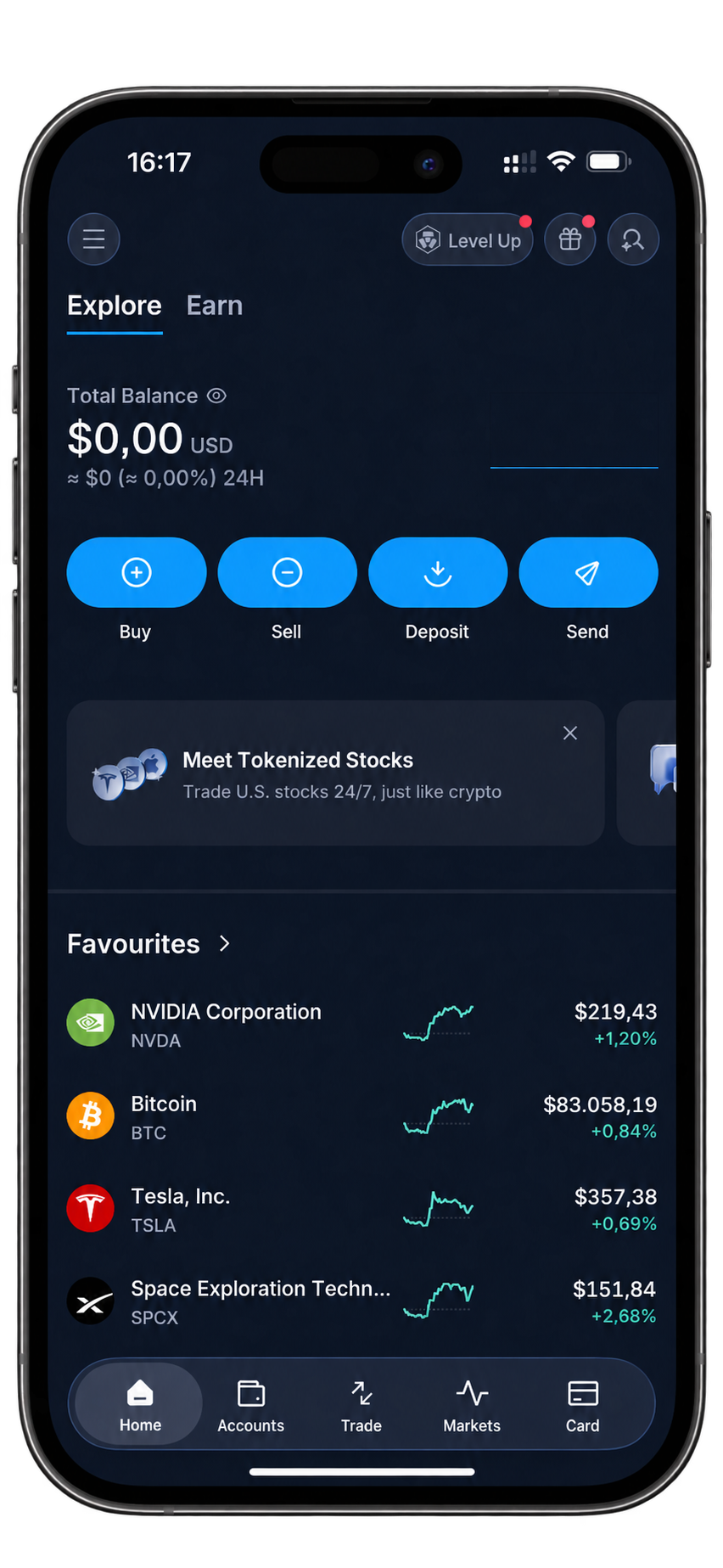
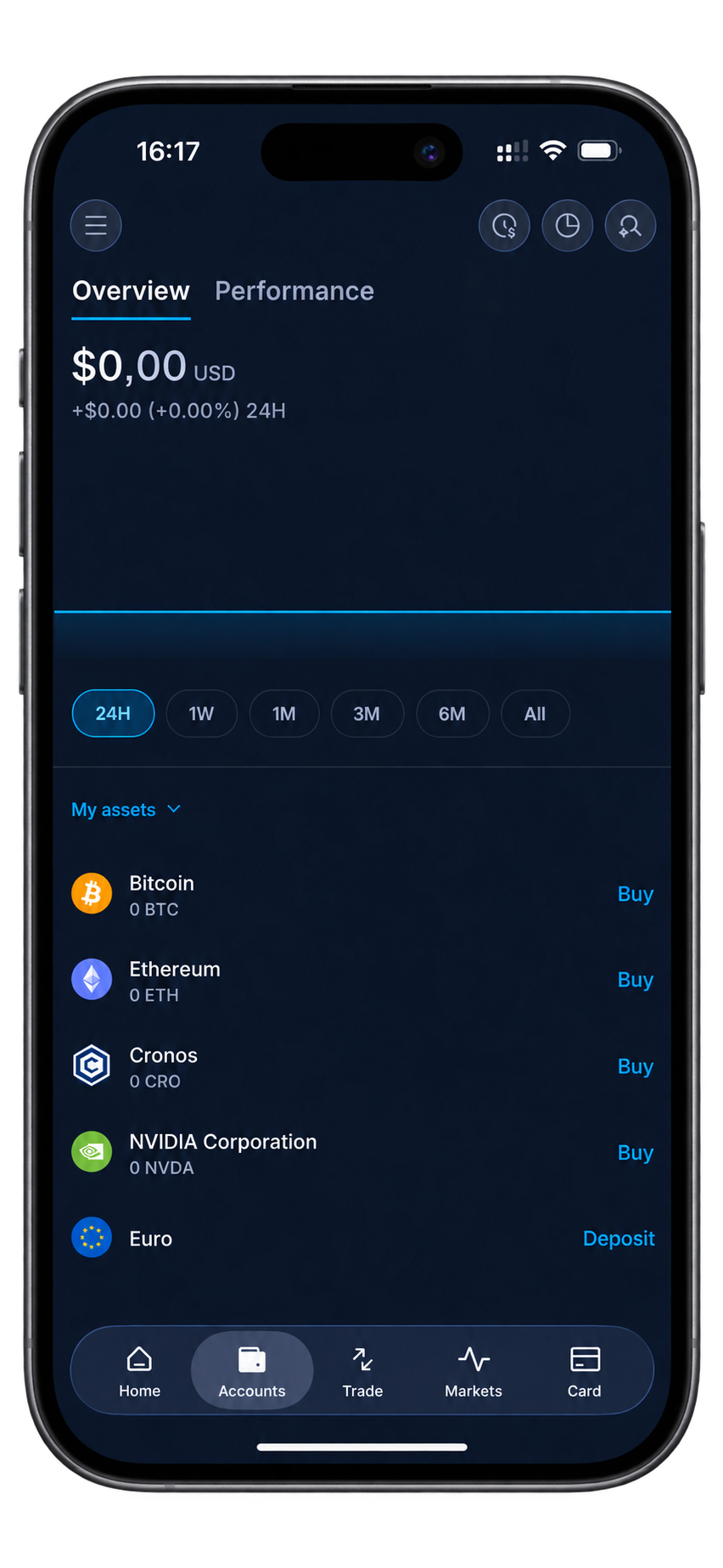
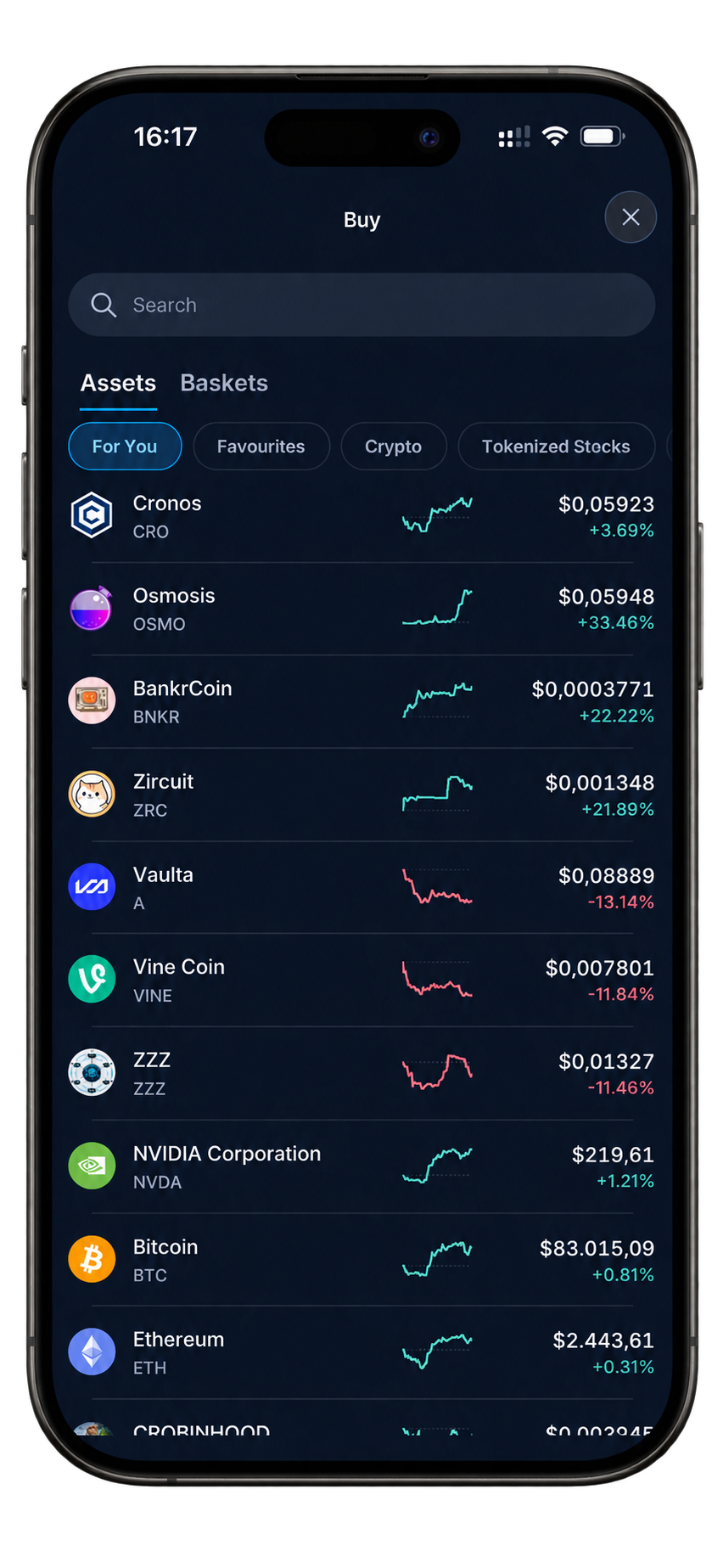
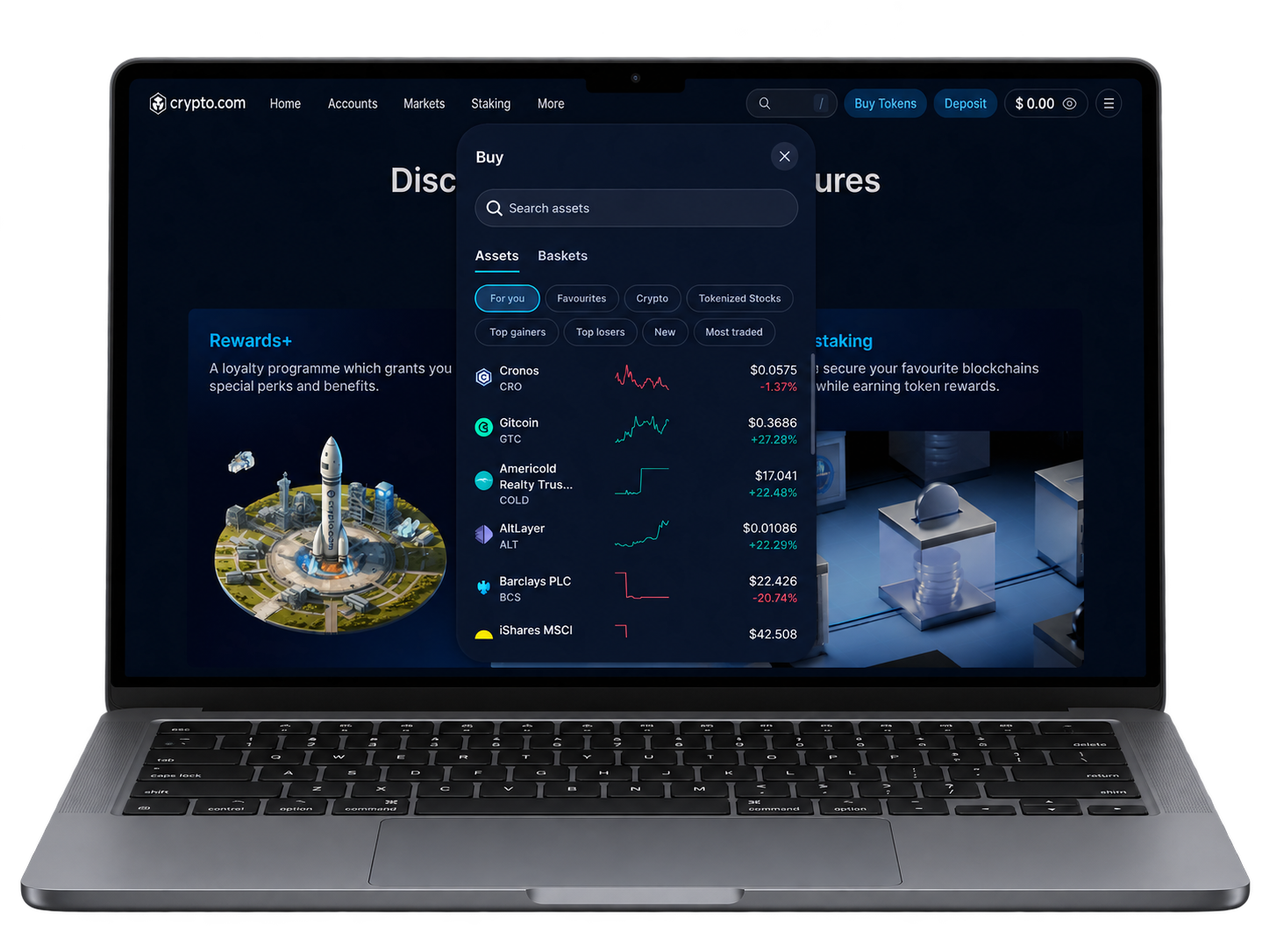
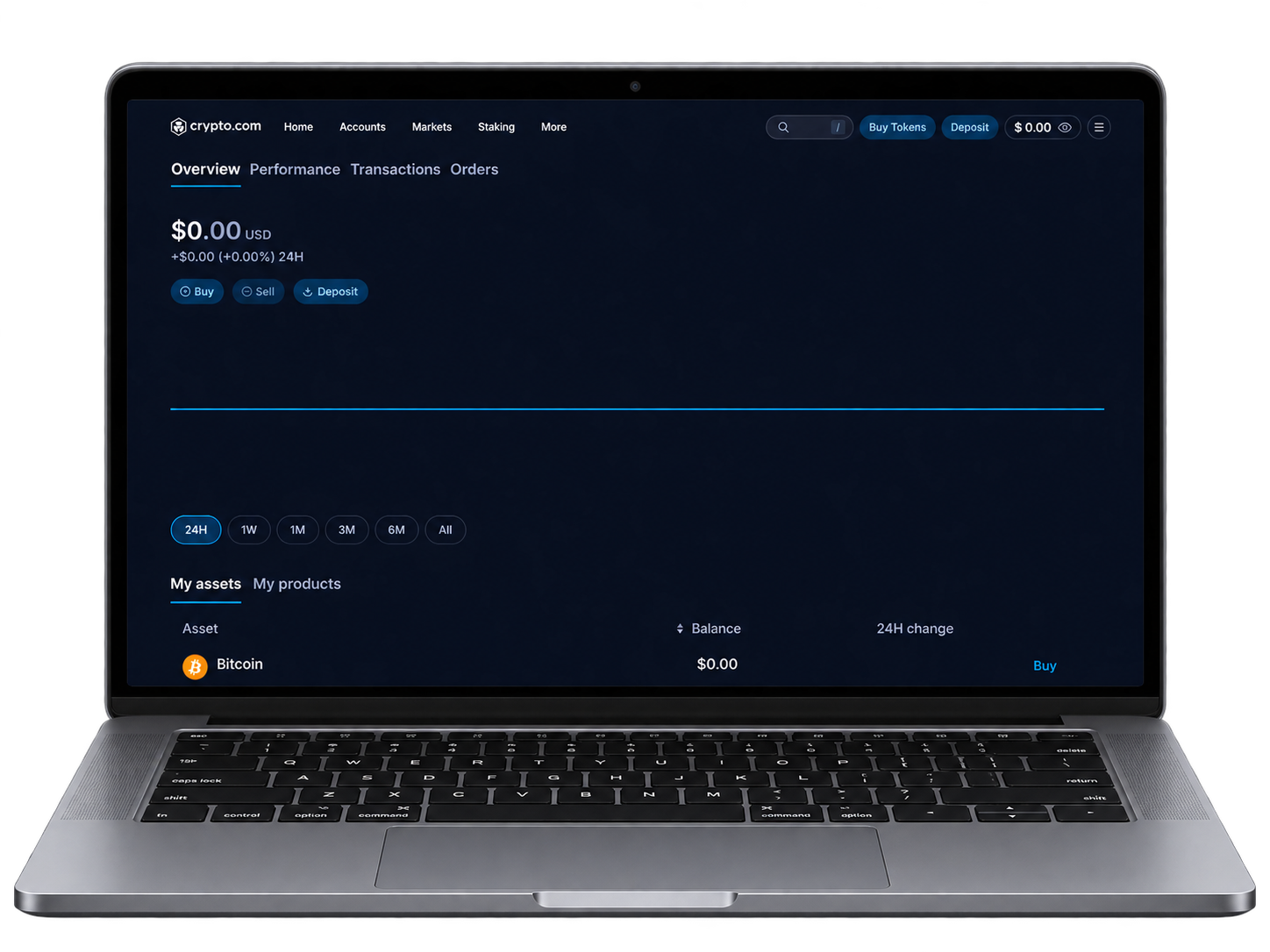
The Crypto.com App is designed for everyday cryptocurrency investing, combining fiat purchases, recurring investments, portfolio tracking, and access to supported earning and payment services. Users can purchase cryptocurrencies through a simplified interface without selecting trading pairs or placing orders on a professional exchange. Supported funding methods include bank transfers, payment cards, and available fiat balances, with eligibility and charges varying by jurisdiction.
Unlike conventional spot trading, the App presents an executable purchase or sale quote rather than direct access to an order book. Crypto.com may apply an administrative fee based on the transaction, asset liquidity, and market conditions, with applicable charges disclosed before confirmation. The quoted execution price can also incorporate a spread, making it important to compare the final amount of cryptocurrency received rather than relying exclusively on advertised trading fees. For investors making frequent or substantial purchases, executing orders through the separate Crypto.com Exchange may provide greater control over trading costs.
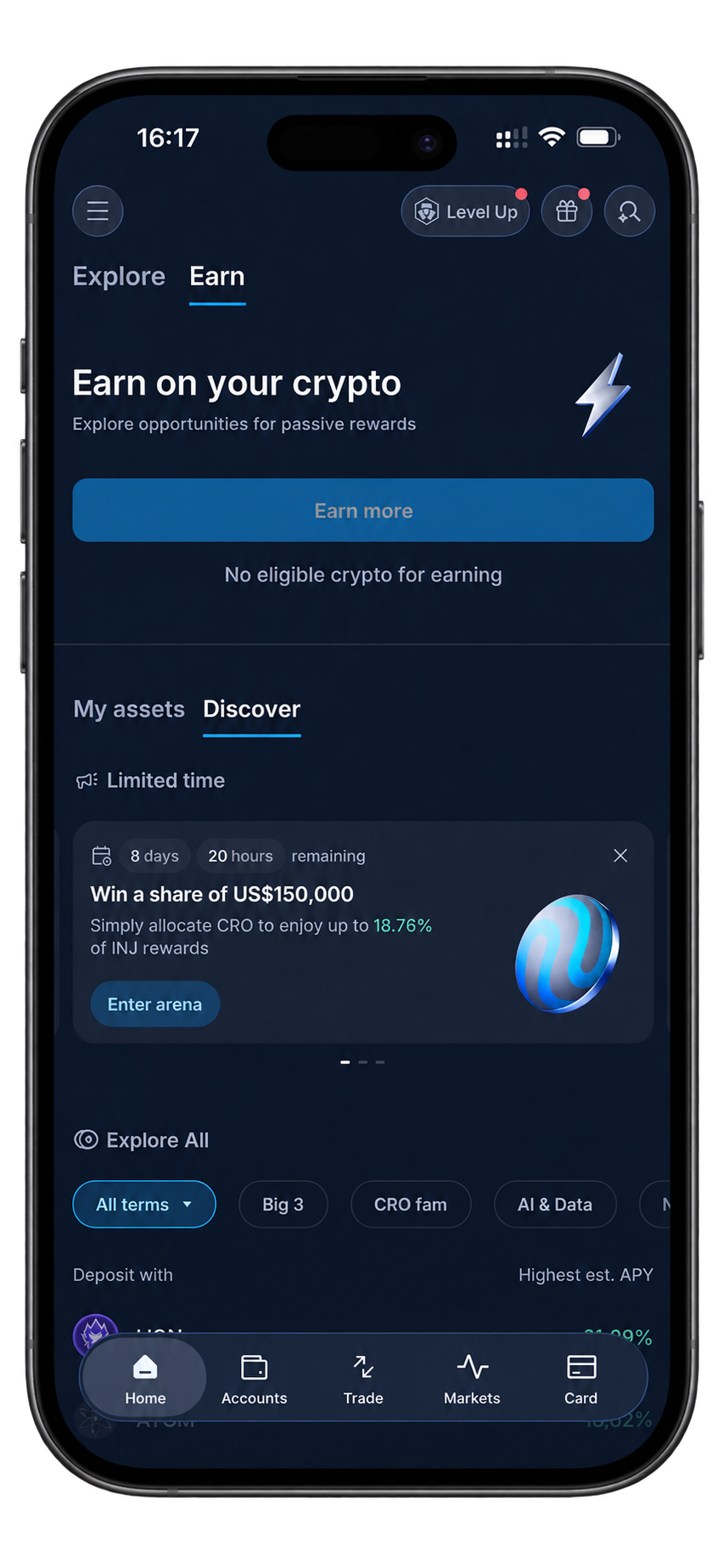
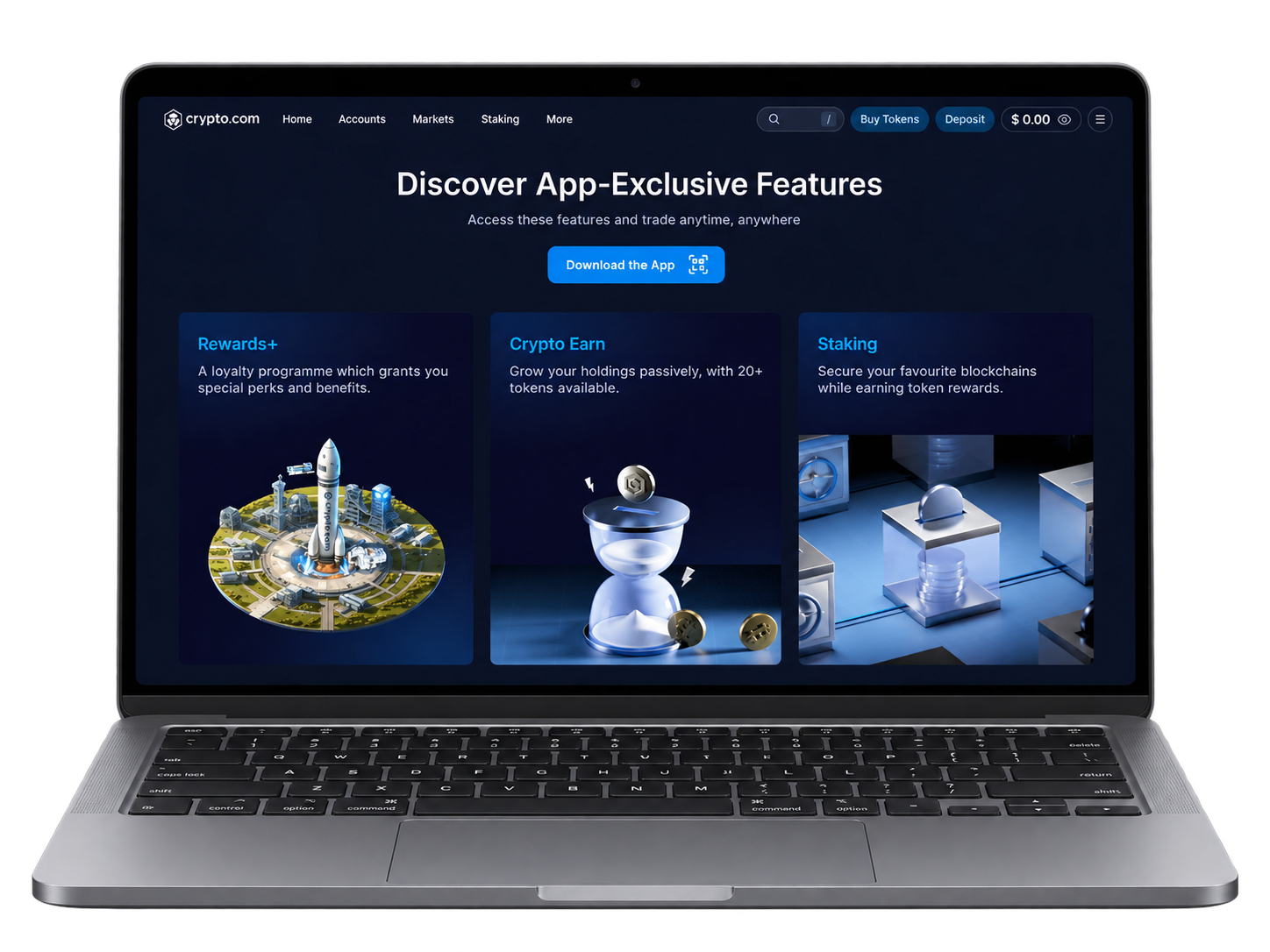
The App also provides access to Crypto Earn, onchain staking, and selected DeFi earning opportunities, although these services generate returns through different mechanisms. Crypto Earn allows eligible customers to allocate supported assets under flexible or fixed-term arrangements, while onchain staking involves participation in proof-of-stake networks through third-party validators. DeFi earning products introduce additional exposure to smart contracts and underlying protocols. Rewards, service commissions, withdrawal conditions, and regional eligibility differ between these offerings, so advertised annual yields should not be treated as interchangeable.
Crypto.com’s Level Up membership program adds another dimension through eligible trading-fee benefits, card rewards, and other account privileges. However, advertised zero-fee App trading does not necessarily eliminate spreads or all applicable transaction charges. The App remains the more accessible option for routine cryptocurrency management, while investors requiring detailed execution controls or automated strategies will generally find the Exchange better suited to their needs.
Crypto.com Exchange
The Crypto.com Exchange provides a dedicated professional trading environment with real-time order books, market-depth information, advanced charts, and volume-based maker-taker fees. Customers can execute spot trades using market and limit orders, while supported stop-loss, take-profit, and one-cancels-the-other (OCO) orders allow more structured entries and exits. Conditional orders help automate execution when specified prices are reached, although a triggered order can still experience slippage or remain unfilled if liquidity is insufficient. Crypto.com’s documented advanced conditional order functionality also differs between fully funded spot trades and margin products.
Eligible traders can access margin, perpetual futures, and other derivatives products, subject to regional restrictions and additional account requirements. These instruments introduce borrowing costs, funding payments, liquidation exposure, and collateral-management considerations beyond ordinary spot trading. Investors should therefore distinguish the Exchange’s conventional cryptocurrency markets from leveraged products that can generate losses exceeding the initial margin committed to a position, depending on the applicable contract terms.
Trading automation is another notable strength. Crypto.com supports grid bots, dollar-cost averaging (DCA), time-weighted average price (TWAP) execution, and funding-arbitrage strategies. Grid bots place orders across predetermined price intervals, while TWAP algorithms divide larger transactions into smaller executions to manage market impact. Funding-arbitrage strategies combine spot and opposing perpetual positions to seek returns from funding payments, although market movements, trading fees, and funding-rate changes can undermine the expected outcome. These tools reduce manual execution requirements without guaranteeing profitable results.
Professional users also benefit from REST, WebSocket, and FIX API connectivity for market data, order management, and automated strategies. The Exchange maintains separate trading balances from the standard Crypto.com App, although supported internal transfers between the two products can be completed without ordinary blockchain withdrawal fees. For active traders, the Exchange offers considerably more flexibility than the retail App, particularly when controlling order prices, managing frequent transactions, and qualifying for lower fees through trading activity.
Crypto.com Onchain
Crypto.com Onchain is the company’s non-custodial wallet, allowing users to hold cryptocurrencies and interact with supported blockchain applications without depositing their assets into a centralized exchange account. Unlike balances maintained through the Crypto.com App or Exchange, the wallet’s private keys remain under the user’s control, with transactions authorized directly through the wallet rather than the company’s custodial infrastructure.
The wallet supports cryptocurrency transfers, decentralized swaps, staking, and access to compatible Web3 applications. Onchain transactions require the relevant blockchain’s network fees, while interactions with external protocols can involve additional smart contract, liquidity, and transaction-approval risks. Users are also responsible for maintaining accurate recovery information, since losing access to their private keys or backup credentials may result in permanent loss of the associated assets.
Self-custody reduces reliance on Crypto.com’s withdrawal infrastructure but does not eliminate wallet-security risks. A smartphone-based non-custodial wallet remains exposed to threats associated with internet-connected devices, including malicious applications and deceptive transaction requests. For substantial long-term holdings, a dedicated hardware device following appropriate cold-storage security practices may offer stronger separation between private keys and everyday online activity.
Crypto.com Onchain is therefore better suited to investors who want direct blockchain access and control over transaction signing, while the custodial App and Exchange provide greater convenience for account recovery, fiat transactions, and centralized trading.
CRO Lockups, Trading Discounts, and Exchange Rewards
Cronos (CRO) plays a central role in Crypto.com’s rewards and membership structure, with different commitment arrangements across the App and Exchange.
On the Crypto.com Exchange, eligible users can lock at least 1,000 CRO for 180 days to access qualifying incentives. These include trading-fee discounts, tier-based rewards of up to 8% annually, and additional benefits linked to the amount committed. Larger lockups can unlock more substantial fee advantages, including zero maker fees and maker rebates for qualifying users. CRO rewards are distributed daily, while additional deposits into an existing lockup can restart the commitment period.
The economic value of these benefits depends on the amount of CRO committed and the trading activity required to use the available discounts. A frequent trader may generate meaningful fee savings, but someone placing only occasional orders may receive limited practical value from locking a substantial amount of a volatile cryptocurrency.
The App’s Level Up program operates separately. Depending on the jurisdiction and membership arrangement, users may subscribe to a paid tier or commit CRO through a staking or lockup mechanism with a 365-day holding period. Available benefits can include payment-card rewards, preferential earning rates, trading advantages, and other services, but these conditions should not be confused with the Exchange’s 180-day CRO lockup.
Crypto.com also provides Soft Lockup on the Exchange, allowing eligible customers to earn rewards on qualifying balances without entering the same fixed CRO commitment arrangement. Rewards and eligible assets depend on the product’s requirements, and holding funds in the Exchange wallet is different from allocating them through the App’s Crypto Earn service. These distinctions are important because the custody arrangements, liquidity conditions, and incentives vary even when each product is presented as an opportunity to earn cryptocurrency rewards.
CRO-based incentives introduce a further consideration beyond the quoted annual return. The market value of CRO can fluctuate substantially during a mandatory holding period, potentially outweighing accumulated rewards or trading-fee discounts. Benefits can also change under the relevant program rules, while locked tokens may remain unavailable when an investor would otherwise prefer to sell.
Crypto.com Visa Card and Level Up Benefits
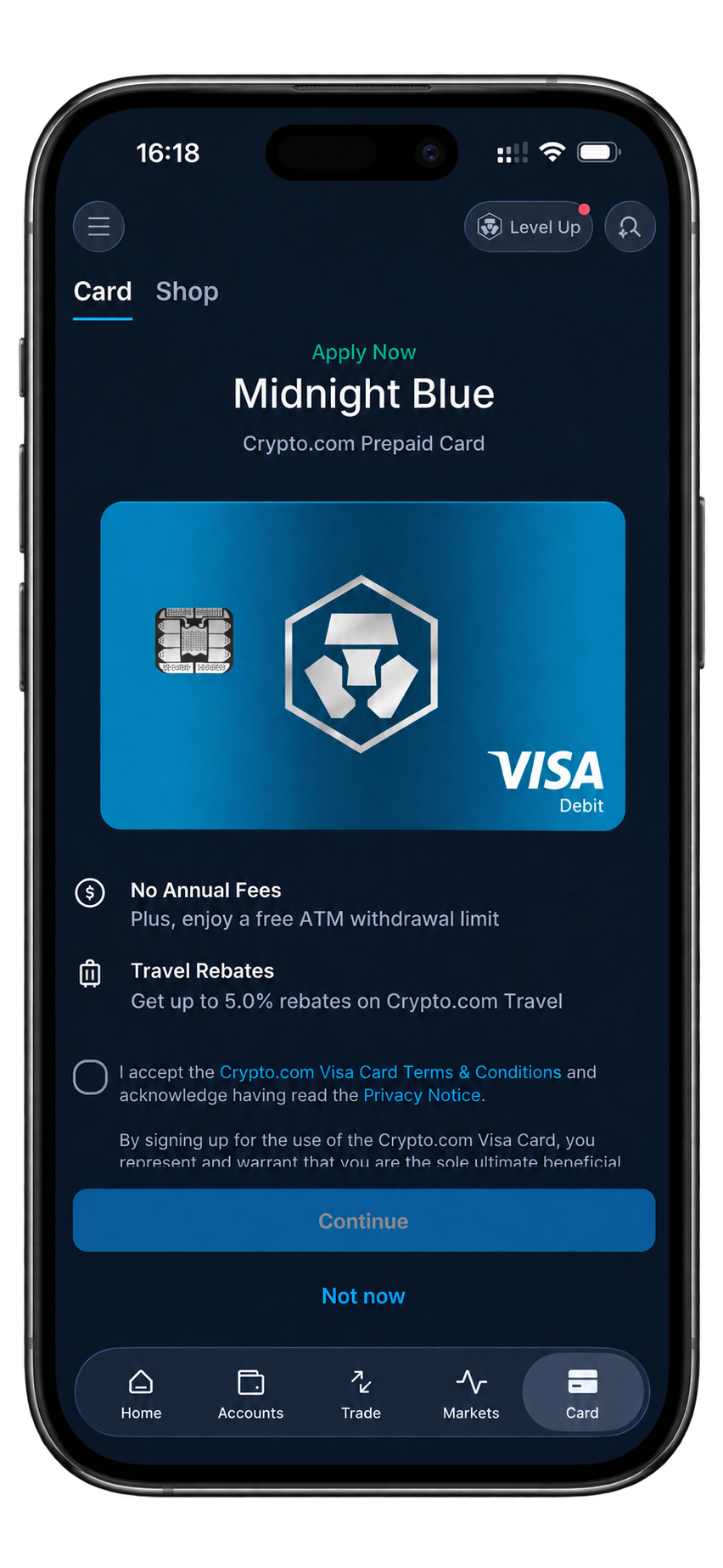
Crypto.com’s prepaid Visa card program extends its services into everyday payments, allowing eligible customers to spend funds loaded onto their cards while earning rewards on qualifying purchases. Cardholders can fund their balances through supported fiat methods or convert eligible cryptocurrencies into the card’s settlement currency. Cryptocurrency used to top up the prepaid card is converted before spending, distinguishing the process from making an ordinary onchain payment directly to a merchant.
In the European Economic Area, the program operates through Level Up, which includes Basic, Plus, Pro, and Private tiers. The free Basic tier provides access to core card functionality, while paid or CRO-backed plans unlock additional benefits. Crypto.com’s current European offering advertises card spending rewards of approximately 2% for Plus and 3% for Pro, with higher rates available through eligible Private arrangements. These rewards are subject to qualifying spending categories, monthly limits, and the applicable program terms.
Plus is available through a subscription starting at €3.99 per month, while Pro costs €24.99 per month under the published European pricing. Private benefits require a substantially larger CRO commitment, with advertised arrangements beginning at approximately €45,000 and a higher tier around €450,000, subject to a 12-month staking or lockup structure. Depending on the plan, additional benefits can include foreign-exchange allowances, subscription rebates, airport lounge access, and increased rewards on eligible Crypto.com services.
The advertised reward percentages do not necessarily apply to every purchase. Spending caps, excluded merchant categories, foreign-exchange limits, and restrictions on particular transaction types can reduce the actual rewards earned. Crypto.com also applies different reward limits across tiers, with higher-level plans offering larger eligible spending allowances. Benefits vary by country and can change under updated program conditions, making it important to review the current European card terms before selecting a plan.
The economics become more significant with paid subscriptions or substantial CRO commitments. A user paying €24.99 per month for Pro needs sufficient qualifying spending and meaningful use of its other benefits to justify the ongoing cost. Private cardholders face a different calculation because the potential value of enhanced rewards and privileges must be weighed against the volatility and opportunity cost of holding or locking a large CRO position.
Card rewards are also commonly denominated in CRO, although eligible customers in selected European countries can choose Bitcoin rewards through supported programs. The value of rewards can therefore change after receipt, particularly when accumulated over longer periods.
For existing Crypto.com customers who regularly use the App, Exchange, and payment services, the prepaid card can provide worthwhile additional utility. Its strongest appeal lies in combining spending rewards with benefits customers already use, rather than acquiring or locking substantial quantities of CRO solely to qualify for a higher advertised cashback rate.
Crypto.com Staking Review: Rewards, Fees, and Risks
Crypto.com offers several ways for eligible customers to earn rewards on cryptocurrency holdings, including on-chain staking, Crypto Earn, CRO lockups, and selected Exchange balance rewards. These services differ in how returns are generated, how long assets remain committed, and what risks users assume. Network staking involves participation in proof-of-stake blockchain infrastructure, while Crypto Earn and exchange incentive arrangements operate under separate product conditions that should not be evaluated as equivalent sources of yield.
On-Chain Staking
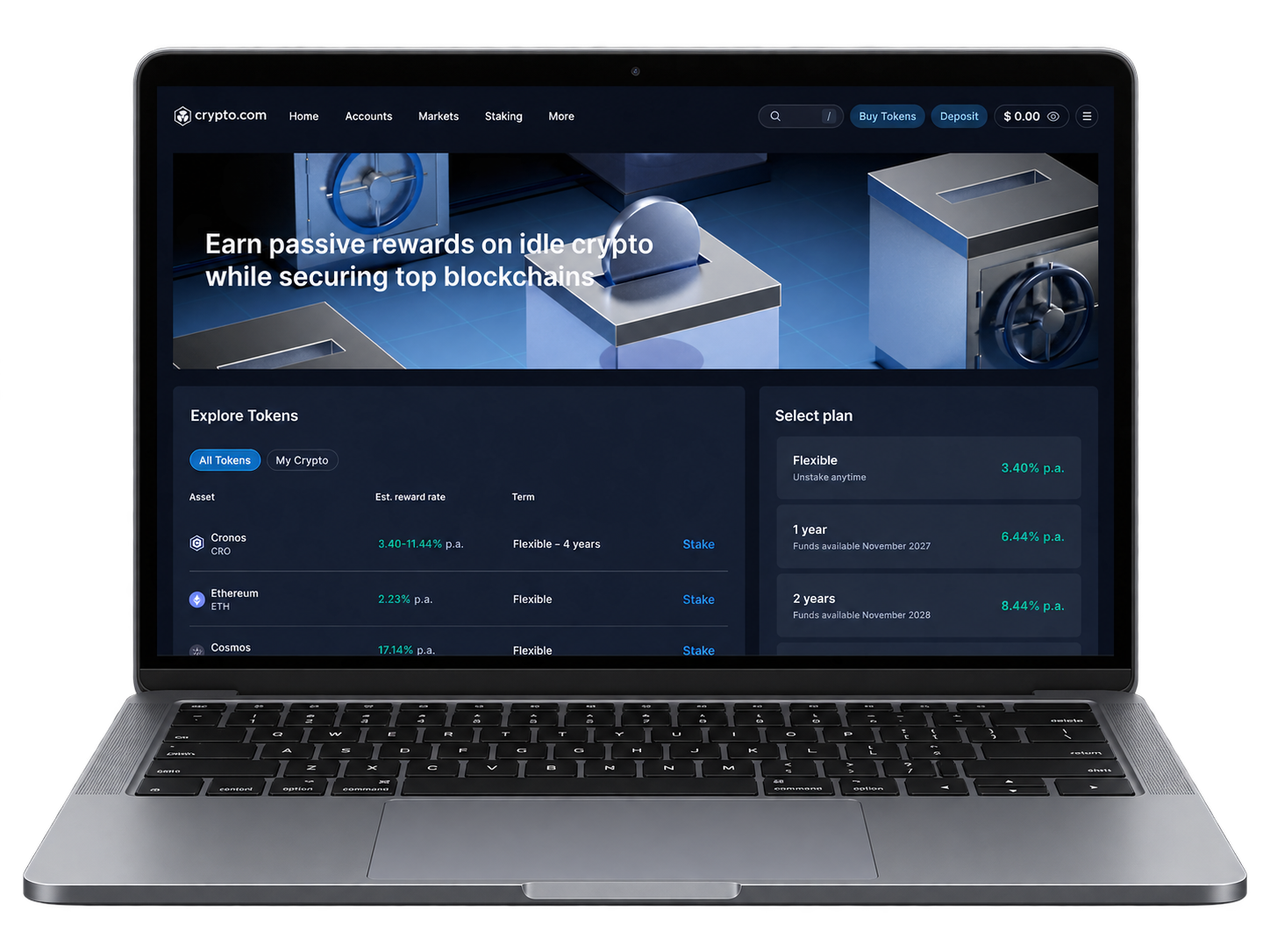
Crypto.com’s on-chain staking service allows eligible customers to participate in supported proof-of-stake networks without operating their own validator infrastructure. The platform facilitates staking through its technical and validator arrangements, manages reward distribution, and provides an interface for submitting unstaking requests. Supported assets include Ethereum, Solana, Polkadot, Cardano, Avalanche, Cronos, and several additional networks, although availability and minimum requirements vary by country and cryptocurrency.
Rewards originate from the underlying blockchain’s staking mechanism and fluctuate according to network conditions, validator participation, and applicable protocol rules. Crypto.com distributes the resulting rewards after deducting its service fees, simplifying the process for investors who do not want to manage validators or delegation infrastructure independently. However, the service retains a custodial component, meaning customers rely on Crypto.com to administer staking positions and process the return of assets.
Unstaking is particularly important because different networks impose different withdrawal conditions. Crypto.com’s published estimates include approximately five days for Solana, 29 days for Polkadot, and potentially days to weeks for Ethereum, depending on network conditions. These periods are not guaranteed, and staked assets generally cannot be traded or withdrawn until the relevant process is complete. Rewards also stop accruing during unbonding under Crypto.com’s published staking terms, potentially reducing returns when investors need to exit quickly.
Crypto.com Staking Fees
Crypto.com’s standard staking commissions vary by asset and are deducted from the rewards generated rather than the original amount staked.
| Staking Asset | Crypto.com Service Fee |
|---|---|
| Ethereum (ETH) | 15% of staking rewards |
| NEAR Protocol (NEAR) | 35% of staking rewards |
| Injective (INJ) | 35% of staking rewards |
| Other supported staking assets | 20% of staking rewards |
For example, an Ethereum position generating 0.05 ETH in gross staking rewards would return approximately 0.0425 ETH after Crypto.com’s standard 15% commission, before any other applicable deductions. The difference becomes more significant over longer holding periods, particularly when investors compare custodial staking with direct delegation or lower-commission validator services.
Crypto.com’s fees should also be evaluated alongside protocol-specific risks. Some proof-of-stake networks impose slashing penalties for validator misconduct, while others primarily affect rewards through validator performance or participation requirements. Unbonding periods can also prevent investors from responding immediately to market declines. Understanding the differences between staking, delegating, and validating helps establish which responsibilities the exchange manages and which financial risks remain with the asset holder.
Crypto.com may apply differentiated fees to qualifying users, and published commission schedules can change. The relevant rate and estimated net rewards should therefore be reviewed for the selected cryptocurrency before committing funds.
Crypto Earn: Flexible and Fixed-Term Rewards
Crypto Earn is a separate product within the Crypto.com App that allows eligible users to allocate supported cryptocurrency to rewards programs. It offers flexible allocations alongside one-month and three-month fixed terms, with annualized reward rates determined by the asset, commitment period, Level Up membership, allocation size, and country of residence. Rewards generally accrue daily and are distributed weekly, while applicable rates for fixed-term allocations are established when the term begins.
Flexible allocations provide easier access to funds, with rewards calculated using the eligible minimum daily balance. Fixed-term allocations offer a more predictable rewards schedule but involve restrictions and conditions governing early withdrawal. For qualifying non-CRO fixed terms, Crypto.com’s published rules permit certain early withdrawals with an adjustment that deducts rewards previously paid during the term from the returned amount. CRO fixed-term allocations do not offer the same early-withdrawal option. These conditions make it important to examine the specific asset and term rather than assuming every fixed allocation must operate identically.
Crypto Earn also uses a tiered reward structure for many fixed-term allocations. The highest advertised rate does not necessarily apply to the investor’s entire balance, particularly when larger amounts are committed.
Crypto Earn Reward Tiers
| Fixed-Term Allocation Tier | Allocation Amount | Applicable Reward Rate |
|---|---|---|
| Tier 1 | First $3,000 | 100% of the applicable base rate |
| Tier 2 | Next $27,000 | 50% of the Tier 1 rate |
| Tier 3 | Amounts above $30,000 | 30% of the Tier 2 rate, equivalent to 15% of Tier 1 |
The tier calculations generally consider qualifying allocations across the relevant Earn portfolio rather than treating every cryptocurrency as a separate $3,000 allowance. The thresholds apply to eligible fixed-term allocations, while flexible allocations are not subject to the same tier reductions. Crypto.com’s documentation also specifies special treatment for USDC, which should not be assessed using the standard tier structure.
For example, an investor with $40,000 in eligible fixed-term allocations would not earn the headline rate on the entire balance. The first $3,000 would receive the full applicable rate, the next $27,000 would receive half that rate, and the remaining $10,000 would fall into the substantially lower third tier. This arrangement can meaningfully reduce the effective portfolio yield, particularly for investors allocating large stablecoin or cryptocurrency balances.
The same consideration applies when comparing rates across Level Up memberships. Higher membership levels can provide additional rewards on eligible fixed-term allocations, sometimes paid separately in CRO, but those benefits remain subject to product terms and allocation limits. Investors should calculate the total return across their intended allocation rather than judging the product using only the highest advertised annual percentage.
Earn Plus and Promotional Rewards
Crypto.com offers Earn Plus as a separate arrangement within Crypto Earn, currently supporting USDC and USDT. Unlike ordinary tiered fixed-term allocations, Earn Plus does not apply the standard $3,000 and $30,000 reward thresholds. Eligible users can allocate up to $2 million across supported flexible and fixed-term arrangements, with a $500,000 fixed-term limit per supported cryptocurrency, subject to the product’s terms.
This structure is particularly relevant for investors considering larger stablecoin allocations because it avoids the sharp rate reductions imposed by the ordinary tiered Earn system. However, the absence of those reductions does not establish that the stablecoin or its underlying rewards arrangement is risk-free. Stablecoin reserves, redemption mechanisms, issuer exposure, platform custody, and applicable liquidity conditions remain important considerations.
Crypto Earn also includes limited promotional opportunities through Flash Rewards, which can offer enhanced rates for selected assets over shorter commitment periods, such as seven or fourteen days. These promotions have allocation limits, campaign deadlines, and regional restrictions. They should not be used to represent the normal returns available through Crypto Earn, particularly when comparing Crypto.com with competing exchanges.
Account Funding
Deposits, Withdrawals, and Fiat Currency Support
Crypto.com Exchange supports cryptocurrency transfers and fiat funding through several payment methods, with availability determined by the customer’s jurisdiction and account eligibility. Supported banking options include SEPA transfers for eligible European users and selected USD and GBP payment services in other markets. The Exchange operates a separate funding and withdrawal structure from the retail Crypto.com App, making it important to distinguish between the two when comparing transaction fees, limits, and processing times.
EUR Deposits and SEPA Bank Transfers
Eligible customers can deposit and withdraw euros directly through Crypto.com Exchange using SEPA bank transfers. The minimum deposit is €1, with no maximum amount per individual deposit specified in the published retail conditions. Crypto.com and its European electronic-money partners do not charge fees for eligible SEPA deposits, although the sending bank may impose separate charges. SEPA Instant deposits generally arrive within minutes when supported by the bank, while an initial transfer from a newly linked account may require additional verification.
EUR withdrawals are also free through the Exchange, with a minimum withdrawal of €80, a daily limit of €100,000, and a monthly limit of €500,000 for eligible retail accounts. Withdrawals generally take approximately one business day, and users must first complete a qualifying SEPA deposit to activate withdrawals to their verified bank account. The account holder’s name must match the identity registered with Crypto.com, while incorrectly submitted deposits may incur a €25 administration charge if returned.
The distinction between Crypto.com’s platforms is particularly relevant here. Although the Exchange does not charge eligible users for EUR SEPA withdrawals, the separate retail Crypto.com App applies a €1 withdrawal fee under its published European pricing schedule. Investors who regularly transfer euros between their bank and trading account may therefore find direct Exchange funding more economical, provided the service is available in their jurisdiction.
Cryptocurrency Deposits, Withdrawals, and Internal Transfers
Cryptocurrency deposits to Crypto.com Exchange generally carry no platform receiving fee, although the sending wallet or exchange may charge network-related costs. External withdrawals incur fees determined by the cryptocurrency and selected blockchain, with applicable amounts and minimum withdrawal requirements displayed before confirmation. These charges differ considerably between networks, particularly for assets such as USDT and USDC that are supported across multiple blockchains.
Selecting the correct network is essential because the same cryptocurrency may exist on Ethereum, Solana, Cronos, or other supported networks without those transfer routes being interchangeable. An unsupported deposit network or incompatible destination can result in funds not being credited automatically or becoming permanently inaccessible. Users should also check whether a destination requires additional information, such as a memo or tag, before initiating the transfer.
Crypto.com offers free, near-instant internal cryptocurrency transfers between eligible linked App and Exchange accounts, avoiding the blockchain fees associated with external withdrawals. Its Exchange interface also supports direct transfers from the retail App, allowing customers to select available balances and authorize deposits through passkeys or authenticator-based verification without manually switching applications. This functionality is useful for investors who manage earning or payment services through the App while placing trades on the Exchange. Both accounts must be linked to the same verified identity, and special promotional lockup conditions may affect the costs of transferring certain eligible balances.
Trading Spreads, Slippage, and Execution Costs
Deposits and withdrawals are only part of the total cost of trading on Crypto.com. Although the Exchange publishes maker-taker commissions, the final execution price also depends on market liquidity, the bid-ask spread, and the order type selected. Market orders prioritize immediate execution against available liquidity, potentially filling across several price levels when the requested amount exceeds the volume offered at the best price. This effect is particularly relevant when trading smaller altcoins or placing large orders in markets with limited depth.
Limit orders provide greater price control by specifying the maximum purchase price or minimum acceptable sale price, but execution is not guaranteed. An order that immediately matches existing liquidity can still incur taker fees, while post-only instructions are designed to prevent an order from executing immediately as a taker. Crypto.com also supports stop orders and one-cancels-the-other (OCO) functionality on eligible markets, allowing traders to combine profit targets with protective exits. These tools can improve execution discipline, although stop-market orders remain exposed to slippage and stop-limit orders may fail to execute during rapid price movements.
For active traders, understanding market, limit, and advanced order types is important when assessing actual trading expenses. A low published commission offers limited value if an order repeatedly executes at unfavorable prices because of poor liquidity or excessive slippage. Comparing expected execution prices, available market depth, and withdrawal costs provides a more accurate assessment of Crypto.com’s overall trading costs than relying on its maker-taker schedule alone.
Assets & Markets
Cryptocurrency Selection and Trading Markets
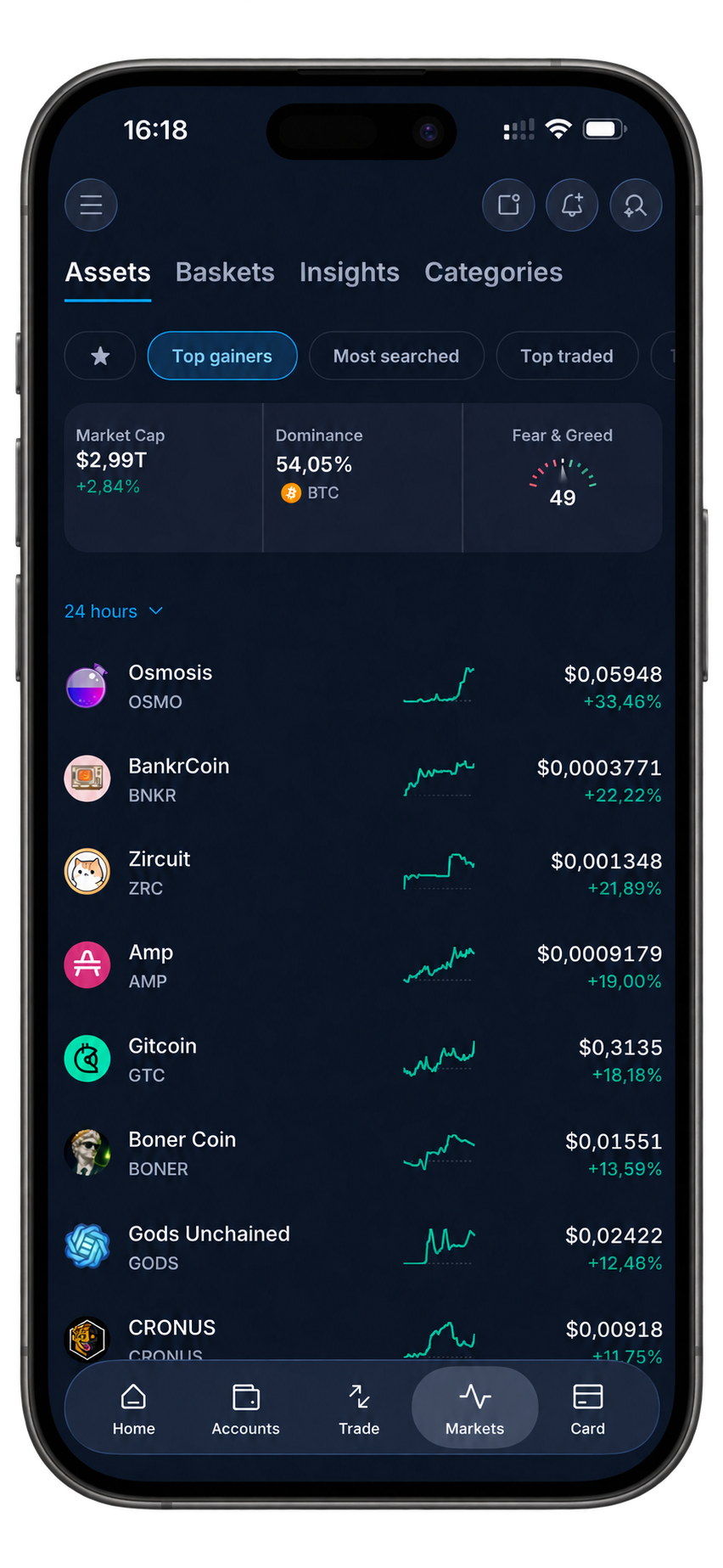
Crypto.com offers extensive cryptocurrency coverage across its retail App and professional Exchange, with access to major blockchain networks, stablecoins, established altcoins, and a selection of emerging digital assets. The Crypto.com App supports more than 400 cryptocurrencies, including Bitcoin, Ethereum, Solana, XRP, Cardano, Avalanche, and Chainlink. Its broader selection extends into decentralized finance, blockchain infrastructure, gaming, artificial intelligence, and meme coins, giving investors exposure to several segments of the cryptocurrency market without maintaining accounts at multiple exchanges.
However, asset availability differs between Crypto.com’s products. The App uses a simplified buying and selling interface, while the Exchange provides order-book trading through specific cryptocurrency pairs. An asset available for purchase in the App may not have a corresponding market on the Exchange, and supported deposit or withdrawal networks can differ as well. Regional restrictions also affect which cryptocurrencies and trading services are accessible. Investors should therefore verify the available trading pair, liquidity, and withdrawal compatibility rather than relying solely on the platform’s advertised asset count.
How Good Is Crypto.com Liquidity?
Crypto.com operates active spot markets for major cryptocurrencies, with Bitcoin, Ethereum, and other widely traded assets generally offering more substantial order-book liquidity than smaller altcoins. Its Exchange provides real-time bid and ask information, market depth, and recent trading activity, allowing traders to assess available liquidity before placing an order. This is particularly useful for investors who want more control over execution than the instant quotes available through the retail App.
Liquidity varies considerably between markets. A widely traded BTC or ETH pair may support relatively large transactions with limited price impact, while an order of similar value in a less liquid token could execute across several price levels. Wider spreads and insufficient resting liquidity can increase trading costs even when the advertised maker-taker fee is relatively low. Professional traders should examine available depth, recent volume, and the expected average execution price, particularly when managing substantial positions or trading newly listed assets.
Crypto.com provides a capable environment for ordinary retail transactions in established cryptocurrencies, but its broad asset selection does not guarantee equivalent execution quality across every pair. Traders dealing in larger amounts should compare actual order-book conditions with competing exchanges such as Binance and OKX, rather than assuming that trading volume or asset listings alone establish the best execution venue.
Advanced Trading and Automation
Crypto.com Exchange provides advanced order management, technical charting, and automated execution tools intended for traders who require greater control over their strategies. Alongside conventional market and limit orders, users can access supported conditional orders and algorithmic trading functionality. Its API infrastructure also allows developers and professional traders to integrate external applications, retrieve market information, and manage orders programmatically.
The platform’s automation suite includes Dollar-Cost Averaging (DCA), Grid Trading, Time-Weighted Average Price (TWAP), and Funding Arbitrage bots. DCA strategies execute purchases or sales at predefined intervals, while grid bots place orders across selected price levels to capture repeated market movements. TWAP algorithms divide larger transactions into smaller orders over a specified period, potentially reducing immediate market impact. Crypto.com also supports automated cryptocurrency baskets, allowing investors to distribute recurring allocations across several selected assets.
Funding Arbitrage bots use a more advanced approach by combining a spot position with an opposing perpetual futures position to seek returns from funding payments. These strategies are not risk-free or guaranteed to remain profitable. Funding rates can reverse, spot and perpetual prices may diverge, and margin requirements can trigger liquidation if a hedged position becomes insufficiently collateralized. Similarly, grid strategies can accumulate depreciating assets during sustained market declines, while DCA automation does not prevent losses when the underlying cryptocurrency continues falling.
Eligible customers can also access margin and derivatives trading, including leveraged long and short positions and more sophisticated order management. These products involve additional costs and requirements, including borrowing charges, funding payments, collateral maintenance, and liquidation exposure. Availability is significantly restricted by jurisdiction: Crypto.com’s published derivatives restrictions cover the United States, United Kingdom, numerous European countries, and other markets. Margin trading has its own restrictions, including across the European Economic Area. The Exchange’s broad product range is therefore most relevant to traders whose accounts qualify for the particular services they intend to use.
Security & Regulation
Crypto.com Security: Is the Exchange Safe?
Crypto.com has developed a substantial security infrastructure supported by institutional custody controls, independent assessments, and internationally recognized certifications. Its credentials include ISO/IEC 27001:2022, ISO/IEC 27701:2019, ISO 22301:2019, SOC 2 Type II, and PCI DSS v4.0 Level 1, alongside an independent Tier 4 assessment against the NIST Cybersecurity and Privacy Frameworks. These cover areas such as information security management, privacy protection, business continuity, payment-data security, and operational controls.
The certifications provide meaningful evidence of established security procedures, particularly when combined with the platform’s cold-storage infrastructure, restricted access to sensitive systems, and ongoing security assessments. However, their scope differs, and none guarantees that cryptocurrency held on Crypto.com is protected against every cyberattack, operational failure, or potential insolvency. The platform remains a centralized custodian, meaning customers depend on its infrastructure and internal controls to safeguard deposited assets and process withdrawals.
Account Security and Withdrawal Protection
Crypto.com supports passkeys, multifactor authentication, biometric verification on compatible devices, and additional controls for cryptocurrency withdrawals. External withdrawal addresses must be added to an approved list before transfers can be initiated, reducing the risk of assets being sent immediately to an unfamiliar destination following an account compromise. Users can also enable a 24-hour withdrawal lock on newly whitelisted addresses through the Exchange’s security settings, adding a delay before funds can be transferred to those destinations.
These protections are most effective when combined with secure account recovery methods and independent safeguards for the registered email address. Authentication codes and withdrawal verification can become vulnerable when attackers compromise connected accounts or impersonate legitimate support personnel. Maintaining layered account security, reviewing approved withdrawal destinations, and using phishing-resistant authentication can reduce exposure to account takeover without relying entirely on the exchange’s internal defenses.
Security Incidents and Historical Performance
Crypto.com’s security record includes incidents that warrant consideration alongside its certifications. In January 2022, attackers exploited a weakness in the withdrawal authentication process, affecting 483 customer accounts and resulting in approximately $33.8 million in unauthorized cryptocurrency withdrawals. The compromised transfers included 4,836.26 ETH, 443.93 BTC, and approximately $66,200 in other assets. Crypto.com reimbursed affected customers, temporarily suspended withdrawals during its investigation, and introduced additional authentication and withdrawal protections.
A separate incident involving employee-targeted phishing occurred in 2023 and received renewed attention in September 2025. Attackers gained access to an employee account and obtained limited personal information relating to a small number of individuals. Crypto.com stated that the incident was contained within hours and that customer funds were neither accessed nor placed at risk. The company also disputed allegations that the breach had not been reported to authorities, stating that notifications were submitted through the Nationwide Multistate Licensing System and to relevant regulators.
The two incidents involved different security weaknesses. The 2022 attack affected withdrawal authorization, while the 2023 breach exposed customer information through compromised employee access. Their inclusion in Crypto.com’s security history is important because account authentication, employee access controls, and personal-data protection remain relevant even when an exchange maintains sophisticated custody infrastructure.
Crypto.com Proof of Reserves
Crypto.com provides a Proof of Reserves verification page that allows eligible customers to examine whether their balances were included in its published reserve assessment. The verification was performed by Mazars using cryptographic Merkle-tree proofs and a comparison between customer liabilities and assets controlled by the exchange. It covered selected cryptocurrencies, including BTC, ETH, USDC, USDT, XRP, DOGE, SHIB, LINK, and MANA.
The principal limitation is the age and scope of the published assessment. The Mazars report uses a snapshot dated December 7, 2022, and was conducted under ISRS 4400 as an agreed-upon-procedures engagement. It was not a financial statement audit and did not express an assurance opinion on Crypto.com’s overall financial position. While the assessment established specified reserve-to-liability comparisons for the covered assets at that date, it cannot verify the exchange’s customer liabilities or reserve coverage in October 2026.
Crypto.com also publishes selected wallet addresses, allowing users to inspect reported onchain holdings. However, observable wallet balances do not independently establish the company’s total obligations, whether assets are encumbered, or how customer claims would be treated during financial distress. A current independent assessment covering both assets and liabilities would provide stronger evidence of present-day reserve coverage.
The distinction between proof-of-reserves verification and a complete solvency assessment is particularly important for centralized exchanges. Reserve snapshots can improve transparency, but they cannot independently establish the absence of undisclosed debt, legal claims, operational vulnerabilities, or future withdrawal restrictions. Crypto.com’s published verification provides historical evidence of asset backing, although its age limits its usefulness for evaluating the platform’s current financial position.
Regulation and Licensing
Crypto.com operates through licensed and registered entities across several major financial markets. In January 2025, Foris DAX MT Limited received authorization from the Malta Financial Services Authority as a Crypto-Asset Service Provider under the European Union’s Markets in Crypto-Assets Regulation (MiCA). This allows the entity to provide authorized cryptocurrency services across the European Economic Area under the applicable regulatory framework, including custody, exchange, order execution, and asset transfers.
Its European permissions expanded in February 2026 when the same Maltese entity obtained a Limited Financial Institutions licence covering specified payment services involving electronic-money tokens. The additional authorization addresses the regulatory requirements applicable to certain stablecoin-related activities and operates alongside its existing MiCA permissions. It should not be interpreted as unrestricted authorization for every payment, investment, or derivatives product offered under the Crypto.com brand.
The company’s broader regulatory presence includes a Major Payment Institution licence from the Monetary Authority of Singapore, UK Financial Conduct Authority registrations and permissions for relevant entities, and registrations and financial-services licences in Australia. These arrangements provide different levels of oversight depending on the jurisdiction and service involved, with customer eligibility, product access, and legal protections determined by the relevant operating entity.
Regulatory authorization strengthens accountability and establishes formal compliance obligations, but it does not insure cryptocurrency deposits against market losses or guarantee uninterrupted access to funds. Crypto.com’s licensing and security certifications are significant advantages, while its historical incidents, custodial structure, and dated public reserve assessment remain important considerations when evaluating the exchange’s overall safety.
Security Verdict: Crypto.com combines extensive security certifications, sophisticated account protections, and substantial regulatory coverage, making its operational infrastructure a clear strength. However, its history of security incidents and the absence of a comparably recent, publicly established exchange-wide reserve assessment warrant a measured evaluation of its custodial risks.
User Experience
Crypto.com User Experience and Beginner Friendliness
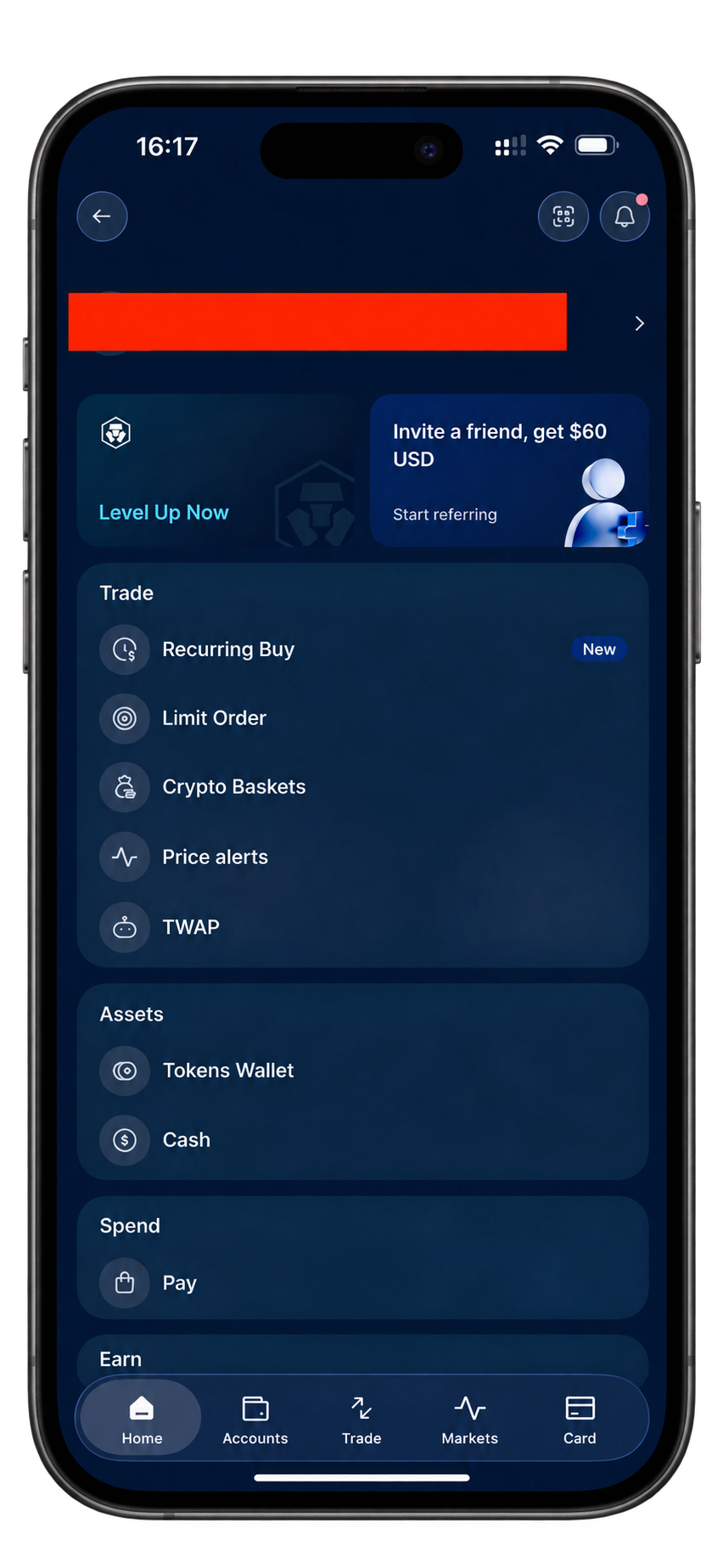
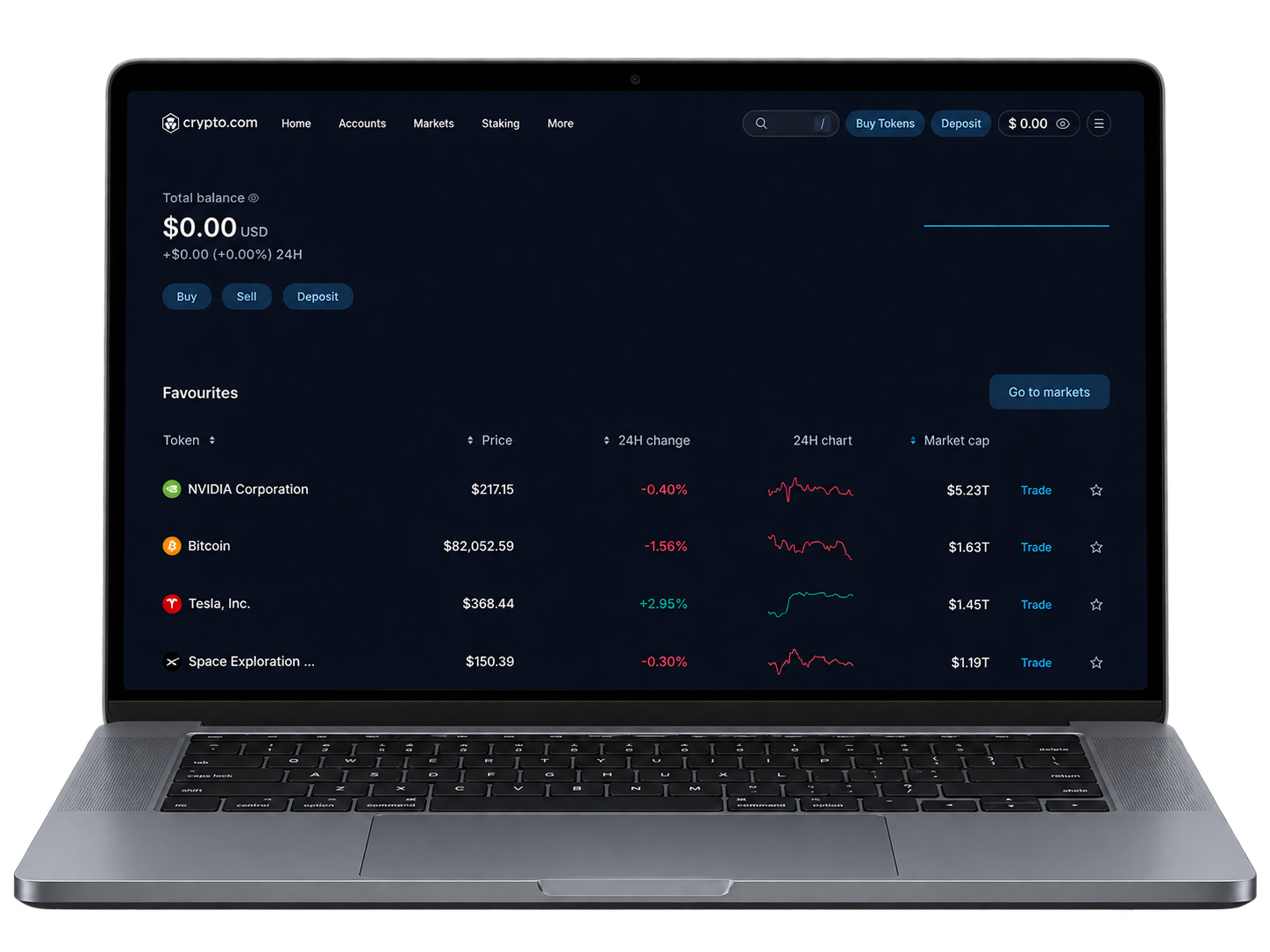
Crypto.com offers two distinct trading environments, allowing beginners to purchase cryptocurrency through a simplified interface while providing experienced investors with professional execution tools. The main Crypto.com App prioritizes everyday portfolio management, with cryptocurrency purchases, balances, recurring investments, price alerts, staking, and payment services accessible through its mobile interface. Users can buy supported assets without navigating order books or configuring advanced orders, although the growing number of financial products makes the application more complex than a basic cryptocurrency wallet.
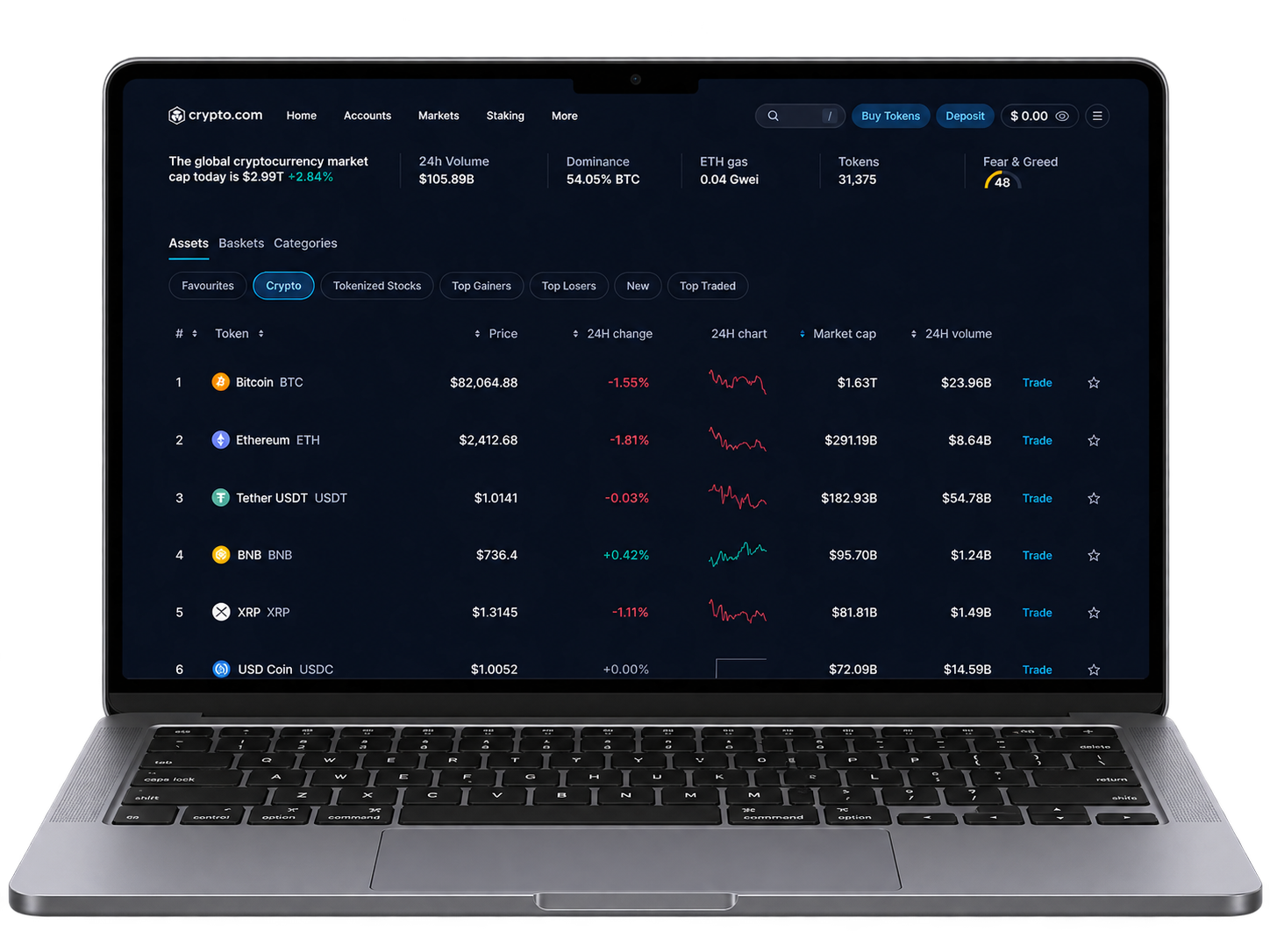
The separate Crypto.com Exchange caters to users seeking greater control over trading costs and execution. Its interface includes advanced charts, live market data, multiple order types, and automated strategies, providing a more sophisticated environment for regular trading. Both platforms are accessible to eligible customers, but they serve different purposes, and understanding their pricing and account structures is essential to using them effectively.
Account Registration and Identity Verification
Opening a Crypto.com App account involves email and phone verification followed by identity checks, typically requiring a government-issued document and a selfie. Verification requirements vary by jurisdiction, while additional information may be requested for certain financial services or account reviews. Applications are generally processed within hours to a few business days, although more complex cases can take longer. Once verified, users can access supported purchasing and funding methods according to their location.
Crypto.com Exchange has its own onboarding and verification requirements, although existing App users can link their accounts where supported. Both operate as custodial services, meaning customers do not independently control the private keys securing assets held on either platform. The separate Crypto.com Onchain wallet follows a self-custody model and should not be confused with an ordinary Exchange account.
Mobile and Desktop Trading
The Crypto.com App is designed primarily for mobile cryptocurrency management, while the Exchange is available through both a dedicated mobile application and a desktop trading platform. The Exchange underwent a major interface upgrade in March 2026, improving navigation, market analysis, and order management. Its mobile application supports spot trading, automated DCA and grid strategies, TWAP execution, and eligible margin and derivatives markets, making it practical for monitoring positions and placing advanced orders away from a computer.
A significant improvement is the integration between the App and Exchange. Although their account balances remain separate, users can transfer supported cryptocurrencies between linked accounts instantly and without standard transfer fees. The Exchange also introduced a unified wallet structure across its own spot, margin, and derivatives products, eliminating the need for separate internal trading-wallet transfers. These improvements make moving between everyday investing and professional trading more convenient, although the two platforms continue to apply different pricing structures and product rules.
Crypto.com advertises 24/7 live customer support, with assistance available for account access, verification, payments, and transaction issues. However, continuous availability does not guarantee immediate resolution, particularly when cases require compliance checks, banking investigations, or additional identity verification.
Is Crypto.com Good for Beginners?
Crypto.com is a strong option for beginners who want straightforward cryptocurrency purchases, recurring investment tools, and accessible portfolio management. Its main App reduces the technical knowledge needed to make an initial purchase, while the Exchange provides a more advanced environment as trading requirements develop. Having both services within the same ecosystem also offers a convenient progression from occasional investing to active market participation.
Trading costs remain the principal consideration. Instant purchases may include spreads and payment-related charges that make them more expensive than comparable Exchange orders, particularly for larger or frequent transactions. Beginners should compare the final cryptocurrency amount received rather than relying exclusively on advertised fees. Crypto.com offers an accessible starting point with considerable room for more advanced trading, but users who understand when to use the App and when to use the Exchange are likely to get the most value from the platform.
Preview
Pros and Cons
- Advanced trading and automation: Spot markets, eligible derivatives, and built-in DCA, Grid, TWAP, and funding arbitrage bots provide flexible trading options.
- Attractive CRO-based fee discounts: Eligible CRO holders can access 0% spot maker fees and reduced taker fees, with additional benefits for higher-volume traders.
- Comprehensive cryptocurrency ecosystem: Integrates professional trading with staking, earning products, fiat transfers, and the wider Crypto.com platform.
- Established custody and security infrastructure: Multi-factor authentication, withdrawal safeguards, cold-storage arrangements, and published Proof of Reserves information provide multiple layers of protection.
- Relatively expensive entry-level trading: Standard spot fees begin at 0.25% maker and 0.50% taker without qualifying CRO benefits or volume discounts.
- CRO exposure for stronger fee benefits: Some of the most attractive discounts depend on maintaining a substantial CRO balance, introducing additional token-price risk.
- Significant regional product restrictions: Derivatives, earning services, payment methods, and individual trading markets are unavailable in certain jurisdictions.
- Custodial risk and limited reserve-report coverage: Exchange-held assets remain under Crypto.com's control, while its publicly available independent Proof of Reserves report does not establish current solvency across every asset and liability.
Crypto.com vs Competitors
Crypto.com vs Kraken, Binance, and OKX
Crypto.com competes with Kraken, Binance, and OKX across spot trading, derivatives, automated strategies, and cryptocurrency earning products. Each platform serves active traders, but their pricing structures and broader services differ significantly. Binance and OKX prioritize competitive trading costs and professional execution, Kraken emphasizes account security and reserve transparency, while Crypto.com combines exchange trading with consumer investing, payment cards, and cryptocurrency rewards.
Crypto.com’s position also depends on which product customers use. The Crypto.com App provides simplified purchases and access to its wider financial ecosystem, while the Crypto.com Exchange offers order-book trading, professional tools, and volume-based fees. Comparing the App’s quoted purchase prices against a competitor’s maker-taker schedule would misrepresent the actual cost difference.
Spot Trading Fee Comparison
The following rates reflect published entry-level spot trading fees in October 2026, excluding volume discounts, token-holding benefits, and promotional pricing.
| Exchange | Maker Fee | Taker Fee | Pricing Basis |
|---|---|---|---|
| Crypto.com | 0.25% | 0.50% | Exchange spot, lowest volume tier without CRO benefits |
| Kraken | 0.38%–0.40% | 0.80% | Kraken Pro entry tier; official schedule versions differ |
| Binance | 0.10% | 0.10% | International regular-user spot trading |
| OKX | 0.10% | 0.20% | EEA spot-only regular-user schedule |
Rates are not directly comparable across every jurisdiction. OKX’s international standard spot fees generally start at 0.08% maker and 0.10% taker, while certain Binance fiat pairs follow different pricing. Kraken’s published entry-level maker rate should be confirmed against the applicable account schedule.
Crypto.com occupies the middle ground on standard trading costs. Its Exchange fees are lower than Kraken’s entry-level charges but higher than those published by Binance and OKX for the markets shown. The gap can narrow through higher trading volumes or Crypto.com’s CRO balance-based benefits, although maintaining CRO exposure introduces an additional investment consideration.
Crypto.com vs Kraken
Kraken is a particularly strong alternative for investors who prioritize exchange security, established banking relationships, and professional trading functionality. Its standard application supports cryptocurrency purchases and portfolio management, while Kraken Pro provides advanced charts, conditional orders, margin trading, futures, and API connectivity. Crypto.com offers comparable core trading functionality through its Exchange, but distinguishes itself through integrated trading bots, its consumer App, card programs, and platform-linked rewards.
Pricing favors Crypto.com at the published entry tiers. Its 0.25% maker and 0.50% taker fees are lower than Kraken Pro’s regular starting rates, although both exchanges reward higher trading activity with reduced commissions. Kraken’s strength lies in its account-security architecture, including the Master Key, Global Settings Lock, and separate funding authentication. It also conducts independently reviewed Proof of Reserves assessments that allow customers to verify the inclusion of eligible balances. Crypto.com publishes reserve-verification material and offers extensive account protections, but buyers should examine the reporting dates and scope of its available assessments rather than assuming identical verification practices.
| Feature | Crypto.com | Kraken |
|---|---|---|
| Standard Spot Fees | 0.25% maker / 0.50% taker | 0.38%–0.40% maker / 0.80% taker |
| Professional Trading | Exchange terminal, advanced orders, derivatives, APIs | Kraken Pro, advanced orders, margin, futures, APIs |
| Trading Automation | Grid, DCA, TWAP, and other supported bots | TWAP orders and API-driven strategies |
| Account Security | MFA, passkeys, withdrawal controls, custody safeguards | Master Key, Global Settings Lock, passkeys, Funding 2FA |
| Reserve Transparency | Published reserve-verification materials | Independently reviewed, customer-verifiable reserve assessments |
| Earning Products | Staking, Crypto Earn, and eligible promotional rewards | Bonded and flexible staking, Auto Earn, DeFi Earn |
| Payments and Extras | Established payment-card and consumer rewards ecosystem | Banking services, Krak payment products, additional investments |
| Best Suited For | Investors seeking trading, automation, rewards, and everyday payments | Security-conscious investors prioritizing account controls and exchange transparency |
Crypto.com has a clearer advantage for users who regularly use its payment cards, consumer rewards, and automated trading strategies alongside their exchange account. Kraken is more attractive to those who value detailed withdrawal-security controls, reserve verification, and a trading experience centered on exchange functionality. For occasional buyers, the practical comparison should include instant-purchase spreads and banking charges, not just the professional spot fees.
Crypto.com vs Binance
Binance provides stronger competition on trading costs and market breadth. Its regular international spot fees begin at 0.10% maker and taker, substantially below Crypto.com’s 0.25% and 0.50% entry-level rates. Eligible Binance customers can reduce standard spot fees to 0.075% when paying with BNB, while higher-volume traders qualify for further discounts. Binance also offers extensive liquidity across major cryptocurrency pairs, although execution quality varies by market and should be evaluated through spreads and available order-book depth.
Both exchanges support sophisticated trading strategies, including grid trading, recurring purchases, and algorithmic execution. Binance extends its automation capabilities through rebalancing strategies, futures bots, arbitrage tools, and a marketplace for copying trading-bot configurations. Crypto.com provides a more closely integrated consumer experience through its main App, Exchange, payment cards, and rewards products. Its account-transfer functionality also allows eligible users to move supported cryptocurrency between the App and Exchange without standard transfer fees, helping connect everyday investing with professional trading.
| Feature | Crypto.com | Binance |
|---|---|---|
| Standard Spot Fees | 0.25% maker / 0.50% taker | 0.10% maker / 0.10% taker internationally |
| Fee Discounts | Trading volume and qualifying CRO balances | Trading volume, VIP tiers, and BNB fee discounts |
| Market Coverage | Extensive spot markets and supported derivatives | Broad spot markets, substantial liquidity, extensive derivatives |
| Trading Automation | DCA, grid, TWAP, funding arbitrage tools | Spot and futures grid, DCA, rebalancing, TWAP, arbitrage |
| Trading Interface | Separate consumer App and professional Exchange | Simplified trading alongside comprehensive advanced tools |
| Earning Products | Staking, Crypto Earn, CRO-linked benefits | Binance Earn, staking, and additional supported reward products |
| Payment Services | Established cryptocurrency card and rewards programs | Regional fiat, payment, and wallet services |
| Best Suited For | Users combining trading with cryptocurrency spending and rewards | Active traders prioritizing lower commissions, liquidity, and automation |
Binance is generally the more economical choice for frequent spot traders operating at standard international fee tiers. Its extensive trading infrastructure and broad selection of automated strategies also make it attractive to experienced users who depend on advanced execution. Crypto.com is better positioned for investors who want cryptocurrency trading connected to payment cards, recurring purchases, and an established consumer rewards ecosystem. The difference becomes less straightforward when comparing jurisdiction-specific services, as Binance’s derivatives, fiat funding, and other products are not available uniformly worldwide.
Crypto.com vs OKX
OKX competes directly with Crypto.com in professional trading, offering advanced order execution, automated strategies, derivatives, and a separately operated self-custody wallet ecosystem. Its trading interface is designed for users who frequently monitor order books, manage multiple positions, and execute strategies across different cryptocurrency markets. Crypto.com also provides sophisticated trading tools, but places greater emphasis on connecting those capabilities with its retail App, card benefits, and cryptocurrency rewards programs.
OKX holds a pricing advantage for regular spot traders in several markets. Its international rates generally begin at 0.08% maker and 0.10% taker, while eligible EEA customers with spot-only accounts pay 0.10% and 0.20% following the September 2026 fee reduction. Both schedules are below Crypto.com’s published entry-level Exchange rates. OKX also offers separately regulated X-Perps for eligible European traders, providing leveraged exposure through contracts with defined expiry dates and periodic funding payments rather than conventional no-expiry perpetual futures.
| Feature | Crypto.com | OKX |
|---|---|---|
| Standard Spot Fees | 0.25% maker / 0.50% taker | International: 0.08% / 0.10%; EEA spot-only: 0.10% / 0.20% |
| Fee Discounts | Higher trading volumes and qualifying CRO balances | VIP tiers based on trading volume and eligible asset balances |
| Advanced Trading | Spot, margin, derivatives, advanced orders, APIs | Spot, margin, futures, options, advanced orders, APIs |
| Trading Automation | Grid, DCA, TWAP, funding arbitrage tools | Grid bots, DCA, TWAP, and other algorithmic strategies |
| Derivatives in Europe | Availability determined by local product permissions | MiFID-regulated X-Perps for eligible EEA traders |
| Reserve Transparency | Published reserve-verification materials | Recurring zk-STARK-based Proof of Reserves |
| Web3 Access | Separate self-custody wallet and supported onchain services | OKX Wallet, DEX aggregation, and Web3 integrations |
| Consumer Benefits | Crypto.com App, card programs, staking, rewards | Trading-oriented ecosystem with eligible earning and wallet services |
| Best Suited For | Investors seeking trading, payments, and rewards together | Experienced traders prioritizing low fees and sophisticated execution |
OKX is particularly compelling for traders whose main priorities are low commissions, algorithmic execution, and access to leveraged markets. Its separately operated Web3 ecosystem provides additional flexibility, although using decentralized applications introduces smart contract and transaction risks outside ordinary exchange custody. Crypto.com offers a more consumer-oriented alternative, particularly for users who want to combine cryptocurrency trading with everyday payment services and platform rewards. European traders should compare the specific products available to their accounts, since OKX’s X-Perps access and fee schedules depend on account classification and regulatory eligibility.
Which Exchange Offers the Best Value?
The most suitable exchange depends on whether the investor’s priority is trading efficiency, security controls, or the broader services available alongside cryptocurrency purchases. Binance and OKX generally offer lower published entry-level spot fees in their international markets, making them attractive to active traders who place frequent orders. Kraken provides a strong alternative for investors who prioritize account-security customization, established fiat services, and independently reviewed reserve transparency.
Crypto.com’s competitive advantage is its combination of products rather than leadership in one isolated category. Its Exchange provides professional execution and automated trading, while the broader platform connects cryptocurrency purchases with staking, payment cards, and rewards. This integration can be useful for customers who actively use several services, although card benefits, CRO-related fee discounts, and earning products should be evaluated against their individual conditions and costs.
For investors primarily interested in trading, total execution cost should carry more weight than the number of products offered. Maker-taker fees, liquidity, spreads, funding expenses, and withdrawal charges can determine whether one platform provides better value than another. Crypto.com remains a competitive all-around cryptocurrency platform, but frequent traders focused on minimizing commissions will often find stronger starting rates at Binance or OKX, while security-focused customers may place greater value on Kraken’s operational controls.
Bottom Line
Is Crypto.com Worth Using in 2027?
Crypto.com is a compelling cryptocurrency platform for investors seeking more than conventional spot trading. Its combination of an accessible mobile App, professional Exchange, automated trading strategies, extensive asset coverage, and integrated earning and payment services provides considerable flexibility. MiCA authorization in Europe, established security certifications, and multiple account-protection mechanisms further strengthen its appeal, particularly for users who value a regulated platform with a broad financial ecosystem.
However, Crypto.com is less competitive when trading costs and investment returns take priority. Standard Exchange spot fees begin at 0.25% maker and 0.50% taker, while simplified App purchases can involve less favorable quoted prices. Staking commissions range from 15% to 35% of rewards, and obtaining certain CRO-related benefits requires additional capital commitments. Reserve transparency also deserves scrutiny, as the independent Proof of Reserves report prominently published by Crypto.com still references a December 2022 snapshot, considerably older than the recurring assessments available from some competing exchanges.
Crypto.com is best suited to investors who will actively use its trading, payment, and rewards ecosystem rather than those focused exclusively on minimizing fees.
FAQs
Is Crypto.com Exchange Safe and Legitimate?
Crypto.com Exchange operates through regulated entities in supported markets and uses security measures including multi-factor authentication, withdrawal controls, and cold-storage infrastructure. It has also published independently examined Proof of Reserves information, although the publicly available Mazars report covers a December 2022 snapshot rather than providing continuous verification of current liabilities. These measures support its security credentials, but cryptocurrency held on the exchange remains subject to centralized custody, operational, and counterparty risks.
What Are Crypto.com Exchange Trading Fees?
Standard spot trading fees start at 0.25% for makers and 0.50% for takers, with progressively lower rates for higher trading volumes. Eligible users maintaining at least 50,000 CRO on the Exchange can qualify for 0% maker fees and discounted taker fees under the published schedule. VIP accounts have separate pricing, while derivatives, withdrawals, and other services carry their own charges. The Crypto.com App also uses a different pricing structure, so its quoted purchase costs should not be confused with Exchange order-book fees.
What Is the Difference Between Crypto.com Exchange and the Crypto.com App?
Crypto.com Exchange is designed primarily for order-book trading, with advanced execution tools, detailed charts, trading bots, and eligible derivatives products. The regular Crypto.com App emphasizes straightforward cryptocurrency purchases, recurring investments, rewards, and payment services. Both belong to the broader Crypto.com ecosystem, and eligible users can transfer supported assets between their accounts. However, fees, available features, and regional requirements differ between the two platforms.
Does Crypto.com Exchange Offer Staking and Passive Rewards?
Yes. Crypto.com Exchange provides eligible users with CRO-related rewards, Soft Lockup, and selected earning opportunities, depending on the product and jurisdiction. Some programs require assets to be committed for a defined period, while others calculate rewards on qualifying balances without conventional long-term staking. Returns depend on the specific terms and are not guaranteed. Users should review applicable lockups, reward rates, eligibility requirements, and the risks of holding CRO or other participating cryptocurrencies before committing funds.
Can Beginners Use Crypto.com Exchange?
Crypto.com Exchange is accessible to beginners, although its professional trading interface requires a basic understanding of market orders, limit orders, spreads, and trading fees. Investors making occasional purchases may find the regular Crypto.com App more approachable, while users willing to learn order-book trading can gain greater control over execution through the Exchange. Automated bots should not be mistaken for low-risk investing tools, since their performance depends on market conditions, strategy settings, and transaction costs.
Is Crypto.com Exchange Available in the United States and Europe?
Availability depends on the customer's jurisdiction and the specific product. Crypto.com operates services in selected U.S. markets and across eligible European countries, but spot trading, derivatives, margin, and earning features are governed by different regional restrictions. Many European jurisdictions restrict access to the Exchange's international derivatives products, even where ordinary cryptocurrency trading is available. Customers should verify the legal entity serving their account and confirm access to their intended products before depositing funds.