







 X
 Facebook
 LinkedIn
 Google News
 Telegram
 Instagram
 RSS Feed



Introduction
Trust Wallet Review 2027: Security, Features, Fees, and Multi-Chain Support
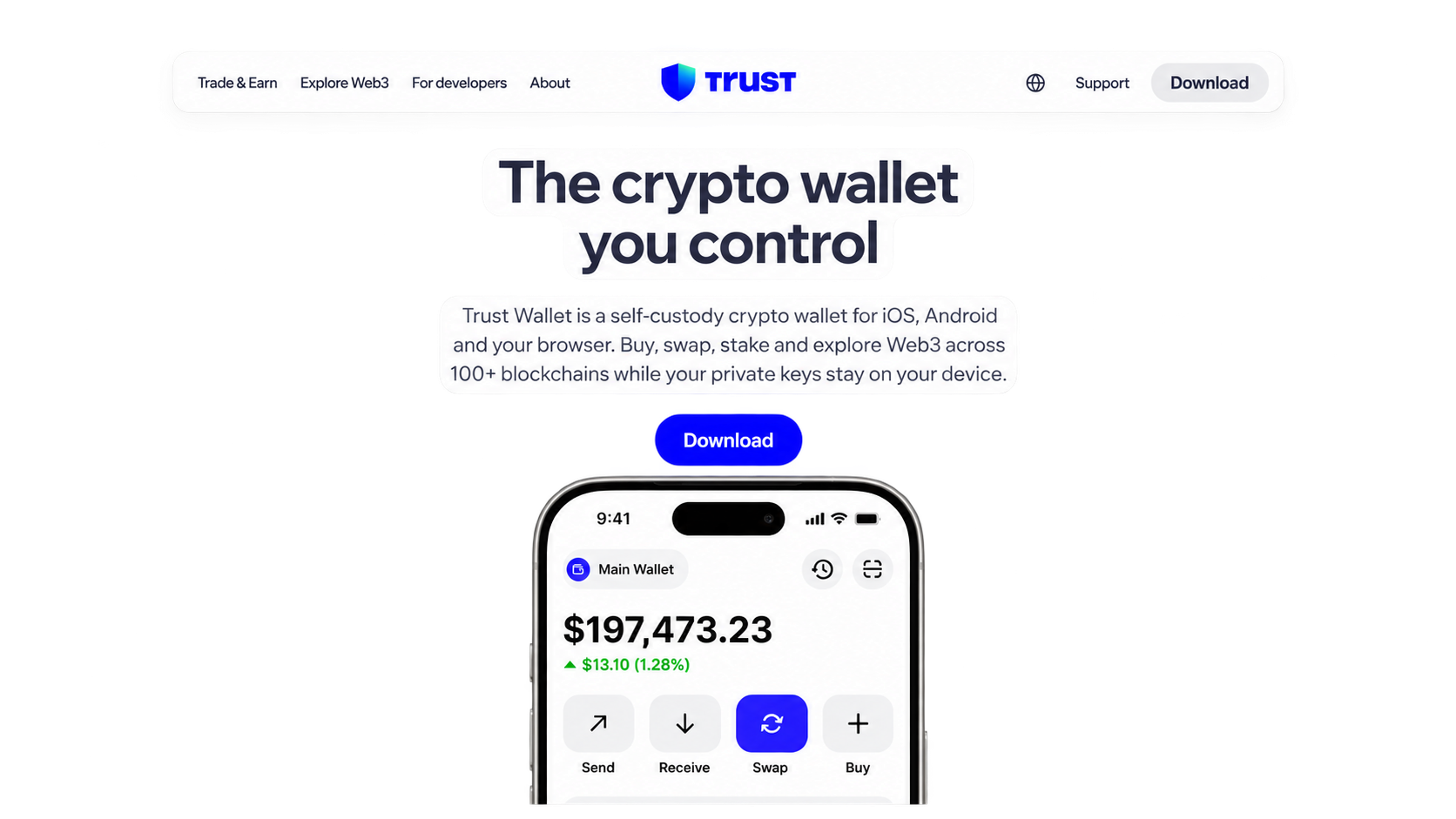
Trust Wallet is a self-custody cryptocurrency wallet that brings more than 100 blockchain networks, integrated trading services, staking, and decentralized applications into a single mobile and desktop ecosystem. Available for iOS, Android, Chrome, and Brave, it supports millions of digital assets across Bitcoin, Ethereum, Solana, BNB Chain, TRON, TON, and numerous other networks, making it particularly useful for investors managing diversified portfolios.
Its appeal extends beyond cryptocurrency storage. Users can swap tokens, participate in staking, manage NFTs, purchase digital assets, and connect to decentralized applications without constantly switching between specialized wallets. Trust Wallet has also expanded into more advanced financial products, including perpetual futures, prediction markets, and tokenized assets, although these services introduce risks beyond conventional cryptocurrency transfers.
Security remains an important consideration. Trust Wallet keeps private keys under the user’s control and provides transaction screening, biometric authentication, and token-approval management. However, the December 2025 compromise of its browser extension exposed weaknesses in its software distribution process and resulted in substantial user losses. The incident distinguishes Trust Wallet’s broad functionality from the stronger isolation provided by dedicated hardware wallets, particularly for investors holding significant long-term balances.
What Is Trust Wallet?
Trust Wallet is a non-custodial software wallet that allows users to manage cryptocurrency without depositing their assets with a centralized exchange or custodial provider. Private keys are generated and stored locally, while the application handles blockchain communication, transaction preparation, and authorization.
Unlike an exchange account, Trust Wallet does not control the underlying cryptocurrency or provide conventional account recovery if the owner loses the necessary credentials. Access depends on the wallet’s private keys and recovery material, which can be used to restore the associated accounts on compatible software.
The platform supports considerably more than conventional Ethereum-based tokens. Its native integrations cover independent blockchain ecosystems with different transaction formats, network fees, and account structures, reducing the need to maintain separate wallets for Bitcoin, Solana, BNB Chain, and other frequently used networks.
Trust Wallet is free to install, with no mandatory subscription for standard wallet functionality. Blockchain transaction fees and charges associated with integrated trading, payment, and financial services still apply.
Mobile App and Browser Extension
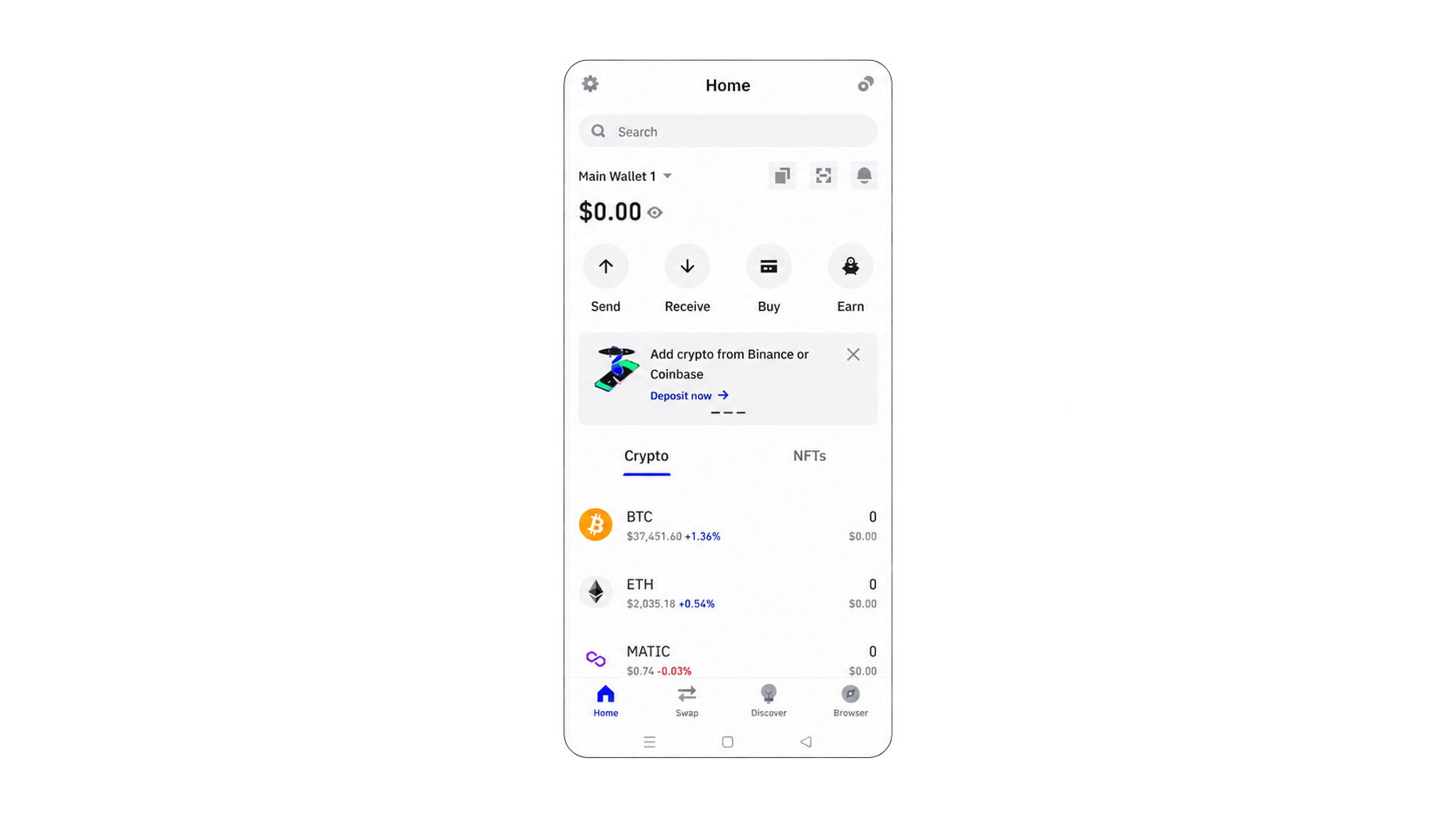
Trust Wallet’s mobile application offers a polished interface for managing cryptocurrency balances, transaction history, transfers, and portfolio activity. Account navigation remains accessible for routine transactions, while integrated swaps, staking, and token discovery allow users to manage common investment activities without navigating multiple external platforms.
The interface is particularly practical for users who regularly receive stablecoins, transfer assets between networks, or maintain several cryptocurrency positions. Portfolio balances and transaction records are organized within the same application, although the growing range of trading products, promotions, and discovery features makes the experience busier than a wallet dedicated exclusively to sending and receiving crypto.
Its browser extension brings similar functionality to desktop environments, with support for Chrome and Brave on Windows, macOS, and Linux. The extension connects directly to compatible decentralized applications, making it more convenient for DeFi protocols, NFT marketplaces, and trading interfaces that rely on browser-based wallet authorization.
Desktop users can also connect compatible Ledger hardware wallets through supported integrations, allowing transaction signatures to remain on a separate device instead of exposing the hardware wallet’s recovery phrase to the browser.
Mobile and browser functionality are not entirely identical, particularly where specific network integrations, hardware connections, or newer product features are involved. Users who depend on a particular blockchain or decentralized application should verify that the required operation is supported on their preferred platform.
For everyday asset management, Trust Wallet offers an accessible interface with enough functionality for experienced users, although its increasingly extensive feature set can make the application less focused than simpler alternatives.
Who Is Trust Wallet Best Suited For?
Trust Wallet is particularly suitable for cryptocurrency investors who frequently manage assets across different blockchain ecosystems and prefer a single interface for transfers, portfolio monitoring, staking, and occasional trading.
Its mobile-first design accommodates users receiving stablecoin payments, maintaining several token positions, or interacting with decentralized applications across EVM and non-EVM networks. The browser extension also makes it practical for desktop DeFi participation without sacrificing the convenience of managing the same underlying accounts from a smartphone.
Investors concentrating on complex EVM trading may prefer a wallet with more extensive transaction simulation, while those holding substantial long-term cryptocurrency balances should consider hardware-backed signing rather than keeping their entire portfolio in software-controlled accounts.
For everyday self-custody, Trust Wallet offers an effective combination of asset coverage, convenience, and integrated financial functionality, particularly when users maintain sensible separation between active trading funds and long-term holdings.
Wallet Setup
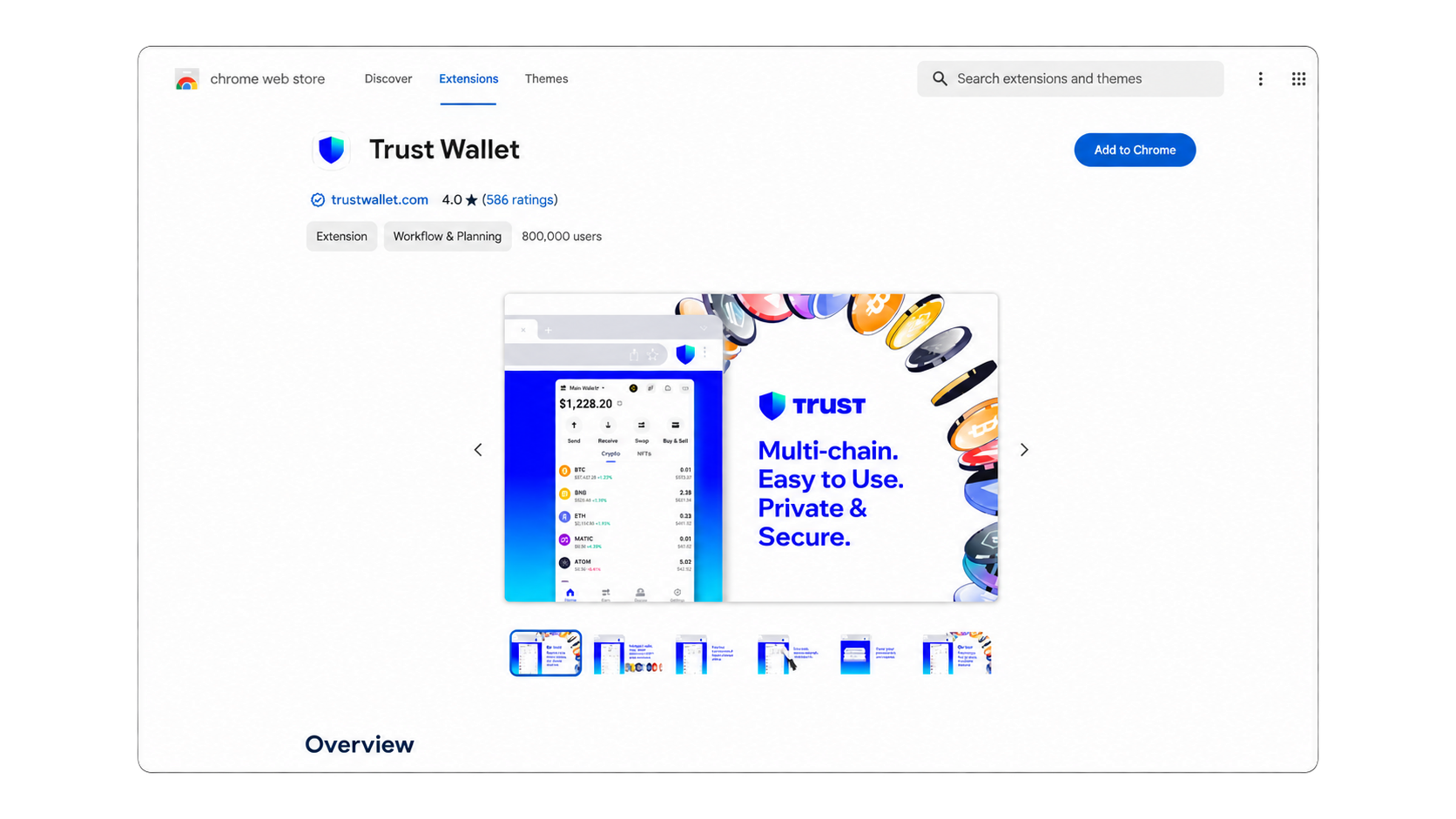
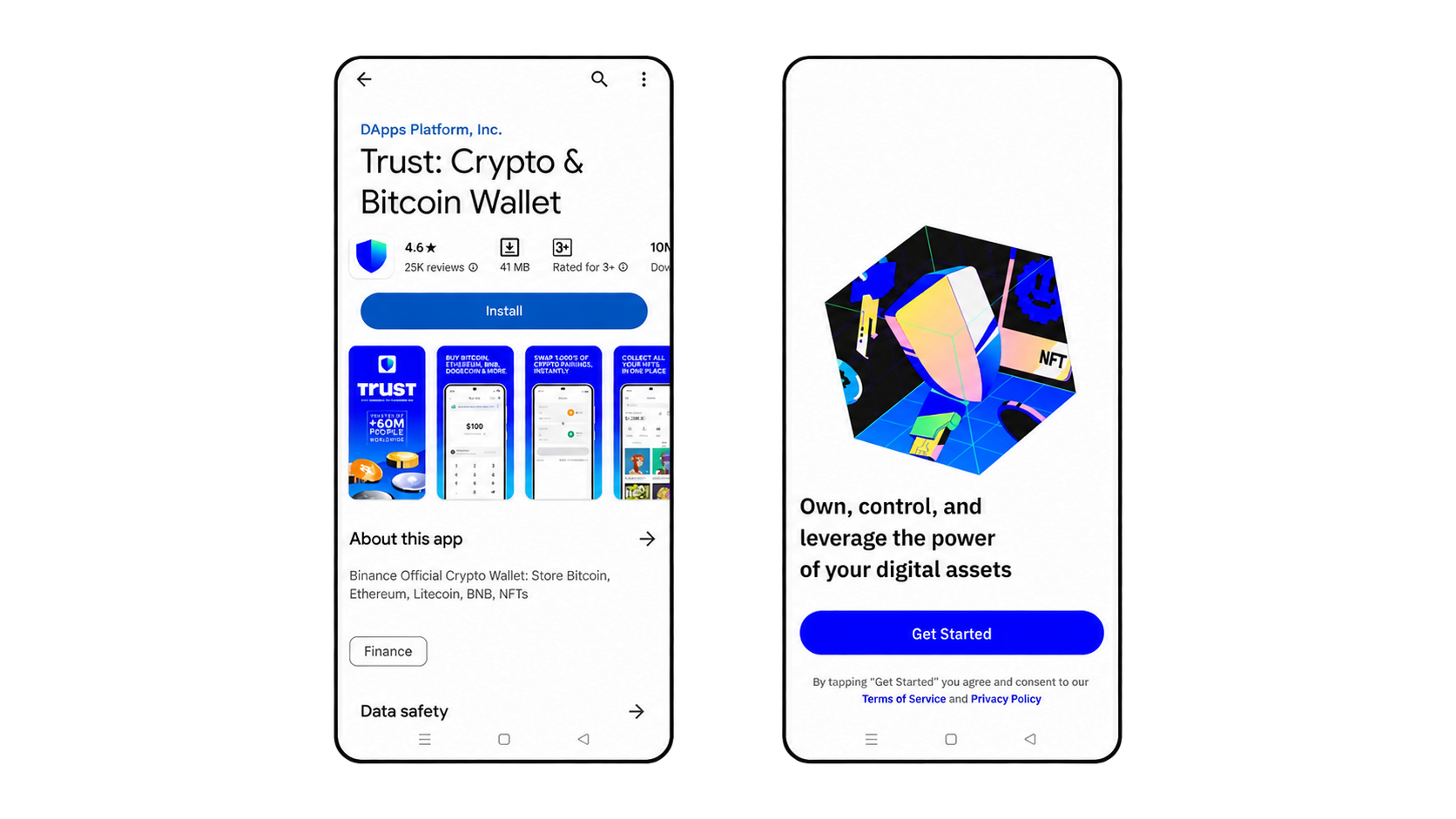
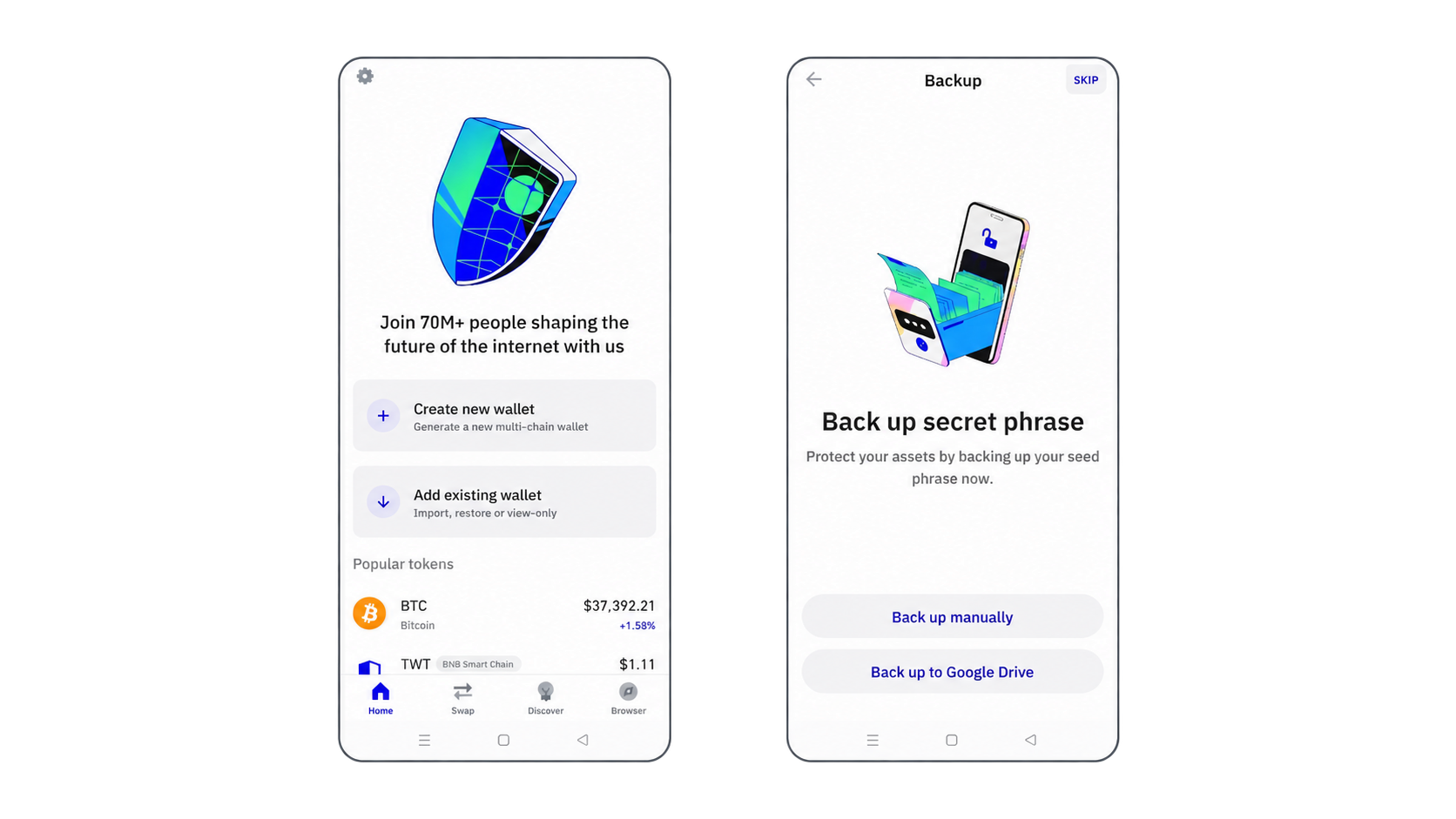
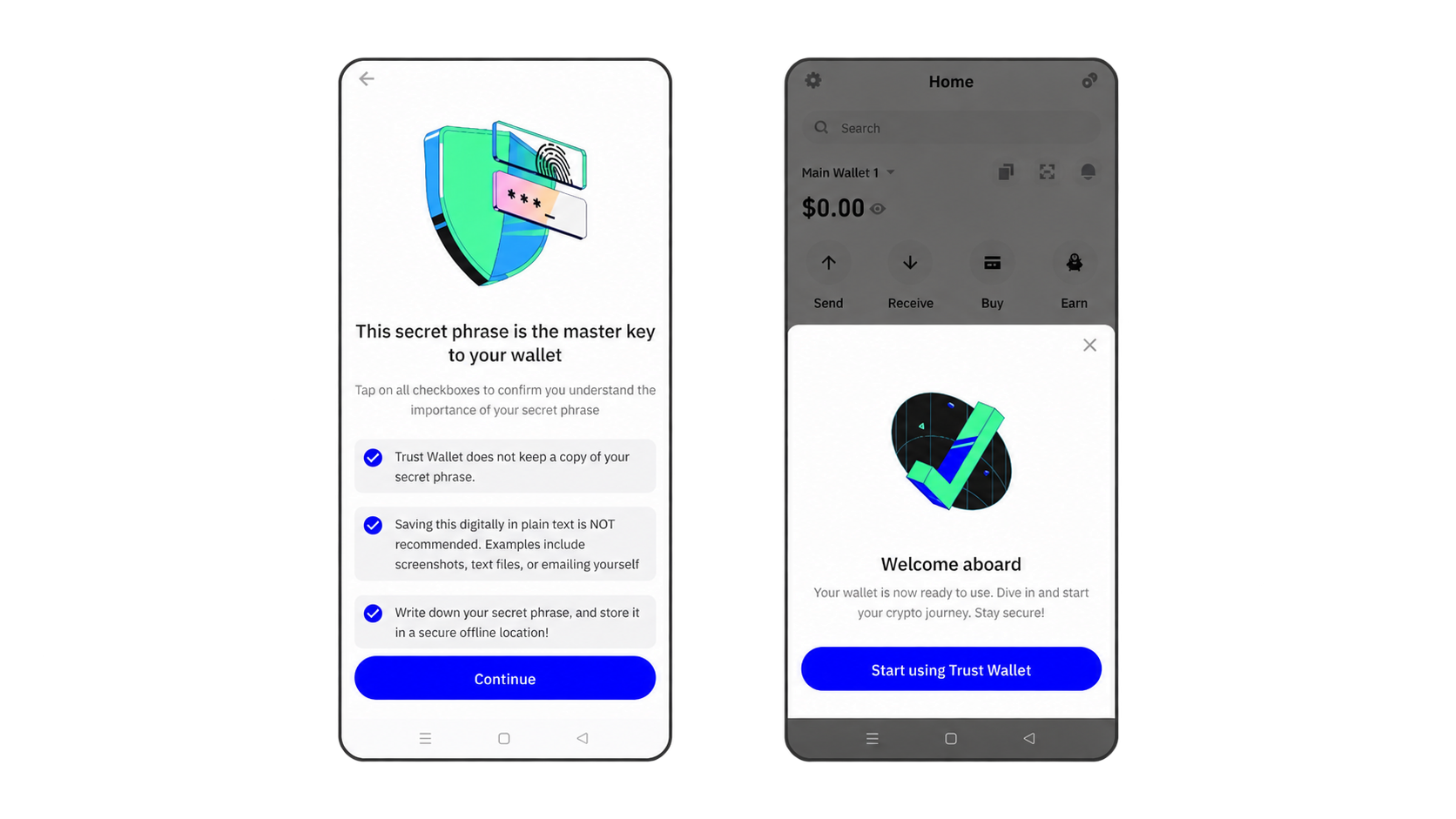
Supported Assets
Supported Cryptocurrencies and Blockchain Networks
Trust Wallet supports more than 100 blockchains and millions of cryptocurrencies and tokens, providing one of the broadest asset selections among general-purpose self-custody wallets. Its compatibility includes Bitcoin, Ethereum, Solana, XRP Ledger, BNB Chain, TRON, TON, Polygon, Arbitrum, Base, and numerous additional networks.
This coverage is particularly useful for investors holding assets across both EVM-compatible and independent blockchain ecosystems. Native Bitcoin and Solana support, for example, allows users to manage those assets alongside Ethereum tokens without relying on extensions or separate applications for basic wallet functionality.
Stablecoins are similarly accessible across supported networks, although identical token names do not make their blockchain implementations interchangeable. USDT on Ethereum, TRON, and BNB Chain involves different networks, transaction fees, and transfer requirements. Selecting an unsupported network can leave funds inaccessible through the intended receiving wallet even when the token symbol appears correct.
Asset compatibility also varies by function. Some cryptocurrencies can be stored and transferred directly but are not eligible for integrated swaps, staking, or purchases. NFTs and less common token standards may require additional application support, while cross-chain transfers can depend on external bridges or liquidity providers.
For investors maintaining several blockchain positions, Trust Wallet’s broad native coverage is a substantial advantage. The extensive asset list is most valuable when the specific cryptocurrency, network, and intended transaction are all supported rather than simply appearing in the same portfolio interface.
Swaps & Fees
Trust Wallet Swaps and Transaction Fees
Trust Wallet includes cryptocurrency swaps through integrated trading providers, allowing users to exchange supported tokens without manually visiting decentralized exchanges. Available routes include same-chain conversions and selected cross-chain swaps, with quotes based on the trading pair, network, liquidity conditions, and underlying provider.
The integrated interface reduces the number of external applications needed for routine portfolio adjustments, but convenience does not necessarily produce the lowest execution cost. Swap pricing can include blockchain gas, provider charges, liquidity spreads, and price impact, with the total varying significantly between liquid assets and thinly traded tokens.
Cross-chain conversions add further dependencies because the transaction may involve bridging infrastructure, multiple blockchain settlements, or an intermediary service. Execution can therefore take longer than a standard same-chain swap, and additional costs may be incorporated into the quoted amount.
For larger trades, comparing the final amount received against independent swap aggregators can reveal whether a different liquidity route offers better execution. This is especially relevant when exchanging volatile tokens, moving substantial stablecoin balances, or transferring assets between blockchains.
Trust Wallet itself does not charge a subscription for basic wallet creation or ordinary account access. However, blockchain networks charge transaction fees, while integrated trading services may include wallet, provider, or routing fees. Some eligible promotional transactions may waive specific service charges without eliminating the underlying network costs.
Cryptocurrency purchases and fiat withdrawals are handled through third-party payment providers. Available payment methods, processing limits, identity verification, and conversion rates depend on the selected provider and the user’s jurisdiction, rather than being uniform across all Trust Wallet accounts.
NFTs & DeFi
Staking, NFTs, and DeFi Features
Trust Wallet supports staking for selected proof-of-stake cryptocurrencies, including Ethereum, Solana, BNB, and other compatible networks. Users can access available staking arrangements directly within the application, review reward information, and authorize delegation or staking transactions without independently connecting to every validator interface.
Staking rewards depend on the underlying blockchain, validator performance, commissions, and network participation. Withdrawal restrictions, unbonding periods, slashing exposure, and supported staking mechanisms vary between assets, while liquid staking products introduce additional smart contract and token risks.
NFT functionality extends to supported blockchain ecosystems, allowing users to view and manage compatible digital collectibles alongside ordinary cryptocurrency balances. The application also connects to NFT marketplaces and decentralized applications, though collection visibility and interaction options differ between networks.
Trust Wallet has expanded its trading capabilities to include perpetual futures, prediction markets, and selected tokenized financial assets through integrated services. These products operate under different financial and technical conditions from ordinary token transfers. Perpetual futures introduce leverage, funding costs, and liquidation risk, while prediction markets depend on contract wording and settlement criteria. Tokenized assets can carry issuer, redemption, and liquidity dependencies that are unrelated to the wallet’s private-key security.
The wider functionality makes Trust Wallet a convenient gateway to Web3, particularly for users who frequently move between basic asset management and decentralized financial applications. However, interacting with more protocols also increases the number of transaction permissions and external contracts associated with a wallet.
Separating long-term holdings from accounts used for unfamiliar decentralized applications can limit exposure without sacrificing access to Trust Wallet’s integrated features.
Security
Trust Wallet Security and Private-Key Protection
Trust Wallet uses encrypted local private-key storage, device authentication, and transaction authorization to protect access to cryptocurrency accounts. Mobile users can enable passcodes and biometric unlocking, while the browser extension provides password-based access controls.
Its Security Scanner evaluates supported transactions, addresses, and interactions against known risk indicators, helping identify suspicious activity before authorization. The application also provides token-approval management, allowing users to inspect and remove permissions previously granted to decentralized applications.
These controls are particularly useful for DeFi participants because token allowances may remain active after a transaction is completed or a website connection is closed. Periodically revoking unnecessary token approvals can reduce exposure to compromised contracts, although revocation requires a blockchain transaction and cannot reverse funds already transferred.
Trust Wallet has also introduced warnings designed to identify suspicious recipient addresses associated with address-poisoning activity. Attackers using address poisoning attempt to place lookalike wallet addresses into transaction histories, hoping users will copy an incorrect recipient during a later transfer.
Security warnings can reduce exposure to known scams, but their effectiveness depends on detection coverage and the transaction information available. Malicious contracts, fraudulent signatures, and compromised websites can still exploit a legitimate wallet when the owner authorizes harmful permissions.
Trust Wallet’s security architecture is also different from hardware-based custody. Private keys remain on the user’s phone or computer rather than inside a dedicated signing device with a physically isolated security environment. Device malware, compromised wallet software, and exposed recovery material therefore represent significant threats, particularly when substantial balances are managed through a browser extension.
The December 2025 Trust Wallet Browser Extension Breach
Trust Wallet suffered a significant security incident in December 2025 when attackers distributed a malicious version of its browser extension through the Chrome Web Store.
Version 2.68 was published on December 24 outside the company’s normal internal release process. The compromised software contained malicious functionality capable of accessing sensitive wallet information and facilitating unauthorized transactions.
The incident affected users who opened and logged into the compromised extension between December 24 and December 26, 2025. Trust Wallet’s incident investigation identified 2,520 drained wallet addresses and approximately $8.5 million in assets associated with the attacker’s identified addresses, while noting that some of those funds involved wallets outside the confirmed incident scope.
The investigation linked the malicious release to compromised development credentials and access to the Chrome Web Store publishing process. Attackers were able to distribute altered wallet software without passing through Trust Wallet’s normal internal approval procedures.
The company subsequently replaced the affected extension, strengthened release controls, and introduced a reimbursement process for eligible victims. Mobile-only users were outside the directly affected software scope, although any recovery phrase exposed through the compromised extension remained unsafe regardless of where the wallet was subsequently accessed.
The incident represents a serious weakness in the wallet’s historical security record because the attack originated through the software distribution process rather than an individual user deliberately approving a malicious transaction.
For accounts exposed through the compromised release, updating the extension alone cannot restore the secrecy of leaked recovery material. Funds must be moved to a newly generated wallet with independent keys.
Trust Wallet’s response and subsequent security improvements are relevant to its current assessment, but they do not erase the demonstrated consequences of a compromised application release.
Open-Source Components and Security Transparency
Trust Wallet maintains the open-source Wallet Core library, which provides cryptocurrency functionality across multiple blockchain networks. The library enables independent examination of important cryptographic and blockchain-specific components.
However, an open-source wallet library does not make the complete mobile application, browser extension, integrated services, or software distribution process independently reproducible. Trust Wallet’s broader security still depends on application development, release integrity, connected-device protection, and the reliability of external integrations.
Its security tools offer practical benefits for everyday use, but the confirmed extension compromise prevents an unqualified endorsement of Trust Wallet as a standalone solution for storing large cryptocurrency balances.
Backup & Recovery
Wallet Recovery and Backup Protection
Trust Wallet relies on recovery material to restore access when a phone is lost, an application is removed, or a device becomes unusable. The recovery phrase associated with a conventional wallet can reconstruct its private keys in compatible software, making it a more sensitive credential than the local application password.
A reliable seed phrase backup should remain private, recoverable, and protected against both physical loss and unauthorized access. Offline storage avoids exposing recovery words to ordinary cloud documents, screenshots, shared devices, or services that could retain copies.
Optional encrypted backup features may provide additional recovery convenience, but their security depends on the specific encryption and account-recovery arrangements chosen. Users should understand which credentials are required for restoration before relying on any digital backup method.
Importing an existing recovery phrase into another software wallet does not improve the security of the underlying keys. Both applications can access the same accounts, and a compromise of either environment may expose the complete wallet.
Hardware wallet integrations offer a different arrangement because compatible transactions can be authorized by a separate signing device without importing its private keys into Trust Wallet. This is a more appropriate approach for investors who want to use browser-based DeFi interfaces while keeping higher-value assets outside a conventional hot wallet.
Wallet recovery and transaction permissions should also be managed independently. A recovery phrase protects access after device failure, whereas removing stale contract permissions reduces exposure to malicious token spending. Attackers using wallet drainers may exploit deceptive signatures or unlimited spending approvals without obtaining the recovery phrase itself.
For investors using Trust Wallet regularly, separate accounts for routine transactions, experimental DeFi activity, and long-term holdings provide a more controlled arrangement than exposing an entire portfolio through one frequently connected address.
Pros & Cons
- Extensive cryptocurrency compatibility: Native support for more than 100 blockchains and millions of assets allows users to manage diversified portfolios without maintaining multiple specialized wallets.
- Strong mobile and desktop experience: Accessible mobile navigation and a capable browser extension accommodate both routine cryptocurrency transfers and more demanding Web3 activities.
- Comprehensive functionality: Integrated swaps, staking, NFT management, fiat services, and decentralized applications provide substantial flexibility within a single wallet ecosystem.
- Practical security controls: Transaction screening, address-risk warnings, token-approval management, and compatible hardware wallet integrations offer useful protections for active users.
- Previous software security compromise: The December 2025 browser-extension breach exposed a serious weakness in software release security and resulted in substantial financial losses.
- Hot-wallet exposure: Locally stored keys remain vulnerable to compromised devices, malicious software, phishing, and unsafe transaction approvals.
- Variable transaction costs: Swap pricing, cross-chain transfers, fiat conversions, and integrated financial services depend on third-party providers and network conditions.
- Increasing interface complexity: The expanding range of blockchain networks, trading products, and in-app services can complicate navigation and increase the potential for transaction mistakes.
Trust Wallet vs Competitors
Trust Wallet vs MetaMask, Rabby, and Phantom
Trust Wallet vs MetaMask
MetaMask provides a particularly mature environment for Ethereum and EVM-based decentralized applications, with integrated swaps, bridging, portfolio tools, and an expandable ecosystem through Snaps. Its supported networks have expanded beyond Ethereum to include Bitcoin, Solana, and additional ecosystems, narrowing some of the historical differences between the two wallets.
Trust Wallet retains an advantage in broad native blockchain coverage, particularly for users maintaining holdings across numerous EVM and non-EVM networks. MetaMask remains attractive for investors whose activity centers on Ethereum-compatible applications and who value its specialized integrations, transaction tools, and established DeFi ecosystem.
Trust Wallet vs Rabby
Rabby Wallet concentrates on improving transaction transparency across EVM networks. Its simulation tools, balance-change previews, contract warnings, and automatic network recognition give users additional information before approving potentially complex DeFi interactions.
Trust Wallet offers significantly broader native asset compatibility and a more versatile general-purpose interface, while Rabby is particularly compelling for active EVM traders who prioritize detailed transaction previews and contract-risk analysis. Investors focused on Bitcoin, Solana, and multiple independent blockchain networks will generally find Trust Wallet more comprehensive.
Trust Wallet vs Phantom
Phantom has developed a particularly refined experience for Solana-based trading, NFTs, token discovery, and mobile cryptocurrency management. Its expansion into Bitcoin and additional blockchain networks has also made it more versatile than its original Solana-focused positioning.
Trust Wallet is better suited to users maintaining assets across a larger collection of blockchain ecosystems, while Phantom remains especially attractive for investors whose daily transactions involve Solana tokens, NFT collections, and integrated trading tools. Both provide accessible mobile interfaces, although their ecosystems emphasize different patterns of cryptocurrency activity.
Bottom Line
Is Trust Wallet Worth Using in 2027?
Trust Wallet earns 8.8/10 for its extensive blockchain compatibility, accessible mobile interface, and unusually broad collection of cryptocurrency management features. Its ability to support Bitcoin, Ethereum, Solana, and numerous other networks within one ecosystem makes it particularly useful for investors who regularly move between different digital assets.
The December 2025 extension compromise remains a meaningful consideration, especially for users evaluating the wallet’s suitability for larger balances. Despite improvements to security controls and software distribution, Trust Wallet is better suited to everyday cryptocurrency activity than serving as the only protection for substantial long-term holdings.
For users who understand the responsibilities of self-custody and maintain appropriate backup and account-security practices, Trust Wallet remains one of the more capable multi-chain software wallets available in 2027.
FAQs
Is Trust Wallet safe to use in 2027?
Trust Wallet uses local encrypted keys, device authentication, risk warnings, and approval controls. Its confirmed December 2025 browser-extension compromise is an important limitation, so larger holdings are better protected through separated accounts and compatible hardware-wallet signing.
Does Trust Wallet charge fees?
The wallet is free to download and normal wallet creation does not carry a subscription fee. Blockchain gas, swap routing charges, liquidity spreads, and fees charged by third-party fiat or trading services can apply. Eligible promotional swap pairs may have a zero wallet fee without being entirely cost-free.
Can Trust Wallet store Bitcoin, Solana, and Ethereum together?
Trust Wallet supports native Bitcoin, Solana, Ethereum, and numerous other networks. Assets remain on their respective chains, so the receiving network, native gas coin, and applicable token contract must still be checked for each transfer.
Is Trust Wallet completely open source?
Trust Wallet's Wallet Core cryptographic library is open source, but that does not mean the complete consumer wallet application, extension distribution process, and every integrated component are fully open source or reproducible by independent users.
Can Trust Wallet connect to a hardware wallet?
The browser extension supports compatible Ledger connections, including supported Bitcoin, Ethereum, and Solana application flows over USB. This allows the hardware device to sign without importing its recovery phrase into a conventional software wallet.
Is Trust Wallet better than MetaMask, Rabby, or Phantom?
Trust Wallet is stronger for broad native multichain coverage. MetaMask is compelling for its mature EVM ecosystem and extensibility, Rabby emphasizes EVM transaction simulation and risk review, and Phantom offers a particularly refined Solana-centered experience with growing multichain support.