







 X
 Facebook
 LinkedIn
 Google News
 Telegram
 Instagram
 RSS Feed

Introduction
CoinStats Review 2027: Portfolio Tracking, Features, Pricing, and Security
CoinStats is a cryptocurrency portfolio tracker designed to give investors a comprehensive view of their digital assets across centralized exchanges, blockchain wallets, and decentralized finance (DeFi) protocols. Founded in 2017, the platform has evolved into a broader portfolio management service combining automated account synchronization, profit-and-loss analytics, NFT tracking, market alerts, and AI-powered investment insights. Its primary appeal lies in simplifying the increasingly complex task of monitoring cryptocurrency holdings spread across multiple exchanges and blockchain networks.
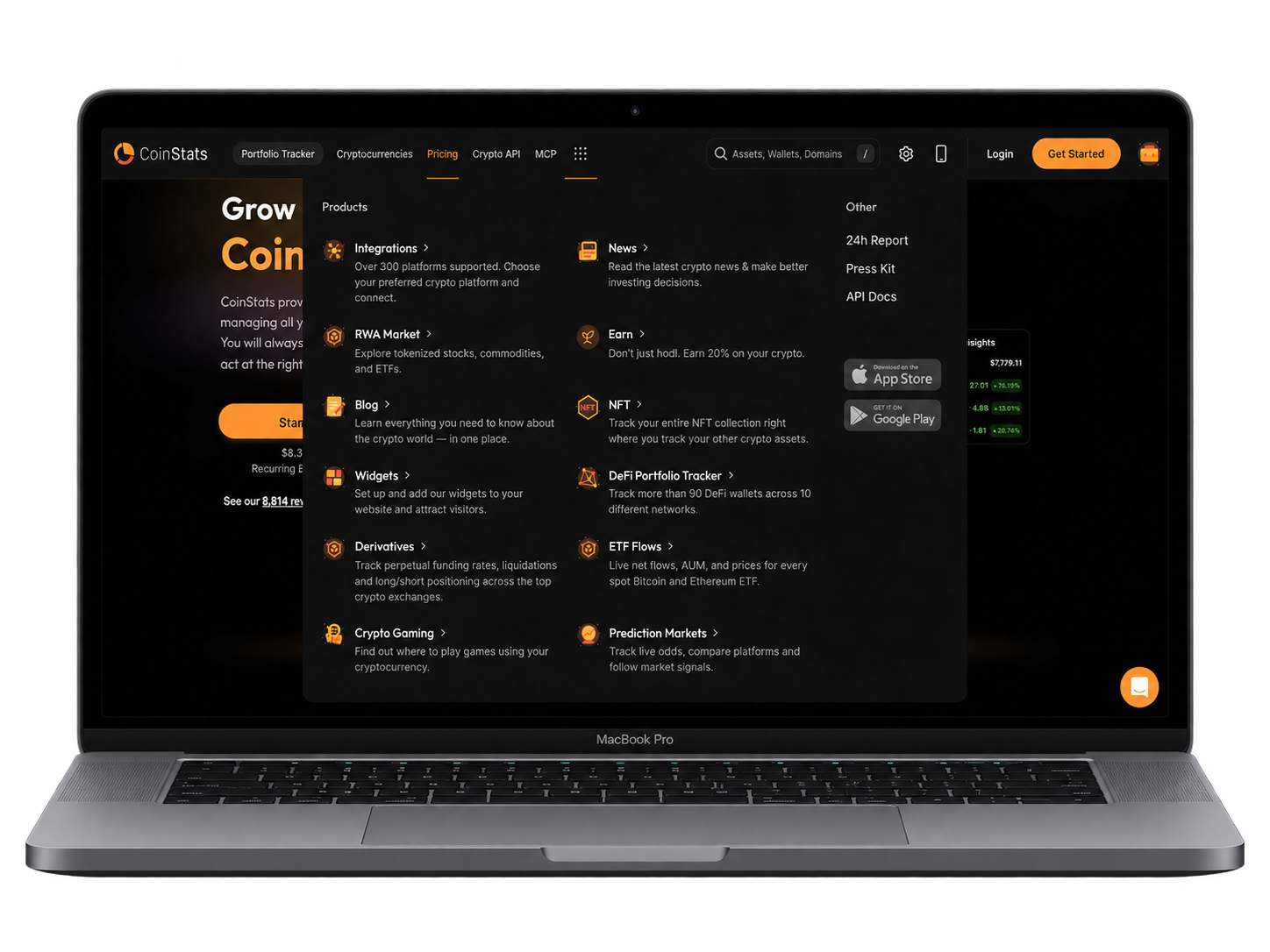
With more than 300 supported wallet and exchange integrations, CoinStats covers major cryptocurrencies alongside tokens held across Layer 1 blockchains, Ethereum Layer 2 networks, and decentralized applications. Its portfolio analytics extend beyond basic balance monitoring, offering realized and unrealized profit calculations, historical performance charts, asset allocation analysis, and transaction records that can support tax reporting. Investors participating in decentralized finance (DeFi) can also monitor supported staking positions, lending activities, and liquidity pools without relying entirely on individual protocol dashboards.
The platform’s broader functionality includes portfolio health assessments, customizable price alerts, AI-assisted market analysis, and tools for planning investment exits. However, the accuracy of its reporting depends on the completeness of imported transaction histories, supported integrations, and synchronization frequency. Some exchanges impose restrictions on historical data retrieval, while complex DeFi transactions and less widely supported NFTs may require additional verification. Automatic synchronization is not necessarily instantaneous, and investors should not assume that every connected account updates continuously.
CoinStats offers an extensive environment for cryptocurrency portfolio tracking, particularly for investors managing assets across multiple exchanges, wallets, and DeFi protocols. Its value lies in consolidating fragmented investment information into actionable portfolio insights, although subscription costs, data accuracy, and security considerations deserve scrutiny before relying on it as a primary portfolio management tool.
How Does It Work?
CoinStats allows investors to monitor their digital asset holdings without transferring funds into a separate trading account. The platform aggregates financial information from connected accounts and blockchain networks, presenting balances, transaction histories, asset valuations, and investment performance through a unified dashboard.
Users can connect supported centralized exchanges through API integrations, link blockchain wallets using public addresses or compatible wallet connections, and import transaction histories through CSV files when automatic synchronization is unavailable. Manual portfolios provide an additional option for recording transactions from unsupported exchanges or tracking holdings that cannot be retrieved automatically. For passive monitoring, read-only API permissions and public wallet addresses allow CoinStats to retrieve relevant information without requiring withdrawal access or control of private keys.
Once connected, CoinStats organizes the available data into individual portfolios and consolidated investment views, calculating asset allocations, cost basis, and profit or loss across supported holdings. Its analytics distinguish between realized gains from completed transactions and unrealized changes in the value of assets still held, while historical charts help investors understand how their portfolios have performed over time. However, missing purchase records, incorrectly classified transfers, and incomplete exchange histories can affect these calculations, making occasional reconciliation necessary.
CoinStats also supports optional token swaps through connected wallets, allowing users to execute supported on-chain transactions without leaving its interface. These activities differ from passive portfolio monitoring because they require transaction authorization and may involve network fees, slippage, and smart contract risks.
For investors holding cryptocurrency across several accounts, CoinStats provides a practical way to evaluate total exposure and investment performance without manually consolidating records. Its advantages become more apparent as the number of exchanges, wallets, and DeFi positions increases, while users maintaining a small portfolio on a single exchange may find its more advanced analytics and subscription features unnecessary.
Markets & Features
CoinStats Integrations and Portfolio Synchronization
CoinStats offers extensive connectivity across centralized cryptocurrency exchanges, blockchain wallets, and decentralized applications, allowing investors to consolidate holdings that would otherwise require several independent dashboards. The platform supports more than 300 wallet and exchange integrations, with connections covering major trading platforms, hardware wallets, and blockchain networks. However, the practical value of these integrations depends on the depth of information available, since access to an account balance does not necessarily include its complete transaction history or historical investment performance.
The platform accommodates different connection methods, including exchange APIs, public blockchain addresses, wallet integrations, and manual transaction imports. This flexibility is particularly useful for investors who maintain long-term holdings in cold storage while actively trading or participating in decentralized finance. The main consideration is whether each connection provides enough historical information to calculate an accurate cost basis and distinguish genuine investment returns from deposits, withdrawals, and transfers.
Exchange API Connections
CoinStats supports major cryptocurrency exchanges, including Binance, Binance.US, Coinbase, Kraken, Bybit, OKX, KuCoin, Bitget, Gate, Gemini, Crypto.com, and several additional platforms. Exchange accounts can generally be connected through restricted API credentials, allowing CoinStats to retrieve supported balances, transactions, and other account information without requiring withdrawal permissions.
However, exchange synchronization varies considerably in depth. Binance supports several years of selected trading records, although withdrawals, transfers, futures transactions, and Earn activity have different historical limits. Kraken restricts spot transaction imports to the latest 1,000 records, while KuCoin generally provides up to 2,000 spot transactions covering a maximum of six months. OKX limits imported spot trades to the latest 300 transactions, even though other account information may remain available.
Some integrations offer considerably less historical detail. Crypto.com Exchange supports balance synchronization without equivalent transaction-history imports, while its separate consumer application relies on CSV files. Several additional exchanges provide balance-only connections, making them suitable for monitoring current holdings but less useful for automatically reconstructing lifetime investment performance.
These differences are particularly important for active traders who have accumulated thousands of transactions. An account may connect successfully and display the correct balance while its calculated profit or loss remains inaccurate because earlier purchases, sales, or transfers are missing. CSV imports and manual transaction adjustments can address some of these gaps, although users should avoid creating duplicate records when combining automatic synchronization with historical files.
CoinStats also supports selected futures balances, open positions, and transaction histories, including integrations with exchanges such as Binance, Kraken, Gate, and Hyperliquid. However, derivatives coverage is not uniform, and the availability of funding payments, liquidations, partial closes, or historical positions depends on the exchange.
Cryptocurrency Wallet Tracking
CoinStats supports public-address tracking for many blockchain wallets, making it possible to monitor cryptocurrency holdings without exposing private keys or authorizing transactions. Investors can enter a supported wallet address, while mobile users can also scan wallet QR codes to establish tracking connections.
Compatible wallets include MetaMask, Ledger, Phantom, Trust Wallet, Rabby, Exodus, and other software or hardware wallet configurations. For hardware wallet users, the ability to monitor assets through public addresses is particularly useful because it allows portfolio valuation and transaction monitoring without connecting the physical device or signing transactions.
The platform also supports Bitcoin extended public keys through compatible wallet integrations, enabling broader visibility into hierarchical deterministic wallets that distribute holdings across multiple addresses. This can provide more complete Bitcoin tracking than monitoring a single receiving address, although extended public keys reveal significant account activity and should still be handled carefully for privacy reasons.
Users can organize connected accounts into separate portfolios, group them into folders, or combine their information through consolidated analytics. This arrangement is useful when separating long-term holdings from trading accounts or tracking investments distributed across multiple wallets.
Portfolio Synchronization Frequency
CoinStats automatically refreshes supported exchange and wallet connections approximately once every 24 hours, with additional manual updates available through Force Sync. This scheduled synchronization should not be confused with the frequency of cryptocurrency price updates, which can change portfolio valuations even when the underlying account balance has not been refreshed.
Manual synchronization allowances depend on the subscription. Premium provides up to 200 daily synchronization requests per portfolio, while Degen offers an unlimited stated allowance. Free accounts have more restrictive synchronization limits, making the paid subscriptions more practical for investors who frequently move assets between wallets or exchanges.
There can also be a delay between establishing a connection and receiving complete performance information. For example, a newly connected Binance account may initially display balances using current market prices before historical transactions are imported and cost-basis calculations are updated.
For investors who require immediate confirmation of a trade, withdrawal, or deposit, the originating exchange or blockchain explorer remains the more reliable source. CoinStats is better suited to consolidated monitoring and performance analysis than real-time transaction confirmation.
Supported Cryptocurrency Markets and Asset Coverage
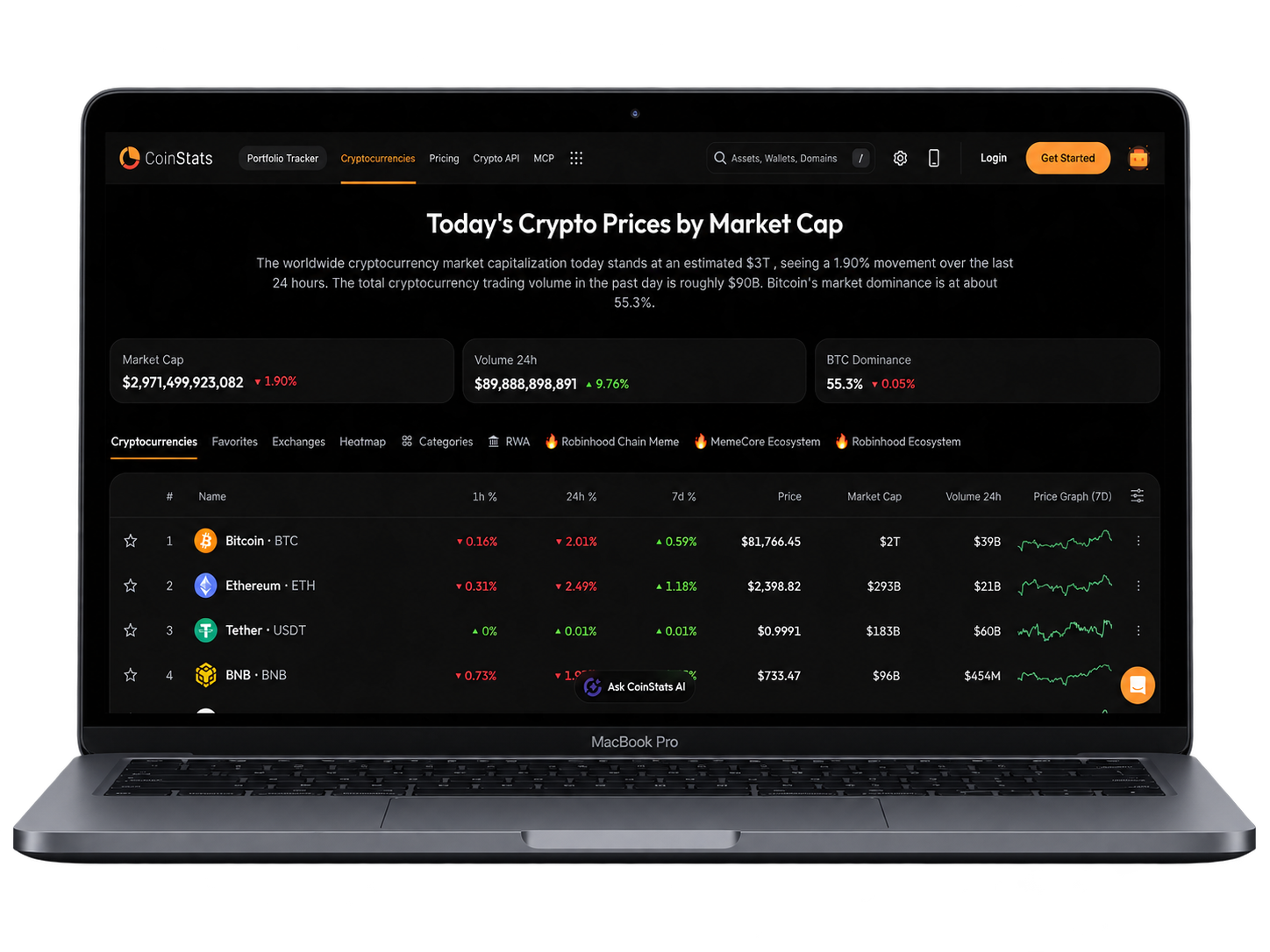
CoinStats extends beyond conventional Bitcoin and altcoin tracking, covering assets across more than 120 blockchains and a broad selection of decentralized finance protocols. Its market-data environment includes cryptocurrencies, stablecoins, NFTs, real-world assets (RWAs), and meme coins, alongside specialized analytics for perpetual futures and cryptocurrency ETFs.
This breadth is valuable for investors participating in different sectors of the digital asset market, although the distinction between market-data coverage and portfolio-level tracking remains important. CoinStats may provide price information for an asset without supporting its complete wallet history, staking activity, or associated decentralized positions.
Layer 1 and Layer 2 Blockchain Support
CoinStats supports major Layer 1 networks such as Bitcoin, Ethereum, Solana, BNB Chain, Avalanche, Sui, Aptos, TON, TRON, and Cardano, alongside numerous additional blockchain ecosystems. Its coverage also extends to Ethereum Layer 2 networks, including Arbitrum, Optimism, Base, zkSync Era, Linea, Scroll, and other compatible scaling networks.
The platform can identify supported native assets and tokens across these ecosystems, allowing investors to examine holdings distributed across different networks. This becomes particularly useful when the same token exists on multiple blockchains or when investors move assets through bridges and decentralized applications.
However, blockchain compatibility is not uniform. Certain networks support comprehensive token balances and transaction histories, while others provide more limited historical information or lack specific functionality such as NFT tracking, staking recognition, or advanced transaction classification.
This distinction is especially relevant for investors using newer blockchain ecosystems, where rapid protocol development can outpace portfolio tracking integrations. A wallet balance may be visible before CoinStats supports every associated transaction type or decentralized application.
DeFi Portfolio Tracking
CoinStats provides a dedicated DeFi dashboard that identifies supported positions across lending platforms, staking protocols, liquidity pools, and yield-generating applications. Its coverage extends across more than 10,000 decentralized protocols and applications, although the depth of available information varies by blockchain and protocol.
The interface organizes DeFi holdings into categories such as liquidity positions, staked assets, rewards, farming, borrowed and lent assets, and other protocol-specific investments. Instead of displaying only the tokens held directly in a wallet, CoinStats attempts to identify how assets are deployed within supported smart contracts.
For example, a wallet interacting with Aave may display supplied collateral and borrowing activity, while positions involving Lido, Uniswap, Raydium, Jupiter, or Kamino can appear according to their supported staking, liquidity, or lending mechanics. Selected protocols also provide information such as debt ratios, health factors, and other position-specific metrics, helping investors understand obligations that might otherwise remain hidden within raw blockchain transactions.
This functionality is particularly useful for investors using several protocols simultaneously, although complex positions remain challenging to value accurately. Liquidity pool holdings can fluctuate because of price movements and impermanent loss, while borrowed assets create liabilities that must be considered when calculating net exposure. Vault shares, reward tokens, and derivative staking positions may also require additional interpretation.
An important limitation is that DeFi balances are not automatically incorporated into CoinStats’ historical portfolio charts. Users can enable the option to include supported DeFi holdings in their total portfolio valuation, but this does not provide a complete historical performance record for every decentralized position.
For investors with extensive on-chain activity, specialized DeFi portfolio trackers can provide additional context around protocol exposure, wallet histories, and complex transaction accounting. CoinStats remains useful for combining these holdings with centralized exchange balances, although it should not be treated as a comprehensive DeFi accounting system.
NFT Portfolio Tracking
CoinStats supports NFT portfolio tracking on Ethereum and Base, allowing users to inspect supported collections, review individual holdings, and monitor their estimated market values. Collections appear within a dedicated NFT section, providing a separate view of digital collectibles alongside conventional cryptocurrency investments.
The platform also supports NFT floor-price alerts, enabling users to receive notifications when a collection reaches a specified price or percentage change. This can be useful for investors following several collections without continuously monitoring NFT marketplaces.
However, CoinStats’ broad blockchain coverage does not translate into equally extensive NFT functionality. Investors holding substantial collections on Solana, Bitcoin Ordinals, or other networks may require additional tools to obtain complete visibility into ownership, collection activity, and estimated values.
NFT valuations also require caution because collection floor prices do not necessarily reflect the realizable value of an individual token. Rarity, liquidity, marketplace activity, and differences between listed and completed sales can produce substantial valuation discrepancies, particularly for collections with limited trading volume.
Real-World Assets and Tokenized Investments
CoinStats expanded its real-world asset coverage in September 2026, introducing a dedicated RWA market section alongside its broader cryptocurrency listings. The feature provides market information for tokenized assets, including selected precious metals and tokenized equity-related products, with individual pages displaying prices, historical charts, and available markets.
The RWA section allows investors to explore the growing market for blockchain-based representations of traditional assets without searching through unrelated cryptocurrency categories. Supported tokens can also appear in connected wallet portfolios when their networks and token contracts are recognized by CoinStats.
However, market-data coverage is not equivalent to comprehensive support for every tokenized investment product. Private-credit instruments, tokenized Treasury funds, restricted securities, and other regulated assets may involve redemption conditions, issuer restrictions, or valuation methods that cannot be represented through conventional cryptocurrency price feeds alone.
A tokenized asset’s displayed market price may also differ from its underlying net asset value or redemption value, particularly when secondary-market liquidity is limited. Investors should therefore examine the legal and economic structure of these products rather than relying exclusively on CoinStats’ quoted valuation.
Meme Coins and Emerging Cryptocurrencies
CoinStats provides market-data coverage for meme coins and newly emerging cryptocurrency projects across supported networks, including Ethereum, Solana, and Base. Users can monitor recognized tokens, follow price movements, examine trading volume, and include supported holdings within their portfolios.
This functionality is useful for traders participating in rapidly changing market sectors, but newly launched assets present particular data-quality challenges. Low-liquidity pools, concentrated token ownership, inconsistent exchange pricing, and unreliable market capitalization figures can make portfolio valuations less dependable than those for established cryptocurrencies.
Users should also distinguish between the price of a token and the amount they could realistically receive by selling their entire position. A thinly traded meme coin may display a substantial paper valuation without sufficient liquidity to support an equivalent sale.
CoinStats supplements its market information with token risk analysis and technical trust indicators, although these tools cannot establish whether a newly launched cryptocurrency is legitimate or safe to trade.
Perpetual Futures and Crypto ETF Market Analytics
CoinStats has also expanded its market coverage into derivatives and cryptocurrency exchange-traded funds, adding research tools that complement its core portfolio tracking functionality.
The derivatives dashboard includes funding rates, liquidation data, and long-to-short positioning ratios, allowing users to examine selected indicators of leveraged market activity across supported exchanges. These metrics can help provide context for changing cryptocurrency prices, although they should not be interpreted as reliable forecasts of future market direction.
The Crypto ETF Tracker covers selected US- and Hong Kong-listed Bitcoin and Ethereum ETFs, displaying information such as fund flows, assets under management, holdings, trading volume, and management fees. This provides investors with a broader perspective on institutional cryptocurrency exposure without requiring separate ETF market-data services.
These tools primarily serve market analysis rather than comprehensive traditional securities portfolio management. Tracking the flows and valuations of cryptocurrency ETFs does not necessarily mean CoinStats can automatically reconcile every investor’s ETF holdings through a stock brokerage account.
CoinStats Portfolio Analytics and Data Accuracy
CoinStats offers a substantial collection of analytical tools designed to help investors understand portfolio performance beyond current asset balances. Its reporting includes realized and unrealized profit and loss, historical valuations, asset allocation, transaction expenses, wallet analysis, and comparisons against cryptocurrency benchmarks.
The usefulness of these analytics depends on the underlying transaction records, particularly when assets have moved across exchanges, wallets, and decentralized applications. A complete current balance is relatively straightforward to establish, but reconstructing historical investment performance requires accurate acquisition prices, disposal records, fees, and transaction classifications.
Profit and Loss Calculations
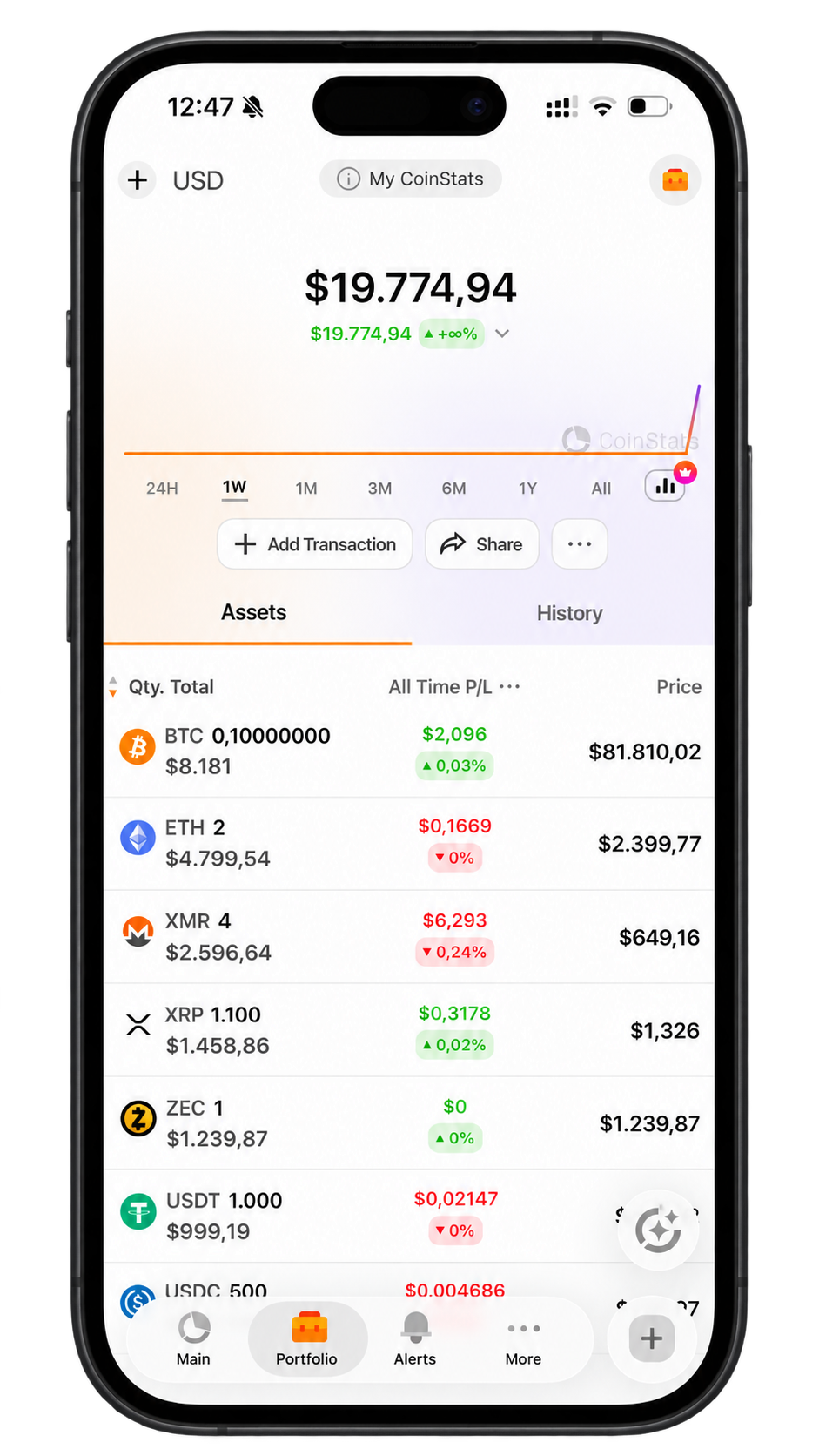
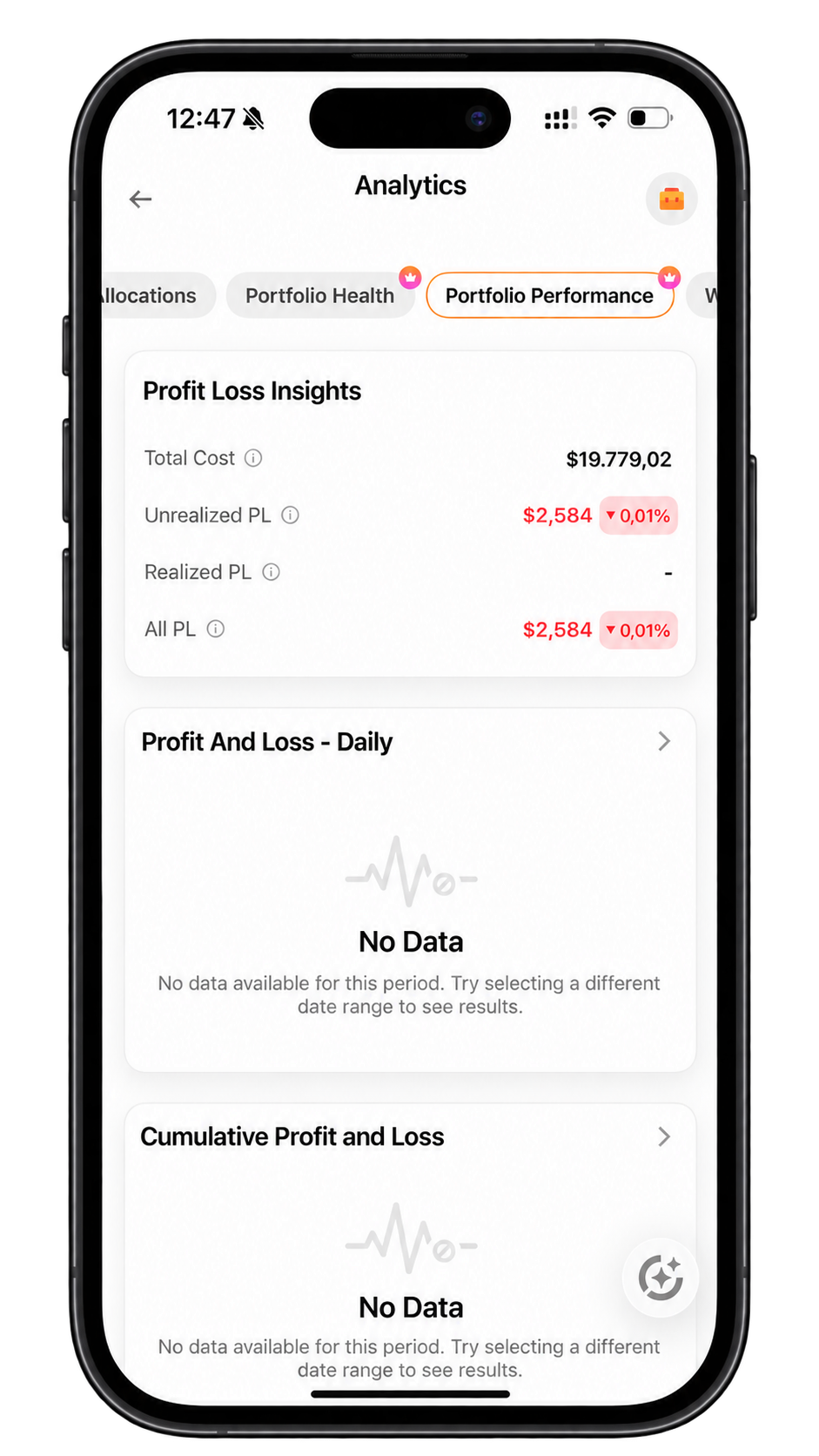
CoinStats calculates portfolio performance through several metrics, including all-time profit and loss, realized P&L, unrealized P&L, performance since the latest transaction, and changes over the previous 24 hours. These measurements serve different purposes and should not be interpreted interchangeably.
Realized P&L reflects the gains or losses associated with completed disposals, while unrealized P&L represents the difference between the current value and cost basis of assets still held. All-time P&L combines those two results, providing a broader assessment of investment performance.
For cost-basis calculations, CoinStats generally applies first-in, first-out (FIFO) matching, assigning the earliest acquired units to the earliest disposals. Remaining holdings retain their associated acquisition costs, with weighted average cost information used to assess unrealized performance.
Transaction fees are incorporated into realized and all-time P&L calculations, although CoinStats does not incorporate them into its displayed unrealized P&L metric in the same manner. Consequently, users should distinguish between the platform’s accounting definitions when interpreting the profitability of open and completed positions.
One of the more important settings concerns how transfers are treated. CoinStats allows users to include or exclude transfer activity from performance calculations, and the selected method can materially change historical results.
When transfers are included, incoming assets may be treated as purchases and outgoing transfers as sales for calculation purposes. Excluding them avoids treating ordinary wallet movements as trades, but can also leave transferred holdings without unrealized P&L if their original acquisition transactions are unavailable.
For example, an investor who purchased Bitcoin on one exchange and subsequently transferred it to a hardware wallet should not assume that CoinStats will automatically preserve the complete acquisition history across both accounts. If the relevant records are missing or transfers are classified incorrectly, cost basis and reported gains may require manual reconciliation.
These settings make CoinStats more flexible than basic balance trackers, but they also place responsibility on the user to verify that the calculations reflect actual investment activity.
Historical Charts, Allocation, and Portfolio Performance
CoinStats provides portfolio performance charts across multiple timeframes, allowing users to examine short-term changes alongside longer-term investment results. Its analytics include asset allocation breakdowns, portfolio inflows and outflows, individual asset performance, and comparisons against Bitcoin and Ethereum.
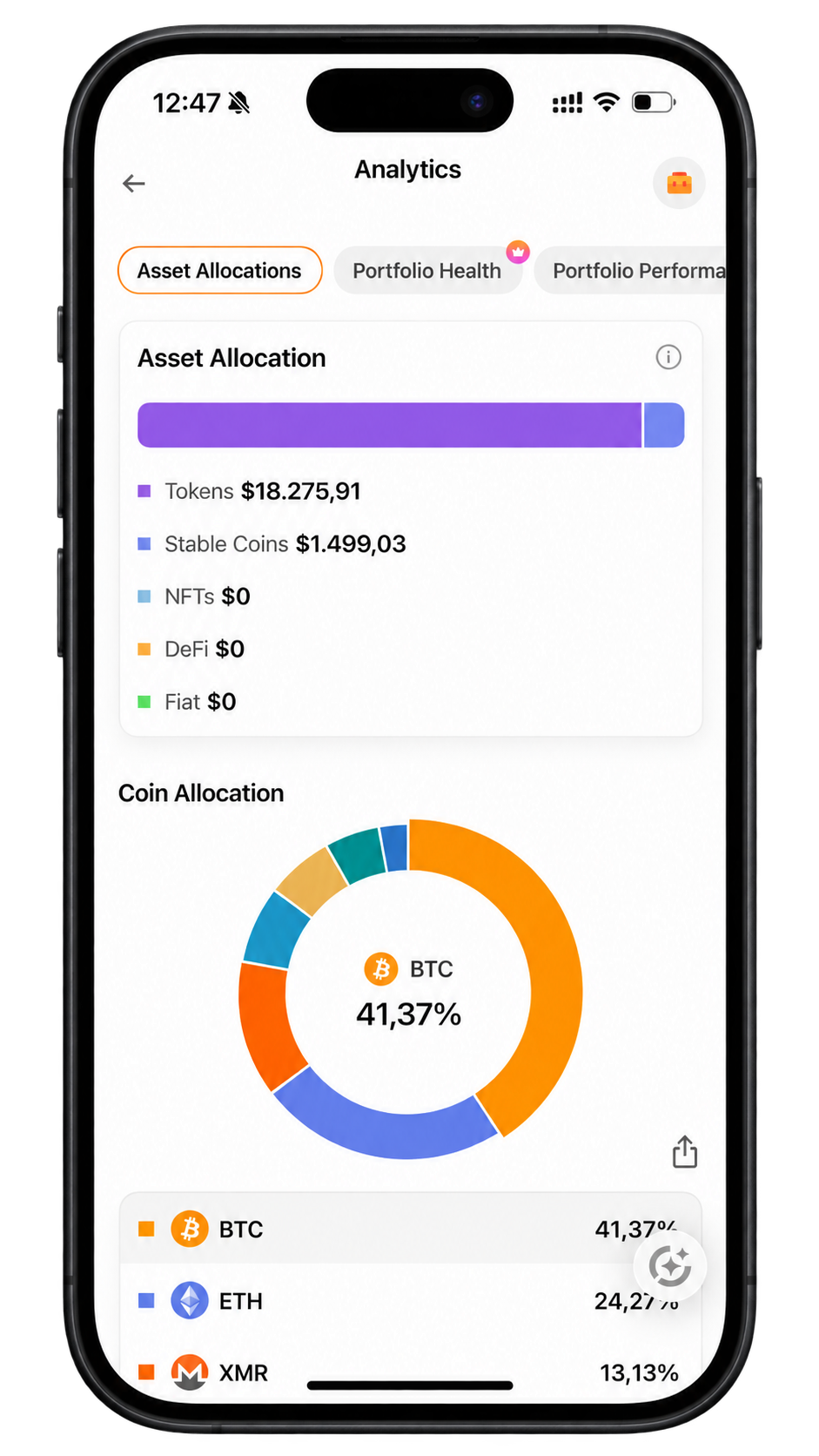
The allocation tools help identify concentration within particular cryptocurrencies or asset categories, while portfolio heatmaps provide a visual overview of relative winners and losers. Investors can also examine the contribution of individual holdings to overall returns, making it easier to identify whether performance is driven by a diversified collection of assets or a small number of highly volatile positions.
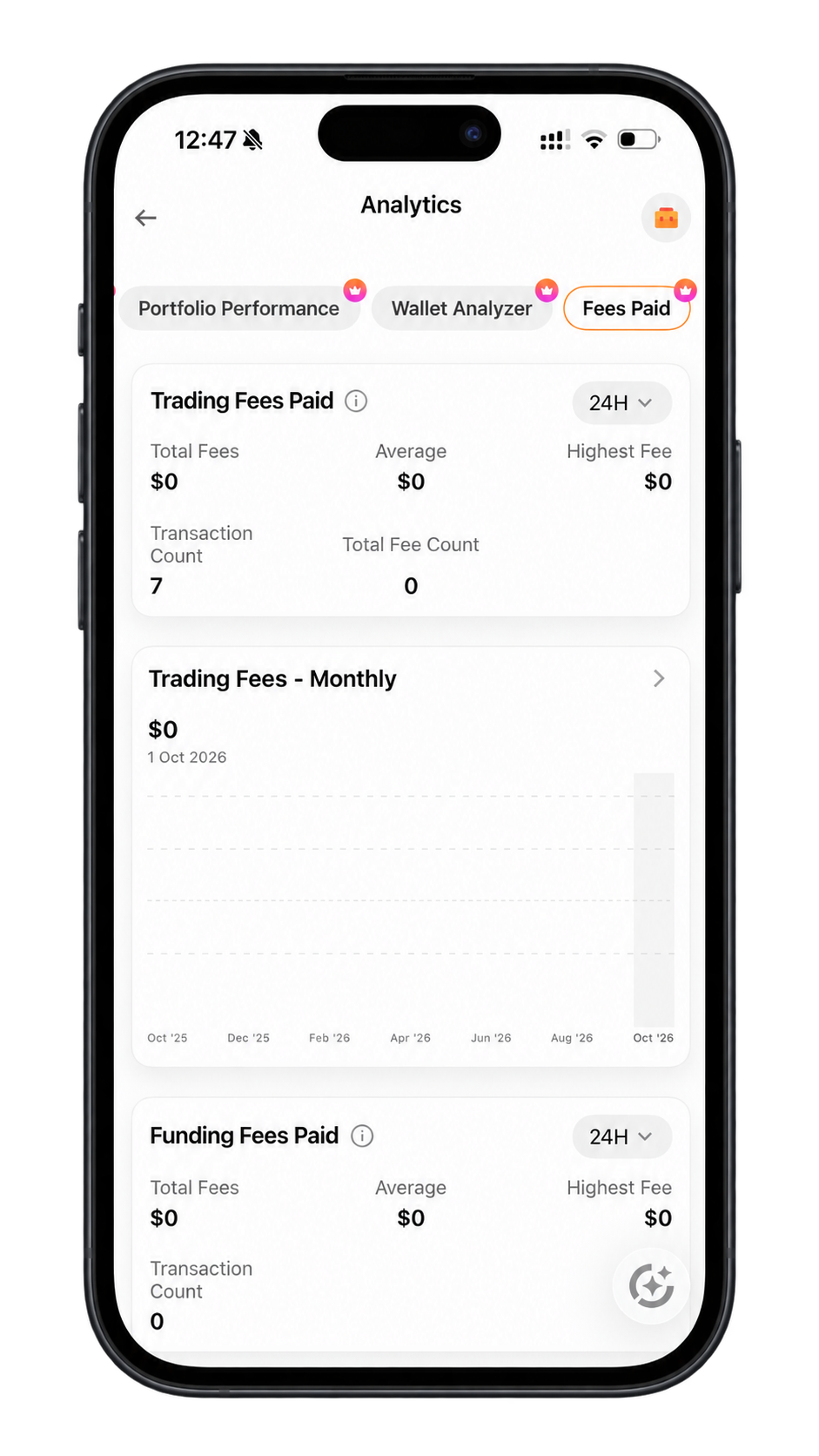
Fee analytics provide additional context by examining transaction expenses and supported blockchain costs. This is particularly useful for active investors whose gross trading gains may be reduced by exchange commissions, network fees, or repeated interactions with decentralized protocols.
However, historical charts are only as reliable as the underlying records. Missing transactions, incorrect asset prices, unsupported tokens, and delayed account synchronization can create discrepancies between displayed performance and actual account history. Portfolio balances should therefore be reconciled periodically, particularly after significant transfers or exchange account changes.
Portfolio Time Machine
CoinStats’ Time Machine allows users to examine portfolio holdings, valuations, and profit-and-loss information for selected historical dates. The feature is particularly useful for reviewing how allocations changed over time or understanding the portfolio’s composition during previous market periods.
Time Machine is available to Degen subscribers and uses two different methods of reconstructing historical information. From the date the feature becomes active under a Degen subscription, CoinStats records daily portfolio snapshots that preserve the holdings and valuations displayed at that time.
For earlier dates, the platform attempts to reconstruct the portfolio from available transaction histories and historical prices. These reconstructed results may be incomplete when exchange records are missing, wallet history is unsupported, or transactions have been incorrectly classified.
The distinction matters because an actual stored snapshot provides a more dependable record of what the dashboard displayed on a particular date than a reconstruction based on incomplete historical transactions. Time Machine is therefore a useful portfolio analysis tool, but it should not replace original exchange statements or independent financial records.
Portfolio Health Score and Token Risk Analysis
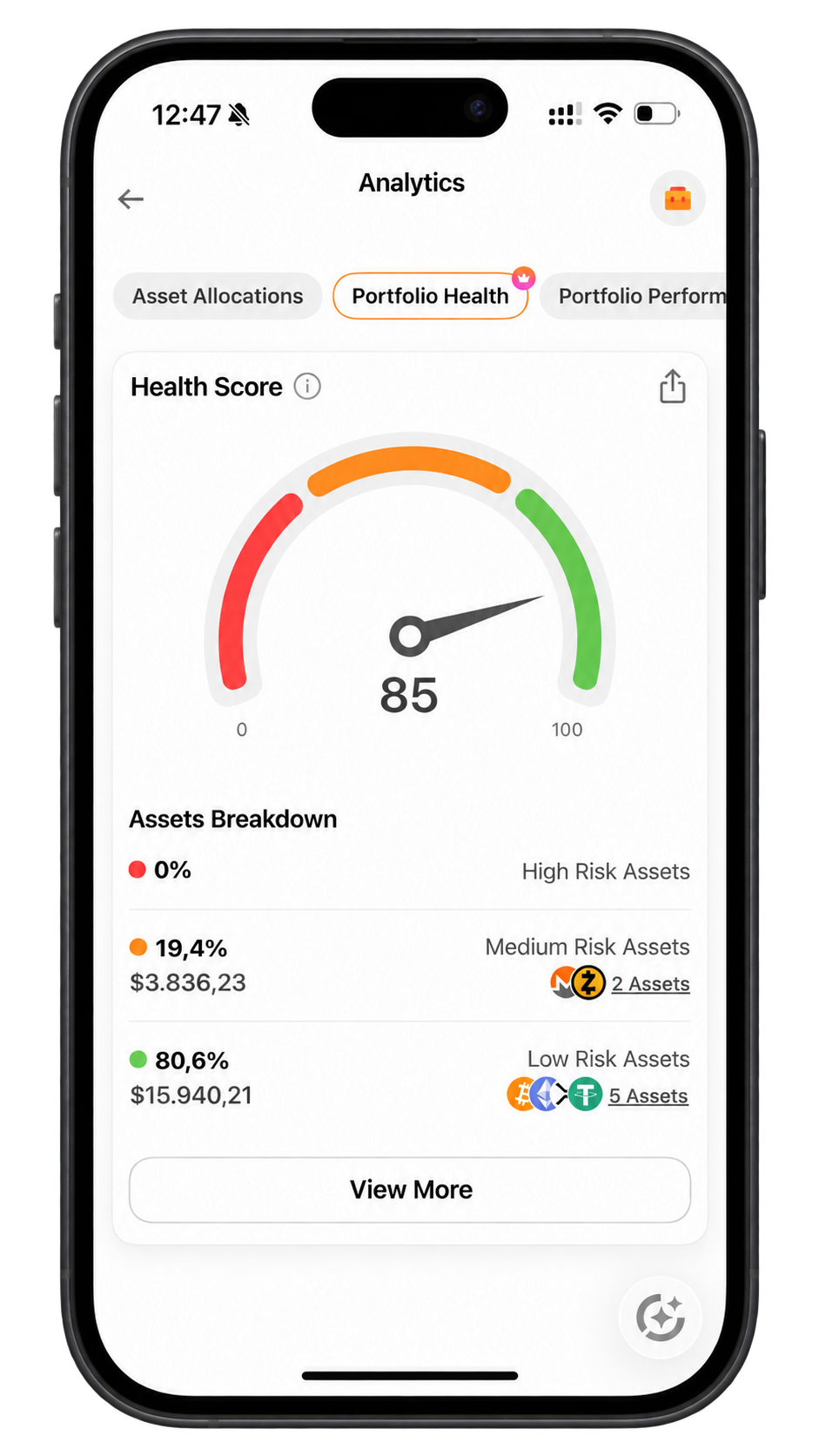
CoinStats provides a Portfolio Health Score that evaluates selected characteristics of a user’s holdings, including volatility, liquidity, market capitalization, and asset-level risk indicators. The score is presented through a color-coded assessment, with additional breakdowns showing which holdings contribute most significantly to the portfolio’s overall risk profile.
This can help investors identify excessive concentration in speculative assets or holdings with limited liquidity, particularly when a portfolio contains numerous smaller cryptocurrencies whose risks are difficult to assess individually.
The platform also incorporates Token Trust Scores and risk assessments powered by Glider, examining supported smart contracts for potential vulnerabilities and other warning indicators. These tools can help identify suspicious token characteristics, although an apparently favorable score does not establish that a project is financially sound or that its smart contracts are free from undiscovered vulnerabilities.
Neither assessment should be interpreted as a complete measure of portfolio safety. Market correlation, leverage, exchange custody, protocol dependencies, and liquidity during periods of financial stress can produce losses that are not fully captured by a simplified risk score.
CoinStats AI Insights, Alerts, and Investment Tools
CoinStats extends its portfolio tracking functionality through research, notifications, and planning tools designed to help investors interpret market developments and make more informed decisions. These features are particularly relevant to users who want portfolio-specific insights rather than general cryptocurrency price information.
CoinStats AI Agent and Market Research
Introduced in April 2026, CoinStats AI Agent combines cryptocurrency research with information from supported portfolios, blockchain activity, market data, and external information sources. Available to Premium and Degen subscribers, the assistant can answer questions about individual holdings, analyze cryptocurrency price movements, and examine market developments through a conversational interface.
The AI Agent uses multiple research processes to examine relevant news, social sentiment, technical indicators, exchange information, and blockchain activity. Its outputs can include written analysis, charts, and structured comparisons, allowing users to investigate specific cryptocurrencies or broader portfolio questions without manually assembling information from several research services.
For example, an investor could ask why a particular token has declined, examine the assets contributing most heavily to portfolio losses, or investigate unusual activity surrounding a wallet address. The assistant also supports research-oriented workflows involving tokenomics, cryptocurrency projects, and on-chain transactions.
CoinStats provides Fast, Deep Research, and supported Backtesting modes, with the more advanced historical testing functionality associated with the Degen subscription. Its Private Mode offers an alternative research-processing arrangement for users who want greater control over how AI queries are handled.
AI-generated analysis nevertheless requires independent judgment. Social sentiment can be manipulated, on-chain transactions may have several possible interpretations, and historical market relationships do not necessarily predict future returns. The AI Agent is therefore most useful as a research and portfolio analysis assistant rather than a source of guaranteed trading signals.
AI Assistant Connectivity Through MCP
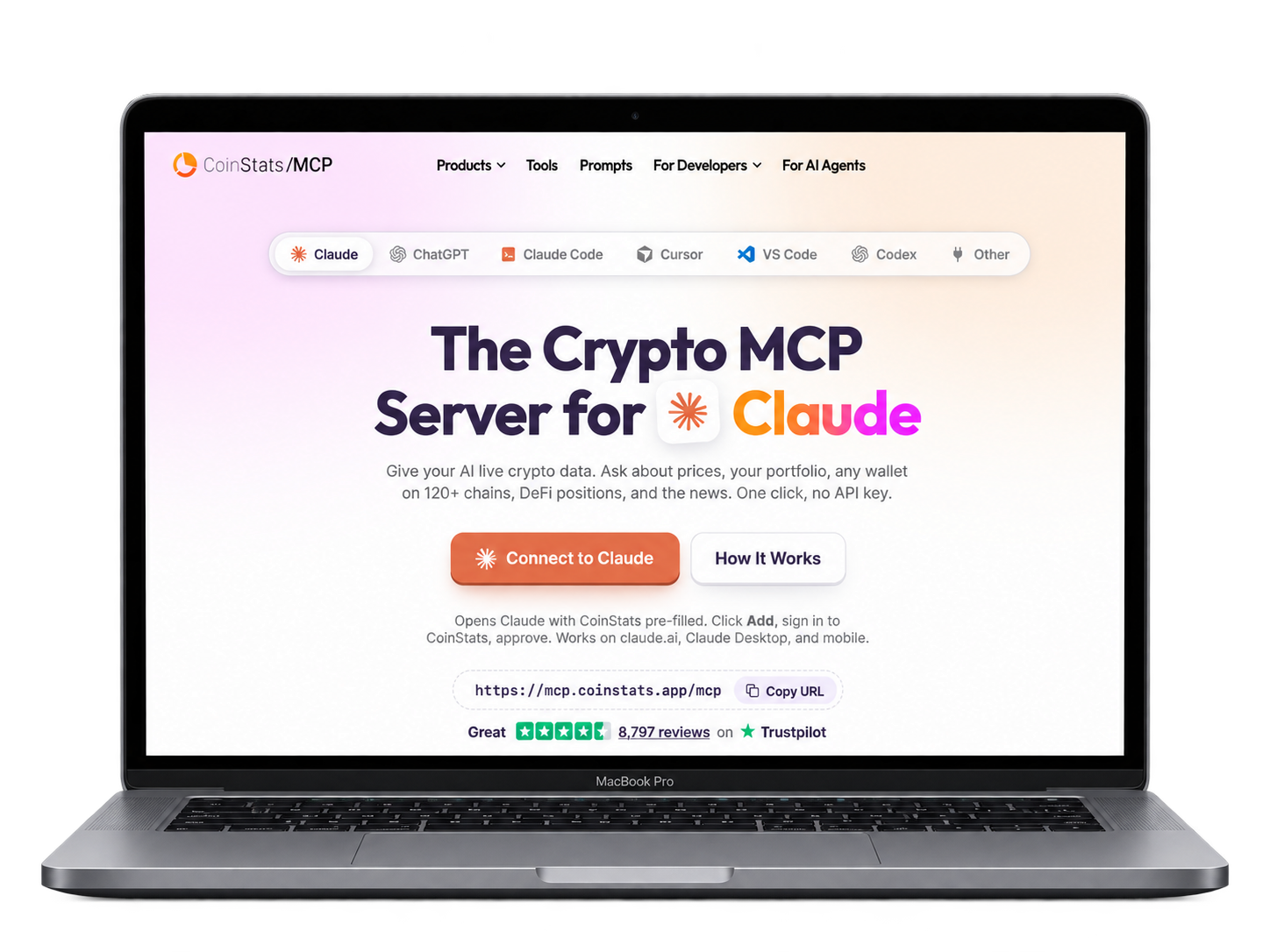
CoinStats also supports the Model Context Protocol (MCP), allowing compatible external AI assistants to retrieve authorized market and portfolio information. This includes access to supported balances, wallet activity, DeFi positions, cryptocurrency prices, and transaction records through a conversational workflow.
The integration uses OAuth authorization with scoped access rather than requiring users to provide their CoinStats API credentials directly to an assistant. Its current implementation is designed around read-only market and portfolio operations, preventing connected assistants from signing transactions, placing trades, or transferring cryptocurrency.
For investors who already use external AI tools for research or financial analysis, MCP provides another way to organize portfolio information and investigate market developments without manually exporting every dataset.
However, the connection should not be confused with autonomous investment management. The assistant can retrieve and analyze authorized information, but it does not receive unrestricted control over the user’s cryptocurrency holdings.
Price Alerts and Portfolio Notifications
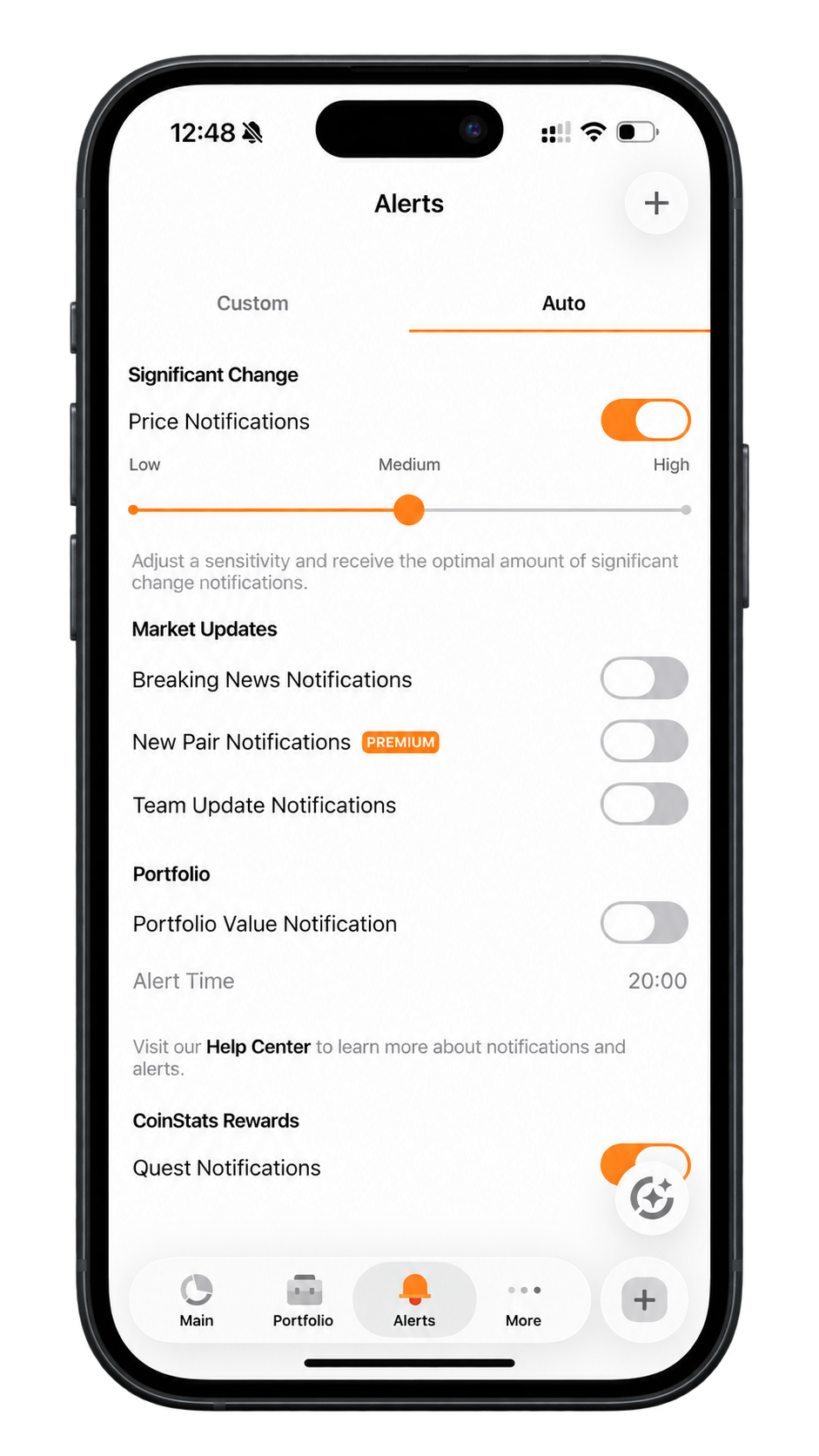
CoinStats supports customizable alerts covering cryptocurrency prices, trading volume, market capitalization, NFT floor prices, and portfolio valuations. These notifications help investors monitor selected market conditions without continuously refreshing charts or exchange applications.
Price alerts can be configured around specified thresholds or percentage changes, while volume and market-cap alerts provide additional ways to identify unusual market activity. NFT alerts operate around collection floor prices rather than guaranteeing the availability of a buyer for an individual asset.
Portfolio-value notifications are available to Degen subscribers, allowing users to receive alerts when their total tracked holdings reach selected valuation thresholds. CoinStats also supports notifications related to wallet activity and newly detected transactions, subject to the relevant connection and subscription settings.
These features are useful for monitoring investment milestones or potentially significant market movements, but their delivery depends on available market data and notification services. Alerts should therefore be treated as monitoring tools rather than guaranteed execution instructions.
Exit Strategy and Profit-Taking Tools
CoinStats includes an Exit Strategy feature that helps users establish potential selling targets for cryptocurrencies within their portfolios. Rather than relying exclusively on short-term market movements, investors can define price levels at which they intend to reduce exposure or realize gains.
The tool allows users to associate target prices with selected holdings and receive notifications when those levels are reached. Premium functionality also includes AI-assisted Bull Market Price estimates, which can provide an additional reference when considering potential valuation scenarios.
The main benefit is encouraging a more structured approach to investment exits, particularly during periods of strong market speculation when investors may otherwise hesitate to realize gains.
However, Exit Strategy is primarily a planning and notification tool rather than an automated execution system that guarantees a sale at the selected price. Investors remain responsible for placing transactions, evaluating available liquidity, and accounting for applicable fees and taxes.
AI-generated price estimates should also be treated cautiously, since cryptocurrency valuations can deviate substantially from historical patterns or model assumptions.
Crypto Tax Reporting and Transaction Exports
CoinStats supports cryptocurrency tax preparation through transaction exports and its integration with CoinLedger. Investors can export supported transaction histories and portfolio balances in CSV format, allowing records to be reviewed in spreadsheets, shared with accountants, or imported into specialized tax software.
Its CoinLedger integration provides a more direct reporting workflow, particularly through the CoinStats mobile application, where users can authorize read-only access to selected portfolios and transfer their transaction histories for tax calculations. CoinLedger then handles transaction review and the preparation of supported tax reports.
This arrangement is useful for investors managing activity across several exchanges and wallets, although CoinStats should not be considered a complete standalone tax accounting system. Its principal function is to collect and organize investment data, while jurisdiction-specific tax calculations and reporting are handled through the relevant external service.
Accurate tax reporting also requires more than importing current balances. Investors need reliable acquisition dates, disposal values, transaction fees, and classifications for events such as staking rewards, swaps, liquidity provision, and cross-chain transfers. Missing records can lead to incorrect cost-basis calculations even when an exchange connection appears to function normally.
Maintaining accurate cryptocurrency tax records throughout the year is therefore important, particularly for investors whose activity involves multiple blockchains or decentralized protocols.
CoinStats is a useful starting point for consolidating the information required by tax software, but users should reconcile significant transactions against original exchange statements and blockchain records before relying on the resulting calculations.
Additional Market and Portfolio Management Features
Beyond its principal tracking and analytics tools, CoinStats includes market research pages, cryptocurrency news, watchlists, and optional transaction services. Its research functionality covers major cryptocurrencies, trading activity, historical charts, market sentiment, and selected derivatives indicators, while personalized watchlists make it easier to follow assets that are not currently held in a portfolio.
The platform also supports token swapping through compatible wallets, with liquidity aggregated from available sources. These operations differ from passive tracking because they require transaction authorization and introduce network fees, execution slippage, and smart contract risks. Paid subscription benefits may reduce CoinStats’ own swap fees, but they do not necessarily remove underlying blockchain or third-party execution costs.
CoinStats is available through web, iOS, Android, and macOS interfaces, alongside supported widgets and Apple Watch functionality. This makes it convenient to monitor holdings across devices, particularly for investors who want access to balances, alerts, and portfolio performance throughout the day.
Its broader feature selection makes CoinStats particularly useful as a general cryptocurrency investment dashboard rather than a narrowly focused wallet viewer. Nevertheless, its most important limitations remain the uneven depth of exchange transaction imports, protocol-specific DeFi coverage, NFT network restrictions, and the dependence of historical performance calculations on complete and correctly classified data.
Pricing & Plans
CoinStats Pricing and Subscription Plans
CoinStats offers three subscription tiers—Basic, Premium, and Degen—with pricing determined primarily by portfolio capacity, transaction limits, synchronization allowances, and access to advanced analytics. The platform provides a functional free plan for investors managing relatively straightforward cryptocurrency holdings, while its paid subscriptions introduce more extensive performance analysis, AI-powered research, customizable alerts, and higher account-management limits.
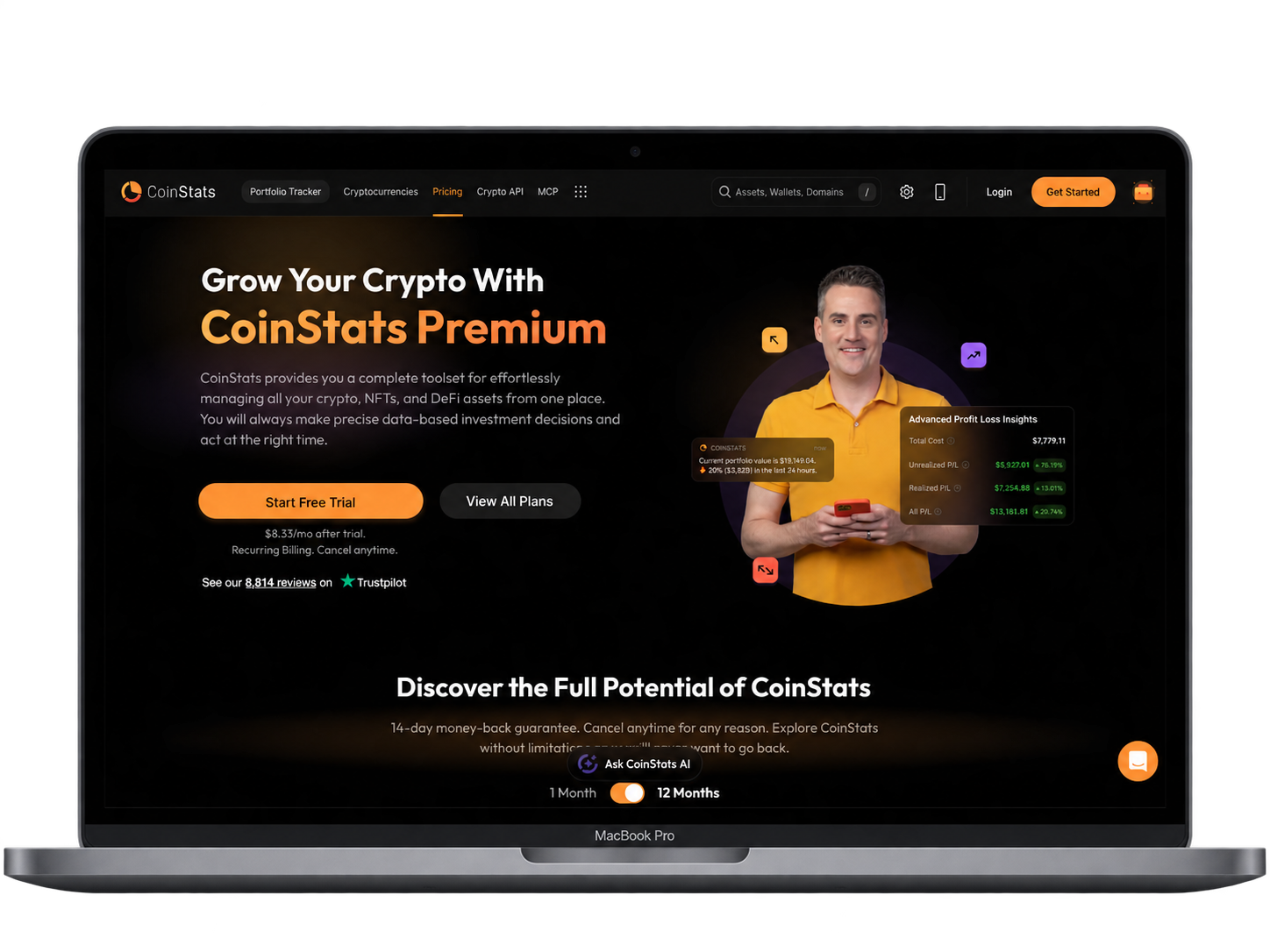
Premium starts at an advertised $13.99 per month with annual billing, while Degen is advertised at approximately $62.91 per month on the same billing basis. The substantial difference between these subscriptions reflects their intended audiences: Premium targets investors who want detailed portfolio monitoring across multiple accounts, whereas Degen is designed for users managing considerably larger transaction histories or requiring specialized analytical tools.
CoinStats Pricing Comparison
| Feature | Basic (Free) | Premium | Degen |
|---|---|---|---|
| Annual-plan monthly equivalent | $0 | $13.99 | $62.91 |
| Portfolios | 10 | 100 | 500 |
| Transaction history capacity | 20,000 | 100,000 | 1,000,000 |
| Daily manual syncs per portfolio | 10 | 200 | Unlimited |
| Advanced performance analytics | Limited | Included | Included |
| Portfolio heatmap and allocation analysis | Limited | Included | Included |
| Wallet and fee analysis | Limited | Included | Included |
| AI Agent and Deep Research | No full access | Included | Higher credit allowances |
| AI trading backtesting | No | No | Included |
| Custom alerts | Limited | Included | Included |
| Advertised CoinStats swap fee | Standard | 0% | 0% |
| Customer support | Basic, under 72 hours | Priority, under 24 hours | VIP, under 1 hour |
Basic Free Plan
CoinStats Basic provides free portfolio tracking with support for up to ten portfolios, 20,000 transactions, and ten manual synchronization requests per portfolio each day. Users can connect supported wallets and exchanges, monitor cryptocurrency balances, and access essential market information without committing to a recurring subscription.
The allowance is sufficient for many investors who maintain a manageable collection of cryptocurrency holdings and primarily want to monitor their combined value. Basic also provides a practical opportunity to evaluate exchange connectivity and identify whether CoinStats can correctly retrieve the information needed from existing accounts before paying for additional features.
However, the free subscription has restrictions on advanced analytics, AI-powered research, and specialized portfolio-management functionality. The synchronization allowance may also become inconvenient for active investors who frequently move assets between exchanges and wallets, particularly when transactions need to appear in the dashboard soon after execution.
For users with relatively simple holdings, Basic offers a reasonable starting point. Its limitations become more noticeable as transaction histories grow, the number of connected accounts increases, or detailed performance analysis becomes important.
Premium Plan
CoinStats Premium is advertised from $13.99 per month with annual billing, increasing portfolio capacity to 100 connections and transaction history coverage to 100,000 records. The subscription also provides up to 200 manual synchronization requests per portfolio daily, making it more suitable for investors who actively manage cryptocurrency across several exchanges, wallets, and decentralized applications.
The principal benefit is access to CoinStats’ advanced analytical tools, including detailed profit-and-loss reporting, portfolio performance charts, asset allocation analysis, wallet analytics, and transaction fee assessments. Premium also includes customizable alerts, AI-powered market research, Bull Market Price estimates, and an advertisement-free interface.
The subscription’s multimodal AI Agent and Deep Research functionality provide additional value for investors who want portfolio-specific analysis rather than relying exclusively on conventional market-data dashboards. These tools can help users investigate holdings, interpret market developments, and identify potential portfolio risks, although AI-generated assessments remain subject to data quality and analytical limitations.
Premium also advertises a 0% CoinStats swapping fee, potentially reducing the platform’s own charges on eligible transactions. However, the benefit does not eliminate blockchain network fees, price impact, or other execution expenses, and users should review the actual swap quote before confirming a transaction.
For most investors who have outgrown the free plan, Premium offers the strongest balance between subscription cost and functionality. Its capacity is generous enough for substantial personal cryptocurrency portfolios, while the additional analytical tools are more relevant to everyday investment management than the specialized features included in Degen.
Degen Plan
CoinStats Degen is the platform’s highest standard subscription tier, with an advertised annual-plan monthly equivalent of approximately $62.91. It increases portfolio capacity to 500 connections, supports up to one million transactions, and removes the stated daily manual synchronization limit, making it suitable for investors with extensive trading histories and large collections of exchange accounts or blockchain wallets.
Beyond the expanded limits, Degen provides increased AI Agent and Deep Research credit allowances, AI Backtesting for Traders, and access to specialized portfolio analysis functionality. Its Time Machine feature allows users to examine historical portfolio holdings and valuations, including daily snapshots recorded during their Degen subscription.
These capabilities are particularly relevant to investors who need to reconstruct historical exposure, examine complicated portfolio activity, or frequently analyze large amounts of transaction data. However, unlimited synchronization requests should not be confused with continuously updated exchange information, since source API restrictions and connection delays can still affect data availability.
Degen also includes VIP customer support with an advertised response target of under one hour, providing a higher level of assistance than the standard and Premium subscriptions.
The considerable price increase makes Degen difficult to justify for investors who primarily need ordinary balance monitoring and profit-and-loss calculations. Its strongest appeal lies in the expanded capacity and specialist analytical tools, particularly for users whose requirements exceed Premium’s 100,000-transaction limit or who specifically need AI backtesting and historical portfolio snapshots.
Free Trial, Billing, and Additional Costs
CoinStats offers a seven-day Premium trial for eligible users subscribing through its annual-plan checkout. The trial provides an opportunity to evaluate advanced analytics, AI research tools, and paid portfolio-management functionality before the subscription charge takes effect. Unless cancelled before the trial expires, the subscription renews according to the selected billing terms.
Annual plans generally provide lower effective monthly prices than month-to-month subscriptions, although users commit to the full billing period upfront. CoinStats also offers a 14-day money-back guarantee subject to its applicable terms, while subscription management and cancellation procedures can differ depending on whether the purchase was completed through the website, Apple App Store, or Google Play.
Cancellation does not immediately remove existing portfolio connections, but access to paid functionality becomes restricted after the subscription period ends. Users may also lose the ability to add portfolios beyond the free plan’s limits unless they renew or reduce their account usage.
For investors using CoinStats’ optional swapping functionality, trading costs should be considered separately from subscription charges. Premium and Degen advertise zero CoinStats platform swapping fees, but blockchain transaction fees and execution costs can still apply. The platform’s standard DeFi swap documentation also identifies a 0.5% CoinStats fee outside applicable subscription benefits, making it important to confirm the final quoted charges rather than assume that every swap is entirely free.
Is CoinStats Premium or Degen Worth Paying For?
CoinStats provides meaningful value when its portfolio-management capabilities replace the manual work involved in monitoring numerous exchange accounts, wallets, and decentralized investments. However, the appropriate subscription depends less on the amount of cryptocurrency held than on the number of connections, transaction records, and analytical features required.
For investors comparing crypto portfolio trackers, the free plan provides a useful benchmark for determining whether additional functionality is necessary. Premium becomes worthwhile when advanced performance analytics, AI research, detailed fee analysis, and frequent synchronization improve the investment-monitoring process. Degen serves a narrower audience requiring substantially greater capacity, enhanced AI functionality, and historical portfolio analysis.
Premium represents the most balanced CoinStats subscription for active cryptocurrency investors, offering a substantial increase in functionality without Degen’s considerably higher cost. The latter is better suited to users who can make practical use of its expanded transaction limits and specialist tools, while Basic remains sufficient for straightforward portfolio monitoring.
Ultimately, paying for CoinStats is most worthwhile when its additional features provide clearer investment records, better portfolio oversight, or meaningful time savings. A more expensive subscription does not automatically improve investment returns, particularly when the underlying transaction data remains incomplete or requires manual reconciliation.
Security & UX
CoinStats User Experience: Desktop and Mobile
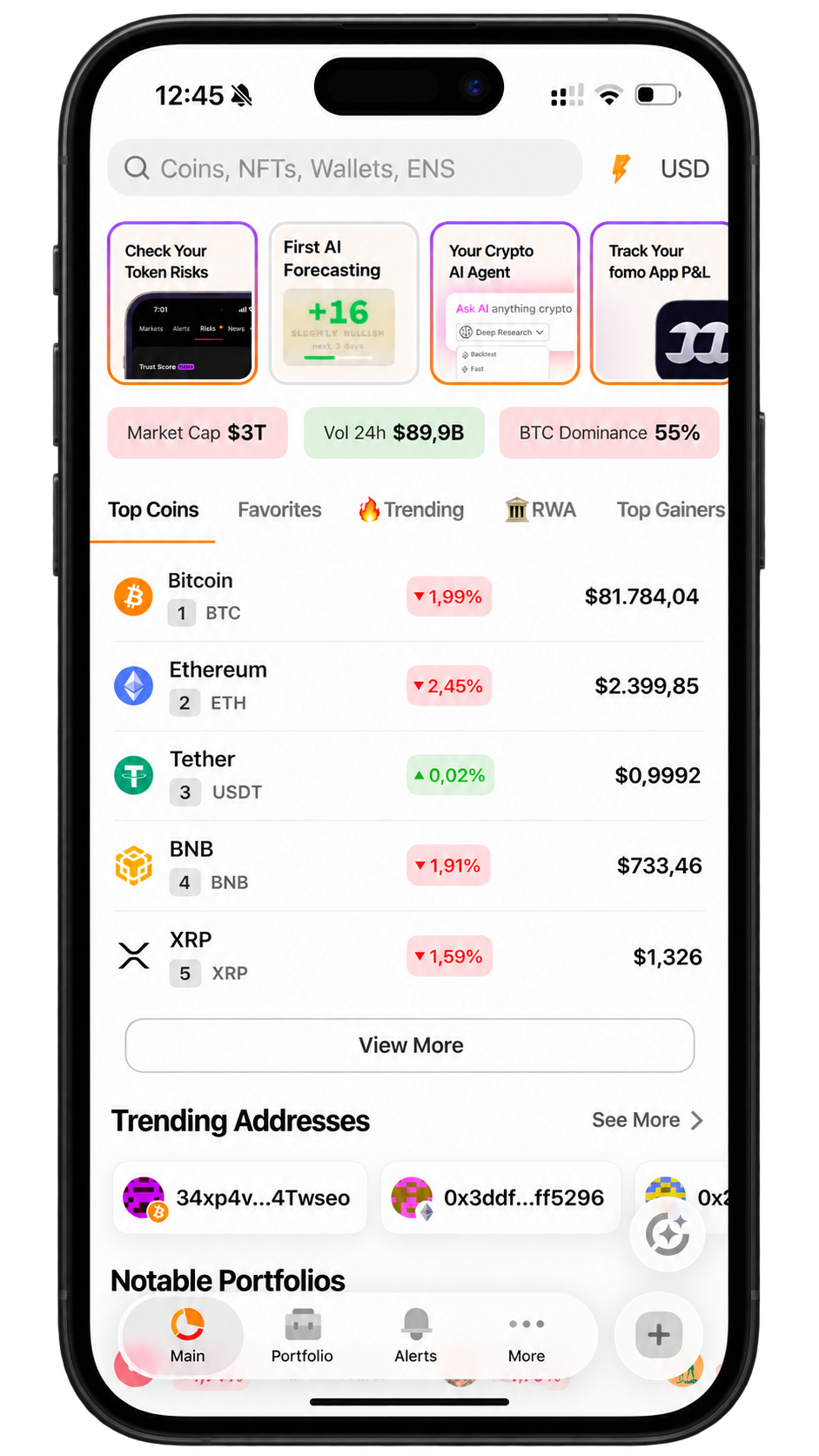
CoinStats provides a consistent portfolio management experience across web browsers, macOS, iOS, Android, and Apple Watch, allowing investors to monitor their cryptocurrency holdings through different devices without maintaining separate portfolio records. Its interface emphasizes accessibility, with portfolio balances, asset performance, market movements, and account allocations presented through a centralized dashboard. Although the platform offers an extensive collection of analytical tools, its navigation remains relatively straightforward for users primarily interested in checking investments and monitoring changes in portfolio value.
The desktop experience is particularly useful for detailed portfolio analysis, where the larger interface provides greater visibility into historical performance, individual asset contributions, and transaction activity. CoinStats organizes information into dedicated portfolio, analytics, and asset views, allowing investors to examine individual accounts or assess their combined holdings. Certain analytical features, including the portfolio heatmap and detailed Portfolio Value Chart, are exclusive to the web interface, making desktop access preferable for investors who regularly examine longer-term performance or compare allocations across several accounts.
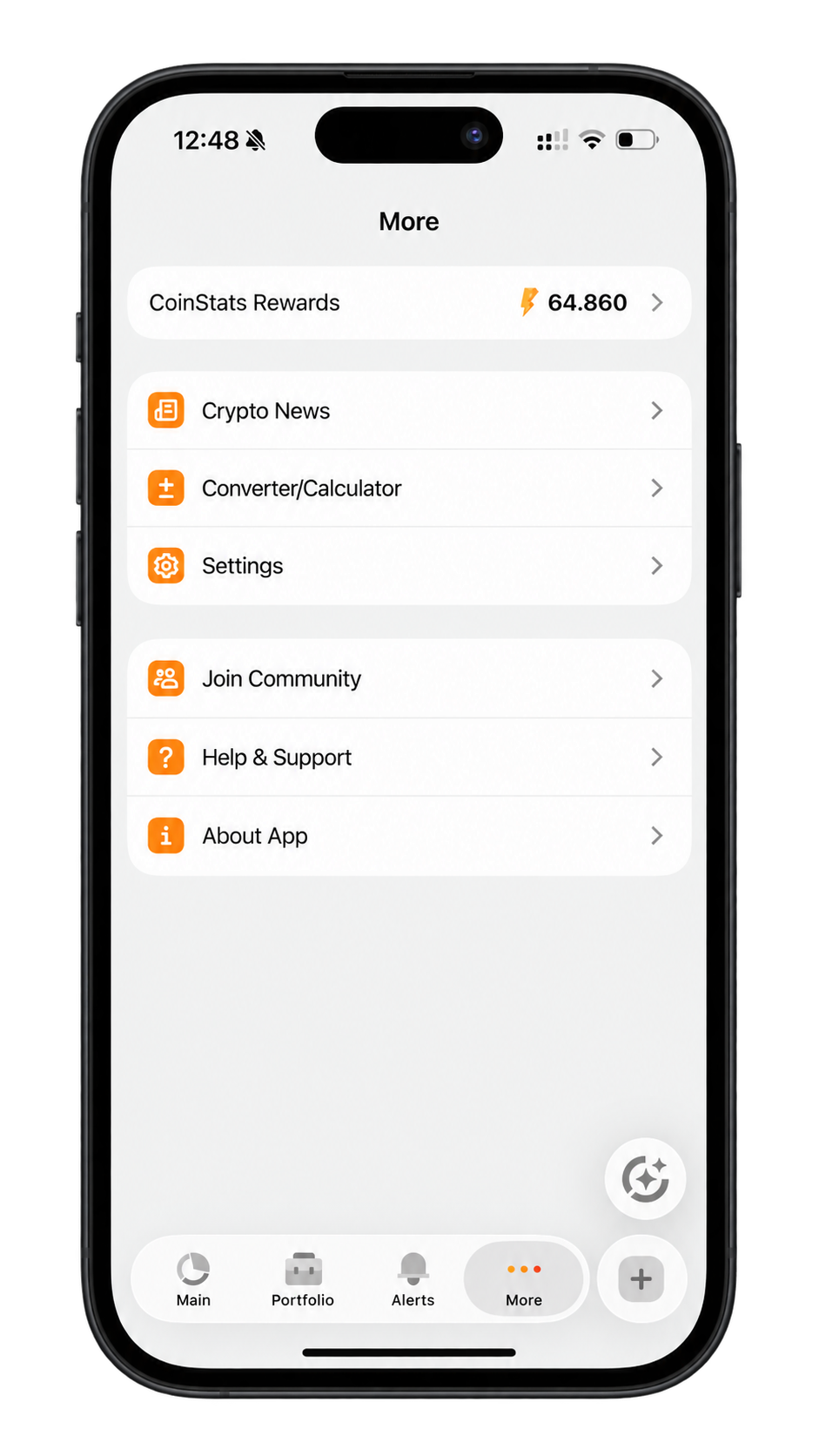
Mobile access offers much of the same functionality through a more compact interface, with particular strengths in everyday portfolio monitoring and notifications. Users can review balances, inspect individual holdings, examine performance analytics, follow cryptocurrency prices, and receive alerts about selected market conditions. Home-screen widgets provide convenient access to market and portfolio information, while Apple Watch support extends basic monitoring to compatible wearable devices.
CoinStats also allows users to organize connected accounts into portfolio groups, making it easier to separate long-term investments, active trading balances, and holdings maintained across different wallets. Both desktop and mobile users can switch between individual portfolios and consolidated views, reducing the difficulty of managing numerous accounts. Portfolio watchlists offer another useful option for monitoring public blockchain addresses without incorporating those holdings into personal investment calculations.
The interface can nevertheless become more demanding as portfolio complexity increases. Investors maintaining numerous exchange connections, blockchain wallets, and DeFi positions may need to navigate several analytical sections to obtain a complete picture of their exposure, while certain advanced features require paid subscriptions. The differences between mobile and desktop functionality also mean users cannot assume that every chart or reporting tool is available identically across devices.
CoinStats delivers its strongest user experience by combining convenient mobile monitoring with more extensive desktop analytics. Its interface is suitable for everyday cryptocurrency investors while providing sufficient depth for users managing more complicated portfolios, although the quality of the experience still depends on the completeness and reliability of connected account data.
CoinStats Security, Privacy, and Trust
CoinStats uses several security measures intended to protect user accounts and connected investment information, including read-only exchange integrations, encrypted data storage, and device-level access controls. Its portfolio tracking functionality generally does not require customers to transfer cryptocurrency into a CoinStats wallet or authorize transactions, allowing investors to maintain custody through their preferred exchanges and self-custody wallets.
For centralized exchange connections, CoinStats supports restricted API credentials that provide access to balances, transaction histories, and other account information without granting trading or withdrawal permissions. Public blockchain addresses offer an alternative for monitoring self-custody wallets without exposing private keys. This separation reduces the financial risks associated with ordinary portfolio tracking, although users should still review the permissions requested by each exchange integration and avoid enabling unnecessary account access.
The application also supports PIN protection and biometric authentication, including Face ID on compatible devices, alongside encryption and access controls intended to protect sensitive information. Additional security measures can be applied at the exchange level, including two-factor authentication and API IP restrictions where supported. Using dedicated read-only credentials and periodically removing unused connections can further reduce unnecessary exposure.
However, these safeguards should not be confused with complete protection against account compromise or broader cryptocurrency security risks. Access to CoinStats may expose sensitive financial information even when an attacker cannot directly transfer assets, while optional wallet transactions and swaps involve permissions beyond passive monitoring. The platform’s security record also warrants closer examination following a significant breach in June 2024.
The June 2024 CoinStats Wallet Security Breach
On June 22, 2024, CoinStats detected unauthorized activity involving wallets created through its integrated non-custodial wallet service. The incident prompted the company to temporarily suspend its platform while investigating suspicious transactions and potential infrastructure compromises. Its subsequent investigation identified unauthorized access affecting internal systems and third-party service providers involved in securing wallet-related credentials.
The attack compromised private keys associated with 1,590 CoinStats Wallets, representing approximately 1.3% of the wallets associated with the service at the time. CoinStats reported that attackers stole approximately $2.2 million in cryptocurrency, making the incident one of the most significant events in the company’s security history.
The investigation identified compromises involving HashiCorp Vault infrastructure, which secured wallet-related authentication information, alongside access to third-party wallet service systems. CoinStats attributed the attack to the Lazarus Group or a related organization, although that attribution reflected the company’s investigative findings rather than a publicly established judicial determination.
Importantly, the incident affected wallets created within CoinStats rather than ordinary externally connected exchange accounts or self-custody wallets used exclusively for portfolio tracking. CoinStats reported that accounts connected through read-only APIs and external wallets such as MetaMask and Phantom were not compromised. This distinction is significant because the security requirements involved in protecting wallet private keys are fundamentally different from those associated with retrieving public blockchain information or exchange balances.
Following the breach, CoinStats rebuilt its production environment, reported the incident to law enforcement, and worked with external security specialists to investigate the attack and strengthen its infrastructure. The company announced that platform functionality had been restored by July 3, 2024, although the financial losses suffered by affected wallet holders remained a material consequence of the incident.
The breach demonstrates why investors should distinguish between portfolio monitoring and wallet custody when evaluating cryptocurrency applications. Read-only tracking presents a substantially different risk profile from services that generate, store, or manage private-key material, even when both functions are offered through the same interface.
The 2024 incident remains an important consideration in CoinStats’ overall trust assessment, despite the company’s subsequent security improvements. It does not establish that its current portfolio tracking connections are unsafe, but it highlights the consequences of infrastructure failures and the importance of limiting the permissions granted to third-party cryptocurrency services.
Privacy and Data Handling
Beyond the security of cryptocurrency holdings, CoinStats’ ability to consolidate information from numerous accounts introduces meaningful privacy considerations. The platform collects information associated with connected wallet addresses, transaction histories, account activity, device identifiers, and application usage. Depending on the connections established, this information can reveal a detailed picture of an investor’s asset allocation, transaction behavior, and financial activity.
CoinStats’ privacy policy states that the company does not sell, rent, license, or lease users’ personal information to third parties. However, it permits information sharing with affiliated companies, external service providers, payment processors, and selected advertising partners under applicable conditions. Users should therefore distinguish between a commitment not to sell personal data and the broader collection and processing activities required to operate the service.
Privacy becomes particularly relevant when several public blockchain addresses are associated with the same CoinStats account. Although wallet addresses are publicly visible on their respective blockchains, combining them within a portfolio tracker can create connections between otherwise separate holdings. This aggregation may reveal investment relationships or transaction patterns that would be less immediately apparent when examining individual blockchain addresses independently.
CoinStats also supports portfolio sharing through generated links, with options to hide balances and, on supported web workflows, apply additional passcode protection. These features are useful for sharing performance information, but users should review the visibility settings before distributing portfolio links, particularly when the underlying accounts contain sensitive financial details.
For privacy-conscious investors, limiting unnecessary wallet connections, reviewing account permissions, and separating particularly sensitive holdings can reduce the amount of financial information consolidated within one service. Users should also periodically review their privacy settings and remove connections that no longer serve an investment-monitoring purpose.
Wallet Permissions and Additional Security Considerations
CoinStats’ portfolio monitoring tools provide visibility into cryptocurrency holdings, but they do not replace dedicated wallet-security practices. Investors who interact regularly with decentralized applications remain exposed to phishing, malicious smart contracts, compromised wallet interfaces, and previously authorized token permissions, regardless of how accurately their portfolios are tracked.
One important distinction concerns smart contract allowances, which can permit decentralized applications to transfer approved tokens without requiring a new authorization for every transaction. Investors can reduce unnecessary exposure by periodically reviewing and revoking risky token approvals, particularly after interacting with unfamiliar protocols or applications that request unlimited token allowances.
Maintaining separate wallets for long-term storage and active DeFi transactions can also reduce the amount of capital exposed to application-level security risks. Hardware wallets provide an additional layer of private-key protection, while transaction signatures and contract permissions should be reviewed independently of any information displayed by a portfolio tracker.
Overall, CoinStats offers a practical security model for passive cryptocurrency portfolio monitoring, particularly through read-only exchange connections and public-address tracking. However, its history of a significant wallet-related breach and the privacy implications of aggregating financial information mean users should approach the platform with appropriate caution.
CoinStats is best evaluated as a portfolio tracking and investment analytics service rather than a substitute for secure cryptocurrency custody. Its monitoring functionality can be used without surrendering control of externally held assets, but maintaining strong exchange security, protecting wallet credentials, and limiting unnecessary permissions remain essential responsibilities for every investor.
Preview
CoinStats vs Competitors
CoinStats vs DeBank, Delta, and De.Fi
CoinStats competes with several established cryptocurrency portfolio trackers, including DeBank, Delta, and De.Fi, although each platform approaches investment monitoring from a different perspective. CoinStats focuses on consolidating exchange accounts, blockchain wallets, and decentralized finance positions into a comprehensive portfolio management environment, while its alternatives place greater emphasis on on-chain transparency, traditional investment tracking, or Web3 security analysis.
The differences become particularly important when evaluating how accurately each service represents complex investments. CoinStats provides extensive portfolio analytics and broad account connectivity, but investors concentrated in decentralized protocols may require more detailed on-chain information, while those managing stocks alongside cryptocurrency may prefer a tracker built around multiple financial asset classes. Security-focused users also have different requirements, particularly when monitoring smart contract exposure and outstanding wallet permissions.
| Platform | Best For | Main Advantage | Main Limitation |
|---|---|---|---|
| CoinStats | Investors managing cryptocurrency across exchanges, wallets, and DeFi | Broad account synchronization, detailed P&L analytics, and AI-powered portfolio insights | Incomplete historical imports and synchronization limitations |
| DeBank | Active DeFi investors using Ethereum and EVM-compatible networks | Detailed wallet activity, protocol positions, and on-chain portfolio visibility | Limited centralized exchange integration and narrower non-EVM coverage |
| Delta | Investors combining cryptocurrency with stocks, ETFs, and other assets | Unified multi-asset tracking, brokerage connectivity, and investment analytics | Less comprehensive DeFi protocol accounting and asset limits on lower plans |
| De.Fi | Investors prioritizing DeFi security and smart contract risk analysis | Wallet monitoring, contract scanning, approval analysis, and security research | Less emphasis on comprehensive historical investment accounting |
CoinStats vs DeBank
DeBank specializes in blockchain wallet analysis and decentralized finance portfolio tracking, making it particularly useful for investors whose cryptocurrency holdings are concentrated in Ethereum and EVM-compatible networks. Rather than emphasizing centralized exchange accounts or conventional investment reporting, DeBank allows users to inspect wallet balances, protocol positions, token holdings, and transaction histories directly through public blockchain addresses.
Its main advantage lies in the depth of information available for supported DeFi applications. Investors can examine assets deposited into lending protocols, liquidity pools, staking services, and yield-generating positions, with protocol-level information providing greater context than a conventional token balance. DeBank also identifies borrowing exposure and other on-chain obligations, allowing users to examine how assets are distributed across different decentralized applications. Its portfolio-data infrastructure supports frequently refreshed protocol information, although update frequency varies according to the underlying data and integration.
This makes DeBank particularly useful for monitoring active wallets or researching unfamiliar blockchain addresses without requiring access to private keys. Its EVM-focused approach also provides visibility into protocol interactions and wallet activity that can be more relevant to DeFi investors than traditional portfolio performance charts. However, it does not provide the same level of centralized exchange aggregation or comprehensive investment accounting expected from a broader portfolio management application.
CoinStats approaches the problem differently by combining exchange balances with holdings across numerous blockchain ecosystems, including Bitcoin, Solana, and other networks outside DeBank’s principal EVM coverage. Its portfolio analytics also place greater emphasis on cost basis, realized and unrealized gains, historical valuations, and consolidated investment performance. This makes CoinStats more practical for investors who actively trade through centralized exchanges while maintaining separate self-custody wallets and DeFi positions.
DeBank nevertheless has advantages when the priority is understanding individual smart contract positions rather than producing a consolidated investment report. Its protocol-oriented interface can make complex lending and liquidity arrangements easier to inspect, while CoinStats provides a broader picture of how those holdings contribute to an investor’s total cryptocurrency exposure.
For investors comparing DeBank and CoinStats portfolio tracking capabilities, the deciding factor is whether detailed EVM wallet visibility or broader account aggregation matters more. DeBank is particularly suitable for active DeFi users who want to examine on-chain positions, whereas CoinStats is better aligned with investors managing cryptocurrency across exchanges, multiple blockchain ecosystems, and long-term portfolios.
CoinStats vs Delta
Delta, owned by eToro, provides a broader investment tracking experience designed for users who hold cryptocurrency alongside traditional financial assets. Unlike CoinStats, which concentrates on digital asset portfolio management, Delta supports stocks, ETFs, mutual funds, forex, commodities, and other investment categories, allowing users to examine their overall financial exposure through a single dashboard.
This multi-asset approach is particularly useful for investors who maintain brokerage accounts alongside cryptocurrency exchange balances. Delta can synchronize supported accounts, track investment performance, and provide asset-level analytics without requiring users to maintain separate records for each market. Its interface emphasizes consolidated investment performance, allocation analysis, and financial market insights, making it more closely aligned with conventional portfolio management than a blockchain-specific analytics service.
Delta also provides detailed performance tools, including realized and unrealized gains, cost-basis reporting, portfolio insights, and AI-assisted explanations of market movements. Higher subscriptions expand access to these features, with the platform’s PRO and PRO+ tiers offering different levels of analytical depth and asset-tracking capacity.
An important change to Delta’s subscription model occurred in September 2026, when the platform introduced a revised structure covering Free, PRO, and PRO+. Free users can now establish unlimited supported account connections, but detailed tracking is restricted to ten assets. PRO increases that allowance to 40 assets, while PRO+ provides unlimited asset tracking, multiple portfolios, and the complete collection of advanced analytics modules. This makes the free subscription more flexible for connecting accounts than earlier versions, although investors holding numerous individual assets may still require an upgrade.
CoinStats offers a different balance of functionality. Its exchange and wallet integrations place greater emphasis on cryptocurrency-specific information, including DeFi positions, staking exposure, NFT tracking, and transaction histories across numerous blockchain networks. These capabilities are particularly relevant when portfolio performance depends on activities that extend beyond conventional purchases and sales.
Delta can monitor supported cryptocurrency wallets, but its main strength remains broader investment aggregation rather than detailed DeFi protocol accounting. Investors participating in complex liquidity pools, decentralized lending arrangements, or yield strategies may therefore find CoinStats more appropriate for understanding their digital asset exposure, even if Delta offers a more complete picture of their overall investment portfolio.
The distinction becomes particularly meaningful for investors who hold substantial traditional investments alongside cryptocurrency. Delta’s multi-asset investment tracking provides a more unified view of stocks, ETFs, and digital assets, while CoinStats offers greater depth for users whose portfolios are primarily concentrated in cryptocurrency and decentralized finance.
Ultimately, Delta is the more practical choice for investors seeking a single dashboard across traditional and digital markets. CoinStats is better suited to cryptocurrency-focused users who need more extensive blockchain integrations, wallet monitoring, and specialized crypto portfolio analytics.
CoinStats vs De.Fi
De.Fi combines multichain cryptocurrency portfolio tracking with a security-focused collection of tools designed to help investors identify risks associated with decentralized applications, smart contracts, and wallet permissions. Although it supports portfolio monitoring across numerous blockchain ecosystems, its most distinctive functionality lies in analyzing the security of assets and protocols rather than concentrating primarily on conventional investment performance reporting.
The platform provides wallet dashboards that consolidate cryptocurrency holdings, staking positions, liquidity pools, and other DeFi investments. Its Bundles functionality allows users to group multiple wallet addresses and supported exchange accounts, offering consolidated visibility into assets distributed across different blockchains. De.Fi also maintains a yield aggregator that helps investors examine lending and liquidity opportunities using information such as annual percentage yields, total value locked, and historical protocol metrics.
Its main advantage over CoinStats is the integration of security analysis directly into the portfolio monitoring experience. The De.Fi Scanner examines supported smart contracts for potential vulnerabilities and suspicious characteristics, including liquidity risks, ownership permissions, and other technical warning indicators. The platform’s Shield functionality focuses on existing wallet approvals, identifying potentially dangerous permissions and helping users revoke unnecessary token allowances.
These tools address risks that conventional portfolio analytics cannot adequately capture. An investor may have a diversified collection of cryptocurrency holdings but still face substantial exposure through unlimited token approvals, vulnerable smart contracts, or interactions with compromised decentralized applications. De.Fi provides additional context for evaluating these threats, while its REKT Database and audit research tools allow users to investigate historical exploits and review available project security information.
CoinStats takes a more investment-management-oriented approach, providing comprehensive exchange synchronization, historical performance analysis, customizable alerts, and portfolio research tools. Its Portfolio Health Score and token risk indicators offer useful assessments, but they do not replace the dedicated smart contract scanning and wallet security analysis available through De.Fi.
The distinction also extends to how investors evaluate performance. CoinStats places greater emphasis on reconstructing transaction histories, calculating cost basis, and measuring realized and unrealized gains across multiple accounts. De.Fi is more useful when the priority is examining protocol exposure, identifying risky contract interactions, or understanding the security implications of existing wallet permissions.
However, security analysis has its own limitations. Automated contract scanners can identify known vulnerabilities and suspicious patterns, but they cannot guarantee that a protocol is secure or that previously undetected exploits will not occur. Similarly, removing unnecessary token approvals reduces certain attack surfaces without eliminating phishing, private-key compromise, or other wallet-related risks.
De.Fi is consequently better suited to active Web3 investors who regularly interact with unfamiliar protocols, liquidity pools, and smart contracts. CoinStats remains the stronger general-purpose portfolio management option for investors seeking consolidated exchange balances, detailed performance reporting, and everyday cryptocurrency monitoring.
Which CoinStats Alternative Is Worth Considering?
CoinStats provides the most balanced experience for investors managing cryptocurrency across several exchanges, blockchain wallets, and decentralized applications, particularly when historical performance, account aggregation, and portfolio analytics are central requirements. Its broad integration coverage and research tools make it a practical primary dashboard, although incomplete transaction histories and synchronization restrictions require periodic verification.
DeBank becomes more compelling for investors concentrated in Ethereum and EVM-based DeFi, where detailed protocol visibility matters more than conventional portfolio accounting. Delta is the stronger choice for users combining cryptocurrency with stocks, ETFs, and other traditional investments, while De.Fi offers additional value to investors who prioritize smart contract security, wallet approvals, and decentralized protocol risk analysis.
CoinStats is best suited to cryptocurrency investors who want comprehensive portfolio oversight rather than a specialized on-chain or security dashboard. Its broader tracking capabilities make it useful for everyday investment management, while DeBank and De.Fi can complement its reporting when more detailed blockchain analysis or security monitoring is required. Delta provides the clearest alternative for investors whose financial exposure extends substantially beyond cryptocurrency.
Pros & Cons
- Extensive account connectivity: Combines centralized exchanges, public wallet addresses, hardware wallets, and DeFi positions in one portfolio.
- Strong portfolio analytics: Realized and unrealized P&L, allocation breakdowns, performance benchmarking, and transaction-cost analysis provide useful investment insights.
- Broad multichain coverage: Supports major Layer 1 and Layer 2 networks, staking positions, liquidity pools, and numerous decentralized protocols.
- Excellent everyday usability: Cross-platform applications, customizable alerts, portfolio history, and AI-assisted insights simplify investment monitoring.
- Limited automatic synchronization frequency: Connected accounts refresh automatically once every 24 hours, with manual synchronization subject to subscription allowances.
- Incomplete transaction and NFT coverage: Historical exchange imports, DeFi calculations, and NFT recognition differ considerably between integrations.
- Significant historical security incident: The 2024 compromise of CoinStats Wallet infrastructure resulted in approximately $2.2 million in stolen cryptocurrency.
- Not a comprehensive standalone tax solution: Reporting relies partly on third-party integration and accurate transaction reconciliation.
Bottom Line
Is CoinStats Worth Using in 2027?
CoinStats is a compelling cryptocurrency portfolio tracker for investors who want a comprehensive view of their digital assets without manually consolidating information from multiple exchanges, wallets, and decentralized applications. Its extensive integration coverage, detailed performance analytics, and accessible interface make it particularly valuable for managing diversified cryptocurrency portfolios. Beyond tracking balances, the platform provides meaningful insights into realized and unrealized gains, portfolio allocations, transaction expenses, and investment performance, while AI-assisted research and customizable alerts add further functionality for active investors.
The platform’s greatest strength is its ability to bring fragmented cryptocurrency holdings into a single investment dashboard, although the accuracy of that information remains dependent on supported integrations and complete transaction histories. Daily automatic synchronization, exchange-specific data restrictions, and limited NFT network coverage can create gaps that require manual reconciliation, particularly for investors with extensive trading or DeFi activity.
CoinStats is worth using for cryptocurrency investors who prioritize consolidated portfolio monitoring, detailed performance analysis, and convenient access across desktop and mobile devices. Its combination of extensive integrations and portfolio management tools makes it a practical choice for both long-term holders and active investors, provided users recognize that automated tracking is not always complete or instantaneous. CoinStats works best as a comprehensive investment monitoring platform, complemented by periodic transaction reconciliation and appropriate wallet security practices rather than treated as an infallible financial record.
FAQs
Is CoinStats safe to connect to Binance, Coinbase, Kraken, and hardware wallets?
CoinStats supports read-only exchange API connections and public-address tracking for compatible wallets. These methods do not require access to private keys or exchange withdrawal permissions. However, users should restrict API credentials, review authorization settings, and distinguish passive portfolio tracking from optional wallet transaction services.
Why does CoinStats show a different portfolio balance or profit than my exchange?
Differences can result from delayed synchronization, incomplete trading histories, missing fees, transfer classifications, or inconsistent market prices. CoinStats also applies FIFO-based cost calculations, which may differ from an exchange's performance methodology. Users should inspect missing transactions and cost-basis settings before relying on displayed lifetime profits.
Does CoinStats track DeFi positions, staking rewards, NFTs, and meme coins automatically?
CoinStats detects many supported DeFi positions, staking balances, liquidity pools, and blockchain tokens. However, recognition varies by network and protocol. NFT tracking is currently documented for Ethereum and Base, while other networks may support token balances without equivalent collectible coverage. Illiquid meme coins can also create unreliable portfolio valuations.
How frequently does CoinStats synchronize connected exchange accounts?
Connected exchanges and wallets automatically refresh once every 24 hours. Users can request additional synchronization manually, subject to the daily limits included in their subscription. Real-time market-price movements should not be confused with immediate transaction-history updates.
Can CoinStats generate accurate cryptocurrency tax reports without additional software?
CoinStats provides transaction exports and a CoinLedger integration for tax-report preparation. However, CoinLedger handles the dedicated reporting workflow, and imported activity may require manual correction. Users should reconcile transfers, staking rewards, NFT transactions, and missing exchange history before relying on any tax calculation.
Is CoinStats better than DeBank, Delta, or De.Fi for tracking a large cryptocurrency portfolio?
CoinStats is particularly effective for portfolios spread across several centralized exchanges and blockchain wallets. DeBank is stronger for detailed EVM-based DeFi exposure, Delta is preferable when tracking stocks and other traditional investments alongside crypto, and De.Fi emphasizes wallet and smart contract security. For large, complicated portfolios, the strongest setup may combine CoinStats for consolidated reporting with a specialized DeFi or tax-analysis tool.