










 X
 Facebook
 LinkedIn
 Google News
 Telegram
 Instagram
 RSS Feed


Introduction
Bitsgap Review 2027: Trading Bots, Pricing, Security, and Verdict
Bitsgap is a cryptocurrency trading automation platform that combines specialized trading bots, AI-assisted strategy configuration, historical backtesting, and advanced order management within a centralized trading environment. Supporting both spot and futures markets, the platform allows users to automate strategies across connected cryptocurrency exchanges without developing their own trading software or transferring assets into a separate custodial account.
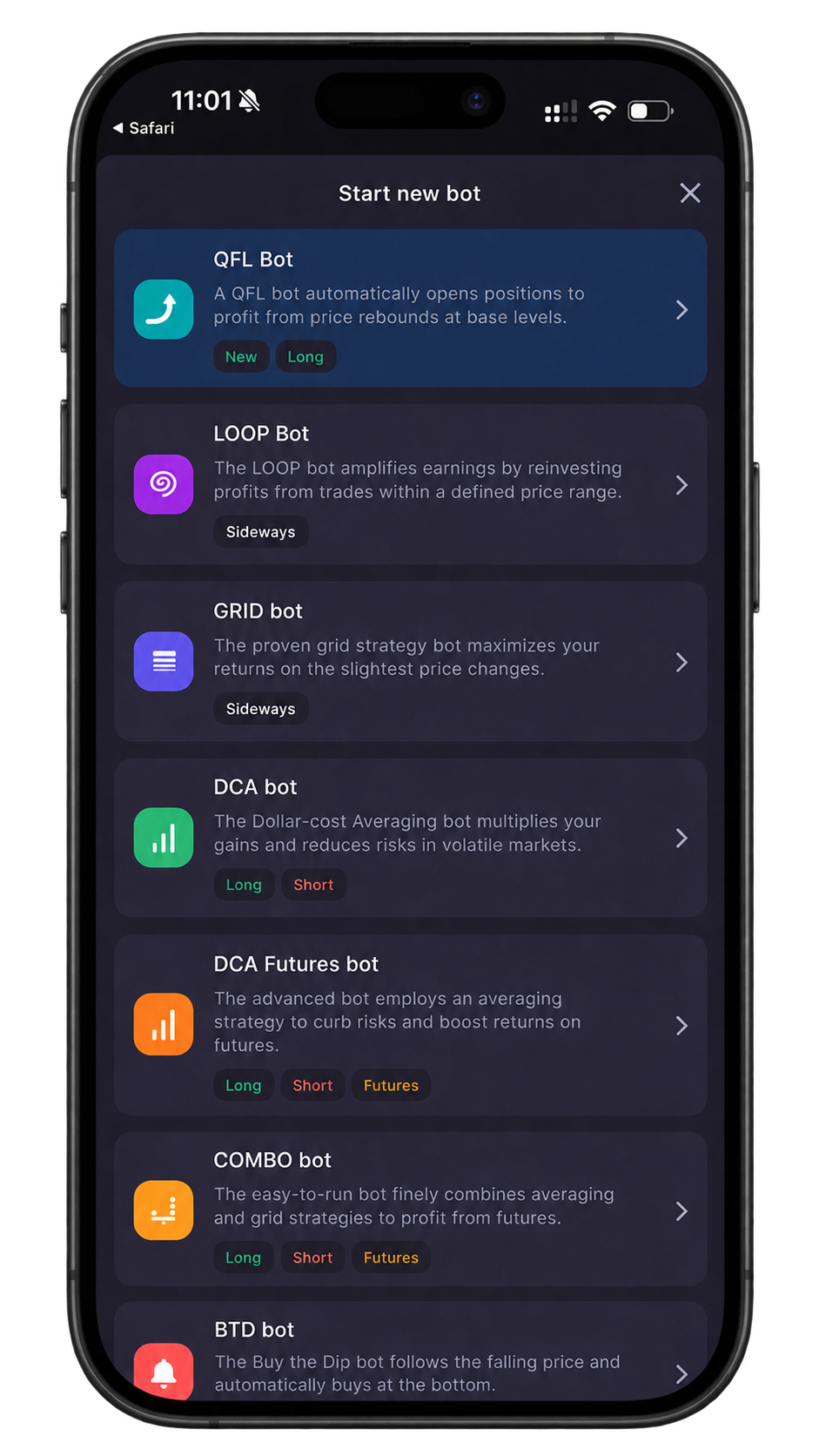
Its strongest advantage is the variety of trading strategies available. Bitsgap offers seven distinct bot types, including GRID, DCA, Buy the Dip (BTD), LOOP, Quickfingers Luc (QFL), DCA Futures, and COMBO. Each follows a different execution approach, ranging from capturing price fluctuations within trading ranges to accumulating assets during market declines or managing leveraged futures positions. This gives traders greater flexibility to select strategies according to market conditions rather than relying on a single automation method.
Bitsgap also provides an AI Assistant that analyzes available capital, historical volatility, and market conditions to recommend diversified bot configurations. Combined with historical backtesting, demo trading, portfolio analytics, and a trading terminal with advanced order controls, these tools allow users to evaluate and manage strategies from a single interface. However, the AI Assistant primarily assists with strategy selection and configuration rather than independently making discretionary trading decisions.
Despite its extensive functionality, Bitsgap has limitations worth considering. Subscription costs increase considerably on higher tiers, certain advanced features and futures strategies require more expensive plans, and bot allowances vary by subscription. Automated strategies also remain exposed to market volatility, exchange trading fees, and execution risks, while leveraged futures bots introduce the possibility of liquidation. Bitsgap simplifies the management of cryptocurrency trading strategies, but its effectiveness ultimately depends on appropriate market selection, capital allocation, and risk management.
What Is Bitsgap and How Does It Work?
Bitsgap is a cloud-based cryptocurrency trading platform that connects to supported centralized and decentralized trading exchanges, allowing users to automate cryptocurrency transactions, monitor portfolios, and manage positions through a unified dashboard.
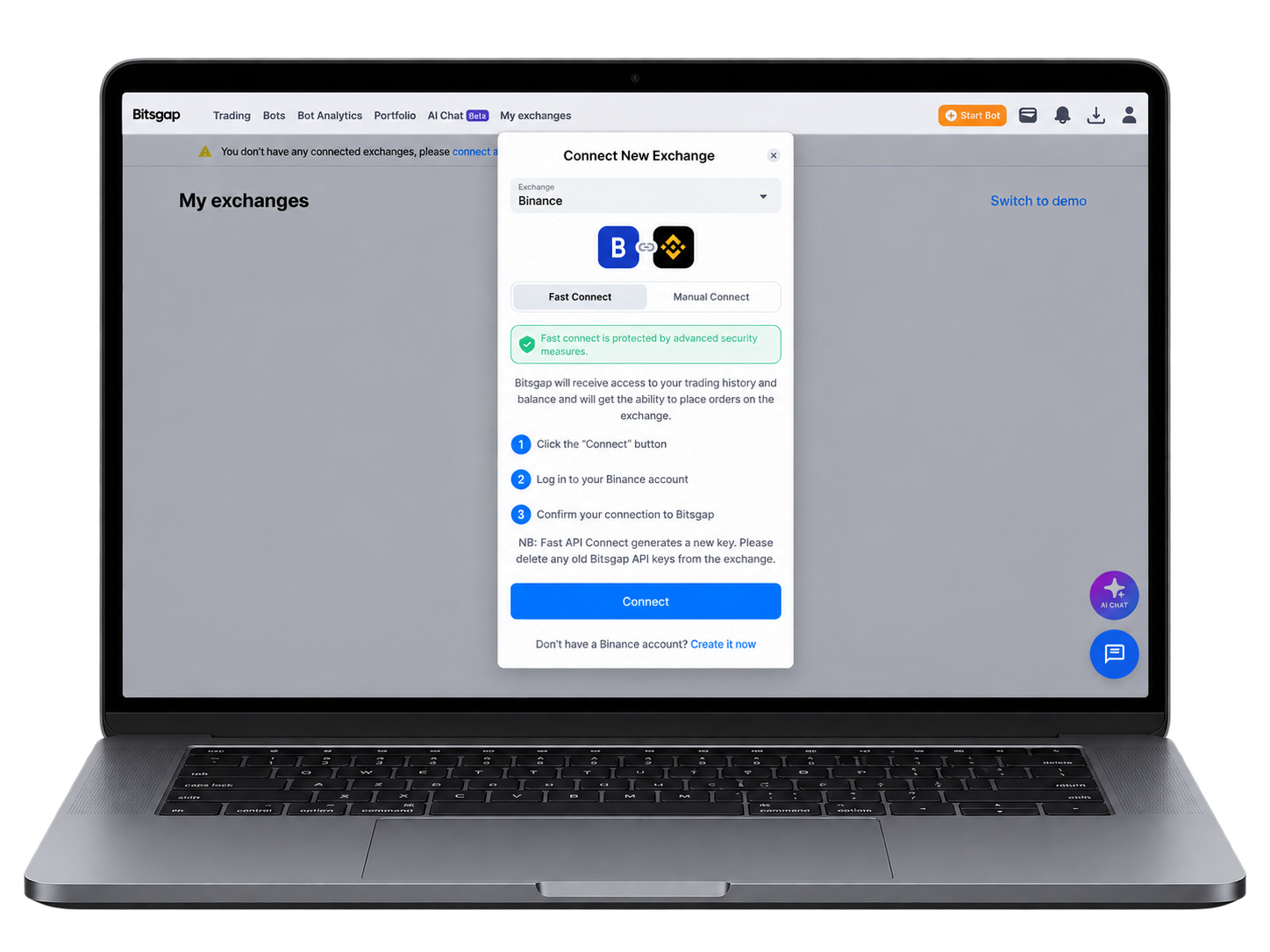
The platform operates primarily through exchange API connections, which authorize Bitsgap to retrieve account information and execute orders according to configured trading rules. Unlike a cryptocurrency exchange or custodial investment service, Bitsgap does not hold users’ trading balances. Assets remain on the connected exchanges, while API permissions are restricted to the functions needed for trading and account monitoring, without withdrawal access.
After connecting an exchange, users select a trading pair, choose an appropriate bot, and configure parameters such as investment size, order spacing, entry conditions, profit targets, and protective exits. A GRID bot, for example, can automate buying and selling within a selected price range, while a DCA bot manages additional entries and adjusts the average position price. More specialized strategies, including LOOP and COMBO, introduce automated profit reinvestment and combined grid-and-averaging mechanics for different trading environments.
Once activated, bots operate through Bitsgap’s cloud infrastructure, allowing strategies to continue running without requiring the user’s computer or mobile device to remain online. Traders can monitor active positions, review performance, modify supported settings, and manage several strategies across connected exchanges. The platform also provides a manual trading terminal with advanced order types, offering additional flexibility for users who combine discretionary trading with automated execution.
Bitsgap’s appeal lies in bringing multiple trading approaches into a single platform while reducing the operational effort involved in executing them. Its bots can follow predefined strategies consistently and respond to market movements without continuous manual intervention, although they cannot determine whether the underlying trading assumptions remain valid. Traders must still account for changing market conditions, transaction costs, and the potential losses associated with each strategy.
Trading Bots & Strategies
Bitsgap Trading Bots and Strategies
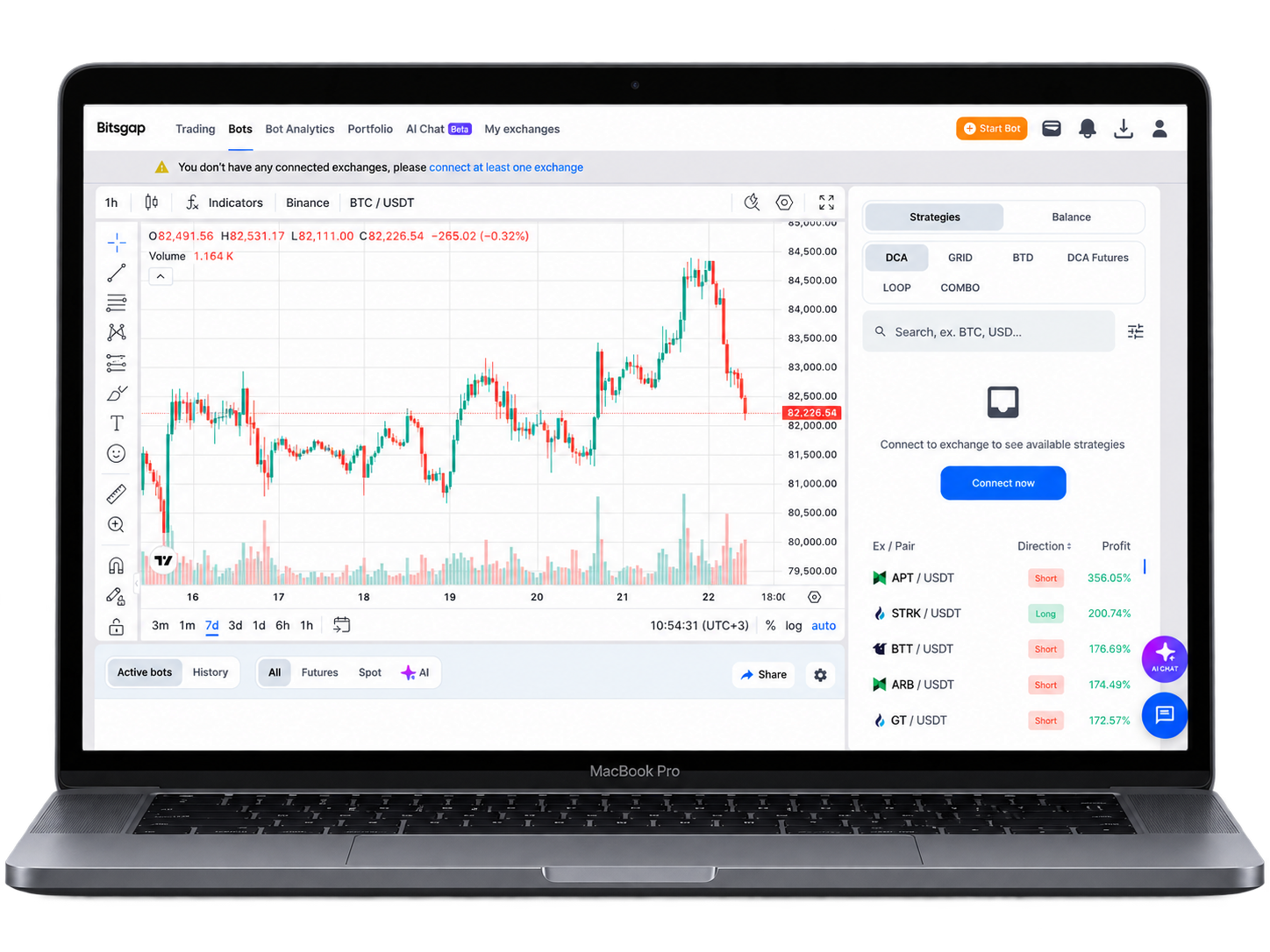
Bitsgap offers seven cryptocurrency trading bot strategies designed to operate under different market conditions, making its automated trading functionality considerably more varied than conventional grid and DCA platforms. Its lineup includes GRID, DCA, Buy the Dip (BTD), LOOP, Quickfingers Luc (QFL), DCA Futures, and COMBO, covering spot trading, cryptocurrency accumulation, short-term rebounds, automated profit reinvestment, and leveraged derivatives.
The differences extend beyond how orders are placed. Some bots aim to generate profits in stablecoins or other quote currencies, while others focus on increasing cryptocurrency holdings through repeated trading cycles. Bitsgap also provides configurable entry conditions, protective exits, historical backtesting, and AI-assisted configuration, allowing traders to adapt supported strategies to their preferred markets and risk tolerance.
However, the availability of multiple bot types does not necessarily make trading more profitable. Each strategy depends on particular market conditions, and combining several automated systems can increase portfolio exposure rather than provide meaningful diversification. Understanding how individual bots manage capital, execute orders, and respond to unfavorable price movements is essential before activating them.
GRID Trading Bot
Bitsgap’s GRID trading bot automates buying and selling at predetermined price intervals within a configured trading range. Instead of attempting to predict a major market movement, the strategy seeks to capture repeated fluctuations by purchasing cryptocurrency at lower grid levels and selling at higher ones. Each completed buying and selling cycle can generate a relatively small gain, with the objective of accumulating returns through multiple transactions.
Traders can customize the upper and lower price boundaries, number of grid levels, order spacing, investment amount, and order size. Narrower intervals generally produce more frequent trading opportunities but smaller potential profits per completed cycle, making exchange fees particularly important. Wider spacing reduces trading frequency while targeting larger price movements, although fewer orders may execute when volatility remains limited.
Bitsgap also provides Trailing Up and Trailing Down functionality on eligible subscriptions. Trailing Up allows the grid to follow rising prices beyond its original upper boundary, while Trailing Down extends the strategy below its configured range by placing additional orders. The latter can consume funds beyond the bot’s initial investment, making it particularly important to establish capital limits before enabling the feature. Pump Protection provides an additional safeguard by temporarily restricting trading during unusually sharp price increases.
GRID bots are generally most effective in markets with recurring price fluctuations, although their profitability depends on the selected range and overall price direction. A sustained decline can leave the bot holding depreciating assets, while a strong rally may move beyond the levels where its existing configuration continues trading effectively. Completed grid profits should therefore be evaluated alongside unrealized position losses and changes in the underlying asset’s value.
DCA Trading Bot
Bitsgap’s DCA trading bot automates position entries and additional orders through a configurable averaging strategy. Unlike conventional long-term dollar-cost averaging, where investors purchase fixed amounts at scheduled intervals, the platform’s trading-oriented DCA implementation uses price deviations and optional technical signals to manage positions through repeated trading cycles.
Users configure an initial order, additional-order spacing, position size, volume multipliers, and take-profit conditions. When prices move against the strategy, the bot can place further orders to adjust the average entry price, allowing a smaller market recovery to reach its profit target. Once a trading cycle closes, the strategy can begin another according to its configured conditions.
The platform supports both long and short DCA configurations on spot markets, although spot short strategies operate by selling cryptocurrency already held in the account and attempting to repurchase it at a lower price rather than opening a leveraged borrowed position. Traders can also incorporate technical indicators, trailing take-profit and stop-loss settings, manual averaging, and limits on total permitted losses.
Bitsgap additionally supports profit reinvestment on eligible subscriptions, allowing successful trading cycles to increase the amount allocated to subsequent positions. Although compounding may improve returns during favorable conditions, it can also increase exposure when market behavior changes.
The principal risk remains the accumulation of increasingly large positions during sustained adverse price movements. Volume multipliers can reduce the average entry price more quickly, but they also accelerate capital consumption and increase potential losses when the market continues moving against the strategy. Traders should calculate the maximum amount committed if every additional order executes, rather than evaluating the bot solely through its expected take-profit percentage.
Bitsgap’s DCA implementation is suitable for traders who anticipate recoveries or recurring pullbacks and want to automate their entry and exit rules. Its effectiveness depends on disciplined position sizing and the willingness to close unsuccessful strategies rather than continue averaging indefinitely.
Buy the Dip (BTD) Trading Bot
Bitsgap’s Buy the Dip bot is designed for spot traders seeking to increase their holdings of a particular cryptocurrency through repeated price declines and recoveries. Although its name suggests a conventional accumulation strategy, its underlying mechanics are closer to an inverted grid system, with profits primarily measured in the base cryptocurrency rather than the quote currency.
For example, a conventional BTC/USDT GRID bot generally aims to increase the amount of USDT generated through completed buying and selling cycles. A BTD bot instead seeks to accumulate additional BTC by selling portions of its holdings at higher prices and repurchasing them after declines. Successful trading cycles can therefore increase the number of coins held without requiring the user to make additional deposits.
The bot operates within a configured price range and supports trailing functionality that allows its grid to follow declining prices. Unlike the GRID bot’s Trailing Down mechanism, which can require additional capital, BTD’s downward adjustment reorganizes its trading levels around the funds already allocated to the strategy.
Its risk profile also differs from conventional long grid trading. Because BTD may sell cryptocurrency before attempting to repurchase it at lower prices, a sudden sustained rally can leave the strategy holding fewer coins than intended or force it to buy them back at unfavorable prices. Bitsgap consequently positions its BTD stop-loss above the grid, where it can trigger a repurchase of the base asset and terminate the strategy.
BTD is particularly relevant to investors who measure their trading success in cryptocurrency holdings rather than stablecoin returns. However, accumulating more coins does not guarantee an increase in portfolio value, especially if the cryptocurrency continues depreciating against the dollar.
LOOP Trading Bot
Bitsgap’s LOOP bot combines range-based spot trading with automatic profit reinvestment, allowing traders to repeatedly buy and sell cryptocurrency while incorporating completed gains into subsequent transactions. Its distinctive feature is the ability to manage profits in the base currency, quote currency, or both, making it relevant to investors who want to accumulate assets while maintaining an active trading strategy.
The bot operates around a fixed entry price established when the strategy launches, with buy and sell orders distributed across a configured range. As orders execute, LOOP creates replacement orders and reinvests the resulting trading proceeds, allowing the strategy to continue through successive market fluctuations without manually reallocating every completed profit.
For example, a BTC/USDT LOOP strategy may sell a portion of Bitcoin after a favorable price movement and subsequently use the proceeds to repurchase BTC at a lower level. Successful cycles can increase the amount available for future orders, potentially producing a compounding effect over extended periods.
Users can customize order spacing, the number of trading levels, investment size, and profit-taking conditions. The bot also supports exits in either base or quote currency, providing flexibility for traders who want to finish a strategy holding cryptocurrency rather than stablecoins.
However, LOOP has an important limitation: its standard configuration does not include a conventional stop-loss feature. Traders can establish take-profit and price-based exit conditions, but they must account for the possibility of adverse market movements without relying on the same protective controls available through other bot types.
Automatic reinvestment also increases the amount exposed to subsequent trading cycles. Although this can benefit strategies operating in favorable ranging markets, accumulated profits may become vulnerable when prices move persistently outside the expected trading environment.
LOOP is therefore best suited to traders seeking ongoing spot-market automation and cryptocurrency accumulation who understand the limitations of its exit controls.
QFL Trading Bot
Bitsgap’s Quickfingers Luc (QFL) bot uses a support-based rebound strategy designed to identify sharp cryptocurrency price declines and enter positions when a potential recovery becomes attractive. Unlike GRID bots, which continuously trade within predefined ranges, QFL waits for specific market conditions before opening positions, making it more selective in its execution.
The strategy is based on identifying a historical support area, referred to as a base, where an asset has previously experienced repeated buying interest. When the price falls sufficiently below that level, the bot may open a position using staged purchase orders, anticipating a recovery toward the earlier support region.
Bitsgap implements QFL as a long-only spot strategy with multi-pair functionality, allowing a single bot to monitor several eligible cryptocurrencies and open independent positions when qualifying signals appear. Traders select their total investment, preferred exchange, maximum number of concurrent trading pairs, and one of three predefined configurations: Quick, Balanced, or Deep.
Quick responds to a wider range of potential rebound signals, Balanced focuses on more selective medium- and longer-term conditions, while Deep concentrates on more substantial price declines. The internal entry and averaging parameters are predefined rather than fully customizable, although users retain control over investment allocation, concurrent positions, and aggregate take-profit and stop-loss conditions.
The multi-pair approach is convenient for traders seeking opportunities across several cryptocurrencies without running separate bots for every asset. However, it also introduces correlated risk, particularly during market-wide selloffs when several coins may decline through their historical support levels simultaneously.
QFL’s profitability depends on whether the anticipated rebound occurs. A breakdown below an established support region does not guarantee that prices will recover, and the strategy may accumulate losing positions when selling pressure continues. Its predefined configurations also provide less control over individual entry mechanics than a manually customized DCA bot.
The strategy is most appropriate for traders who understand support-based trading and want to automate selective rebound opportunities rather than operate continuous range-trading systems.
DCA Futures Trading Bot
Bitsgap extends its averaging strategy to cryptocurrency derivatives through the DCA Futures bot, allowing traders to automate long and short positions using leverage. The bot operates on compatible futures exchanges and supports leverage settings of up to 10x, with the available configuration depending on the exchange and selected market.
Like its spot counterpart, DCA Futures uses an initial position followed by additional orders to adjust the average entry price as the market moves. Traders can configure the number and spacing of additional entries, leverage, position size, take-profit conditions, and protective exits, including trailing functionality.
The platform also supports cross and isolated margin modes where available, although the distinction has substantial implications for risk management. Isolated margin limits the collateral assigned to a particular position, while cross margin can expose a larger portion of the account’s available futures collateral to losses.
The main concern is the interaction between leverage and additional orders. A futures DCA bot may increase exposure during unfavorable market movements, consuming available margin while moving the position closer to liquidation. Even if the underlying cryptocurrency eventually recovers, the leveraged position may be liquidated before the bot reaches its planned final averaging level.
Funding payments, trading commissions, and sudden changes in liquidity can further affect returns, particularly when leveraged positions remain open for extended periods. Automated stop-loss instructions offer additional protection but do not guarantee execution before liquidation or at a specified price during volatile trading conditions.
DCA Futures is therefore more appropriate for experienced traders who understand derivatives, margin requirements, and the consequences of averaging into leveraged positions. Its availability is generally restricted to higher subscriptions, although Bitsgap maintains separate access arrangements for certain futures bots on supported decentralized venues.
COMBO Trading Bot
Bitsgap’s COMBO bot combines grid trading and DCA position management within a single futures strategy, allowing traders to capture price fluctuations while adjusting their average entry price through additional orders. It supports long and short configurations on eligible derivatives markets, together with leverage settings of up to 10x and exchange-dependent margin controls.
The strategy uses two complementary order structures. In a long configuration, orders above the current market price are generally used to reduce the position and realize profits, while orders below the market add exposure and adjust the average entry price. A short configuration follows the opposite arrangement, using lower price levels for profit-taking and higher levels for additional entries.
This approach allows COMBO to manage multiple smaller exits rather than relying exclusively on one take-profit target for an entire futures position. Traders can configure the number of grid and DCA levels, spacing between orders, leverage, stop-loss settings, and other position-management parameters.
Its main advantage is the ability to combine repeated profit-taking with automated position averaging, particularly when a futures market experiences substantial fluctuations around a broader directional trend. However, this also means the strategy combines the risks of grid trading with those of leveraged averaging, including rising exposure, funding payments, and the possibility of liquidation during sustained adverse price movements.
Bitsgap supports COMBO through selected centralized futures integrations and EVEDEX, with the latter offering a separate bot allowance even on the Free subscription. Traders should confirm the availability of their intended futures exchange before selecting a plan, since the same market access and subscription restrictions do not apply to every venue.
COMBO is one of Bitsgap’s more sophisticated trading strategies, but its combined execution logic makes it unsuitable for traders who do not understand the relationship between additional orders, margin consumption, and liquidation thresholds.
Bitsgap AI Assistant and Portfolio Management
Bitsgap’s AI Assistant helps traders select and configure automated cryptocurrency strategies based on available capital, historical volatility, and prevailing market conditions. Rather than requiring users to manually evaluate every trading pair and bot parameter, the Assistant analyzes the selected exchange and proposes a portfolio of rule-based strategies intended to match the trader’s preferred investment horizon.
The configuration process begins with selecting an exchange, allocating an investment amount, and choosing between three duration profiles. The short-term Aggressive setting targets approximately one to five days, Moderate focuses on two to four weeks, and Conservative is designed for periods extending beyond two months. These categories determine how the Assistant approaches strategy selection and portfolio allocation, rather than guaranteeing that bots will close successfully within those timeframes.
After analyzing market conditions, Bitsgap recommends trading pairs, bot configurations, and capital allocations, allowing users to review the proposed strategies and examine available historical performance information before activation. The Assistant primarily works with spot-market automation rather than independently developing leveraged futures strategies.
An important distinction is that Bitsgap’s AI Assistant does not continuously make discretionary trading decisions after deployment. Its role is to select and configure supported bots, which subsequently execute their predefined rules through the connected exchange. Although the initial recommendations incorporate market analysis and historical data, the resulting strategies remain exposed to the same risks as manually configured automation.
The AI Assistant is available across Bitsgap’s paid subscriptions, but Pro introduces additional portfolio-management functionality.
AI Portfolio Mode
Bitsgap’s AI Portfolio Mode allows Pro subscribers to group AI-configured trading bots into a consolidated portfolio, providing combined performance monitoring and shared profit-taking conditions. Instead of reviewing every automated strategy independently, users can track the overall capital allocated, asset distribution, trading pairs, and accumulated returns through a single portfolio view.
The feature supports portfolio-level take-profit conditions based on two different performance measures. Portfolio Total PNL incorporates combined realized and unrealized results, while Portfolio Bot Profit measures realized profits generated by completed trading activity. This distinction is particularly important because a portfolio can contain several profitable completed transactions while simultaneously carrying unrealized losses on open positions.
Users can establish a target based on either measure, allowing the portfolio to stop operating when the selected performance threshold is reached. However, closing an entire collection of bots can also terminate strategies that remain favorably positioned, while the execution process may incur exchange fees and slippage.
Portfolio Mode consequently provides more convenient management of multiple AI-configured strategies, but it should not be confused with unrestricted portfolio rebalancing or comprehensive risk management. The feature consolidates selected bots and their performance rather than independently optimizing every position as market conditions change.
Bitsgap AI Chat
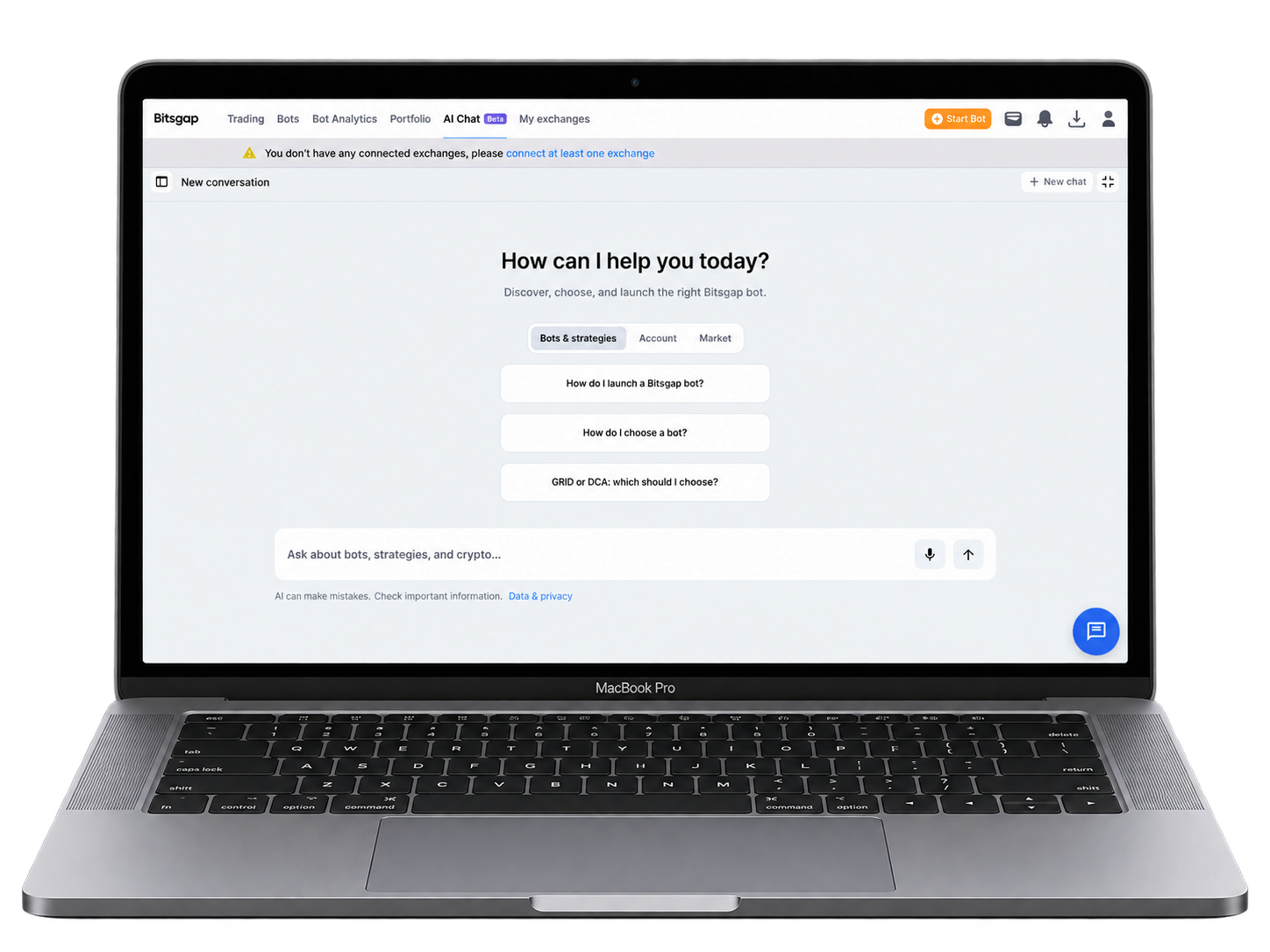
Bitsgap has also introduced an AI Chat interface that allows users to discuss trading ideas and configure supported bots through natural-language instructions. Unlike the AI Assistant’s structured portfolio-building workflow, AI Chat provides a conversational approach in which traders can describe their preferred market, capital allocation, and strategy objectives before reviewing suggested bot settings.
For example, a user could request a GRID strategy for Ethereum during a sideways market or ask for a DCA configuration suited to a selected trading pair. The interface can examine relevant market conditions, propose an eligible bot type, and prepare execution settings for the user to review. Launching the strategy requires confirmation, after which the bot operates according to its established trading rules.
The conversational interface reduces the technical work involved in configuration, but it does not turn Bitsgap into an unrestricted AI trading system capable of inventing and executing arbitrary strategies. Its recommendations remain tied to the platform’s supported bots, available market data, and exchange integrations.
AI Chat is included in Bitsgap’s published subscription lineup, including Free, making it another accessible way to explore the platform’s automation tools.
Historical Backtesting and Demo Trading
Bitsgap provides historical backtesting and simulated trading tools designed to help users evaluate strategies before allocating real capital. These features complement its automated bots by allowing traders to examine how selected configurations might have performed during earlier market conditions and observe their behavior against live market movements without placing real exchange orders.
Historical Backtesting
Bitsgap’s backtesting engine evaluates bot configurations using historical market data, taking into account parameters such as investment amount, grid spacing, and the selected trading range. Results can help traders compare settings and determine whether a particular strategy would have been compatible with previous market conditions before activating it.
The platform’s published subscription structure offers historical testing periods of up to 30 days on Basic, 180 days on Advanced, and 365 days on Pro, although individual bot interfaces and older help materials may display different limits. The practical testing window should therefore be confirmed within the selected bot configuration.
An important advantage is that Bitsgap’s backtesting engine incorporates exchange trading commissions into its calculations. Where supported, it retrieves the user’s applicable maker and taker rates through the connected exchange API, falling back to standard exchange fees when individual rates are unavailable.
This produces a more realistic cost estimate than simulations that ignore commissions altogether, although historical testing still cannot fully reproduce live order-book liquidity, slippage, or unexpected market conditions.
Backtesting is useful for identifying unsuitable grid spacing, excessive transaction frequency, and weak historical strategy performance, but results remain estimates rather than guarantees. A configuration optimized against a selected historical period may perform differently when volatility, liquidity, or market direction changes.
Demo Trading
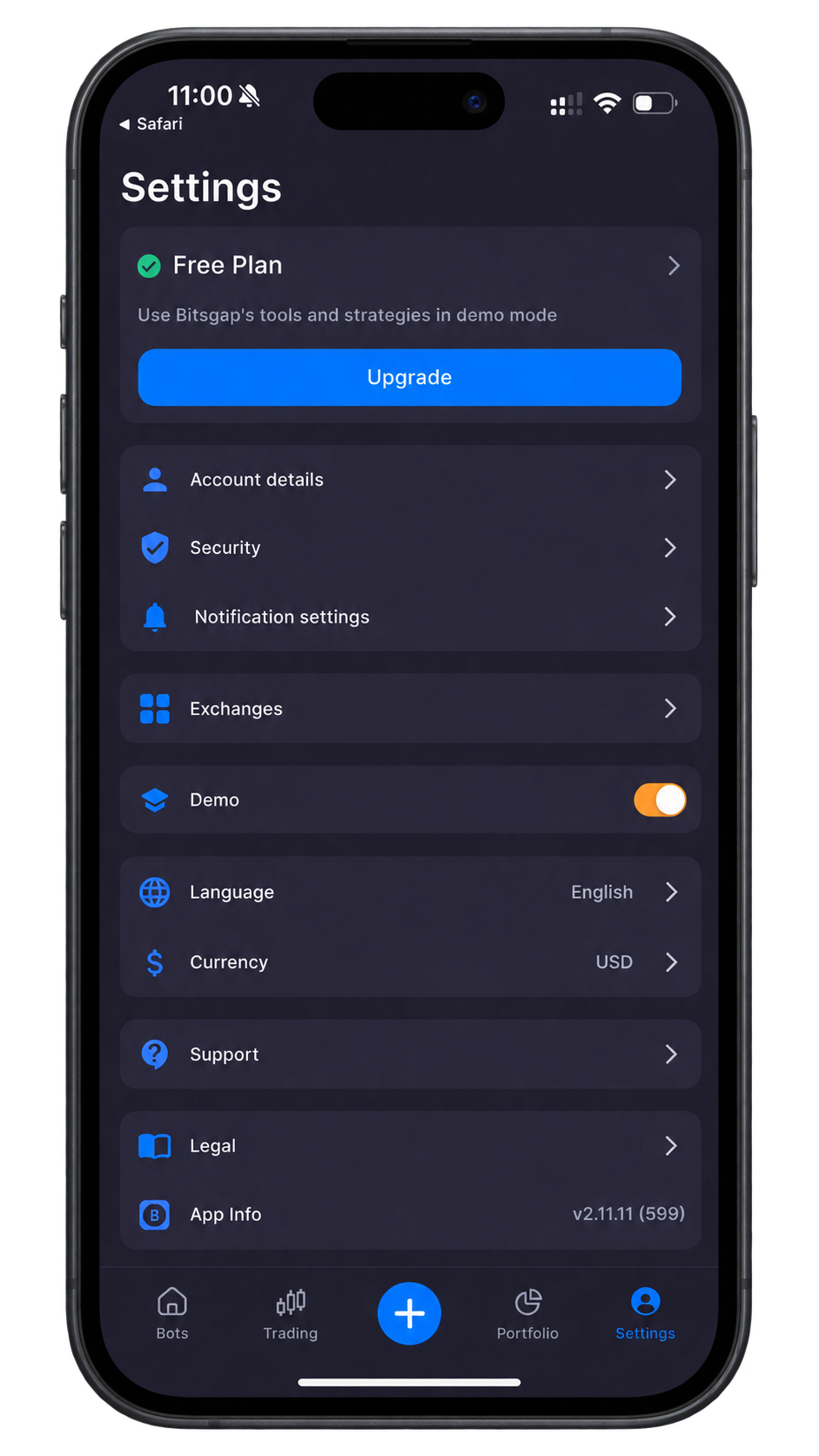
Bitsgap also offers a demo trading environment that allows users to operate automated strategies and place manual orders using virtual funds. The platform advertises a simulated balance of $100,000, with market prices and order-book conditions designed to resemble activity on supported cryptocurrency exchanges.
Demo mode supports testing trading bots, Smart Orders, and manual strategies without transferring real assets or providing exchange API credentials. Users can examine how grid, DCA, and futures configurations behave under changing market conditions, making the environment particularly useful for understanding order execution and position management before operating live bots.
The Free subscription supports up to 20 active demo bots, providing an opportunity to evaluate multiple trading approaches without purchasing a paid plan. Nevertheless, simulated trading remains an approximation of live execution, and users should not assume that every order will fill at the same price or with the same liquidity when real capital is involved.
Smart Trading Terminal and Advanced Orders
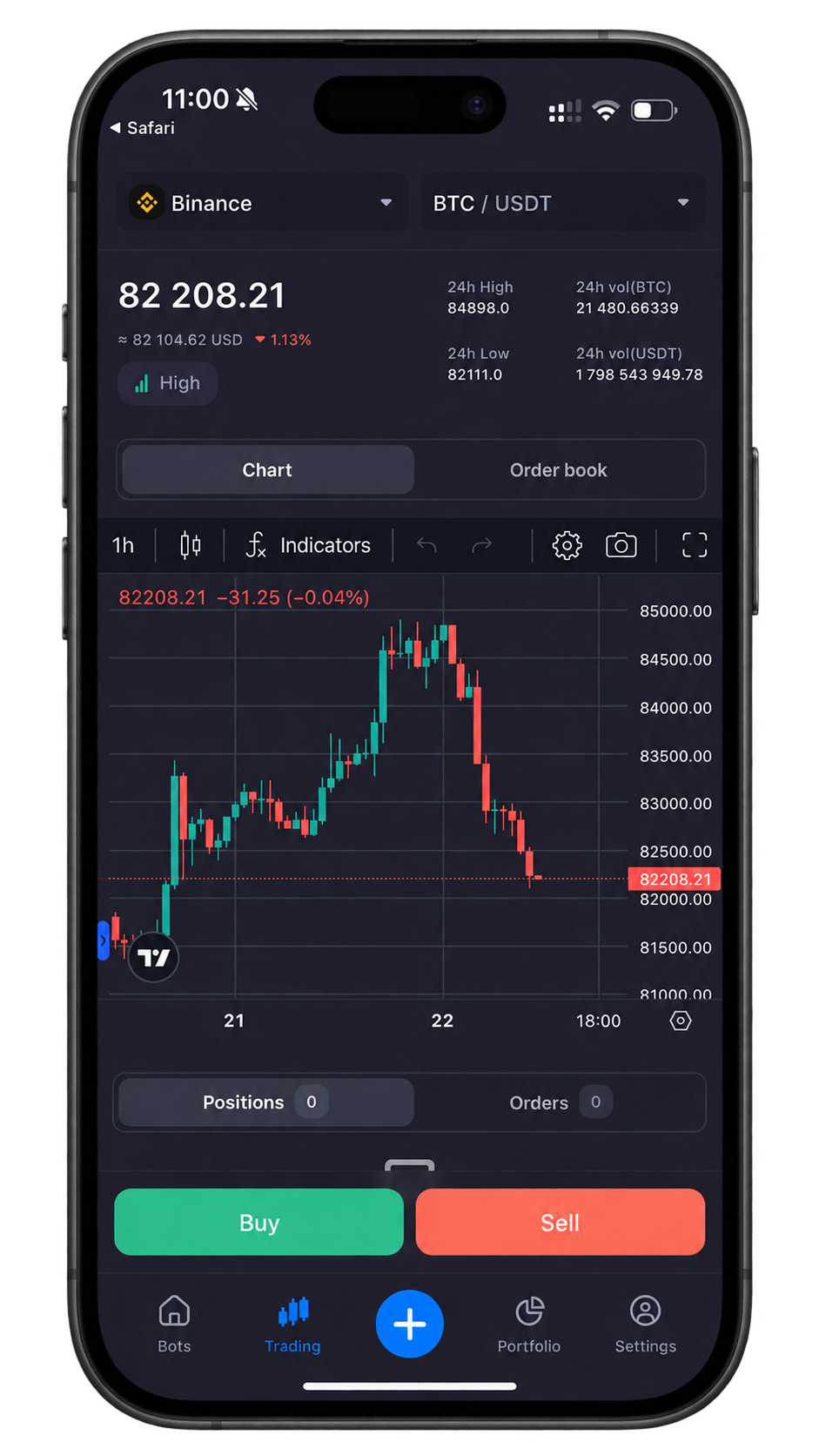
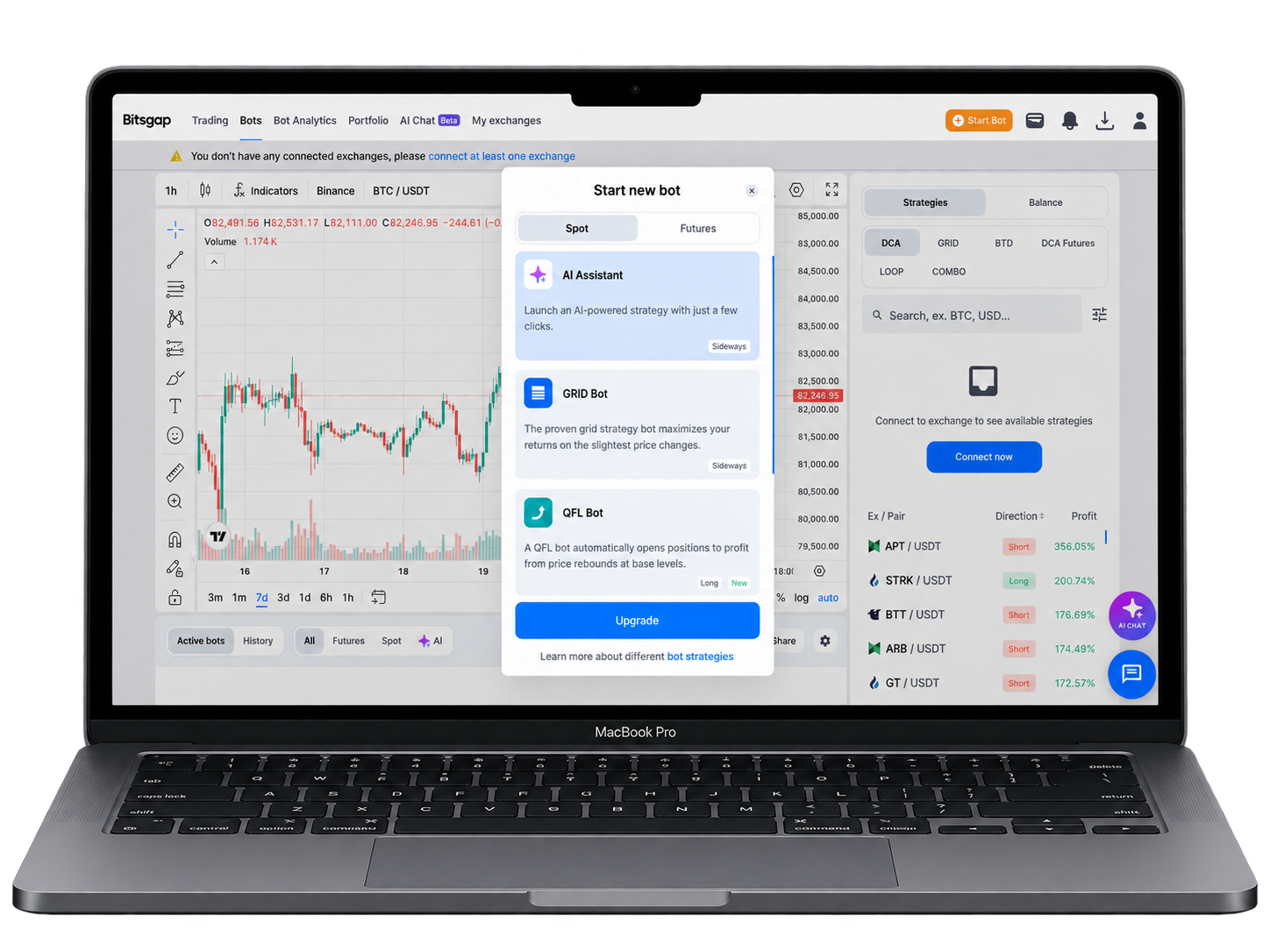
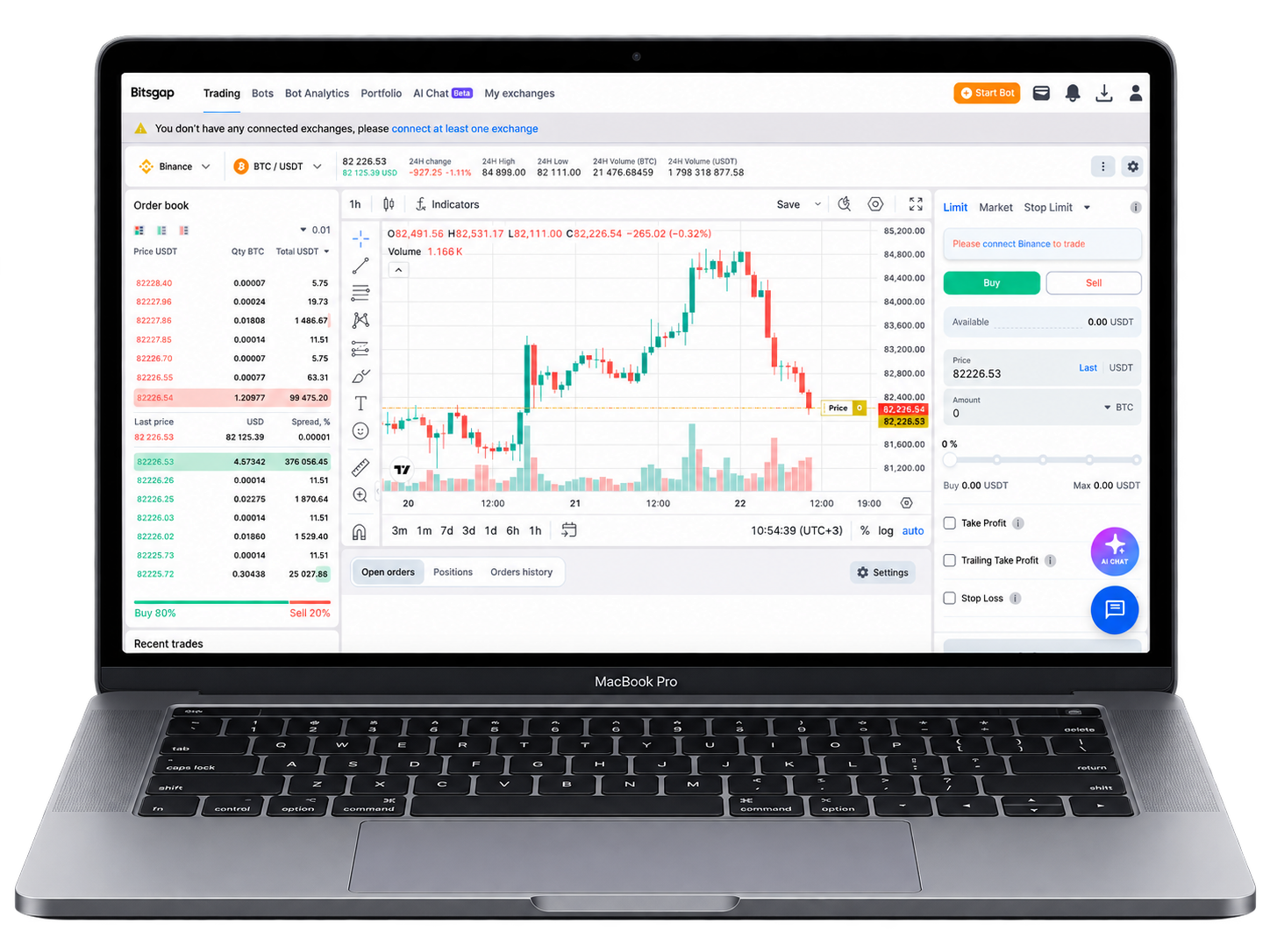
Beyond automated bots, Bitsgap provides a unified trading terminal designed for users who want to manage cryptocurrency positions manually across connected exchanges. The interface combines order placement, charts, technical indicators, open positions, and trading history, reducing the need to switch between individual exchange applications.
The terminal supports conventional market and limit orders alongside more advanced execution methods, including stop-market, stop-limit, Time-Weighted Average Price (TWAP), scaled orders, and compatible conditional order structures. These tools allow traders to divide larger transactions across multiple price levels or time intervals, automate protective exits, and establish more detailed trade-management instructions without operating a continuously active bot.
Bitsgap’s Smart Orders extend this functionality through take-profit, stop-loss, and trailing conditions that can be associated with supported positions. For example, a trader entering a Bitcoin position manually can establish an automated exit if the asset reaches a chosen profit target or declines below a predefined loss threshold, reducing the need to monitor the position continuously.
The terminal also includes technical analysis tools and chart-based market information, making it relevant to traders who combine discretionary market analysis with automated execution. However, the availability of particular order types may depend on the connected exchange and market, while protective exits remain subject to liquidity constraints and potential slippage.
Unlimited manual trading and Smart Orders are included in Bitsgap’s published subscription offerings, although exchange transaction fees continue to apply independently of the platform’s software charges.
Portfolio Analytics and Mobile Trading
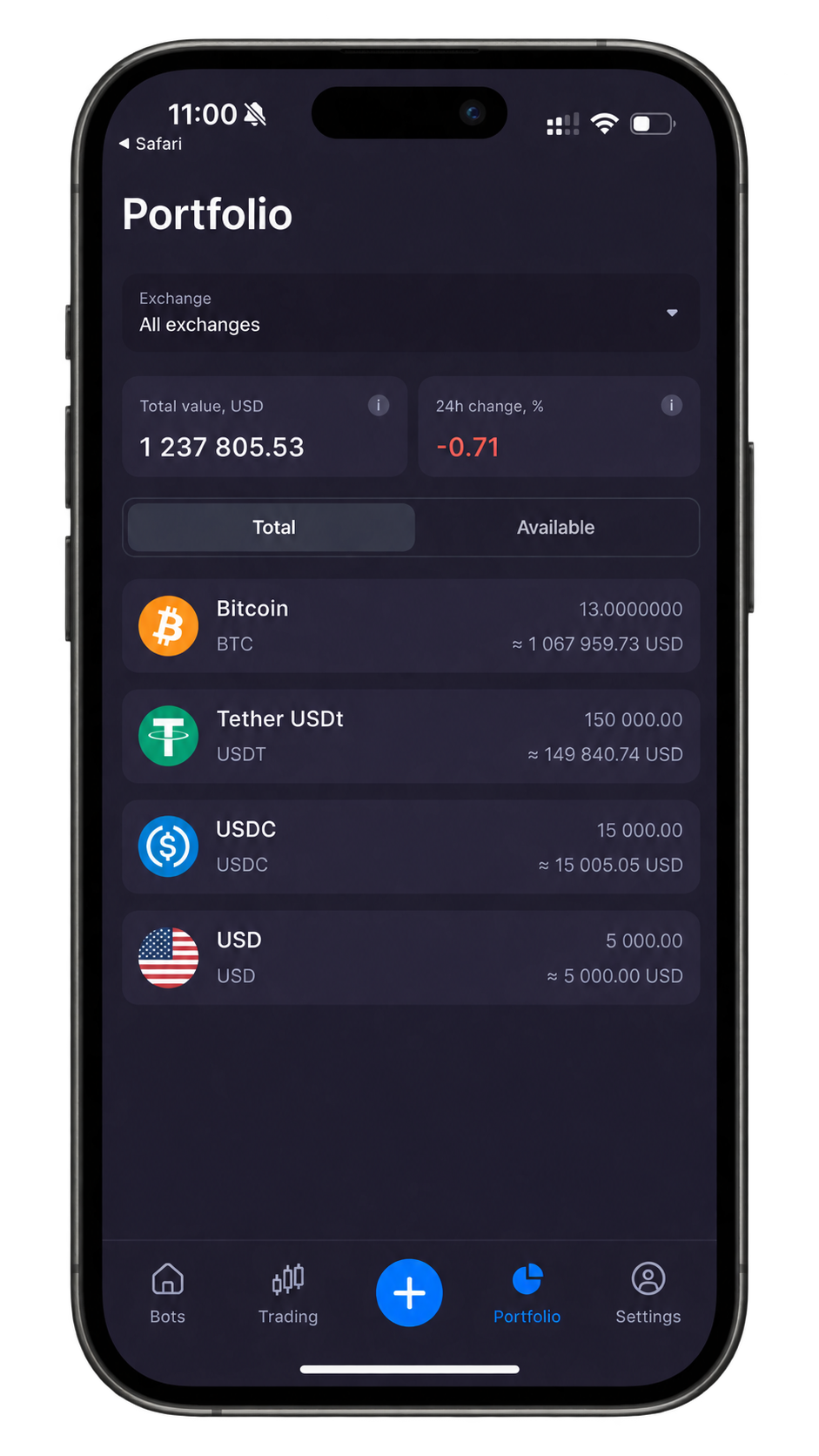
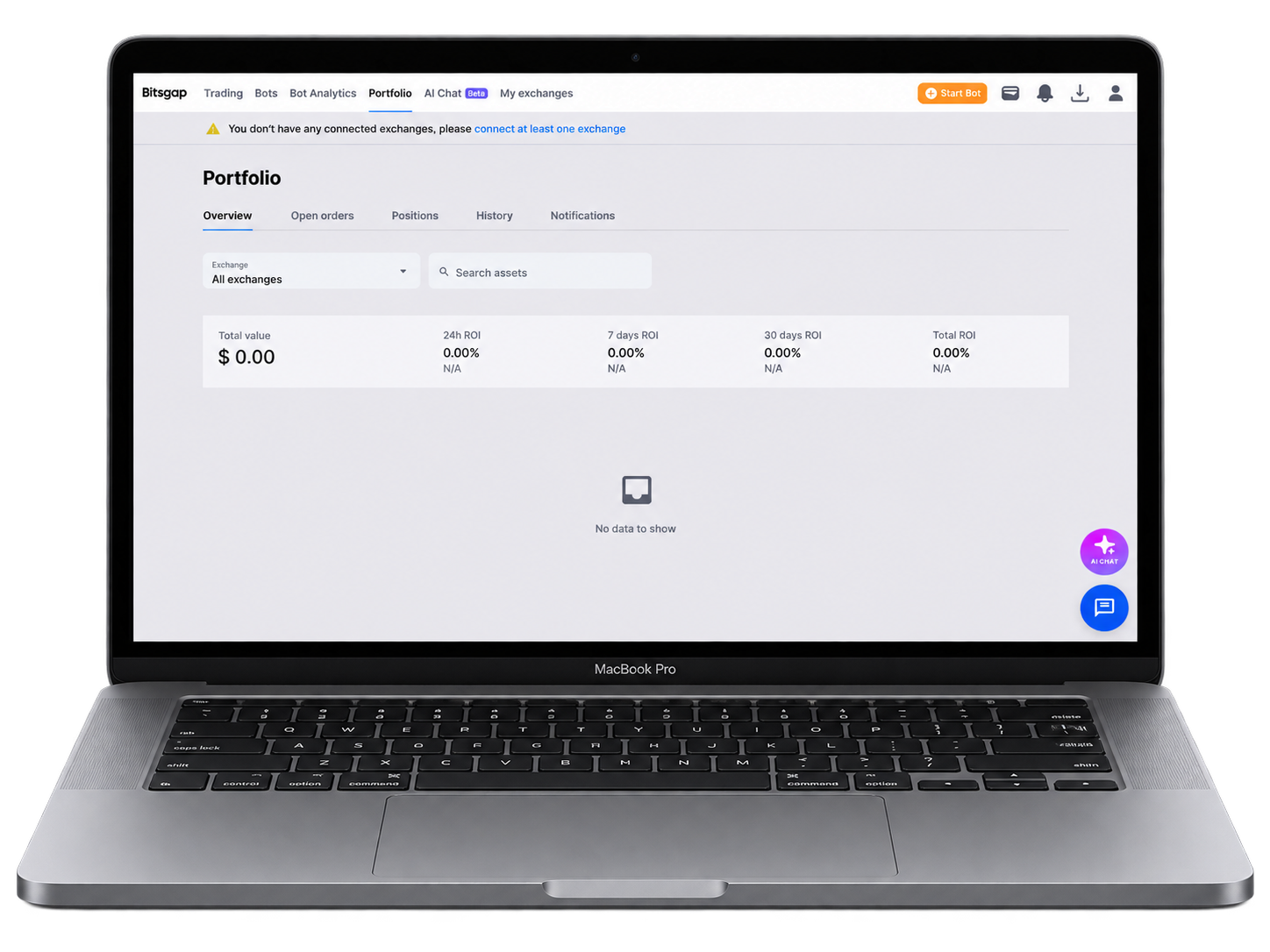
Bitsgap’s portfolio tracking functionality consolidates account information from connected exchanges, allowing users to monitor cryptocurrency balances, asset allocations, portfolio valuations, and automated trading performance through a centralized dashboard. This is particularly useful for traders operating several bots across different trading pairs, as it provides a broader picture of exposure than reviewing completed transactions individually.
The platform also provides detailed bot analytics, including realized profits, unrealized position performance, allocated investment, and trading history. These distinctions matter because a bot may continue generating positive returns from completed orders while holding an underlying cryptocurrency position that has declined substantially in value. Evaluating total PNL alongside realized bot profits provides a more meaningful assessment of overall performance.
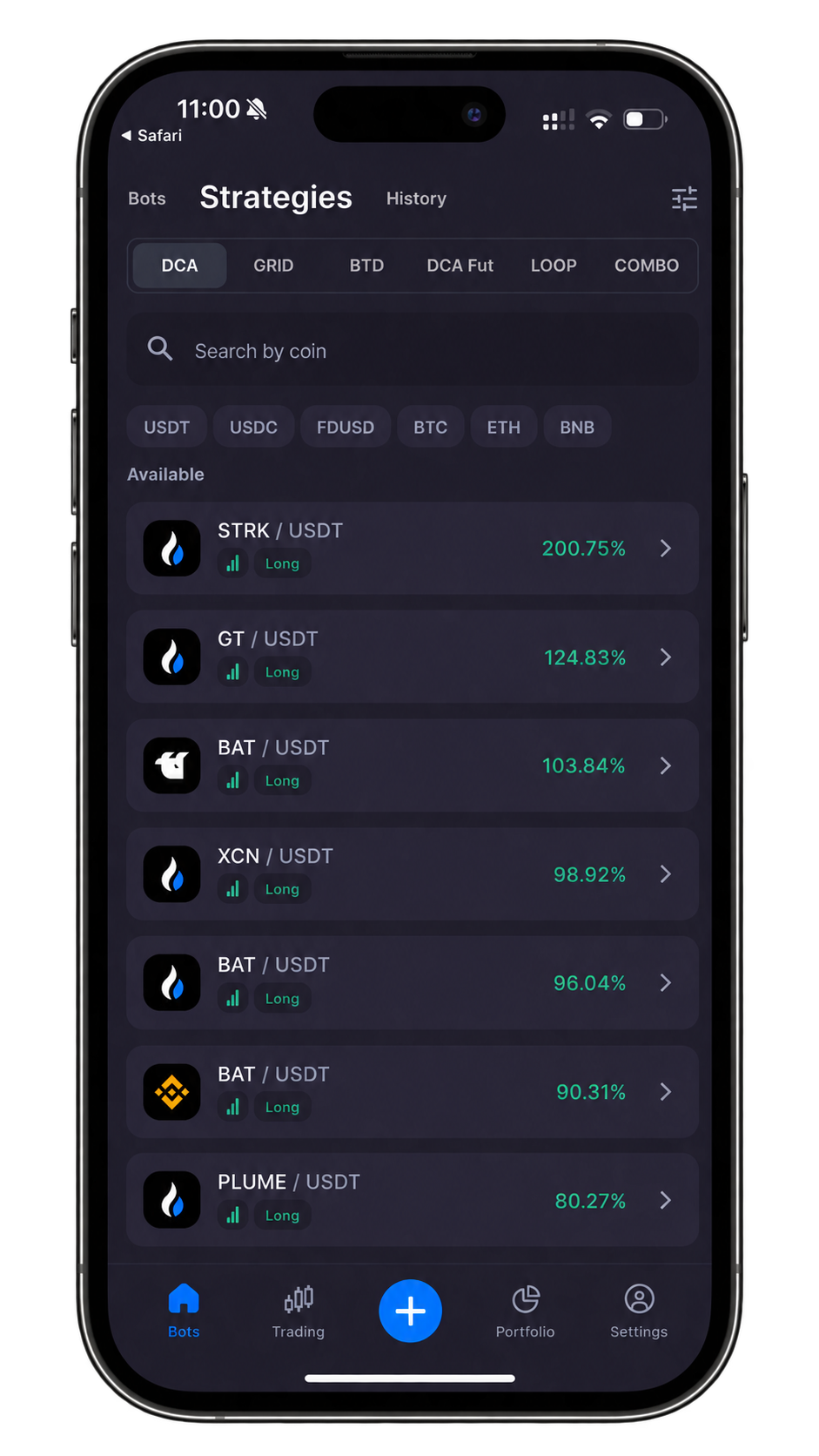
Bitsgap offers mobile applications for iOS and Android, allowing users to monitor and manage bots, review portfolio information, and respond to changing market conditions without remaining at a desktop computer. Automated strategies continue operating through Bitsgap’s cloud infrastructure even when the application is closed, although users remain dependent on exchange availability and functioning API connections.
For traders managing several automated strategies, the combination of portfolio analytics and mobile access is a practical advantage. However, consolidated reporting does not automatically prevent excessive exposure to correlated assets, and performance should still be evaluated against total capital committed, transaction costs, and open-position risk.
Bitsgap Public API and Developer Tools
Bitsgap also provides a public trading API for users who want to integrate external software or develop customized trading workflows. Introduced in 2026, the API allows authorized applications to retrieve market information, inspect account balances, monitor orders, and submit supported trading instructions through Bitsgap’s connected exchange infrastructure.
The service provides REST and WebSocket connectivity, with a unified command structure and authenticated requests using Ed25519 key pairs. Official reference implementations are available for Python, TypeScript, Go, and Rust, allowing developers to build integrations without independently implementing the connection requirements of every supported exchange.
A practical advantage is the ability to test custom workflows against Bitsgap’s demo environment before executing transactions with live balances. API access is also included across the subscription lineup, including Free, although users remain responsible for developing, operating, and securing their own software.
The public API expands Bitsgap’s usefulness beyond predefined bot configurations, particularly for technically experienced traders who want programmatic access to market data and trading operations. However, building custom algorithms introduces additional responsibilities involving error handling, execution logic, credential protection, and risk controls that are not automatically solved by the platform.
Overall, Bitsgap provides a comprehensive cryptocurrency trading environment that extends well beyond conventional automated bots. Its seven trading strategies, AI-assisted configuration, portfolio management tools, backtesting, demo trading, advanced terminal, and developer API offer considerable flexibility for different trading approaches. The platform’s main limitation is not a lack of available tools, but the need to understand how each strategy behaves and whether its execution requirements justify the subscription costs and trading risks involved.
Exchanges
Supported Cryptocurrency Exchanges
Bitsgap supports a broad selection of cryptocurrency exchanges, allowing traders to access major spot markets and selected perpetual futures exchanges through a centralized trading interface. Its integrations include Binance, Binance.US, Coinbase, Kraken, OKX, KuCoin, Bitget, Gate, Crypto.com, Gemini, HTX, Bitfinex, BitMart, Poloniex, and WhiteBIT, alongside decentralized exchanges such as Aster and EVEDEX. Additional trading integrations include Bybit and Hyperliquid, extending the platform’s coverage across centralized and decentralized derivatives markets.
This exchange selection provides considerable flexibility for traders who maintain accounts across multiple platforms or want to choose where to operate particular strategies. However, the number of supported exchanges is only one consideration, as differences in exchange liquidity, trading fees, and execution quality can directly affect the profitability of automated strategies. A trading pair offering sufficient liquidity on Binance, for example, may have wider spreads or lower trading volume on a smaller exchange, making frequent grid transactions less economical.
Futures support is more selective than spot trading coverage, with Bitsgap offering derivatives automation through exchanges such as Binance, Bybit, OKX, KuCoin, and Bitget, alongside supported decentralized integrations. Hyperliquid, Aster, and EVEDEX provide additional opportunities for perpetual futures trading, although available bot types and account requirements differ between exchanges. These distinctions become particularly important when selecting crypto futures exchanges for leveraged strategies, where contract availability, funding rates, margin requirements, and liquidation mechanisms can influence overall trading performance.
Bitsgap’s exchange coverage is a meaningful advantage for traders seeking flexibility across spot and derivatives markets, although not every integration supports the same bots, trading pairs, or order functionality. Regional restrictions can also affect derivatives availability, even when an exchange is otherwise supported. Traders should therefore confirm compatibility with their preferred exchange and trading strategy before purchasing a subscription, particularly when futures automation or access to specific decentralized exchanges is essential.
Pricing & Plans
Bitsgap Pricing and Subscription Plans
Bitsgap uses a subscription-based pricing model with four tiers: Free, Basic, Advanced, and Pro. Paid subscriptions start at $29 per month and reach $149 for Pro, with annual billing offering approximately 20% savings. Unlike trading platforms that charge commissions on individual bot transactions, Bitsgap’s software fees remain fixed regardless of trading volume, although exchange commissions and other execution costs still apply.
The differences between subscriptions extend beyond the number of active bots. Higher plans introduce futures automation, longer historical backtesting periods, additional profit-management controls, and AI Portfolio Mode. Consequently, choosing the appropriate subscription depends on the strategies a trader intends to operate rather than simply selecting the plan with the highest bot allowance.
Bitsgap Pricing Comparison
| Feature | Free | Basic | Advanced | Pro |
|---|---|---|---|---|
| Monthly subscription | $0 | $29 | $69 | $149 |
| Annual billing, monthly equivalent | $0 | $23 | $55 | $119 |
| Total annual cost | $0 | $276 | $660 | $1,428 |
| Active GRID bots | 0 | 3 | 10 | 50 |
| Active DCA/LOOP bots | 0 | 10 | 50 | 250 |
| EVEDEX COMBO bots | 3 | 3 | 10 | 50 |
| General futures automation | No* | No* | Yes | Yes |
| AI Assistant | No | Yes | Yes | Yes |
| AI Chat | Yes | Yes | Yes | Yes |
| Historical backtesting | — | 30 days | 180 days | 365 days |
| GRID Trailing Up/Down | No | No | Yes | Yes |
| DCA profit reinvestment | No | No | Yes | Yes |
| AI Portfolio Mode | No | No | No | Yes |
| Manual trading | Yes | Yes | Yes | Yes |
Free Plan and Seven-Day Trial
Bitsgap’s Free subscription provides access to its trading interface, AI Chat, and demo trading environment without requiring a recurring payment. Users can operate up to 20 simulated bots with a virtual balance of $100,000, making it possible to explore different configurations and become familiar with the platform before committing actual capital.
An unusual advantage is the inclusion of three COMBO bots on EVEDEX, even without a paid subscription. However, this allowance applies specifically to the supported EVEDEX integration and should not be mistaken for unrestricted access to live GRID, DCA, or futures bots across other exchanges. Users seeking conventional live automation will generally need to upgrade.
New customers can also activate a seven-day Pro trial without providing credit card details. The trial unlocks the platform’s highest subscription features, allowing prospective users to evaluate advanced bot settings, historical backtesting, and AI functionality before selecting a paid plan. If no subscription is purchased, the account automatically transitions to Free without an automatic charge.
Basic Plan
Bitsgap Basic costs $29 per month, reduced to an effective $23 monthly with annual billing. It supports three active GRID bots and ten DCA/LOOP bots, alongside AI-assisted configuration, unlimited manual trading, Smart Orders, and historical backtesting covering up to 30 days.
The subscription is particularly suitable for traders operating a small number of spot strategies who want more flexibility than exchange-native automation typically provides. Its bot allowances are sufficient for maintaining several independently configured positions, while the AI Assistant can help users select trading pairs and establish suitable starting parameters without manually evaluating every configuration.
However, Basic excludes general futures automation, advanced GRID trailing functionality, and DCA profit reinvestment. The relatively short backtesting window also limits its usefulness for traders interested in evaluating strategies across several months of changing market conditions.
For users primarily focused on spot GRID and DCA trading, Basic provides a reasonable entry point without requiring a substantial subscription commitment. Its limitations become more relevant when strategies depend on derivatives, dynamic grid adjustments, or more extensive historical analysis.
Advanced Plan
Advanced costs $69 per month, with annual billing reducing the monthly equivalent to $55. The subscription increases capacity to ten GRID bots and fifty DCA/LOOP bots while unlocking general futures automation, DCA profit reinvestment, GRID Trailing Up and Down, and historical backtesting covering up to 180 days.
These additions make Advanced considerably more versatile than Basic, particularly for traders who want greater control over active strategies. Trailing functionality allows eligible GRID configurations to adjust their trading boundaries as prices move, while profit reinvestment enables supported DCA strategies to allocate completed gains toward subsequent trading cycles. Futures access also introduces the ability to automate leveraged long and short positions, although the associated margin and liquidation risks require additional experience.
The longer backtesting period provides another meaningful benefit, allowing traders to evaluate configurations against a wider selection of historical market conditions. Nevertheless, six months of historical performance remains insufficient to establish how a strategy might behave throughout an entire cryptocurrency market cycle.
Advanced is the most balanced subscription for active traders who want to use Bitsgap’s broader automation capabilities without paying for Pro’s substantially higher bot limits and portfolio-management features.
Pro Plan
Bitsgap Pro costs $149 monthly or an effective $119 per month with annual billing, making it the platform’s most expensive standard subscription. It supports 50 active GRID bots, 250 DCA/LOOP bots, and 50 EVEDEX COMBO bots, alongside general futures automation and historical backtesting covering up to 365 days.
Its main advantage over Advanced is not simply the larger bot allowance, but access to additional portfolio-level controls. Pro includes AI Portfolio Mode, allowing users to group AI-configured bots and monitor their combined performance, together with take-profit functionality for eligible GRID and AI-launched strategies. These features can simplify the management of a larger trading operation, particularly when several bots contribute to an overall portfolio objective.
The extended backtesting period also provides greater scope for examining historical strategy behavior, although live execution may still differ because of changing liquidity, market conditions, and slippage.
Pro is most appropriate for experienced traders managing substantial capital across numerous strategies or requiring its dedicated AI portfolio features. For users operating only a handful of conventional bots, the additional $80 monthly compared with Advanced may be difficult to justify through functionality alone.
Trading Fees and Additional Costs
Bitsgap does not charge separate platform commissions for transactions executed through connected cryptocurrency exchanges. However, the subscription fee is only one component of the total cost of automated trading, since users remain responsible for the exchange’s applicable maker and taker commissions, spreads, and slippage.
These expenses become particularly relevant when operating strategies that execute numerous transactions. Even relatively low crypto trading fees can absorb a meaningful portion of the expected profit when individual trading cycles target small price movements. Futures strategies introduce additional considerations, including periodic funding payments and potential liquidation-related expenses.
Bitsgap accepts major payment cards, PayPal, and selected cryptocurrencies for subscription purchases. Automatic renewal is supported for eligible card and PayPal payments, while users can disable recurring billing through their account settings without immediately losing access to an already-paid subscription.
What Happens When a Bitsgap Subscription Expires?
Subscription continuity deserves particular attention because Bitsgap’s automated strategies depend on an active plan. When a paid subscription expires, the account enters a two-day Limited period during which existing bots and orders remain active. Users can close positions through supported controls, cancel orders, manage API connections, or renew their subscription, but they cannot launch new live bots or create additional automated trading instructions.
If the subscription is not renewed within those two days, Bitsgap cancels the bots and orders created through its interface and transfers the account to Free. Cryptocurrency balances remain on the connected exchanges, but the automated strategies and their associated order management no longer continue operating.
This distinction is particularly important for traders relying on stop-loss and take-profit orders managed through Bitsgap, since cancelling outstanding orders may leave exchange holdings or derivatives positions without the intended automated protection.
Traders planning to discontinue their subscriptions should therefore review active positions and outstanding orders before the paid period ends rather than assuming that existing automation will continue indefinitely.
Is Bitsgap Worth the Subscription Cost?
Bitsgap offers a competitive combination of automated trading functionality, AI-assisted configuration, historical backtesting, and advanced execution controls, although its value depends heavily on how extensively these features are used. For traders managing several active strategies, the subscription can reduce the time spent configuring orders, monitoring positions, and maintaining separate trading workflows. However, convenience alone does not establish that the software will generate returns sufficient to justify its recurring expense.
Subscription costs become more significant for smaller trading accounts. At $69 per month, Advanced represents an annual expense of $828 under monthly billing or $660 when paid annually, before exchange trading fees and other execution costs. A trader operating a relatively small portfolio would need to consider whether the benefits of automation justify that expense, particularly when several strategies generate limited trading activity.
The distinction between subscription tiers also matters when evaluating long-term value. Basic provides sufficient capacity for straightforward spot automation at a comparatively accessible price, while Advanced delivers the strongest balance of functionality and cost for traders requiring futures access, extended backtesting, and more flexible bot management. Pro offers substantially greater capacity and portfolio controls, but its higher price is more appropriate for experienced users managing extensive automated trading operations.
Bitsgap is worth considering for traders who actively use its specialized bots and broader trading tools, rather than those seeking automation for a single basic strategy. Its fixed software pricing makes costs relatively predictable, but subscription fees, exchange commissions, and ongoing market exposure must all be considered when evaluating whether the platform provides sufficient value.
Security & UX
Bitsgap Security: Is It Safe?
Bitsgap provides a relatively strong security framework for cryptocurrency trading automation, combining non-custodial exchange connectivity with encrypted API credentials, two-factor authentication, and account access controls. Since the platform does not hold customer trading balances, users retain their assets on connected exchanges while authorizing Bitsgap to execute transactions through restricted API permissions. This arrangement reduces direct custody risks, although the security of connected exchange accounts and the permissions granted to automated trading software remain important considerations.
One of Bitsgap’s most significant safeguards is its restriction on API withdrawal permissions. When users connect an exchange account, the platform verifies that the API key permits only the necessary account information, trading history, and order-management functions. Keys with withdrawal permissions enabled are automatically rejected, preventing Bitsgap from directly transferring assets out of connected accounts through those credentials. However, trading-enabled API access still carries risks, since compromised credentials could potentially be used to execute unauthorized transactions or manipulate positions through unfavorable orders.
Bitsgap protects account credentials through encryption, including RSA-2048-based security measures and encrypted transmission during API setup. Additional account protections include two-factor authentication through authenticator applications, email verification for unfamiliar login attempts, and temporary IP restrictions following repeated failed authentication attempts. The platform also supports passkey authentication, allowing users to secure account access through compatible biometric devices, hardware-backed credentials, or password managers rather than relying exclusively on conventional passwords.
Exchange-specific IP allowlisting provides another layer of protection by restricting API requests to approved Bitsgap addresses where supported. Its API Account Lock mechanism also helps prevent the same API credentials from being reused across different Bitsgap accounts, reducing the potential for unauthorized connections. These features complement conventional crypto API trading security practices, particularly the use of restricted permissions, dedicated trading subaccounts, and separate API credentials for different automated strategies.
Despite these protections, security should not be evaluated exclusively through credential management. Exchange outages, API connection failures, unexpected order execution, and compromised exchange accounts can still affect trading activity, while futures automation introduces financial risks unrelated to unauthorized access. Traders managing substantial portfolios should consider limiting the balances available to individual strategies, enabling exchange-level security protections, and reviewing active API connections periodically.
Bitsgap also references internal security procedures, employee access restrictions, and infrastructure safeguards, but a comprehensive, independently published security audit or certification covering its current trading infrastructure could not be established. Its Dubai business registration should likewise not be interpreted as an investment guarantee or evidence that customer trading balances are insured against losses.
Overall, Bitsgap offers a credible security structure for non-custodial cryptocurrency trading automation, particularly through withdrawal-restricted APIs, encrypted credentials, account authentication, and exchange-specific access controls. These measures help reduce unauthorized access risks, but they cannot eliminate operational failures, compromised trading permissions, or financial losses resulting from poorly configured strategies. Users remain responsible for protecting their exchange accounts and managing the capital exposed to automated trading.
User Experience, Backtesting, and Performance Analytics
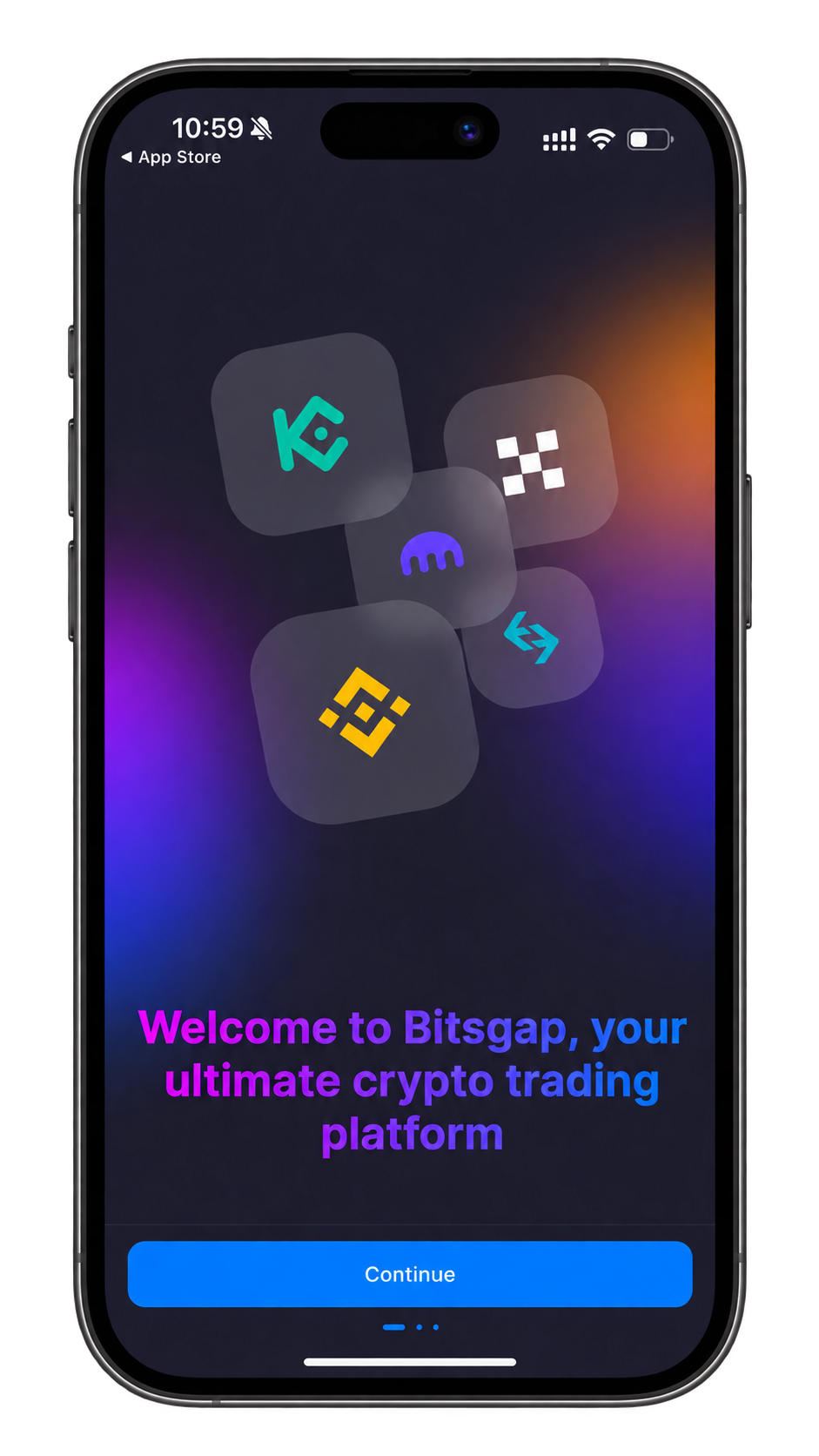
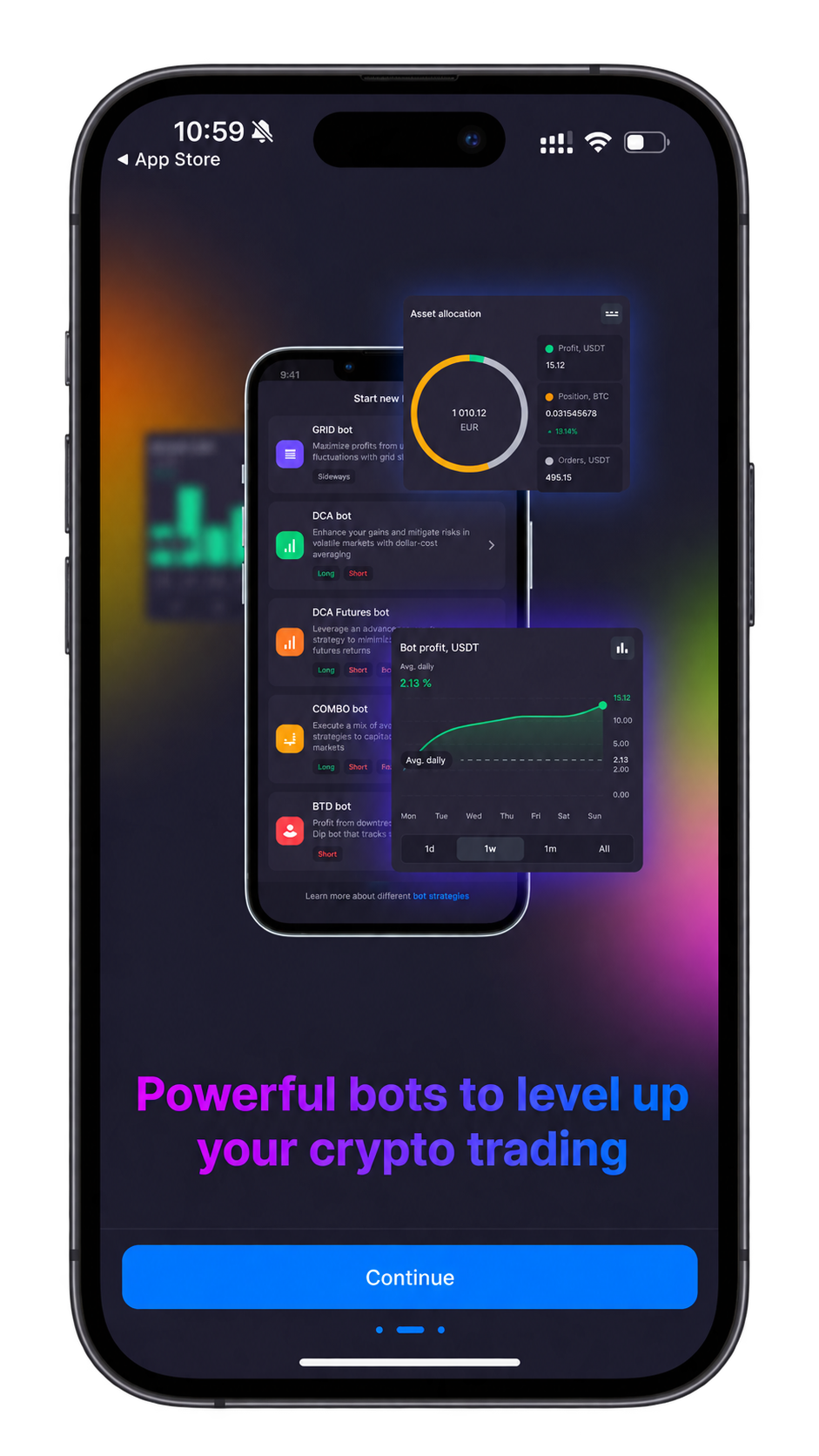
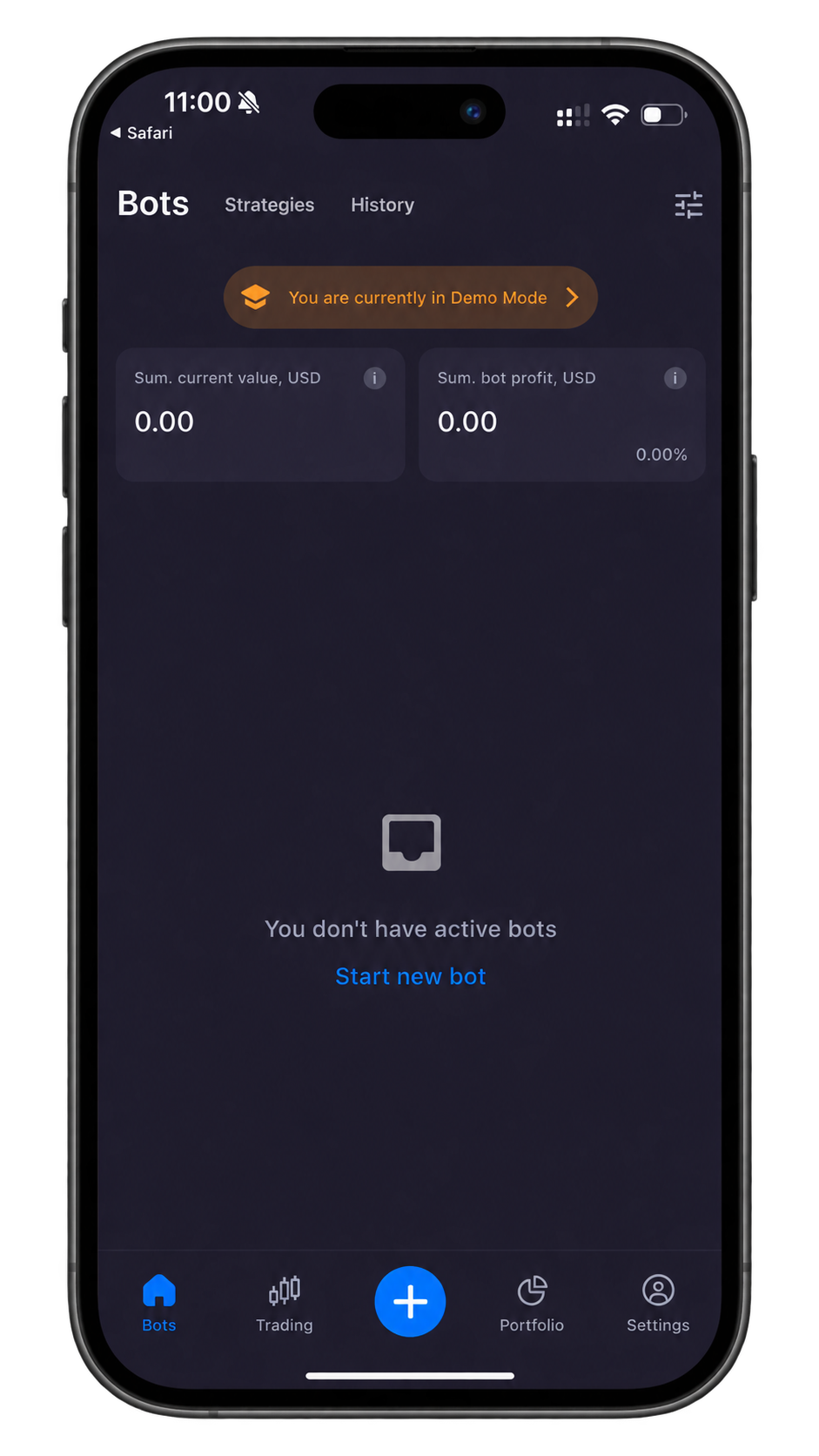
Bitsgap provides a comprehensive trading interface that brings automated strategy management, manual trading, portfolio monitoring, and performance analysis into a centralized dashboard. Despite the platform’s extensive range of tools, its interface remains relatively approachable, with guided bot configuration, predefined strategy settings, and AI-assisted recommendations reducing the work involved in getting started. Traders can review available balances, monitor open positions, and manage their strategies through the web platform or dedicated iOS and Android applications without relying on individual exchange dashboards for everyday trading activity.
The learning curve becomes more noticeable when moving beyond conventional GRID and DCA strategies. More specialized bots require an understanding of their underlying execution mechanics, while futures automation introduces leverage, margin allocation, and liquidation considerations. Bitsgap’s trading Terminal adds further flexibility through advanced orders, including scaled execution and Time-Weighted Average Price (TWAP) functionality, although these tools are most useful to traders who already understand order-book liquidity and the consequences of dividing larger transactions across multiple price levels or execution intervals.
Historical backtesting and demo trading make the platform more accessible to users who want to evaluate strategies before deploying real capital. An advantage of Bitsgap’s backtesting engine is its ability to incorporate applicable exchange trading commissions, including individual maker and taker rates where supported. This provides a more realistic estimate than simulations that ignore transaction costs, although historical results still cannot fully account for slippage, changing liquidity, or unexpected market conditions. Demo trading offers a complementary way to observe strategy behavior against current market movements, but simulated order execution should not be interpreted as a guarantee of equivalent live results.
Bitsgap’s performance analytics are particularly useful because they distinguish between profits generated by completed bot transactions and changes in the value of open positions. The dashboard presents Bot Profit, Position PNL, and Total PNL, allowing traders to assess whether realized trading gains are being offset by unrealized losses. For example, a GRID bot may generate $120 in accumulated trading profits while holding cryptocurrency that has declined by $200 in value, leaving its combined trading result negative despite the positive profit figure.
This distinction becomes even more important when comparing different bot strategies. GRID and DCA Long bots generally report trading profits in the quote currency, while accumulation-focused strategies such as BTD and DCA Short can generate returns measured in the underlying cryptocurrency. LOOP also reinvests its trading proceeds rather than displaying conventional Bot Profit separately, meaning its performance requires closer attention to changes in asset holdings and overall position value. Consequently, headline profit figures are not always directly comparable across different bot types.
The analytics interface provides additional context through trading history, average daily profit, investment allocation, transaction counts, and performance charts. Users can examine individual orders and compare results across active or completed strategies, making it easier to identify bots that have stopped trading effectively or accumulated unfavorable positions. However, average daily profit should not be interpreted as a sustainable daily return, particularly when calculated over short periods of unusually favorable market activity.
For a meaningful assessment, traders should evaluate realized and unrealized PNL together with exchange commissions, futures funding payments where applicable, and subscription expenses. Capital committed to open positions and the portfolio’s overall change in value are equally important, since a strategy generating frequent profitable transactions may still underperform a simpler investment approach once its full costs and exposure are considered.
Bitsgap delivers a strong user experience for traders who want detailed control over automated strategies without managing separate trading systems. Its combination of guided configuration, testing tools, advanced execution, and performance analytics provides a practical environment for active cryptocurrency trading, although the quality of its reporting ultimately depends on users interpreting the figures correctly. The most useful measure of success is not how frequently a bot completes profitable trades, but whether the entire strategy improves portfolio performance after costs and risk are taken into account.
Preview
Bitsgap vs Competitors
Bitsgap vs QuadTerminal, WunderTrading, and Coinrule
Bitsgap competes with several established cryptocurrency trading automation platforms, including QuadTerminal, WunderTrading, and Coinrule. Although these services share core functionality such as automated trading, exchange connectivity, and portfolio monitoring, their approaches differ considerably in strategy development, execution flexibility, and the tools available for managing trading activity. Bitsgap concentrates on specialized trading bots and AI-assisted configuration, while its competitors place varying degrees of emphasis on unified trading terminals, external signals, and customizable trading strategies.
The differences become particularly important when deciding whether to use predefined automation or build strategies around specific market conditions. Bitsgap provides a relatively structured environment for configuring and testing established trading methods, whereas WunderTrading offers greater flexibility for signal-driven execution and Coinrule emphasizes AI-generated conditional strategies. QuadTerminal occupies a somewhat different position, combining multi-exchange trading and portfolio management with automated trading functionality. The most appropriate choice depends on how much customization traders require and whether the additional tools justify their subscription costs.
| Platform | Best For | Main Advantage | Main Limitation |
|---|---|---|---|
| Bitsgap | Specialized grid, DCA, and futures automation | Diverse bot strategies, AI-assisted configuration, and integrated backtesting | Higher subscription costs for advanced functionality |
| QuadTerminal | Multi-exchange trading and portfolio management | Unified trading terminal, portfolio oversight, and Cody AI | Less readily verifiable current pricing and feature limits |
| WunderTrading | TradingView automation and advanced execution | Free live bots, Signal Bots, and specialized futures strategies | More complex configuration for advanced trading |
| Coinrule | AI-powered strategy development and multi-asset trading | Natural-language trading agents, customizable rules, and automated portfolio management | Credit-based pricing, execution restrictions, and regional limitations |
Bitsgap vs QuadTerminal
QuadTerminal, formerly known as Quadency, approaches cryptocurrency automation primarily through a unified trading environment that combines exchange connectivity, portfolio monitoring, and automated execution. Its interface is designed for traders who want to consolidate activity across several exchange accounts while maintaining access to manual trading tools, strategy templates, and portfolio analytics. Bitsgap offers similar account-management convenience, but its strongest differentiator is the depth of its dedicated bot strategies and the controls available for configuring automated trades.
One of QuadTerminal’s more distinctive features is Cody, an AI-powered assistant designed to translate natural-language trading ideas into automated strategies. This gives the platform an alternative to conventional bot configuration, particularly for users who want to experiment with customized trading conditions rather than rely entirely on predefined parameters. Its automation offering has also included TradingView signals, portfolio rebalancing, and technical trading strategies, creating a broader environment for traders who combine discretionary execution with systematic approaches.
Bitsgap takes a more structured approach to automation, offering specialized bots such as LOOP, BTD, QFL, and COMBO alongside its conventional GRID and DCA strategies. These products provide different methods of managing trading positions, accumulating cryptocurrency, and taking profits, with strategy-specific settings already integrated into the platform. Traders can also use historical backtesting and AI-assisted configuration to evaluate suitable parameters without developing their own execution logic.
The distinction becomes clearer when considering how much work users want to undertake before launching a strategy. QuadTerminal’s multi-exchange trading and Cody AI functionality may appeal to traders interested in combining manual account management with customized automation. Bitsgap is more suitable for those who prefer dedicated trading strategies with established configuration controls, particularly when selecting between spot accumulation, range trading, and leveraged derivatives.
Subscription transparency is another consideration. Bitsgap maintains clearly defined Free, Basic, Advanced, and Pro plans, with published bot allowances and historical backtesting limits. QuadTerminal has advertised Free, Pro, and Advanced subscriptions, including discounts associated with its QUAD token, although its current live subscription limits and checkout pricing are less readily verifiable. Traders considering QuadTerminal should confirm the available features and payment conditions before committing to a subscription rather than relying on historical pricing.
Overall, QuadTerminal is worth considering for users who prioritize consolidated exchange management, portfolio visibility, and AI-assisted customization. Bitsgap offers a more focused proposition for traders who want to operate specialized cryptocurrency bots with clearly defined strategy controls and testing functionality.
Bitsgap vs WunderTrading
WunderTrading is one of Bitsgap’s strongest alternatives for traders who rely heavily on TradingView signals, external trading instructions, and sophisticated execution workflows. Both platforms provide conventional DCA and grid automation, centralized trading interfaces, and support for spot and futures markets, but their emphasis differs. Bitsgap concentrates on specialized bot mechanics and AI-assisted strategy selection, while WunderTrading provides greater flexibility for converting technical signals into automated transactions across connected exchange accounts.
WunderTrading’s Signal Bots are particularly relevant to traders using TradingView indicators or Pine Script strategies. They can receive webhook alerts and execute predefined actions, allowing users to maintain their technical strategy logic outside the trading platform while automating order placement. Its multi-account functionality also supports coordinated execution, which can be useful for traders operating similar strategies across several exchange accounts.
The platform extends beyond conventional automation through spread trading, statistical arbitrage tools, and market-neutral futures strategies. Its Market Neutral Bot, available for live trading on Premium, uses relationships between cryptocurrency futures pairs to establish coordinated positions rather than relying entirely on the direction of a single asset. However, these strategies introduce additional considerations involving leverage, funding payments, execution timing, and the possibility that historical price relationships will break down.
Bitsgap offers a different kind of flexibility through its specialized strategies, particularly those combining averaging, grid execution, and cryptocurrency accumulation. Its AI Assistant simplifies the process of selecting trading pairs and configuring bots, while the available backtesting tools help users examine historical strategy behavior before deployment. WunderTrading also provides backtesting and optimization for supported bots, so the distinction is less about whether testing exists and more about how each platform integrates it into the trading workflow.
Accessibility presents another important difference. WunderTrading’s permanent Free subscription includes one live Signal Bot, one DCA Bot, and one Grid Bot, making it possible to operate a limited number of strategies without paying recurring software fees. Bitsgap provides free demo trading and a restricted EVEDEX COMBO allowance, but conventional live GRID and DCA automation requires a paid subscription. This makes WunderTrading particularly attractive to traders who want to experiment with a small number of live strategies before committing to a larger automation setup.
WunderTrading also provides API and MCP connectivity, allowing technically experienced users to connect external applications and compatible AI assistants to supported trading functionality. These capabilities strengthen its appeal for traders seeking greater control over signal generation and execution rather than relying exclusively on predefined automation tools.
For users developing their own chart-based systems, TradingView automation and advanced Signal Bots make WunderTrading particularly compelling. Bitsgap remains more appealing when the priority is selecting from a diverse collection of specialized bots, refining their configurations, and managing strategies through an integrated trading environment.
The choice ultimately depends on whether traders prefer to bring their own signals into an execution platform or use a broader collection of predefined strategies. WunderTrading offers greater scope for signal-based and specialized futures execution, while Bitsgap provides a more structured approach to bot configuration and strategy management.
Bitsgap vs Coinrule
Coinrule provides a different approach to automated trading through its recently updated AI-powered platform, emphasizing customizable trading agents rather than conventional bot templates. Users can describe their strategies in natural language, Pine Script, or Python-style instructions, with Coinrule interpreting those inputs into structured execution rules. This makes it particularly relevant to traders who want to develop strategies around specific technical indicators, market conditions, and risk parameters without programming their own trading software.
Bitsgap offers AI-assisted automation, but its implementation serves a different purpose. Its AI Assistant primarily helps traders select supported strategies, identify suitable trading pairs, and establish bot configurations based on market conditions and investment preferences. Coinrule allows users to define more customized conditional trading logic, including combinations of indicators, entry requirements, exit instructions, and position-sizing rules that operate through automated trading agents.
The difference becomes particularly relevant for traders developing systematic strategies. Coinrule’s multi-market scanners can monitor several cryptocurrency or stock instruments within a single strategy, while its portfolio baskets support automated allocation management and periodic rebalancing. The platform also extends beyond cryptocurrency exchanges through supported stock and ETF brokerage integrations, giving users additional opportunities to automate investment strategies across different asset classes.
Coinrule’s integration with external AI assistants provides another distinction. Through the Model Context Protocol, compatible assistants can inspect trading activity, evaluate strategies, request backtests, and manage authorized trading agents. This creates a conversational workflow for developing and operating automated systems, whereas Bitsgap’s AI functionality remains more closely integrated with selecting and configuring its established bot strategies.
However, greater strategy flexibility introduces additional considerations. Coinrule’s automated agents operate within a supported execution framework rather than an unrestricted programming environment, and its historical simulations exclude transaction fees and slippage. Bitsgap’s backtesting incorporates applicable exchange commissions, providing a more useful cost estimate for strategies where trading frequency materially affects profitability, although live results can still differ from historical simulations.
Pricing follows different models as well. Bitsgap charges fixed subscription fees according to bot capacity and available features, while Coinrule combines subscriptions with credits consumed through activities such as market monitoring, AI processing, deployments, and trading execution. For traders running frequently triggered strategies across numerous markets, those usage charges can make the total software expense less predictable.
Coinrule also imposes restrictions on access for EU and EEA residents under its current MiCA-related policies, making regional eligibility an important consideration before subscribing. Its support for stocks and ETFs can broaden its appeal, but it does not automatically make the platform suitable for every market or jurisdiction.
Traders interested in developing AI-assisted trading strategies and customizable execution rules may find Coinrule’s approach more suitable than relying on predefined trading bots. Bitsgap is preferable for users who want a dedicated collection of GRID, DCA, accumulation, and futures strategies with established controls and a more predictable software subscription structure.
Both platforms offer meaningful AI functionality, but neither should be treated as an autonomous investment manager capable of reliably identifying profitable trades. Their effectiveness ultimately depends on the trading rules deployed, the markets selected, and the capital exposed to each strategy.
Which Bitsgap Alternative Is Worth Considering?
Bitsgap’s main advantage is the breadth of its specialized trading strategies and the way its automation tools are integrated with AI-assisted configuration, historical testing, and portfolio management. It provides a practical environment for traders who want to operate several established strategies without developing customized execution systems, particularly when managing a combination of spot and futures positions.
QuadTerminal offers a more terminal-oriented approach for traders prioritizing consolidated account management and AI-assisted strategy creation, while WunderTrading is particularly attractive to those relying on TradingView signals, multi-account execution, or specialized derivatives strategies. Coinrule provides the most distinct alternative for users interested in natural-language strategy development, customizable trading agents, and automated investing across cryptocurrencies and traditional financial markets.
Bitsgap is best suited to traders who want specialized cryptocurrency trading bots with accessible configuration, detailed strategy controls, and integrated testing tools. Its higher subscription costs may be justified for users actively managing several strategies, but those prioritizing external signal execution, custom conditional logic, or basic free live automation may find one of the alternatives better aligned with their requirements.
Pros & Cons
- Extensive trading bot selection: Seven distinct strategies cover range trading, averaging, buy-the-dip execution, reinvestment, and futures automation.
- Strong exchange connectivity: A consolidated Terminal supports established centralized exchanges and selected decentralized trading venues.
- AI-assisted portfolio management: Automated configuration, historical testing, and portfolio-level controls simplify strategy deployment.
- Comprehensive testing tools: Demo trading, backtesting, and performance analytics help traders evaluate configurations before committing capital.
- Expensive advanced subscriptions: Professional features and higher bot allowances require significantly greater monthly expenditure.
- Restricted entry-level functionality: Futures bots, extended backtesting, advanced trailing settings, and portfolio-level AI controls are limited by subscription.
- Strategy complexity increases risk: Leveraged COMBO and DCA Futures bots can accumulate substantial exposure during volatile markets.
- Dependence on exchange APIs: Platform interruptions, failed orders, connection restrictions, and compromised trading credentials remain operational risks.
Bottom Line
Is Bitsgap Worth Using in 2027?
Bitsgap is a strong choice for cryptocurrency traders seeking a comprehensive automation platform with greater strategy variety than conventional grid and DCA trading services. Its seven specialized bots cover different trading approaches, from capturing price fluctuations and accumulating cryptocurrency to managing leveraged futures positions. Combined with AI-assisted configuration, historical backtesting, and multi-exchange connectivity, these capabilities make Bitsgap particularly attractive to traders who want to manage several automated strategies without developing their own trading infrastructure.
The platform’s greatest strength lies in combining sophisticated trading functionality with relatively accessible configuration and management tools. Its AI Assistant simplifies strategy selection, while demo trading, advanced order controls, and detailed performance analytics provide additional flexibility for evaluating and monitoring automated positions. However, Bitsgap’s higher subscription costs can be difficult to justify for smaller portfolios, particularly when access to futures automation, advanced trailing features, and AI Portfolio Mode requires more expensive plans. Traders must also account for exchange commissions, unrealized position losses, and the additional risks associated with leveraged strategies.
Bitsgap is worth considering for active cryptocurrency traders who want specialized automation, flexible execution controls, and integrated strategy-testing tools. Its combination of bot diversity and AI-assisted functionality provides substantial value for users managing multiple strategies, although those running only a basic grid or DCA bot may struggle to justify the recurring expense. Bitsgap makes automated trading more convenient and configurable, but its long-term value ultimately depends on disciplined capital allocation, realistic performance expectations, and whether its advanced features meaningfully improve the trader’s existing workflow.
FAQs
Is Bitsgap legitimate, and does it hold customer cryptocurrency?
Bitsgap is operated by Bitsgap Software Solutions – FZCO, a company registered in Dubai. Its standard centralized exchange integrations operate through API connections rather than direct custody. Funds remain with connected exchanges, and Bitsgap rejects API credentials with withdrawal permissions enabled. However, non-custodial operation does not eliminate unauthorized trading, exchange insolvency, or technical execution risks.
Can Bitsgap bots lose money even if their completed trades show profits?
Yes. A bot can generate realized profits from completed trading cycles while retaining open positions with substantial unrealized losses. This is particularly relevant to grid and DCA strategies during prolonged market declines. Total account performance must include outstanding positions, transaction costs, and changes in cryptocurrency holdings rather than relying exclusively on reported bot profits.
Does Bitsgap offer free live trading bots or only demo trading?
Bitsgap provides a permanent Free plan supporting simulated trading and manual trading functionality. Its current pricing also includes a specific exception allowing three COMBO bots through the Evedex integration. Standard live GRID and DCA automation on centralized exchanges generally requires a paid subscription. New users can test Pro features through a seven-day trial without providing a credit card.
What happens to active Bitsgap trading bots when a subscription expires?
When a paid subscription expires, Bitsgap provides a two-day Limited period during which existing bots remain active but users cannot initiate new live automation. If the subscription is not renewed, Bitsgap cancels its managed bots and orders and transfers the account to Free. Traders should monitor renewal dates because stopping platform-managed automation can leave exchange balances or positions requiring manual attention.
Can Bitsgap's AI Assistant trade futures or guarantee profitable strategies?
The AI Assistant is currently focused on configuring spot trading bots rather than autonomously managing leveraged futures positions. It analyzes market information and proposes configurations that operate through predefined trading rules. Historical optimization does not guarantee profitability, and AI-generated portfolios remain exposed to unfavorable market conditions, execution costs, and correlated asset movements.
Is Bitsgap better than WunderTrading or Coinrule for beginners?
Bitsgap offers accessible bot presets, AI-assisted configuration, and an extensive demo environment. WunderTrading provides a more economical introduction to live automation through its permanent free bots, while Coinrule Cloud emphasizes natural-language strategy development and conditional execution. Bitsgap is particularly suitable for beginners interested in learning grid and DCA mechanics, although its subscription costs make it less attractive for users experimenting with very small portfolios.