











 X
 Facebook
 LinkedIn
 Google News
 Telegram
 Instagram
 RSS Feed


Introduction
Coinrule Review 2027: AI Trading Bots, Pricing, Security & Verdict
Coinrule is an AI-powered trading automation platform that allows users to create, test, and execute customized strategies without programming their own trading infrastructure. Founded in 2018, the company has recently transformed its platform into a more advanced, AI-driven trading environment supporting cryptocurrencies, stocks, and ETFs through connected exchanges and brokerage accounts. Its expanded functionality includes natural-language strategy creation, automated trading agents, historical backtesting, portfolio rebalancing, and integrations with external AI assistants.
Coinrule’s main advantage is its flexibility in turning trading ideas into automated strategies. Users can describe their preferred approach in plain English, Pine Script, or Python-style instructions, with the platform’s AI interpreting those inputs into structured trading rules. These can incorporate technical indicators, price conditions, position sizing, take-profit targets, and protective exits, while TradingView signals and multi-market scanning provide additional control over execution. Traders can also automate recurring investments and manage diversified asset baskets without building separate trading systems.
However, the additional functionality introduces considerations beyond strategy configuration. Coinrule uses subscription plans with credit-based usage allowances, meaning active traders may face additional costs depending on their automation requirements. Historical backtesting and paper trading also exclude transaction fees and slippage, potentially overstating simulated performance. Regional availability presents another limitation, as Coinrule currently does not serve EU or EEA residents under its MiCA-related restrictions.
What Is Coinrule and How Does It Work?
Coinrule is a cloud-based trading automation service that enables users to build and deploy rule-based strategies across supported cryptocurrency exchanges and stock brokers. Its non-custodial structure means assets remain with the connected trading venue, while Coinrule executes authorized orders through exchange APIs or supported account connections. This allows traders to automate market activity without depositing their funds directly into the platform.
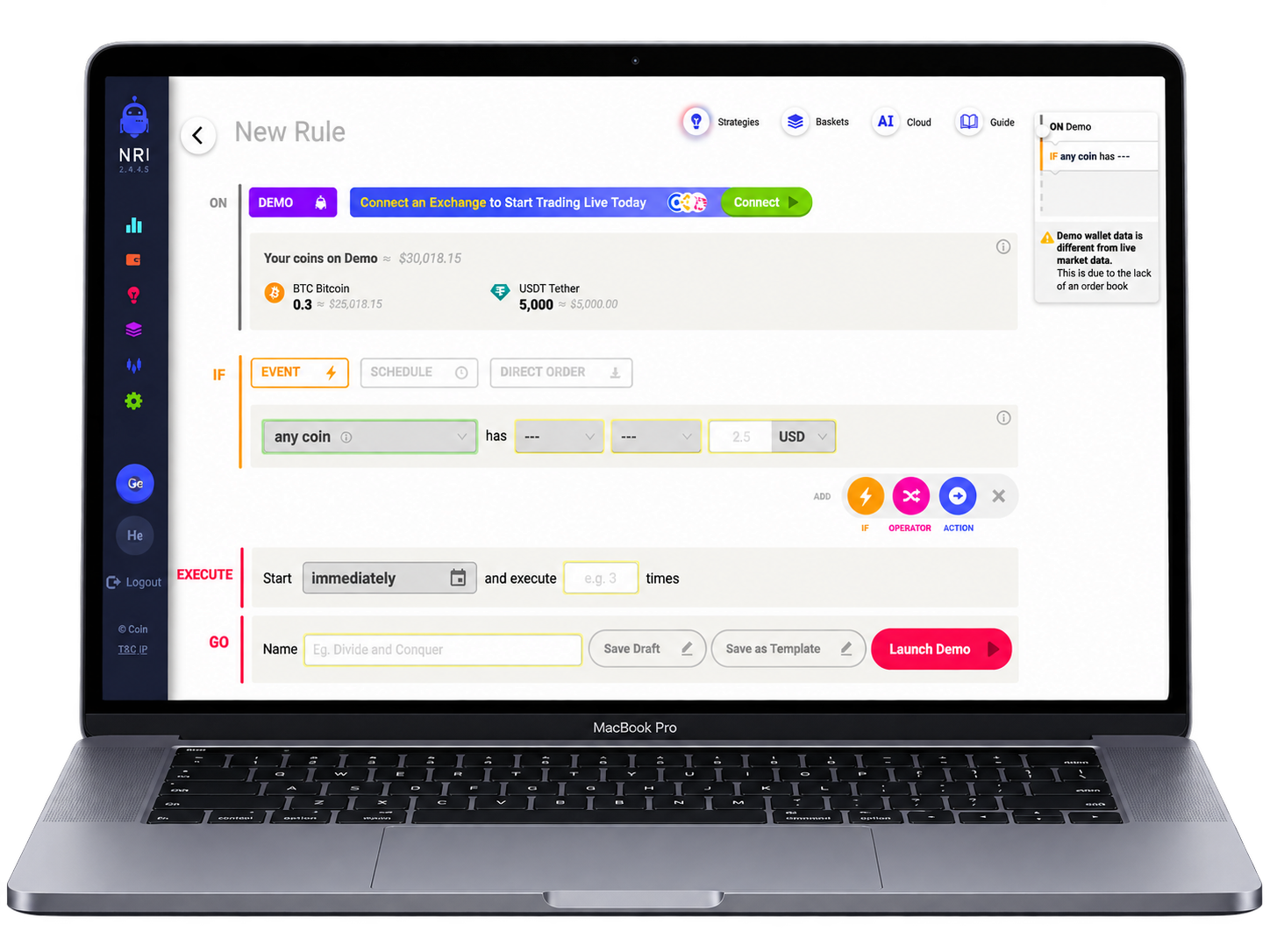
Following its recent transition to an AI-powered trading environment, Coinrule simplifies strategy creation by converting natural-language instructions into executable trading rules. Instead of manually programming every condition, users can describe the market signals they want to follow, review the generated configuration, and adjust indicators, timeframes, allocation limits, and exit conditions before activating an automated trading agent.
For example, a trader could configure a Bitcoin strategy that opens a position when the Relative Strength Index (RSI) crosses above 55 and the price remains above its 50-period exponential moving average. The agent would monitor those conditions, execute the configured order when the requirements are satisfied, and manage the position according to its predefined profit targets or stop-loss settings.
Coinrule also supports TradingView webhooks, automated portfolio baskets, historical backtesting, and connections to compatible AI assistants through the Model Context Protocol (MCP). These integrations allow users to develop, evaluate, and monitor trading strategies through a centralized interface, with live execution handled by the platform’s cloud infrastructure.
Importantly, Coinrule’s AI converts trading instructions into supported strategy logic rather than independently predicting profitable trades. Users remain responsible for evaluating the generated rules, allocating capital, and managing the risks associated with automated execution.
Who Should Use Coinrule?
Coinrule is particularly suitable for retail and experienced traders who want customizable trading automation without developing their own execution software. Its AI-assisted strategy builder makes technical trading rules more accessible, while predefined templates provide a practical starting point for users unfamiliar with constructing automated strategies. More experienced traders can combine multiple indicators, external TradingView signals, and portfolio-level controls to develop strategies suited to their preferred markets.
The platform also appeals to users interested in systematic investing, with scheduled purchases, multi-asset baskets, and automated rebalancing supporting portfolio management alongside active trading. Historical backtesting and paper trading provide additional opportunities to evaluate strategies before committing capital, although simulated results should not be treated as reliable forecasts of live performance.
Coinrule may be less suitable for traders who only need basic DCA or grid automation and have little interest in its broader strategy-building capabilities. Its subscription and credit-based costs also deserve consideration, particularly for users operating multiple active agents or monitoring numerous markets. Professional traders requiring unrestricted algorithmic programming, high-frequency execution, or sophisticated arbitrage infrastructure may find its supported strategy framework restrictive.
Coinrule is best suited to traders seeking flexible, AI-assisted automation across cryptocurrency and traditional financial markets. Its combination of customizable trading agents, strategy testing, portfolio management, and external AI integrations provides a comprehensive environment for systematic trading, although its value ultimately depends on how effectively users apply those tools and manage the associated costs and risks.
Products & Services
Coinrule Trading Bots and Strategy Features
Coinrule has expanded its trading automation capabilities considerably through its recent transition to an AI-powered platform, bringing strategy creation, execution, backtesting, and portfolio management into a unified environment. Rather than concentrating exclusively on traditional DCA or grid bots, the platform allows traders to automate strategies based on technical indicators, market conditions, scheduled transactions, and external trading signals across supported cryptocurrency exchanges and stock brokers.
Its central feature is an AI-assisted strategy builder that translates trading instructions into executable rules without requiring users to develop their own software. Coinrule also provides multi-market scanners, automated portfolio baskets, historical backtesting, TradingView integration, and connectivity with external AI assistants. These features make the platform particularly relevant to traders seeking greater flexibility than conventional trading bots provide, although the available execution methods remain subject to Coinrule’s supported strategy framework.
AI-Powered No-Code Strategy Builder
Coinrule’s AI-powered strategy builder allows traders to create customized trading systems by describing their intended rules in natural language, Pine Script, or Python-style instructions. Instead of manually programming exchange-specific APIs, users can explain the conditions under which they want to enter or exit a position, specify the relevant technical indicators, and establish capital allocation and risk-management parameters.
For example, a trader could request a Bitcoin strategy that opens a position when the 14-period Relative Strength Index (RSI) crosses above 55 while the price remains above its 50-period exponential moving average. Additional instructions could establish a 6% take-profit target, a 3% trailing stop, and a maximum allocation of 4% of the portfolio per trade. Coinrule’s AI interprets these requirements and produces a structured strategy containing the necessary entry conditions, exit rules, timeframes, and position-sizing instructions.
The generated configuration can be reviewed and adjusted before deployment, allowing users to examine how the platform has interpreted their trading instructions. Coinrule also generates Python-based execution logic and automated tests, although the underlying code operates within its supported trading framework rather than functioning as an unrestricted Python development environment. Users can inspect the generated code, but changes to the strategy’s logic are generally made by revising the instructions and generating an updated configuration.
Once activated, the strategy runs as an automated trading agent that monitors market conditions and submits orders through the connected exchange or brokerage account. Traders can review its activity, adjust supported settings, monitor open positions, and pause or stop execution through the dashboard without keeping their own computers running.
The main advantage is the ability to translate relatively sophisticated trading ideas into automated instructions without managing the technical infrastructure behind them. However, AI-assisted strategy generation does not guarantee that the resulting logic is appropriate or profitable. Ambiguous instructions, excessive indicator combinations, and poorly defined exits can still produce ineffective strategies, making it essential to review the generated configuration before committing capital.
Trading Strategy Templates, DCA, and Grid Bots
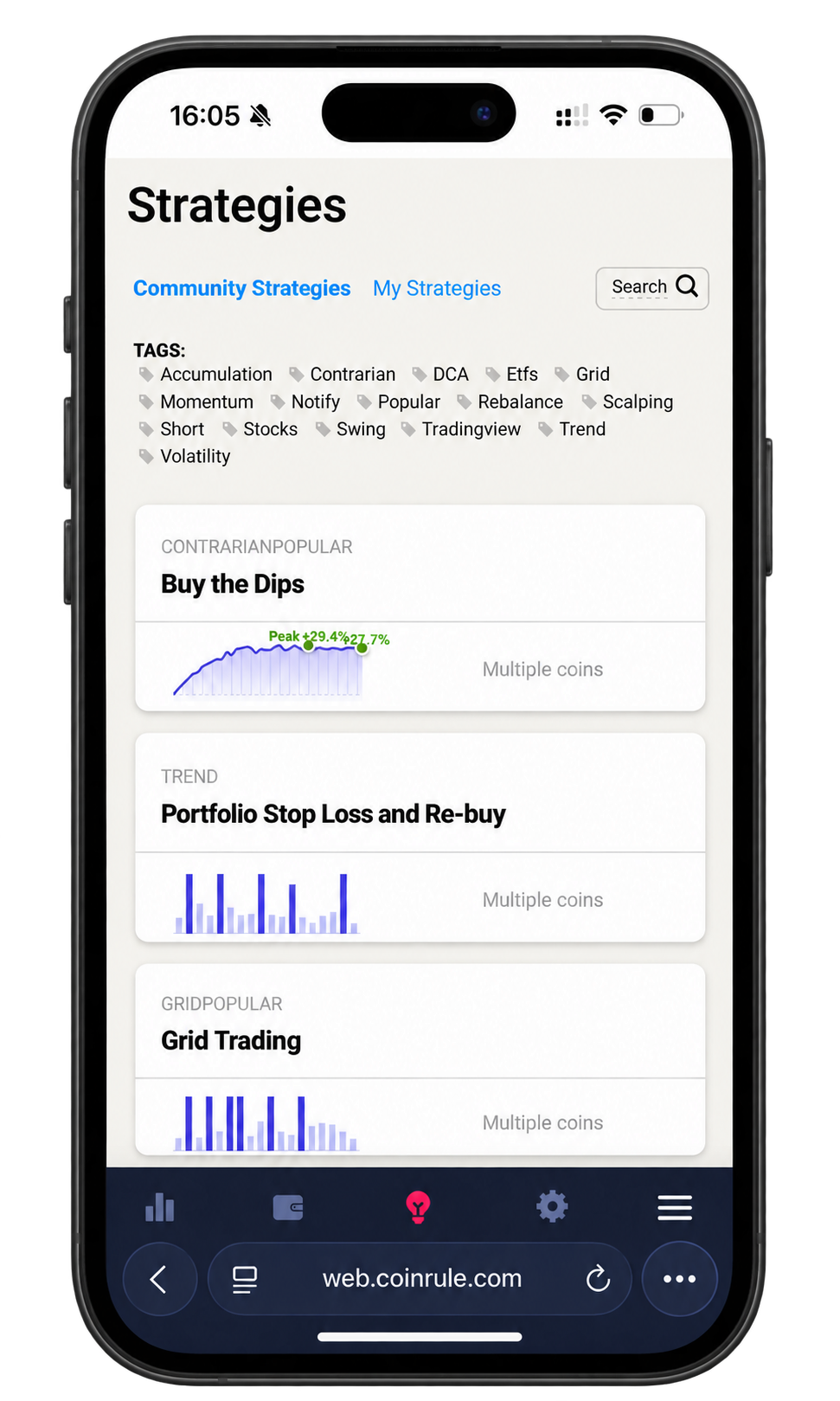
Coinrule provides a library of predefined trading strategies covering commonly used technical and systematic trading approaches. Available templates include moving-average crossovers, momentum trading, RSI-based entries, Bollinger Band mean reversion, volatility breakouts, trend-following systems, dollar-cost averaging, and grid-style trading. These configurations offer a convenient starting point for traders who want to automate established strategies without constructing every rule independently.
Templates can be customized according to the selected market, indicator parameters, trading timeframe, capital allocation, and exit conditions. A moving-average strategy, for instance, could use longer intervals to reduce trading frequency, while a momentum configuration might combine RSI and MACD signals to require additional confirmation before opening a position. The ability to modify these parameters provides greater flexibility than relying on completely fixed bot settings, although it also increases the importance of testing strategies under different market conditions.
Coinrule supports scheduled dollar-cost averaging, allowing users to automate recurring cryptocurrency or stock purchases at predetermined intervals. A trader could configure a weekly Bitcoin purchase of $100 or introduce an additional condition requiring the asset to trade below a selected moving average before execution. This approach is primarily intended for systematic accumulation and differs from aggressive averaging-down strategies that increase position sizes as prices decline.
Grid trading is also available through predefined strategy templates, enabling traders to automate buying and selling around selected price intervals. However, grid trading is one component of Coinrule’s broader rule-based automation environment rather than the platform’s defining product. Traders seeking highly specialized grid configurations may find its supported execution framework more restrictive than dedicated grid trading systems.
The template library is particularly useful for understanding how technical strategies translate into automated execution, but its configurations should not be treated as independently validated investment products. Market conditions, execution costs, and capital allocation can substantially influence results, even when a strategy has performed well historically. Our guide to crypto trading bots examines how different automation strategies work and the risks associated with their execution.
Multi-Market Scanners and Automated Trading Agents
Coinrule supports multi-market scanning, allowing a single automated trading agent to monitor numerous cryptocurrency pairs or stock instruments simultaneously. Instead of configuring a separate bot for every asset, traders can establish a market universe and define the technical conditions that must be satisfied before the agent opens a position.
The scanning engine supports universes of up to 50 cryptocurrency markets or 200 stock instruments per strategy, making it particularly useful for momentum, breakout, and trend-following approaches. For example, a trader could configure an agent to monitor the 50 largest cryptocurrency pairs by trading volume and purchase assets that satisfy selected RSI, moving-average, and volatility conditions. Each instrument is evaluated independently, allowing the strategy to identify potential opportunities across the monitored market selection.
Users can also establish limits on the number of positions held simultaneously, preventing the strategy from allocating capital to every asset generating a qualifying signal. This is an important safeguard because cryptocurrency markets frequently move together, and several assets may satisfy similar entry conditions during the same market rally or decline.
Multi-market scanning reduces the operational effort involved in monitoring numerous trading pairs, but it does not eliminate the need for portfolio-level exposure management. A strategy may open several positions in strongly correlated assets, while market-data subscriptions and execution activity consume credits under Coinrule’s usage-based billing model. Scanning also remains limited to supported markets and indicators rather than providing unrestricted access to external data or cross-exchange arbitrage opportunities.
Portfolio Baskets and Automated Rebalancing
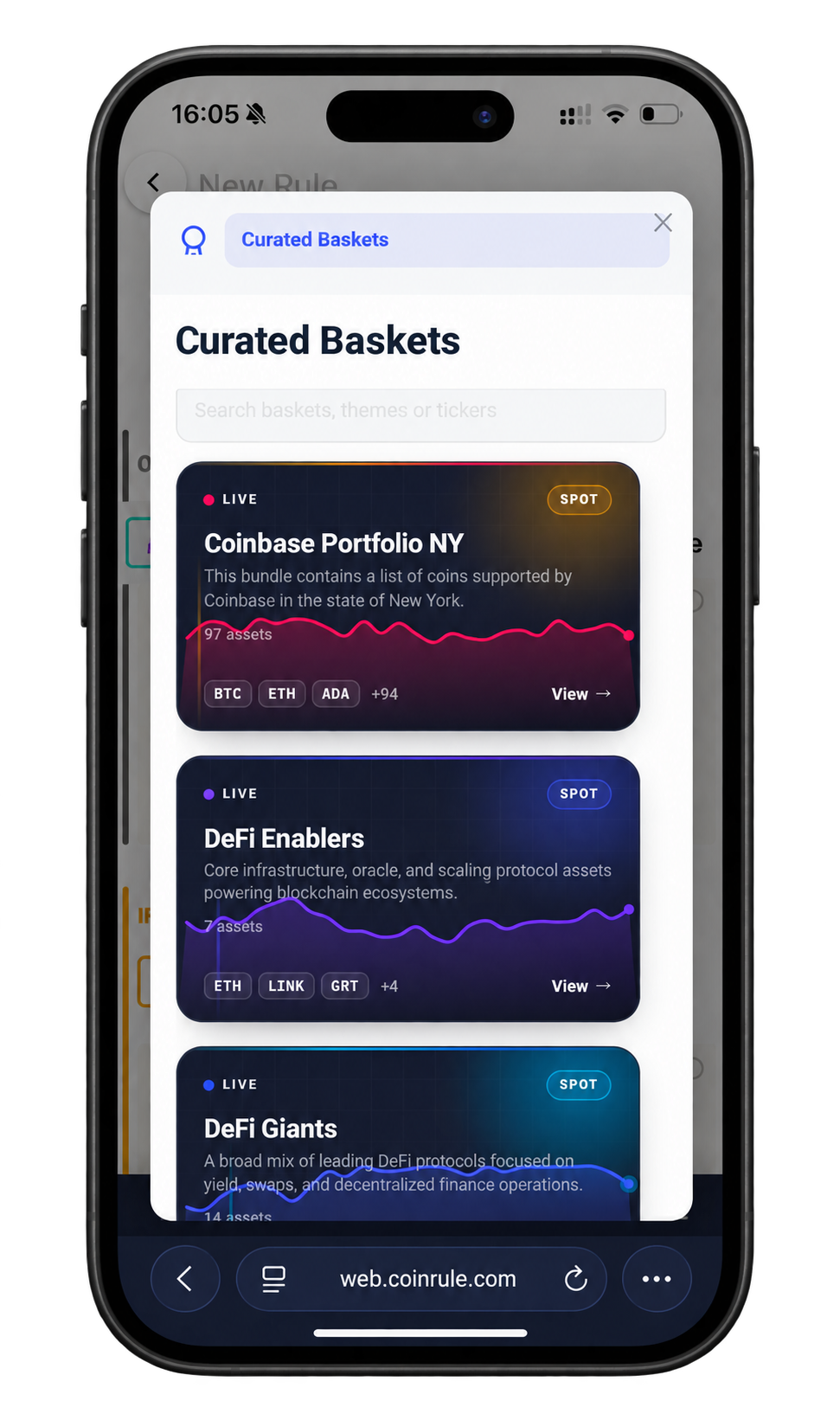
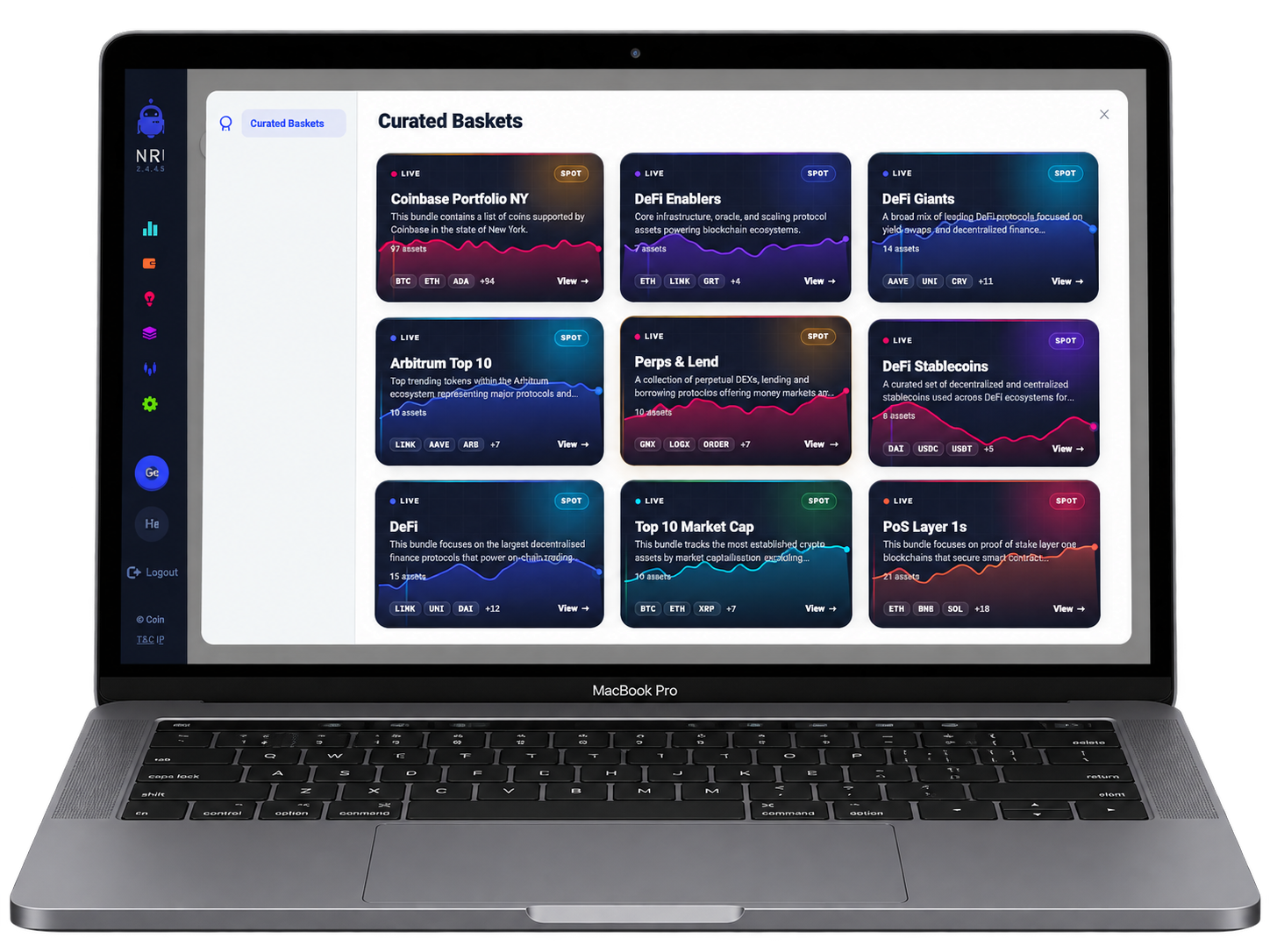
Coinrule’s portfolio baskets allow traders to automate investments across multiple cryptocurrencies, stocks, or exchange-traded funds through a single strategy. Users can choose from curated thematic portfolios or construct custom baskets containing between two and 20 assets, assigning target allocations according to their preferred investment approach.
For example, a cryptocurrency basket might allocate 50% to Bitcoin, 30% to Ethereum, and 20% to Solana. Coinrule distributes the initial investment according to those proportions and subsequently evaluates whether price movements have caused the portfolio to drift away from its intended allocation. When rebalancing occurs, the strategy may sell portions of overweight holdings and purchase underweight assets, subject to available balances and the connected venue’s minimum order requirements.
Custom baskets support daily, weekly, and 30-day rebalancing schedules, allowing users to choose how frequently the system attempts to restore their target weights. This distinguishes automated rebalancing from conventional DCA, where recurring purchases increase the investment amount over time. Coinrule’s basket rebalancing uses the existing allocated portfolio rather than automatically introducing a new deposit at every scheduled interval.
The platform also provides curated baskets covering cryptocurrency categories such as major Layer 1 networks, decentralized finance, AI-related assets, and memecoins, alongside stock and ETF portfolios. These configurations allow traders to obtain systematic exposure to selected market themes without managing every asset through an independent bot. Availability depends on the connected trading venue, with cryptocurrency spot and perpetual futures baskets supported alongside eligible stock and ETF strategies. On-chain ecosystem baskets remain a developing part of the offering rather than a fully available feature across all supported blockchain networks.
Portfolio baskets nevertheless have important limitations. Coinrule does not automatically apply a basket-level take-profit or stop-loss order through the standard basket configuration, meaning periodic rebalancing cannot prevent losses during broader market declines. Frequent rebalancing may also generate exchange commissions and taxable transactions, particularly when portfolio weights change substantially during volatile conditions.
For traders seeking systematic allocation management, baskets represent one of Coinrule’s more useful features beyond conventional trading bots. However, maintaining target allocations should not be confused with managing total investment risk, since a diversified portfolio can still experience substantial losses when its underlying assets decline together.
Cryptocurrency, Stock, ETF, and Futures Trading Automation
Coinrule supports automated trading across several asset classes, allowing users to apply rule-based strategies to cryptocurrencies, stocks, ETFs, and selected perpetual futures markets. This broader market coverage makes the platform relevant to traders who want to manage different investment strategies through a centralized automation environment rather than using separate software for each asset class.
Cryptocurrency automation covers supported spot exchanges, where traders can configure strategies involving Bitcoin, Ethereum, and other available digital assets. Eligible derivatives integrations also support perpetual futures trading, including long and short strategies through venues such as Kraken Futures and Hyperliquid. These markets introduce additional flexibility for directional trading, although leverage, funding payments, and liquidation requirements create risks that do not apply in the same way to unleveraged spot positions.
Stock and ETF automation extends Coinrule’s strategy framework to traditional financial markets through supported brokerage connections. Users can configure technical trading rules, scheduled purchases, and portfolio baskets involving eligible equities or funds, while retaining the ability to monitor their automated strategies through the same dashboard.
The distinction between asset classes remains important because cryptocurrency exchanges generally operate continuously, whereas stock markets follow scheduled trading sessions and brokerage-specific restrictions. Available order types, minimum investment amounts, instrument eligibility, and execution conditions can also differ substantially between connected venues.
Coinrule’s supported strategy framework places further limits on specialized trading methods. Cross-exchange arbitrage, conventional market making, unrestricted high-frequency trading, and strategies depending directly on external news or social sentiment feeds are not supported as native execution categories. The platform is therefore better understood as a flexible environment for systematic retail trading rather than a replacement for professional high-frequency or institutional execution infrastructure.
TradingView Integration and External Trading Signals
Coinrule supports TradingView webhook integration, enabling traders to connect externally generated technical signals to automated trading agents. This is particularly valuable for users who already develop strategies using TradingView indicators or Pine Script and want to automate execution without building a separate connection to their cryptocurrency exchange.
The integration allows a TradingView alert to communicate with a Coinrule strategy through a dedicated webhook URL. When the configured market condition is triggered, TradingView sends the alert to Coinrule, which verifies the authentication credentials and processes the corresponding trading instruction. Depending on the strategy and supported market, these signals can initiate purchases, sales, or changes to long and short positions.
For example, a trader could configure a Pine Script strategy that generates a buy signal when a moving-average crossover occurs alongside increasing trading volume. Instead of manually responding to that alert, Coinrule can receive the signal and execute the corresponding order through the connected exchange account.
The implementation includes authenticated webhook messages, controls for duplicate signals, and execution records that help users identify when alerts have been received and processed. Coinrule also imposes signal-rate limits, while TradingView alerts consume credits under the platform’s usage-based pricing structure.
Although external signals provide greater flexibility than built-in technical indicators alone, the integration remains dependent on successful webhook delivery, valid authentication, and exchange execution conditions. TradingView may identify a signal at a particular chart price, but the eventual trade can execute at a different level because of market movement, spreads, or insufficient liquidity.
TradingView integration therefore expands Coinrule’s usefulness for systematic traders without removing the execution risks associated with automated trading. Its value is greatest when users already have a defined signal-based strategy and need a controlled way to translate those alerts into orders.
Coinrule MCP and AI Assistant Integration
One of Coinrule’s more distinctive capabilities is its integration with external AI assistants through the Model Context Protocol (MCP), introduced in 2026. This allows compatible services, including ChatGPT, Claude, and Grok, to interact with a Coinrule account through natural-language conversations, providing another way to create strategies, examine portfolios, and manage automated trading activity.
Through an authorized connection, users can ask an AI assistant to retrieve balances, review portfolio allocations, inspect active trading agents, analyze transaction history, or compare available performance information. The integration also supports historical backtesting and access to strategy templates, allowing traders to evaluate trading ideas without navigating every configuration screen manually.
With additional permissions, an assistant can help generate strategies, validate their logic, launch trading agents, adjust configurations, and manage portfolio baskets. For example, a user could request a backtest of an RSI-based Bitcoin strategy before authorizing its deployment, with Coinrule handling the supported validation and execution processes.
The integration uses OAuth 2.1 authentication and separates access into read-only and read-and-write permissions. Read-only access permits portfolio and strategy inspection without authorizing trading modifications, while read-and-write access enables actions that can initiate or change live trading activity. Users can revoke connected assistants and manage their permissions through Coinrule’s account settings.
This separation is important because conversational trading introduces the possibility of instructions being misunderstood or applied more broadly than intended. A request to stop a trading agent, for example, may have different consequences depending on whether existing positions should remain open or be closed. Users should therefore review the requested action carefully before authorizing account modifications, particularly when real capital is involved.
Coinrule MCP provides a practical extension of AI-assisted trading automation, but it does not allow external models to operate outside Coinrule’s supported execution framework or independently access exchange credentials. The integration makes account management and strategy creation more conversational, while responsibility for trading decisions and risk management remains with the user.
Backtesting and Paper Trading
Coinrule provides historical backtesting and paper trading functionality, giving users two ways to evaluate automated strategies before deploying them with real capital. Although both tools simulate trading activity, they serve different purposes: backtesting examines how a strategy would have performed during previous market conditions, while paper trading follows live market developments using virtual funds.
The availability of both features strengthens Coinrule’s appeal to traders interested in developing systematic strategies, particularly when compared with automation services that emphasize immediate deployment without providing extensive opportunities for testing. However, the quality of simulated results depends on the assumptions used by the underlying execution engine, making it essential to understand what each tool measures and excludes.
Historical Strategy Backtesting
Coinrule’s backtesting engine evaluates trading strategies against historical candlestick data, supporting simulation periods of up to two years. Traders can use the feature to examine historical profitability, win rates, maximum drawdowns, trade frequency, and average holding periods before deciding whether a configuration warrants further testing.
The current interface includes predefined bull-market, bear-market, and sideways-market scenarios, providing a way to assess how a strategy behaved under different market conditions. Users can also evaluate parameter variations within the available testing framework, although unrestricted custom date ranges and advanced walk-forward analysis are not currently supported.
The engine models order execution at the opening price of the candle following a qualifying signal, rather than assuming the strategy could trade using information that became available only after the relevant candle closed. This helps reduce certain forms of look-ahead bias, although it does not recreate the complete execution conditions of a live cryptocurrency exchange or stock broker.
An important limitation is that backtesting excludes transaction fees, slippage, and order-book liquidity. Trades are modeled using simplified market-order assumptions, meaning the reported results may be more favorable than actual execution, particularly for strategies involving frequent transactions or less-liquid assets.
Access also depends on the subscription, with the Investor plan including five lifetime backtest runs and Trader, Pro, and Enterprise providing unlimited runs under the published plan structure. Backtesting is therefore more practical for repeated strategy development on higher subscriptions, while entry-level users must be selective about the configurations they evaluate.
Historical simulations are useful for identifying obvious weaknesses and understanding how strategies responded to previous market environments, but they cannot establish whether an automated trading system will remain profitable in the future. Excessive parameter optimization can also create overfitting, where a strategy appears effective against selected historical data but performs poorly when market conditions change.
Coinrule Paper Trading
Paper trading provides an opportunity to test automated strategies against current market data without submitting real orders or risking exchange balances. Coinrule assigns a virtual balance of $10,000 USDT to each paper trading strategy, allowing users to observe how entry signals, exit conditions, and position-management rules behave as markets develop.
Unlike historical backtesting, paper trading follows market conditions as they occur, making it useful for evaluating whether an automated agent responds consistently to its configured instructions. Traders can monitor simulated positions, examine execution history, and identify whether a strategy generates more or fewer trades than expected before connecting it to a live exchange account.
However, Coinrule’s simulation assumes execution at the current market midpoint and does not include exchange commissions or slippage. This can produce more favorable results than real trading, especially when a strategy targets relatively small price movements or operates in markets with limited liquidity. Each simulated agent also receives its own virtual balance, meaning several paper strategies do not compete for the same pool of funds as they would when operating through a shared live exchange account.
Paper trading is available without connecting an exchange account, with free access to simulated functionality providing a practical starting point for exploring the platform. Live execution requires an eligible subscription and a supported trading connection.
For traders evaluating a new strategy, backtesting and paper trading are most useful when used together. Historical simulations can expose weaknesses under previous market conditions, while forward testing helps determine whether the strategy behaves as expected before real capital becomes involved. Neither method guarantees profitability, but both can reduce the likelihood of deploying poorly understood automation.
Portfolio Monitoring, Performance Analytics, and Alerts
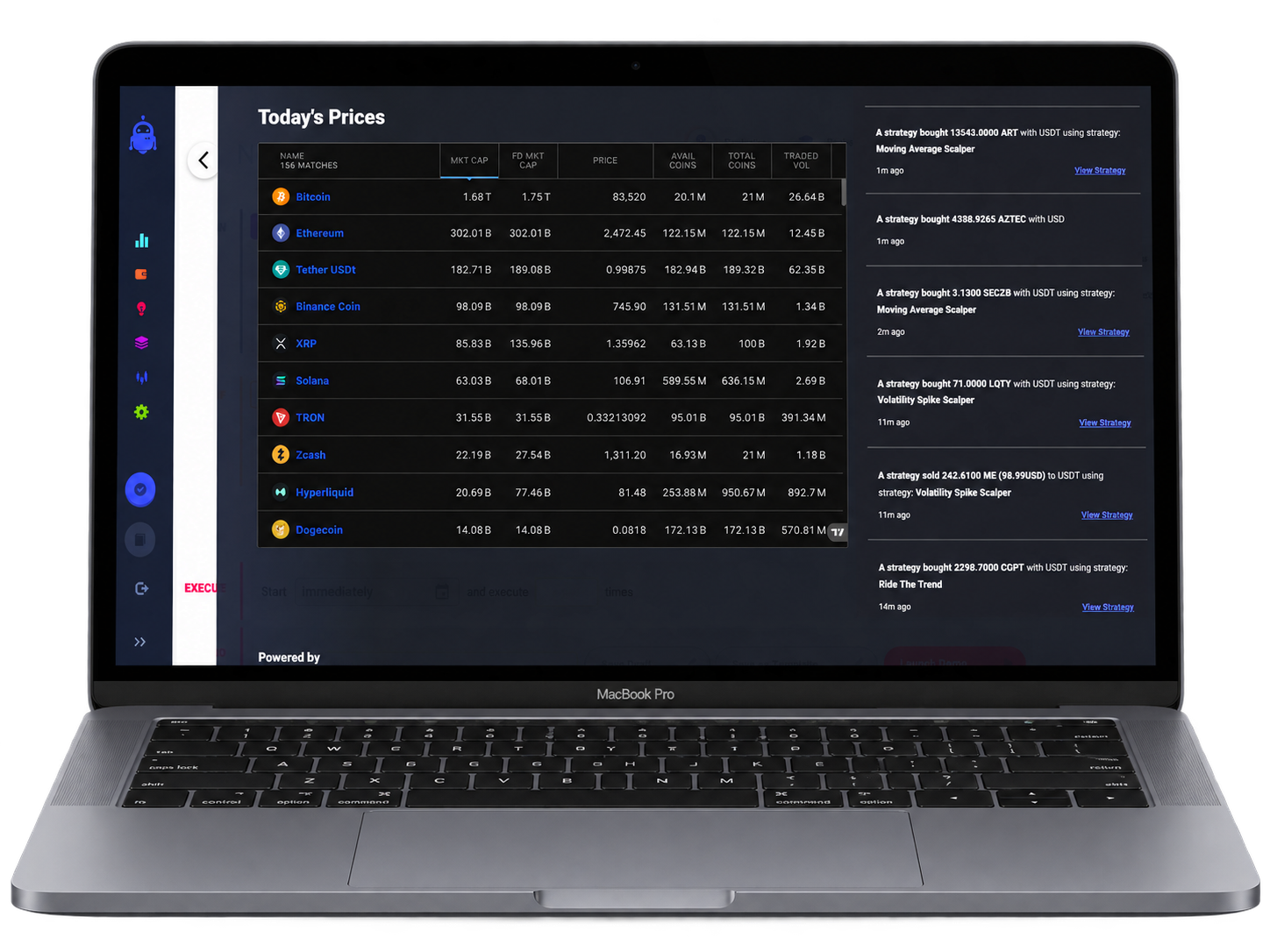
Coinrule provides a centralized portfolio dashboard that consolidates information from connected trading accounts, allowing users to monitor balances, holdings, asset allocations, and account valuations without switching between multiple exchanges or brokers. This functionality becomes particularly useful when several automated strategies operate simultaneously, especially across different asset classes or trading venues.
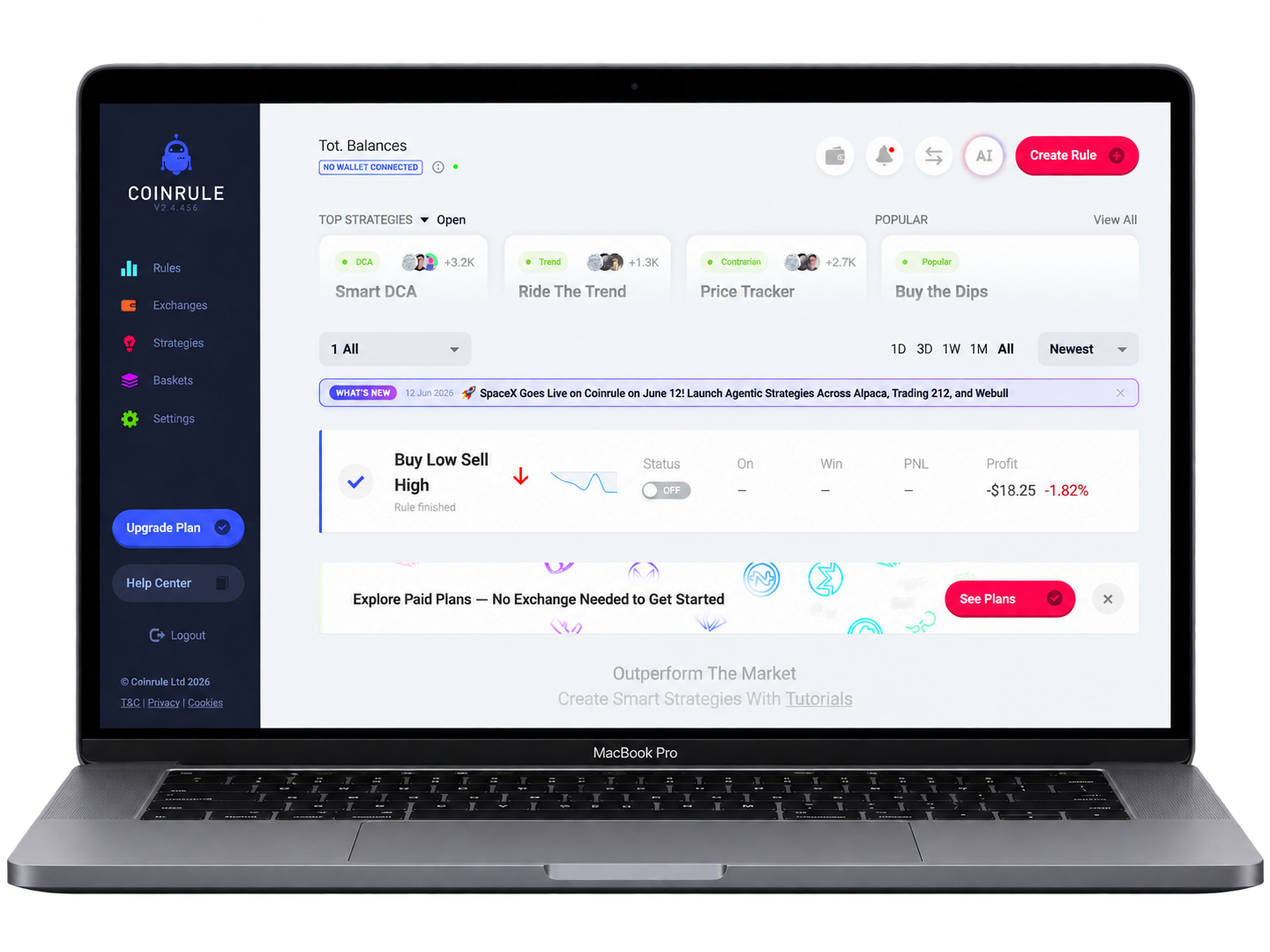
The trading-agent dashboard provides more detailed information about individual strategies, including operating status, profit-and-loss figures, open positions, and transaction history. Coinrule also includes proximity indicators showing how close current market conditions are to satisfying configured entry or exit rules, helping traders understand whether a strategy is approaching an execution threshold without constantly reviewing technical charts.
Activity logs record strategy evaluations, executed orders, errors, and configuration changes, giving users a clearer picture of how their automated trading instructions are being applied. Trade history can also be reviewed and exported, providing additional flexibility for independent performance analysis and recordkeeping.
Coinrule supports benchmark comparisons against Bitcoin or the S&P 500, depending on the underlying market, allowing traders to assess whether an automated strategy has delivered returns that justify its complexity and exposure. Nevertheless, benchmark comparisons should be interpreted alongside drawdowns, unrealized positions, trading costs, and the amount of capital committed to each strategy rather than focusing exclusively on reported profits.
Notifications are available through email, Telegram, and the platform’s in-app interface, with users able to configure alerts for relevant trading activity and operational events. These tools can help identify completed transactions, execution problems, or changes in strategy status, although notification preferences must be enabled and configured appropriately.
Mobile Trading and Strategy Management
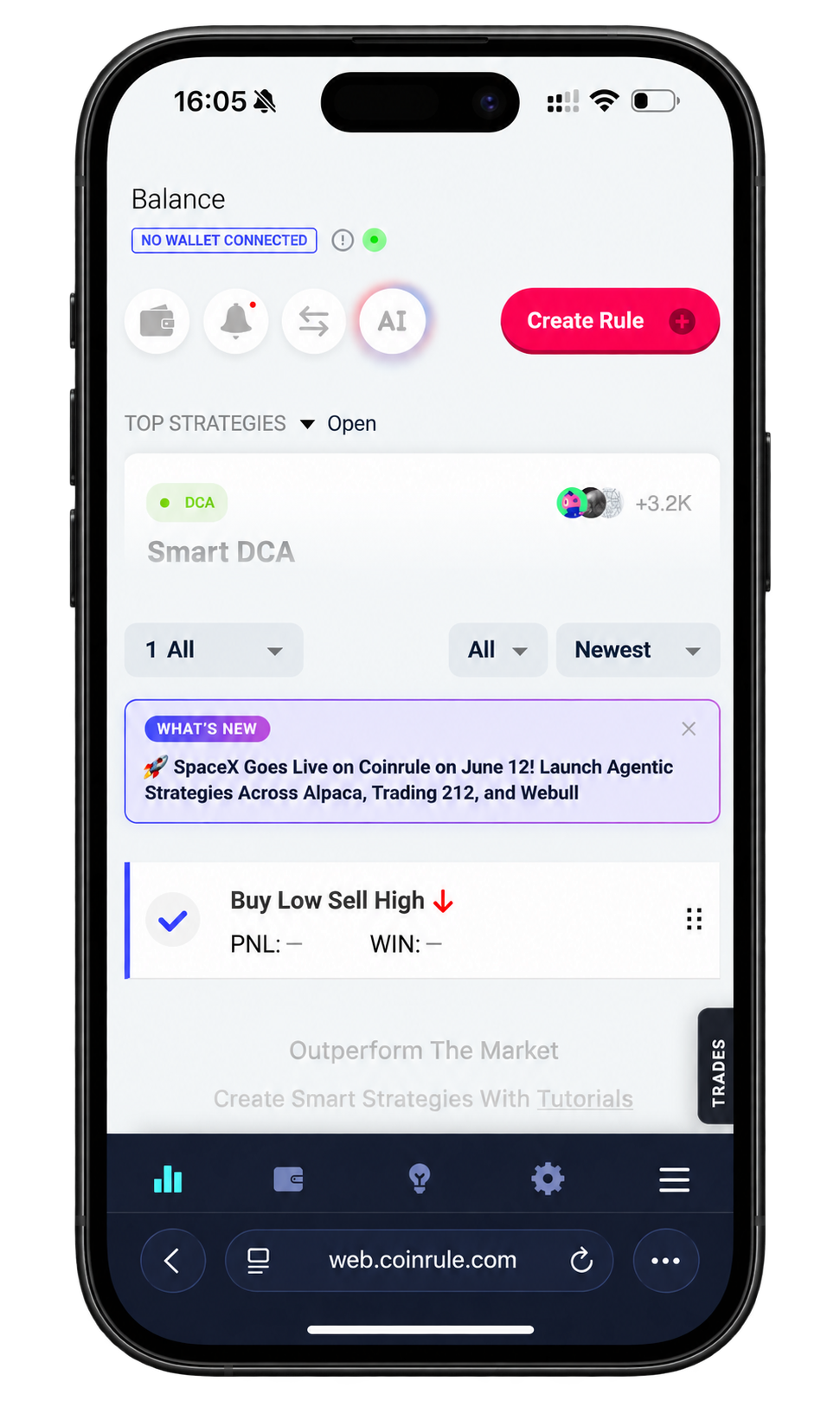
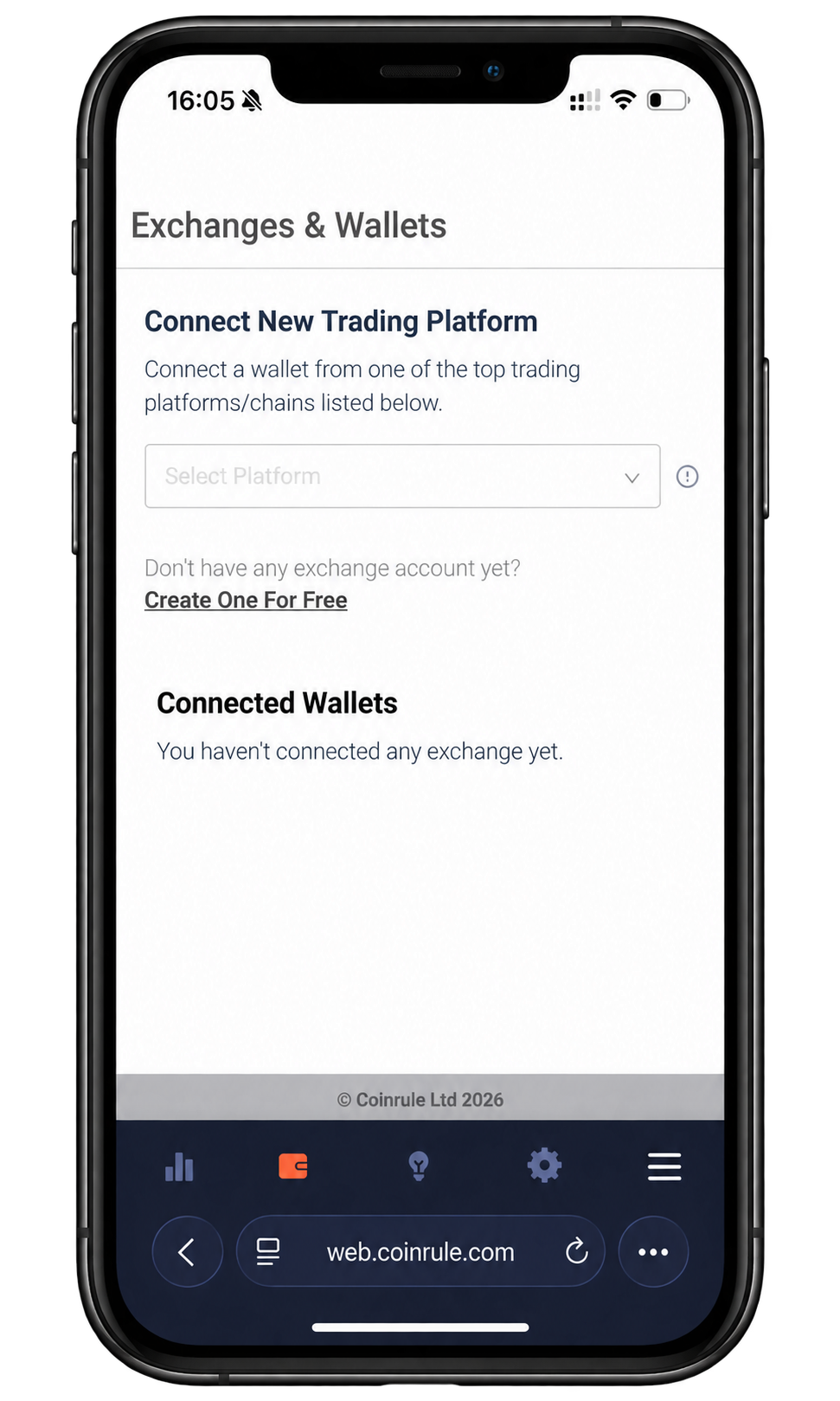
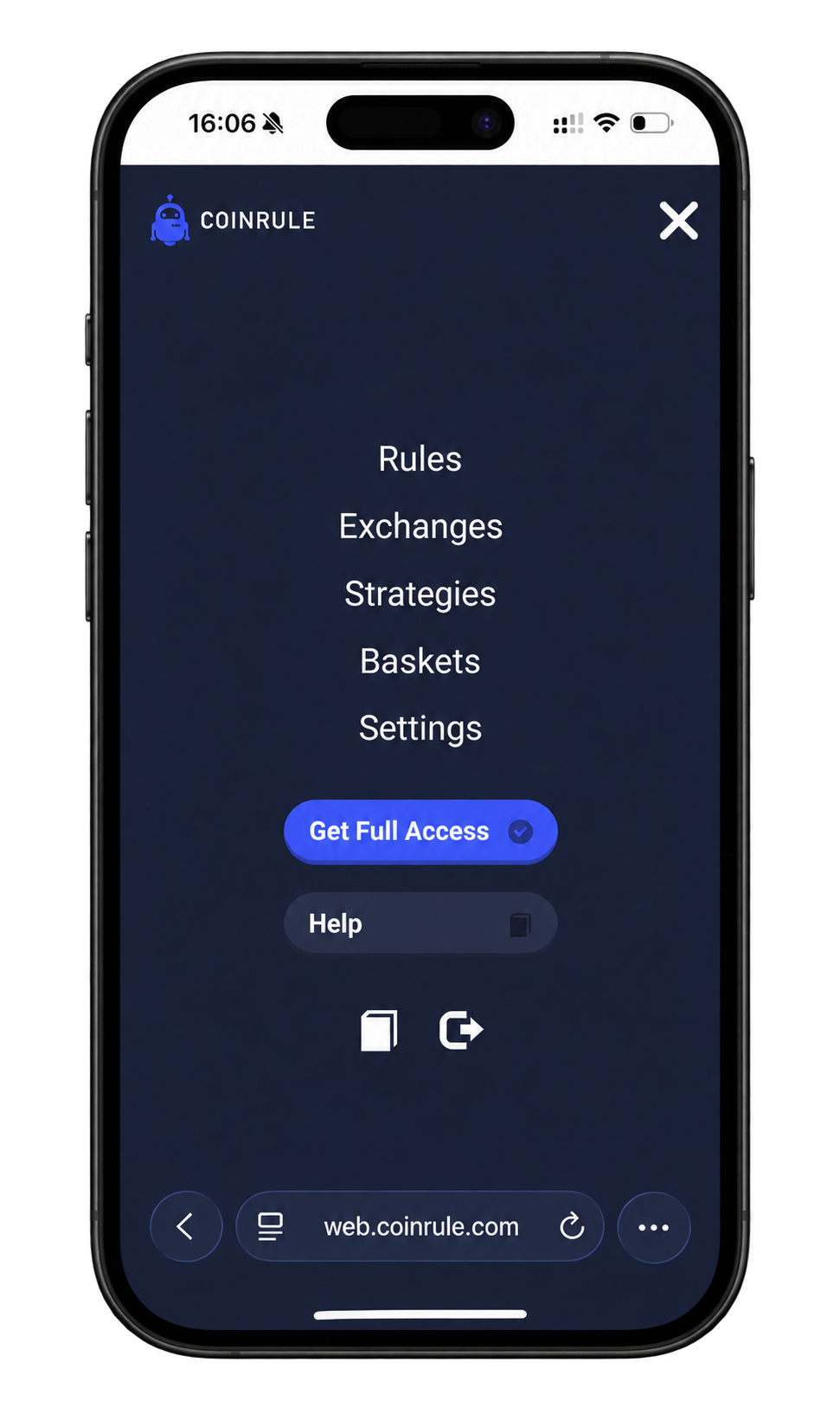
Coinrule provides mobile access through a responsive web interface, allowing users to create, monitor, and manage automated trading agents directly from a smartphone browser. The platform does not require a separate mobile application for its current trading environment, and users can add the website to their device’s home screen for more convenient access.
The mobile interface supports portfolio monitoring, performance review, and trading-agent management, making it possible to check automated activity or pause strategies while away from a desktop computer. Because Coinrule executes strategies through cloud infrastructure, trading agents can continue operating when the user’s browser is closed or the device is offline.
This arrangement provides considerable convenience for traders managing active strategies, particularly in cryptocurrency markets that operate around the clock. However, mobile accessibility should complement rather than replace regular portfolio reviews, since automated positions may remain exposed to changing market conditions even when the underlying software is operating correctly.
Professional Trading Services and API Access
Coinrule also offers additional functionality for advanced users and professional trading operations through its higher subscription tiers. These capabilities include expanded trading-agent capacity, broader exchange connectivity, increased credit allowances, and programmatic API access for users who need more extensive automation than the standard interface provides.
The Pro subscription supports unrestricted concurrent agent capacity within the published plan limits and introduces developer-oriented functionality, making it more relevant to traders managing numerous strategies or integrating Coinrule with external software. Enterprise arrangements extend these capabilities through team accounts, shared dashboards, custom integrations, white-label options, and private infrastructure deployment configurations.
These services are primarily relevant to professional trading teams, proprietary trading firms, and fintech businesses seeking centralized automation and account management. However, the availability of additional infrastructure does not remove Coinrule’s underlying strategy restrictions, meaning unsupported approaches such as conventional high-frequency market making and sophisticated cross-exchange arbitrage still require different execution systems.
Coinrule’s credit-based billing also becomes an important consideration for more active users. Credits are consumed through activities such as AI strategy interpretation, deployments, live trading executions, monitored market data, and TradingView signals, with usage increasing as strategies become more complex or monitor additional instruments. As a result, the cost of operating numerous agents depends not only on the subscription but also on trading frequency, market coverage, and the amount of data processed.
Coinrule’s updated platform combines AI-assisted strategy creation, multi-market automation, portfolio rebalancing, TradingView signals, conversational AI integrations, and strategy testing within a single trading environment. Its strongest advantage is the ability to automate a wide range of systematic trading approaches without developing independent execution infrastructure, while its principal limitations involve supported strategy types, simulation assumptions, credit consumption, and the risks of deploying automated rules in live markets.
Supported Exchanges
Supported Exchanges and Trading Markets
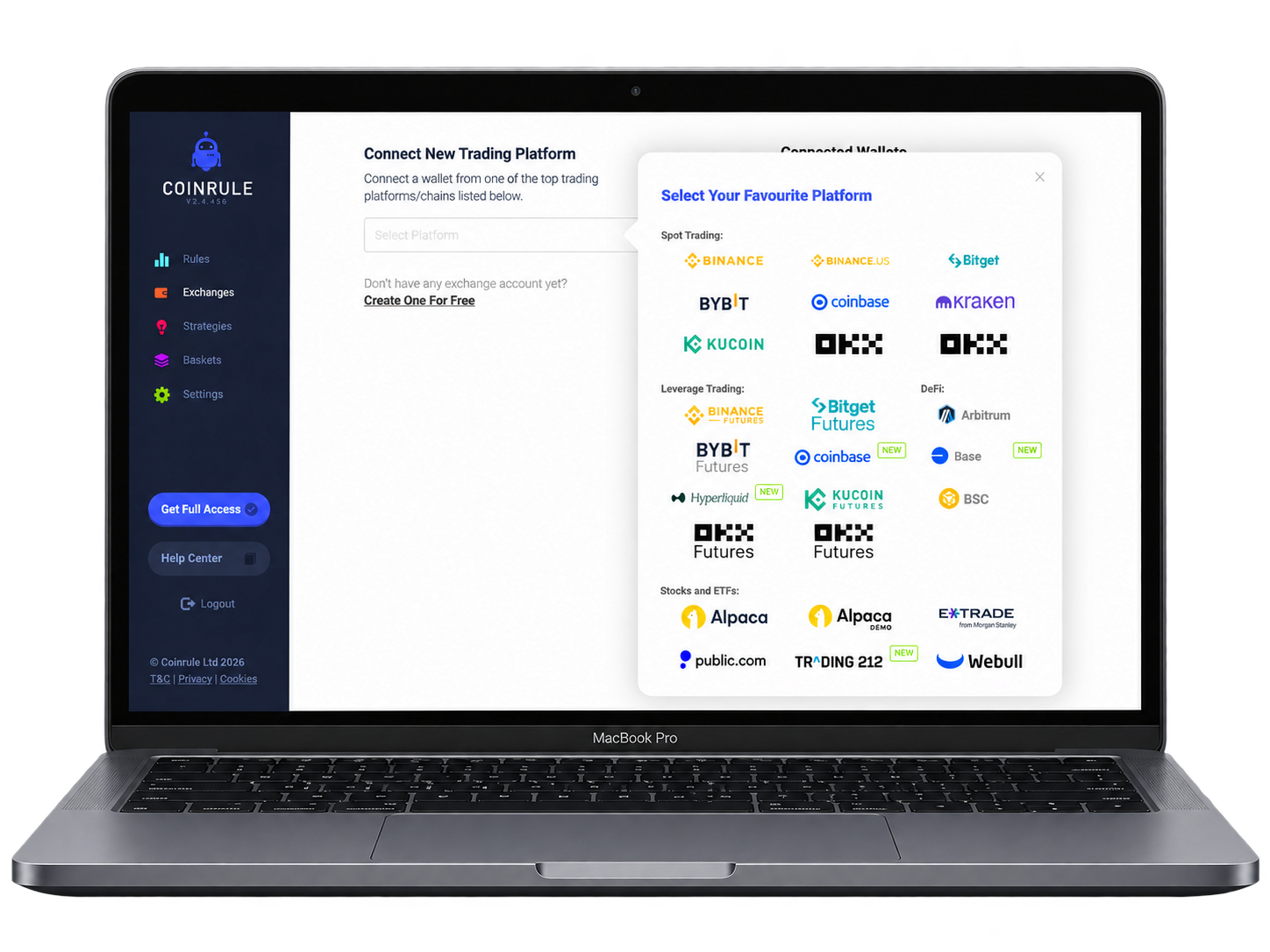
Coinrule supports automated trading across cryptocurrency exchanges, stock brokerages, and decentralized trading platforms, allowing users to manage strategies across different financial markets through a unified interface. The platform advertises access to more than 30 trading venues, with its integration ecosystem including major cryptocurrency exchanges such as Binance, Coinbase, Kraken, KuCoin, OKX, Bybit, and Bitget. However, its detailed connection guides currently cover a more limited selection, so the advertised integration count should not be interpreted as confirmation that every venue supports identical live trading functionality.
Coinrule’s documented integrations include Binance, Coinbase Advanced Trade, Kraken, KuCoin, Hyperliquid, and Trading 212. The platform also promotes connections with stock brokers such as Alpaca, Webull, and Public, expanding its offering beyond cryptocurrencies into US equities and exchange-traded funds. This multi-asset approach allows traders to automate technical strategies, scheduled investments, and portfolio baskets without maintaining separate trading systems for each asset class, although supported instruments and order types depend on the connected venue.
Cryptocurrency automation covers spot markets and selected perpetual futures contracts, including eligible integrations with Binance, Kraken Futures, and Hyperliquid. The latter provides a distinctive option for decentralized derivatives trading, using wallet-based authorization rather than conventional exchange API keys. Traders authorize a dedicated agent wallet to place and cancel orders while retaining custody of funds in their Hyperliquid account. Nevertheless, perpetual futures strategies remain exposed to leverage, funding payments, margin requirements, and liquidation risks.
Exchange connectivity also depends on the selected Coinrule subscription. Investor supports one connected trading account, while Trader increases the allowance to five. Pro and Enterprise provide unlimited connections under their published subscription terms, making them more suitable for users managing strategies across multiple exchanges or brokerage accounts.
Although Coinrule’s expanding exchange and brokerage coverage is an advantage for multi-asset trading, compatibility should be assessed at the individual market level. Regional restrictions, API requirements, supported order types, and derivatives eligibility can all affect whether a particular strategy can operate as intended. Coinrule also does not actively offer or market its services to EU or EEA residents under its current MiCA-related restrictions. Traders should therefore confirm venue availability and jurisdictional eligibility before subscribing, particularly when relying on futures automation or specific brokerage integrations.
Pricing & Plans
Coinrule Pricing and Subscription Plans
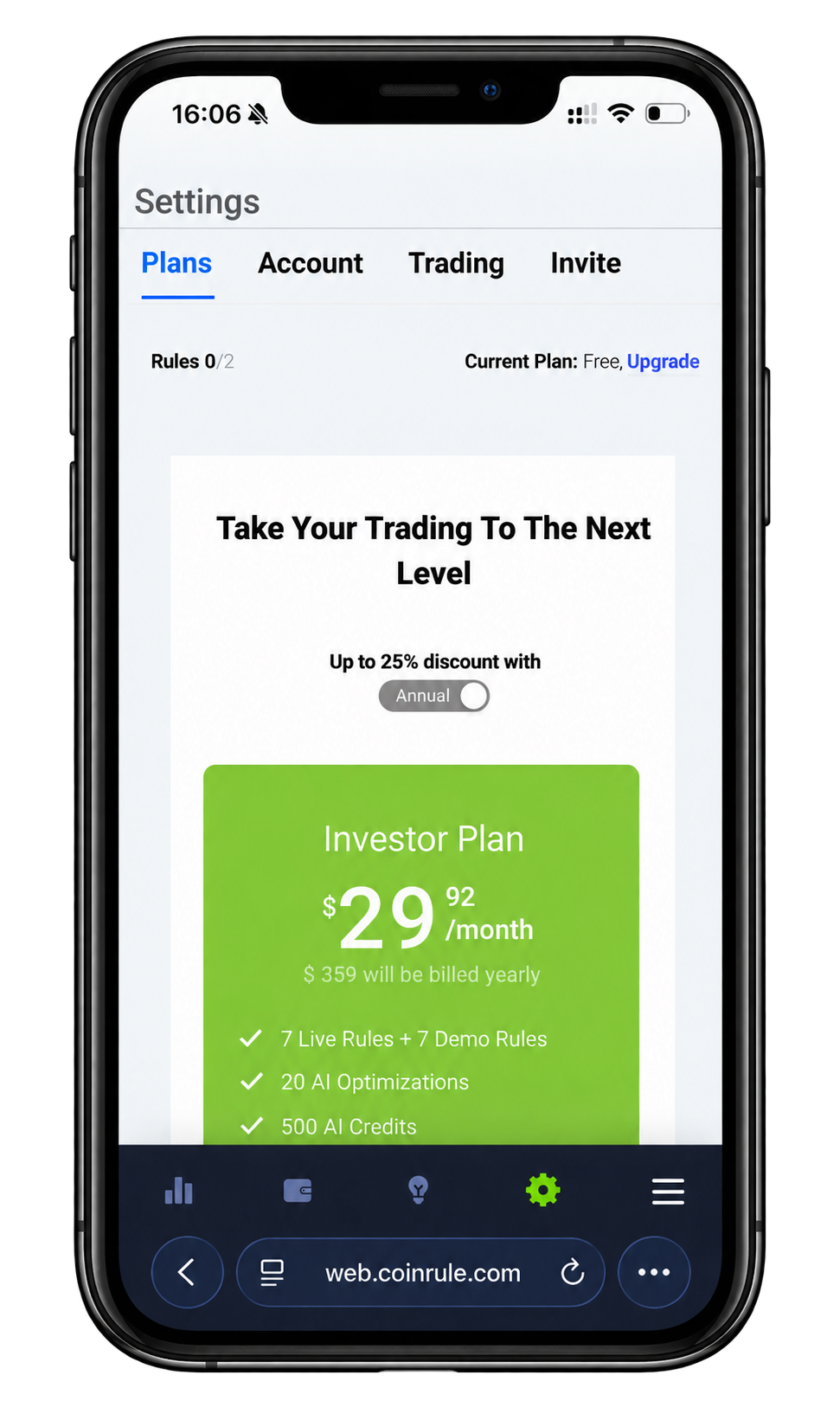
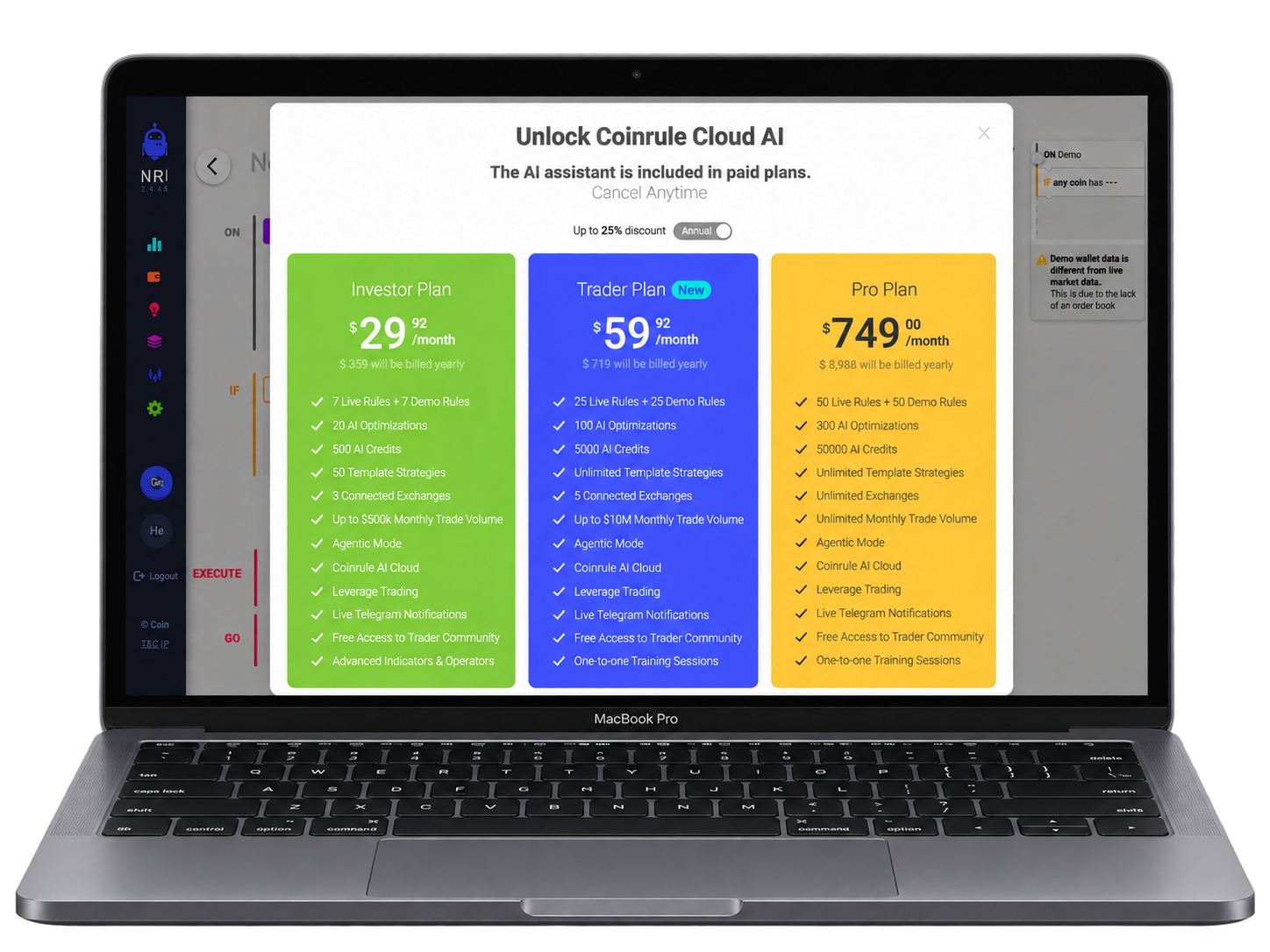
Coinrule uses a subscription-based pricing model combined with usage credits, allowing traders to choose a plan according to the number of automated agents, connected trading accounts, and resources their strategies require. The platform offers five subscription tiers—Free, Investor, Trader, Pro, and Enterprise—with higher plans providing greater execution capacity, expanded backtesting, portfolio management tools, and professional trading functionality.
Unlike platforms that charge a fixed subscription regardless of trading activity, Coinrule also measures resource consumption through credits. These cover AI strategy processing, agent deployment, monitored market data, live transactions, and external TradingView signals. Each subscription includes a monthly credit allowance, with additional usage charged separately when that allocation is exceeded.
Coinrule Pricing Comparison
| Feature | Free | Investor | Trader | Pro | Enterprise |
|---|---|---|---|---|---|
| Advertised annual-plan monthly equivalent | $0 | $14.99 | $36.99 | $812.50 | Custom |
| Concurrent live agents | None | 3 | 10 | Unlimited | Unlimited |
| Exchange connections | Paper only | 1 | 5 | Unlimited | Unlimited |
| Monthly credits | 50 | 1,000 | 10,000 | 100,000 | Unlimited |
| Paper trading | Yes | Yes | Yes | Yes | Yes |
| Historical backtesting | — | 5 lifetime runs | Unlimited | Unlimited | Unlimited |
| TradingView integration | — | Yes | Yes | Yes | Yes |
| Automated portfolio baskets | — | 5 curated baskets | Unlimited | Unlimited | Unlimited |
| Advanced risk controls | — | Limited | Yes | Yes | Yes |
| Programmatic API access | No | No | No | Yes | Yes |
| Team accounts | No | No | No | Yes | Yes |
USD prices reflect the advertised annual-plan monthly equivalents on Coinrule’s pricing page in October 2026. Annual subscriptions require upfront payment. Coinrule currently displays conflicting annual prices in its pricing materials, particularly for Pro, so the final checkout amount should be confirmed before purchasing.
Free Plan
Coinrule’s Free plan provides an opportunity to explore its AI-assisted trading environment without committing funds or connecting a live exchange account. Users can create and operate one paper trading agent, test supported strategy conditions, and become familiar with the platform’s execution interface through a monthly allowance of 50 credits.
The absence of live trading makes this tier primarily an educational and evaluation tool rather than a practical solution for ongoing cryptocurrency automation. Its limited credit allowance also restricts extensive strategy experimentation, particularly when using AI interpretation or monitoring several market conditions.
Nevertheless, Free provides a useful introduction to Coinrule’s trading-agent workflow, allowing prospective subscribers to understand how strategies are created and monitored before purchasing a plan.
Investor Plan
Coinrule’s Investor subscription is the entry point for live automated trading, with an advertised annual-plan monthly equivalent of $14.99. The plan supports three concurrent trading agents, one connected exchange or brokerage account, and 1,000 monthly credits, providing sufficient capacity for traders operating a small collection of relatively straightforward strategies.
Investor includes AI-assisted strategy creation, TradingView integration, paper trading, and access to the platform’s template library. Users can also run five lifetime historical backtests and access five curated portfolio baskets, making it possible to explore both active trading strategies and systematic investment approaches without upgrading immediately.
The principal limitations concern trading capacity and strategy evaluation. Three live agents may be sufficient for someone automating Bitcoin, Ethereum, and a third cryptocurrency, but traders who want to monitor numerous markets or develop several strategies simultaneously may reach the plan’s restrictions relatively quickly. The five-backtest allowance is also limiting for users who regularly refine technical indicators or compare different configurations.
Investor is best suited to traders beginning with live automation who want access to Coinrule’s principal features without paying for extensive execution capacity they may not need.
Trader Plan
Trader increases the available capacity to ten concurrent agents, five exchange connections, and 10,000 monthly credits, with an advertised annual-plan monthly equivalent of $36.99. The subscription also introduces unlimited historical backtesting, broader portfolio basket functionality, advanced risk controls, and more detailed performance analytics.
These improvements make Trader considerably more practical for users developing and managing multiple automated strategies. Unlimited backtesting is particularly valuable for traders who routinely adjust technical indicators, compare entry conditions, or evaluate strategies across different market environments. Advanced risk-management functionality, including trailing stops and portfolio-level protective controls, also provides greater flexibility when managing live positions.
The larger credit allowance is another meaningful advantage, particularly for strategies that monitor multiple cryptocurrency pairs or generate frequent trading signals. Nevertheless, resource consumption remains dependent on the number of monitored markets, execution frequency, and external integrations, meaning the higher allowance does not guarantee that every active trading configuration will remain within the included credits.
Trader represents the most balanced subscription for active retail users who want to take advantage of Coinrule’s broader automation capabilities without requiring professional infrastructure or unrestricted agent capacity.
Pro Plan
Coinrule’s Pro subscription targets advanced traders and professional trading operations requiring substantially greater execution capacity. It supports unlimited concurrent agents and exchange connections, 100,000 monthly credits, unrestricted backtesting, and access to the platform’s advanced trading and portfolio-management functionality.
Pro also introduces programmatic API access, team seats, shared dashboards, dedicated onboarding, priority chat support, and additional webhook and alerting capabilities. These features are particularly relevant to traders coordinating numerous automated strategies or integrating Coinrule with external software and existing account-management systems.
However, Pro carries a substantial subscription commitment. Coinrule’s public pricing page currently advertises an annual-plan equivalent of $812.50 per month, while other published subscription information contains different pricing. This discrepancy makes checkout verification especially important before committing to an annual subscription.
For most retail traders, the additional capacity will be difficult to justify unless they are operating a significant number of strategies or specifically require the professional integrations unavailable on lower tiers.
Enterprise Plan
Enterprise is designed for institutional trading teams, proprietary trading firms, and financial technology businesses requiring customized automation infrastructure. Rather than using a standard subscription price, Coinrule provides individual quotations based on execution requirements, account structure, technical integrations, and support needs.
The plan includes unlimited agents, exchange connections, and credit allowances, alongside dedicated account management, custom integrations, white-label functionality, and options for private cloud or on-premises deployment. Additional features include single sign-on, dedicated communication channels, and a published 99.9% uptime service-level agreement.
These capabilities extend beyond conventional retail trading automation and are intended for organizations requiring dedicated infrastructure, account controls, and contractual support arrangements.
Coinrule Credits and Additional Trading Costs
Coinrule’s credit system is an important consideration because the advertised subscription fee does not necessarily represent the total cost of operating automated strategies. Credits are consumed through AI processing, strategy deployment, market-data monitoring, trade execution, and external trading signals, with more active or complex strategies generally requiring greater resources.
The platform’s published credit schedule includes two credits for opening a position, one credit for closing it, and one credit for processing a TradingView webhook signal. Monitoring a market-data subscription consumes 0.5 credits per watched market per day, while transaction volume incurs an additional 0.1 credit for every $1,000 traded. Strategy deployment and AI processing generate separate charges depending on the complexity of the configuration.
For example, a strategy monitoring ten cryptocurrency pairs on hourly candles would consume approximately 150 credits over a 30-day month from market-data subscriptions alone, before accounting for executions, AI processing, or other activity. This makes the credit structure relatively manageable for a small number of low-frequency strategies but potentially more expensive for active multi-market automation.
When a paid subscriber exceeds the included monthly allowance, Coinrule charges $0.02 per additional credit, meaning 500 extra credits would add $10 to the subscription bill. Users can also purchase prepaid credit packages, including 500 credits for $10, 2,500 for $50, and 10,000 for $200. Unlike unused monthly subscription credits, which do not roll over, prepaid credits do not expire under the published terms.
Paid trading agents continue operating when their monthly credit allowance is exhausted, with excess consumption billed separately. Free accounts do not incur overage charges, although their simulated strategies can be stopped once their included credits are depleted.
Importantly, these platform charges are separate from the fees imposed by connected exchanges and brokerages. Trading commissions, bid-ask spreads, slippage, and applicable futures funding payments remain the user’s responsibility, while live trading performance may differ from historical or simulated results.
Free Trial and Overall Value
Coinrule also advertises a three-day trial for eligible paid subscriptions, allowing users to examine live trading functionality before committing to a longer subscription. Trial availability and duration depend on the checkout offer, and a payment method may be required, with the subscription renewing automatically unless cancelled before the trial ends.
The platform’s pricing is most attractive when traders can use its broader strategy-building capabilities rather than relying exclusively on basic automated purchases. Investor provides an affordable entry point for limited live trading, while Trader offers a more practical balance of concurrent agents, backtesting, risk controls, and included credits. Pro and Enterprise are considerably more specialized, targeting users whose trading operations justify greater automation capacity and infrastructure requirements.
Ultimately, Coinrule’s value depends on both subscription costs and credit consumption. Traders operating a small number of moderately active strategies may find the included allowances sufficient, while users deploying numerous agents across different markets should estimate their expected credit usage before selecting a plan. The platform offers substantial flexibility, but its consumption-based pricing requires closer monitoring than a conventional fixed-cost trading bot subscription.
Security & US
Coinrule Security: Is It Safe?
Coinrule operates through a non-custodial trading model, allowing users to automate cryptocurrency transactions without transferring their assets into wallets controlled by the platform. Funds remain on connected exchanges or supported trading accounts, while Coinrule uses authorized API connections to monitor balances and execute orders. This arrangement reduces the custody risks associated with depositing cryptocurrency into third-party trading services, although users still need to consider the security of their exchange credentials, automated strategies, and connected AI integrations.
The platform protects exchange API credentials using Fernet symmetric encryption, with sensitive information stored in encrypted form and the encryption keys managed separately from the underlying database. Credentials are decrypted by the execution engine only when required for trading operations and are not exposed through standard API responses or application logs. Coinrule also restricts the permissions required for exchange connections, limiting access to balance information, order history, and authorized trading activity rather than withdrawals or account transfers.
These restrictions provide an important security boundary, but they do not eliminate the risks associated with trading-enabled API keys. If credentials are compromised, an attacker may still be able to execute unauthorized transactions or create financial losses without withdrawing assets directly. Coinrule supports exchange-specific IP allowlisting, allowing users to restrict API requests to approved addresses where the connected exchange permits it. Dedicated API keys, regular credential rotation, and separate exchange subaccounts with limited balances can provide additional protection, particularly when several automated strategies operate simultaneously.
Account authentication is managed through Privy, with support for passwordless email verification, Google, Apple, and compatible EVM wallet connections. Wallet-based authentication is particularly relevant to supported decentralized trading integrations, while users connecting conventional exchanges can manage their authorized trading accounts through Coinrule’s central interface. Maintaining strong security on the associated email, Google, Apple, or wallet account remains essential because those credentials can affect access to the trading platform.
Coinrule’s AI assistant integrations introduce an additional consideration. Connections established through the Model Context Protocol (MCP) use OAuth 2.1 authorization rather than sharing exchange API credentials with external assistants. Users can grant read-only access for portfolio monitoring, strategy inspection, and performance analysis, or enable read-and-write permissions that allow supported assistants to create, modify, and activate trading strategies. These permissions can be revoked through account settings, providing control over which external services can interact with trading activity.
Read-only authorization is the safer choice when an AI assistant is used exclusively for research or portfolio monitoring, since broader permissions can result in transactions involving real funds. Traders should also understand that stopping an automated agent does not automatically close its open exchange positions, making it necessary to distinguish between pausing a strategy and exiting an active trade.
Beyond account protection, operational reliability remains an important part of Coinrule’s security assessment. Exchange outages, API failures, rejected orders, and sudden market volatility can interfere with automated execution, while protective orders may not execute at their intended prices during unfavorable conditions. Although Coinrule publishes details of its credential encryption, authorization controls, and security reporting procedures, these disclosures do not independently establish the effectiveness of every infrastructure safeguard.
Overall, Coinrule offers a reasonably structured security model for non-custodial trading automation, with encrypted credentials, restricted API permissions, protected authentication, and configurable AI-assistant access. Its safeguards reduce several important risks, but they cannot guarantee uninterrupted execution, prevent losses caused by trading strategies, or eliminate vulnerabilities associated with third-party exchanges and connected accounts.
Regulatory Considerations
Coinrule’s regulatory availability is an important consideration, particularly for European users. The platform states that its products and services are not intended for, directed at, or actively marketed to residents of the European Union and European Economic Area. It also confirms that it does not hold a Crypto-Asset Service Provider (CASP) authorization under the EU’s Markets in Crypto-Assets Regulation (MiCA).
Coinrule’s published terms reference reverse solicitation, under which access initiated exclusively by an eligible customer may be considered separately from services actively marketed into the region. However, this should not be interpreted as unrestricted availability or a guarantee that every EU/EEA resident can legally access the platform. Applicable regulatory requirements, account eligibility, and the circumstances of individual access remain relevant.
Traders should confirm their jurisdictional eligibility before subscribing or connecting live exchange accounts, particularly when using leveraged derivatives or brokerage integrations subject to additional local restrictions.
Ease of Use and User Experience
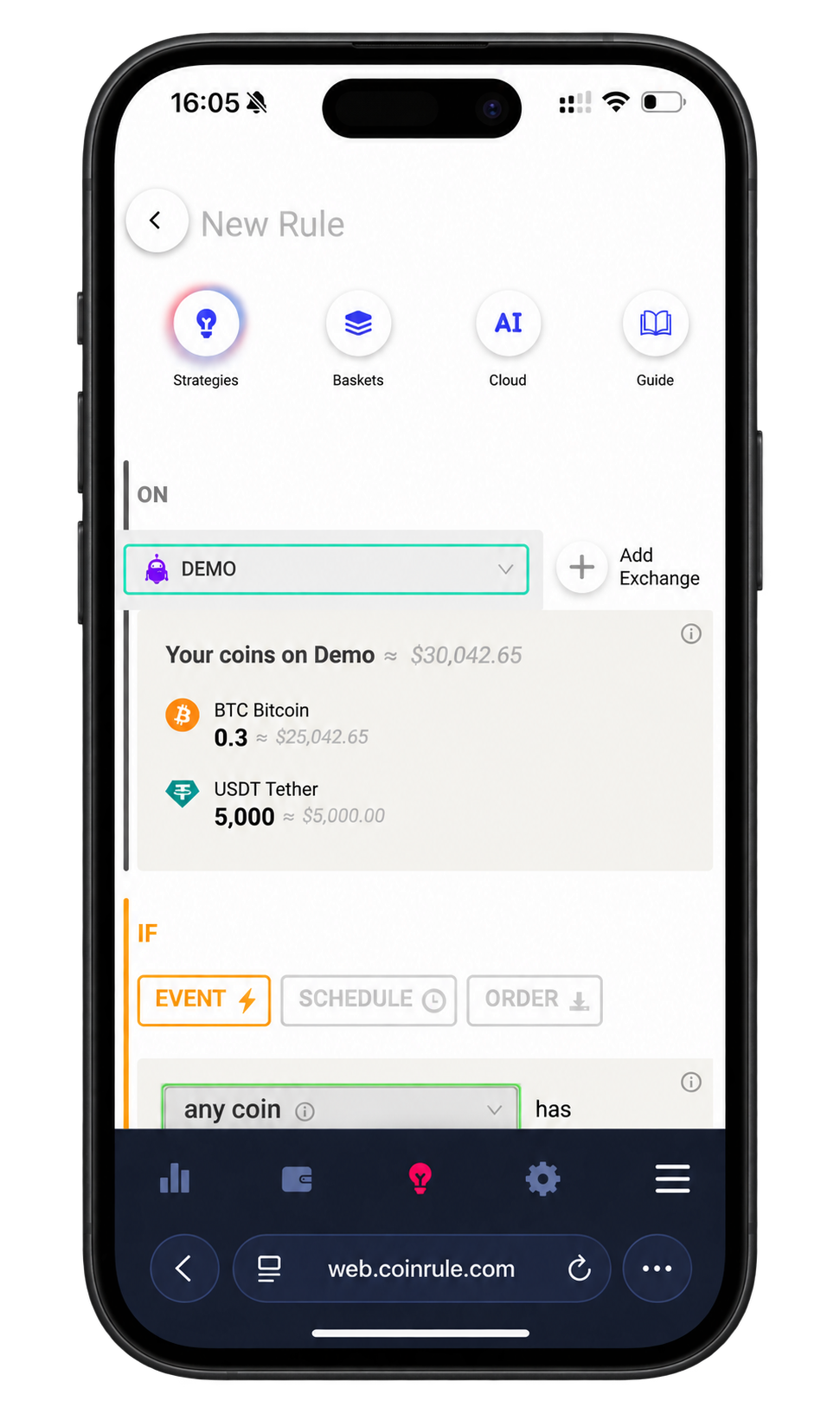
Coinrule’s updated trading interface emphasizes accessibility through AI-assisted strategy creation, allowing users to turn trading ideas into automated instructions without developing their own software. Rather than requiring detailed programming knowledge, traders can describe their preferred strategy in natural language, specify technical conditions, and review the generated execution rules before activating an agent. This approach makes the platform particularly appealing to users who understand market indicators but lack experience building automated trading infrastructure.
The strategy creation process follows a relatively straightforward workflow. Users describe their trading approach, review the interpreted rules, adjust position sizes and risk parameters, and select either paper trading or a supported live account. Predefined templates provide additional starting points for common strategies, while historical backtesting allows users to examine potential weaknesses before committing capital. The ability to inspect generated instructions is particularly important because AI interpretation can produce unexpected results when trading conditions are ambiguous or insufficiently defined.
Once a strategy is active, Coinrule’s dashboard provides access to agent status, open positions, trading history, performance information, and execution logs. Proximity indicators show how close market conditions are to triggering configured rules, helping traders understand what their automated agents are monitoring without continuously reviewing external charts. Portfolio analytics, account-level valuations, and notifications through email or Telegram further simplify the management of multiple strategies.
Coinrule also offers a mobile-responsive web interface, allowing users to monitor portfolios, create strategies, and manage trading agents through a smartphone browser without installing a separate application. Because execution runs through cloud infrastructure, automated strategies can continue operating when the user’s device is switched off or disconnected.
Despite these conveniences, the learning curve becomes more demanding when strategies involve multiple indicators, market scanners, advanced risk controls, or leveraged futures positions. The credit-based pricing model also requires users to monitor resource consumption, particularly when running several agents across numerous trading pairs. Beginners may find the initial configuration accessible but still need time to understand how different execution conditions affect capital allocation and trading exposure.
Coinrule’s strongest usability advantage is its ability to simplify the technical process of developing automated trading strategies without removing the underlying complexity of trading itself. Its AI-assisted workflow, testing tools, and centralized dashboard create an accessible environment for systematic trading, although users still need sufficient market knowledge to evaluate strategy logic, manage risk, and interpret performance accurately.
Preview
Coinrule vs Competitors
Coinrule vs TradeSanta, Cryptohopper, and WunderTrading
Coinrule competes with several established cryptocurrency trading automation platforms, including TradeSanta, Cryptohopper, and WunderTrading. While all four services allow users to automate trading strategies without developing their own exchange infrastructure, they differ considerably in strategy creation, execution flexibility, testing capabilities, and subscription costs. Coinrule’s updated AI-powered platform emphasizes natural-language strategy development, automated trading agents, and portfolio management across cryptocurrency and traditional financial markets, whereas its competitors focus on different combinations of conventional trading bots, technical strategy development, and specialized execution tools.
Coinrule allows traders to describe strategies in plain English, Pine Script, or Python-style instructions and convert them into executable rules, while its backtesting, multi-market scanning, and external AI integrations provide additional flexibility. However, its credit-based pricing introduces usage costs that require closer monitoring, and traders who primarily need straightforward DCA or grid automation may find a more specialized platform easier to manage.
| Platform | Best For | Main Advantage | Main Limitation |
|---|---|---|---|
| Coinrule | AI-assisted strategy creation and multi-asset automation | Natural-language trading agents, backtesting, portfolio baskets, and AI integrations | Credit-based pricing, agent limits, and supported strategy restrictions |
| TradeSanta | Straightforward DCA and grid trading | Accessible setup, generous bot allowances, and predictable subscription costs | Limited strategy development and advanced customization |
| Cryptohopper | Technical strategy development and marketplace trading | Strategy Designer, backtesting, third-party signals, and Copy Bots | Higher subscription costs and potential marketplace expenses |
| WunderTrading | TradingView automation and advanced execution | Free live bots, Signal Bots, multi-exchange tools, and specialized futures strategies | Advanced functionality requires greater trading knowledge |
Coinrule vs TradeSanta
TradeSanta provides a more focused approach to cryptocurrency trading automation, concentrating on conventional DCA and grid strategies through a straightforward configuration interface. Its bots allow traders to establish order sizes, additional entry levels, profit targets, and protective exits without constructing complex conditional trading systems. Coinrule takes a broader approach, allowing users to develop customized strategies through natural-language instructions, technical indicators, and AI-assisted execution rules rather than relying primarily on predefined bot mechanics.
This difference becomes particularly relevant for traders who want to combine multiple market conditions within a single strategy. Coinrule can interpret instructions involving RSI thresholds, moving-average relationships, trading timeframes, and position-sizing limits, while its multi-market scanners allow agents to monitor several cryptocurrency pairs or stock instruments simultaneously. TradeSanta supports technical indicators and TradingView signals, but its automation remains more closely tied to established DCA and grid execution structures.
Coinrule also provides more extensive tools for evaluating and managing strategies, including historical backtesting, paper trading, automated portfolio baskets, and AI-assistant connectivity. Its ability to rebalance diversified portfolios and automate investments across supported stocks and ETFs further distinguishes it from TradeSanta’s primarily cryptocurrency-focused offering. These capabilities make Coinrule more suitable for traders interested in systematic strategy development and broader portfolio automation rather than simply configuring individual trading bots.
However, TradeSanta has advantages in simplicity and subscription predictability. Its monthly plans cost $25 for Basic, $45 for Advanced, and $90 for Maximum, with the entry-level subscription supporting up to 49 bots and all paid tiers providing unlimited exchange access points. Coinrule’s Investor subscription starts at an advertised $14.99 per month when billed annually, but supports only three concurrent live agents and one exchange connection. Its Trader plan increases those limits to ten agents and five connections, while additional usage can generate credit charges beyond the subscription allowance.
TradeSanta is consequently better suited to traders who want to operate numerous conventional DCA or grid strategies without managing a consumption-based billing structure. Coinrule provides greater flexibility for users who want to develop technical trading systems, evaluate historical performance, or automate portfolio allocations, although the additional capabilities introduce greater complexity.
The choice ultimately depends on whether the trader values straightforward execution or customizable strategy development. Those seeking accessible, ready-to-configure bots may prefer TradeSanta, while Coinrule offers a more comprehensive environment for building and managing systematic strategies.
Coinrule vs Cryptohopper
Cryptohopper is one of Coinrule’s stronger competitors in strategy development, offering an established environment for building technical trading systems, evaluating historical performance, and accessing third-party trading signals. Both platforms support automated execution, strategy testing, and technical indicators, but their approaches to building and managing trading strategies differ considerably.
Cryptohopper’s Strategy Designer allows traders to combine indicators and market conditions into automated trading rules without conventional programming. Its backtesting environment and paper trading tools provide opportunities to evaluate configurations before live execution, while its marketplace offers strategies, templates, technical signals, and separate Copy Bot subscriptions. This ecosystem is particularly useful for traders who want to explore community-generated strategies or subscribe to external trading signals rather than developing every configuration independently.
Coinrule differentiates itself through AI-assisted strategy interpretation, allowing traders to describe their intended approach in natural language or provide Pine Script and Python-style instructions. The platform translates those descriptions into structured trading agents that can be reviewed, tested, and deployed through supported exchange connections. Its multi-market scanning, automated portfolio baskets, and AI-assisted execution framework also make it relevant to traders seeking a more integrated approach to systematic investing across cryptocurrencies, stocks, and ETFs.
Both platforms now offer Model Context Protocol integrations, although their documented capabilities serve different purposes. Cryptohopper’s MCP service focuses on providing live cryptocurrency market information, including order books, price candles, and exchange data, to compatible AI assistants. Coinrule’s integration extends further into account-level trading operations, allowing authorized assistants to inspect portfolios, create strategies, run backtests, and manage trading agents through read-only or trading-enabled permissions.
Cryptohopper nevertheless offers a broader ecosystem of established trading products, particularly for users interested in marketplace strategies, social trading, and specialized automation. Its Hero subscription includes additional capabilities such as algorithmic intelligence, market-making tools, and arbitrage functionality, although these features require a stronger understanding of execution mechanics and market risks.
Subscription pricing also differs. Cryptohopper’s standard monthly plans cost $29 for Explorer, $69 for Adventurer, and $129 for Hero, with each tier increasing trading capacity, strategy evaluation frequency, and access to specialized features. Its conventional trading-bot subscriptions generally cover one live trading bot and one paper trading bot, although individual bots can manage multiple positions. Copy Bots use separate subscriptions, while marketplace strategies and signal providers may involve additional expenses.
Coinrule’s Investor and Trader subscriptions can support several independent live agents under a single subscription, making the platform attractive for users developing multiple customized strategies. However, the included credits must be considered alongside agent limits, since monitoring numerous markets or generating frequent transactions can increase the overall cost.
Cryptohopper is particularly appealing to traders who prefer established strategy-building tools, an extensive marketplace, and access to third-party trading products. Coinrule is better suited to those who want to translate their own trading ideas into automated agents, integrate AI assistants into their workflows, or manage systematic portfolios across different asset classes.
Both platforms provide substantial opportunities for strategy experimentation, but neither removes the risk of overfitting historical results or relying on ineffective trading signals.
Coinrule vs WunderTrading
WunderTrading provides a comprehensive cryptocurrency trading automation environment with particular strengths in TradingView execution, multi-exchange trading, and specialized derivatives strategies. Both platforms support automated trading, external signals, and AI integrations, but WunderTrading places greater emphasis on executing sophisticated trading operations, whereas Coinrule focuses on helping users construct and deploy customized strategies through an AI-assisted workflow.
WunderTrading offers conventional DCA and grid bots alongside Signal Bots that execute trades from TradingView alerts or other supported signal sources. Its trading terminal also provides advanced order-management functionality, while the Spreads and Arbitrage Terminal allows traders to manage positions involving multiple instruments or exchanges. These capabilities extend beyond conventional directional trading, although their effectiveness depends on liquidity, execution costs, and the ability to manage several positions simultaneously.
The platform’s Market Neutral Bot represents another distinction. It uses statistical methods to examine relationships between cryptocurrency futures pairs, identify deviations from historical price relationships, and execute coordinated long and short positions. This approach can reduce reliance on predicting the direction of an individual cryptocurrency, but it remains exposed to spread breakdowns, funding expenses, leverage, and liquidation risks. Coinrule does not provide an equivalent dedicated market-neutral futures bot within its standard strategy offering.
WunderTrading has also expanded into AI-assisted execution through MCP and API connectivity, allowing compatible external AI agents to submit and manage trades on supported exchanges. However, its implementation emphasizes providing execution infrastructure for externally developed AI strategies, while Coinrule integrates natural-language interpretation, strategy construction, backtesting, and automated agent management within its own platform. This makes Coinrule more accessible to users who want to move from a written trading idea to a structured automated strategy without assembling a separate development workflow.
Pricing and accessibility introduce another important distinction. WunderTrading offers a permanent Free plan that includes one Signal Bot, one DCA Bot, and one Grid Bot, allowing users to operate a limited selection of live strategies without recurring subscription costs. Its paid Basic, Pro, and Premium subscriptions increase the available bot allowances and access to more sophisticated functionality. Coinrule also provides free paper trading, but live automation requires a paid subscription, with concurrent agent limits and credit consumption determining the practical capacity of each plan.
WunderTrading’s free live bots may be particularly attractive to users who want to automate a small number of conventional cryptocurrency strategies without paying for features they do not need. Its specialized tools become more compelling for experienced traders managing multiple exchanges, futures positions, or externally generated trading signals.
Coinrule offers a different proposition, combining AI-assisted strategy design, multi-market scanning, historical testing, and automated portfolio management. Its support for stocks and ETFs through eligible brokerage integrations also makes it more relevant to traders seeking systematic automation beyond cryptocurrency markets.
For users who primarily rely on TradingView signals or require sophisticated derivatives execution, WunderTrading provides a more specialized trading environment. Coinrule is preferable when the objective is to develop customizable strategies through natural-language instructions and manage those systems through a centralized AI-powered platform.
Which Coinrule Alternative Is Worth Considering?
Coinrule’s strongest advantage is its combination of AI-assisted strategy creation, automated trading agents, and portfolio management across different asset classes. Its ability to transform natural-language instructions into structured trading strategies reduces the technical barriers associated with systematic trading, while historical backtesting, market scanning, and external AI integrations provide additional flexibility for users developing increasingly sophisticated approaches.
However, that flexibility does not make Coinrule the most practical choice for every trader. TradeSanta offers a more straightforward environment for conventional DCA and grid strategies, supported by generous bot allowances and fixed subscription costs. Cryptohopper provides a more established ecosystem for technical strategy development, marketplace signals, and copy trading, while WunderTrading is particularly relevant to users requiring TradingView-driven execution and specialized derivatives tools.
Pricing also deserves consideration beyond the advertised subscription rates. Coinrule’s credit-based system can introduce additional expenses for active multi-market strategies, while Cryptohopper’s marketplace services and WunderTrading’s advanced subscriptions have their own cost structures. The appropriate choice depends on the trading methods being automated, the number of accounts and strategies involved, and whether the additional functionality justifies the ongoing expense.
Regional access is another material difference. Coinrule does not actively offer or market its services to EU or EEA residents under its current MiCA-related restrictions, making jurisdictional eligibility an important consideration before choosing the platform.
Coinrule is particularly compelling for traders who want to develop customized strategies using AI rather than rely exclusively on conventional trading bot templates. Its updated platform offers a flexible combination of strategy creation, testing, execution, and portfolio monitoring, although traders who prioritize simple DCA automation, marketplace-driven copy trading, or specialized futures execution may find the alternatives better aligned with their requirements.
Pros & Cons
- Excellent strategy customization: Visual rules, technical indicators, and natural-language instructions support complex trading systems without custom execution infrastructure.
- AI-powered trading tools: Coinrule Cloud offers strategy interpretation, automated agents, portfolio baskets, and integrations with compatible AI assistants.
- Useful testing and risk controls: Historical backtesting, paper trading, trailing stops, and conditional exits help traders evaluate strategies before committing capital.
- Broad market connectivity: The platform supports major cryptocurrency exchanges, selected perpetual futures markets, and additional stock brokerage integrations.
- Complicated subscription structure: Different pricing schedules for classic Coinrule and Coinrule Cloud make plan selection less straightforward.
- Usage-based Cloud costs: AI processing, market monitoring, webhook signals, and trading executions consume credits.
- Limited advanced execution strategies: Cloud does not directly support cross-exchange arbitrage, market making, or high-frequency trading below one-minute intervals.
- Imperfect strategy simulations: Paper trading and backtesting exclude fees and slippage, potentially overstating practical profitability.
Bottom Line
Is Coinrule Worth Using in 2027?
Coinrule is a compelling option for traders seeking flexible, AI-powered automation without the technical complexity of developing their own trading software. Its recently updated platform combines natural-language strategy creation, customizable trading agents, historical backtesting, and automated portfolio management within a unified environment. The ability to turn trading ideas into executable strategies using plain English, Pine Script, or Python-style instructions is particularly valuable for users who want greater control over their investments without building custom algorithms or managing exchange infrastructure.
The platform’s capabilities extend beyond conventional cryptocurrency trading bots, with multi-market scanning, automated portfolio rebalancing, TradingView signals, and integrations with external AI assistants providing considerable flexibility. Support for cryptocurrencies, stocks, and ETFs further strengthens its appeal to traders interested in managing systematic strategies across different asset classes. However, Coinrule’s credit-based pricing introduces additional costs for active users, while limitations in historical backtesting and paper trading mean simulated performance may not fully reflect real-market execution. Regional restrictions and the absence of unrestricted algorithmic programming are also important considerations.
Coinrule stands out as a capable and increasingly sophisticated AI trading automation platform, particularly for traders who value strategy customization, testing, and portfolio management. Its combination of accessible strategy creation and advanced functionality makes it worth considering for both developing and experienced systematic traders, although subscription expenses, credit consumption, and execution risks should be carefully evaluated. Coinrule provides the tools to automate sophisticated trading ideas, but their long-term effectiveness ultimately depends on the quality of the underlying strategies and disciplined risk management.
FAQs
Is Coinrule legitimate, and can it withdraw cryptocurrency from my exchange account?
Coinrule is an established cryptocurrency trading automation provider that connects to supported exchanges through API credentials or eligible wallet authorization. Its standard exchange connection model does not require withdrawal permissions. However, trading-enabled API credentials can still execute orders, creating financial exposure if an account is compromised or a strategy malfunctions.
Does Coinrule offer free live trading bots in 2027?
Coinrule's classic platform advertises a Free Starter plan with two running strategies and limited trading volume. The newer Coinrule Cloud Free plan operates differently. It provides paper trading with no live exchange connections. Users should confirm which application they are accessing because the two pricing structures have different features and limitations.
Can Coinrule's AI trading agents create profitable strategies automatically?
Coinrule's AI tools can interpret strategy descriptions and translate them into executable trading rules. They do not guarantee that those rules will generate profits. Incorrect assumptions, unreliable signals, changing market conditions, and execution costs can undermine performance. Users should review generated strategies, conduct historical tests, and evaluate simulated performance before enabling live trading.
Why can Coinrule backtesting results differ substantially from live trading?
Coinrule Cloud's documented backtesting engine excludes trading fees, slippage, and order-book liquidity. Paper trading also uses simplified execution assumptions. Live orders may execute at less favorable prices, particularly during volatility or when trading illiquid assets. Strategies with narrow profit margins or high transaction frequency are especially sensitive to these differences.
Can Coinrule automate trading across multiple exchanges and perpetual futures markets?
Yes. Coinrule supports several centralized exchanges and selected perpetual futures integrations, including Hyperliquid. However, supported products vary by venue and jurisdiction. Coinrule Cloud Investor permits one live exchange connection, while Trader supports five. Higher plans provide expanded connectivity. Users should verify individual exchange compatibility before deploying derivatives strategies.
Is Coinrule better than WunderTrading or Cryptohopper for beginners?
Coinrule is particularly approachable for users interested in constructing strategies through visual rules or natural-language instructions. WunderTrading offers a stronger permanent free live-bot allowance and more specialized trading tools. Cryptohopper provides greater access to third-party strategies, templates, and marketplace products. For beginners who want to learn conditional strategy development rather than operate predefined bots, Coinrule is a compelling choice. However, understanding position sizing and market risk remains essential regardless of the interface.