











 X
 Facebook
 LinkedIn
 Google News
 Telegram
 Instagram
 RSS Feed


Introduction
WunderTrading Review 2027: Trading Bots, Pricing, Security, and Verdict
WunderTrading is a cryptocurrency trading automation platform that combines DCA bots, grid strategies, TradingView signal execution, and multi-exchange trading within a single interface. Established in 2019, it has expanded beyond conventional trading bots to include statistical arbitrage, market-neutral futures strategies, advanced position management, and API-based execution for custom trading systems and AI agents. Its tools accommodate both straightforward automated trading and more sophisticated strategies involving multiple positions, exchanges, and market conditions.
WunderTrading’s strongest advantage is the flexibility of its execution infrastructure. Traders can automate TradingView indicators and strategies, deploy bots across supported exchange accounts, optimize grid and DCA configurations, and manage entries, exits, and risk parameters without developing their own exchange integrations. Its Market Neutral Bot adds a more specialized approach, using statistical relationships between cryptocurrency futures to identify spread-trading opportunities. Meanwhile, REST API and Model Context Protocol (MCP) connectivity allow external trading systems and AI agents to submit orders through the platform.
The service operates without taking custody of customer cryptocurrency, while its subscription model includes a permanent free plan with limited bot capacity and paid tiers for more demanding strategies. However, automated trading does not eliminate market risk, and sophisticated tools can amplify losses when configured incorrectly. Exchange connectivity, execution delays, funding charges, and API security also influence results, particularly when trading leveraged derivatives or managing several positions simultaneously.
How Does WunderTrading Work?
WunderTrading is a cloud-based trading automation service operated by Wunderbit SIA, a company registered in Latvia. Rather than functioning as a cryptocurrency exchange or brokerage, it connects to supported trading venues through API credentials and uses those connections to place and manage orders. Customer assets remain in their respective exchange accounts, where trades are executed against the available liquidity under the exchange’s trading rules and fee structure.
After connecting an exchange, users can configure a trading strategy using predefined bot settings, technical indicators, TradingView alerts, or external trading instructions. DCA bots automate entries and position adjustments, while grid bots place orders across selected price ranges. Signal Bots translate predefined conditions into executable orders, with multi-exchange functionality allowing compatible strategies to operate across several connected accounts. More advanced workflows include spread trading, statistical arbitrage, and externally generated instructions submitted through WunderTrading’s API or MCP integrations.
This structure gives traders considerably more control over execution than manually placing every order. However, WunderTrading executes trading instructions rather than independently determining whether a strategy is profitable. Users remain responsible for position sizing, leverage, stop-loss conditions, and capital allocation, while the connected exchange determines actual fills, trading fees, and available markets. Demo trading and strategy backtesting provide opportunities to assess configurations before deployment, although simulated performance may not fully reproduce live slippage, partial fills, or execution costs.
An important distinction concerns copy trading. WunderTrading discontinued its social copy-trading marketplace at the end of 2024 and no longer provides a native system for subscribing to and automatically following other traders. Its current offering focuses on user-configured automation, including external signals and custom strategies, rather than a marketplace of lead traders. This separates it from platforms built around copying published trading histories and performance rankings.
Who Should Use WunderTrading?
WunderTrading is particularly well suited to intermediate and experienced cryptocurrency traders who want to automate established strategies across multiple exchanges. TradingView users benefit from direct signal execution, while DCA and grid traders can configure entry conditions, position adjustments, and risk controls without manually managing every order. Its multi-exchange tools also appeal to investors operating several trading accounts who want to coordinate strategies and monitor execution from one platform.
More advanced users can take advantage of statistical arbitrage, market-neutral futures trading, and external API or AI-agent integrations. These capabilities are particularly relevant to systematic traders developing custom signals, managing correlated positions, or experimenting with automated execution based on multiple data sources. However, market-neutral strategies still involve spread divergence, funding costs, liquidity constraints, and liquidation risks, making them unsuitable for users unfamiliar with derivatives trading.
Beginners can use WunderTrading’s free plan and demo environment to explore automated cryptocurrency trading without immediately committing substantial capital. Nevertheless, the platform becomes more valuable as users develop a defined strategy and understand how execution settings affect risk. Investors seeking a passive copy-trading service or guaranteed automated returns should look elsewhere, while those prepared to manage their own strategies will find a versatile collection of trading and execution tools.
Products & Services
WunderTrading Trading Bots and Features
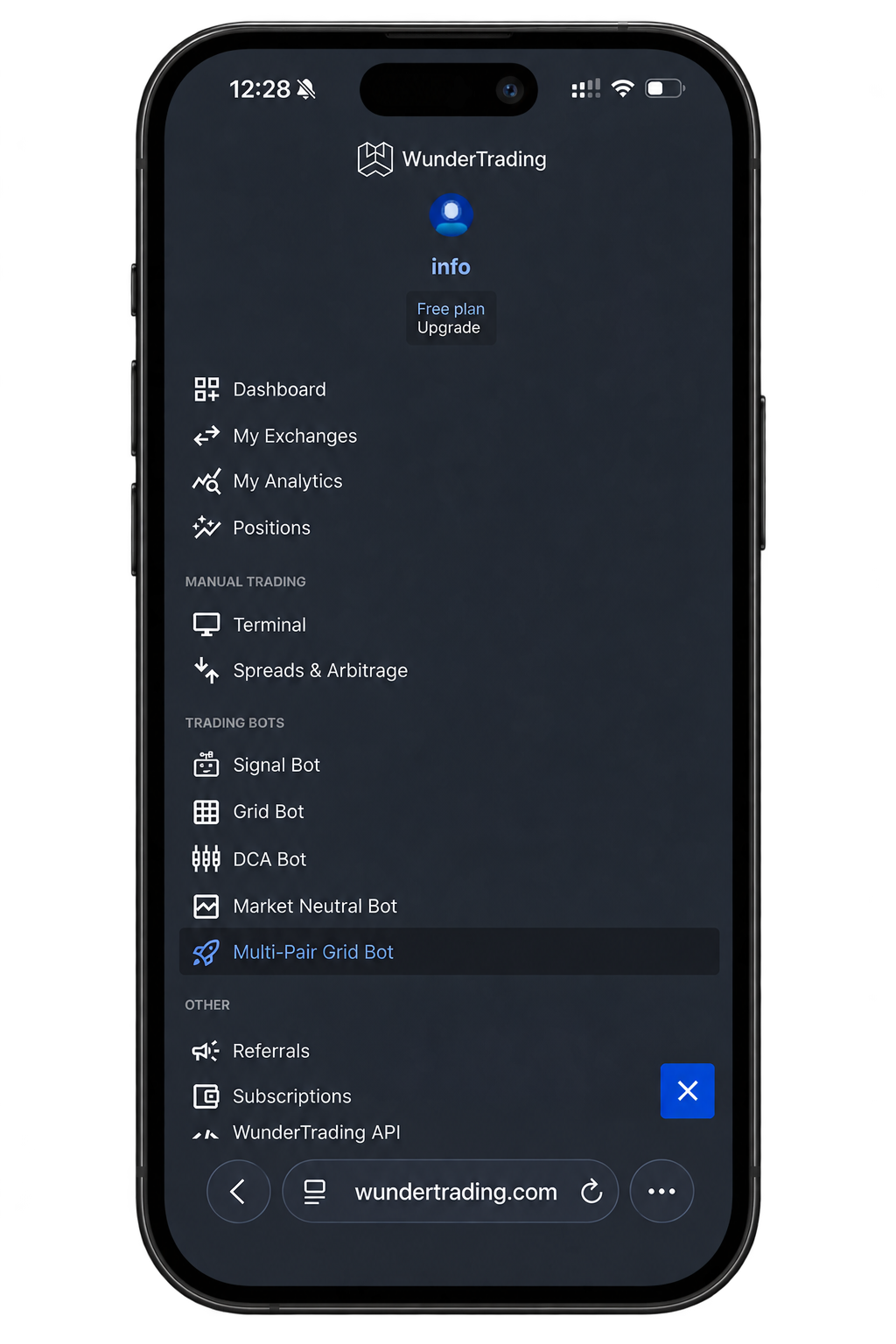
WunderTrading offers five primary automated trading products: Signal Bot, DCA Bot, Grid Bot, Multi-Pair Grid Bot, and Market Neutral Bot. Each addresses a different trading strategy, from systematic cryptocurrency accumulation and range trading to TradingView-based execution and statistical arbitrage. The platform also provides manual trading terminals, market-screening tools, demo trading, and developer integrations for managing strategies across supported exchanges.
Its main advantage is the ability to combine different execution methods within one account. Traders can automate technical signals, configure bots that operate independently, or manage several exchange accounts through a consolidated interface. However, strategy availability depends on subscription tier and exchange compatibility, with some advanced products restricted to Premium accounts.
Signal Bot and TradingView Automation
The Signal Bot is one of WunderTrading’s strongest features, allowing traders to convert TradingView alerts and external signals into automated orders on connected exchanges. Instead of repeatedly monitoring charts and submitting trades manually, users can define entry and exit conditions through technical indicators, Pine Script strategies, or compatible third-party signal providers. WunderTrading receives the resulting webhook instructions and processes them according to the bot’s configured execution rules.
The platform supports signals from TradingView, RunBot, custom servers, and workflow automation services such as Zapier, Make, and n8n. Users can configure fixed or percentage-based position sizing, multiple entries, partial exits, stop-loss orders, trailing stops, and automatic movement of protective stops to breakeven. Dynamic JSON messages allow more sophisticated strategies to adjust order quantities and execution instructions using information generated by the underlying trading system.
For example, a trader could develop a breakout strategy that enters when a cryptocurrency moves above a predefined resistance level and exits when momentum weakens. TradingView generates the corresponding alerts, while WunderTrading handles order submission and position management on the connected exchange. The strategy can also incorporate additional entries or partial profit-taking without requiring the trader to remain at the computer throughout the session.
The updated Signal Bot supports multi-pair trading and execution across multiple exchange accounts. Its multi-API functionality can distribute trades across as many as 50 API profiles from the same exchange, while the newer multi-exchange capability extends supported signal workflows to different trading venues. This is particularly useful for traders maintaining separate portfolios or implementing related strategies across exchanges, although differences in liquidity, symbol availability, and order execution can produce different results from identical signals.
WunderTrading is particularly competitive among TradingView cryptocurrency automation platforms because it combines external signal execution with extensive position-management controls. However, webhook automation requires careful configuration. Incorrect order quantities, duplicate alerts, incompatible futures settings, or poorly formatted JSON messages can produce unintended trades. Strategies should be tested with demo accounts and small live positions before being deployed across multiple exchanges.
DCA Trading Bots
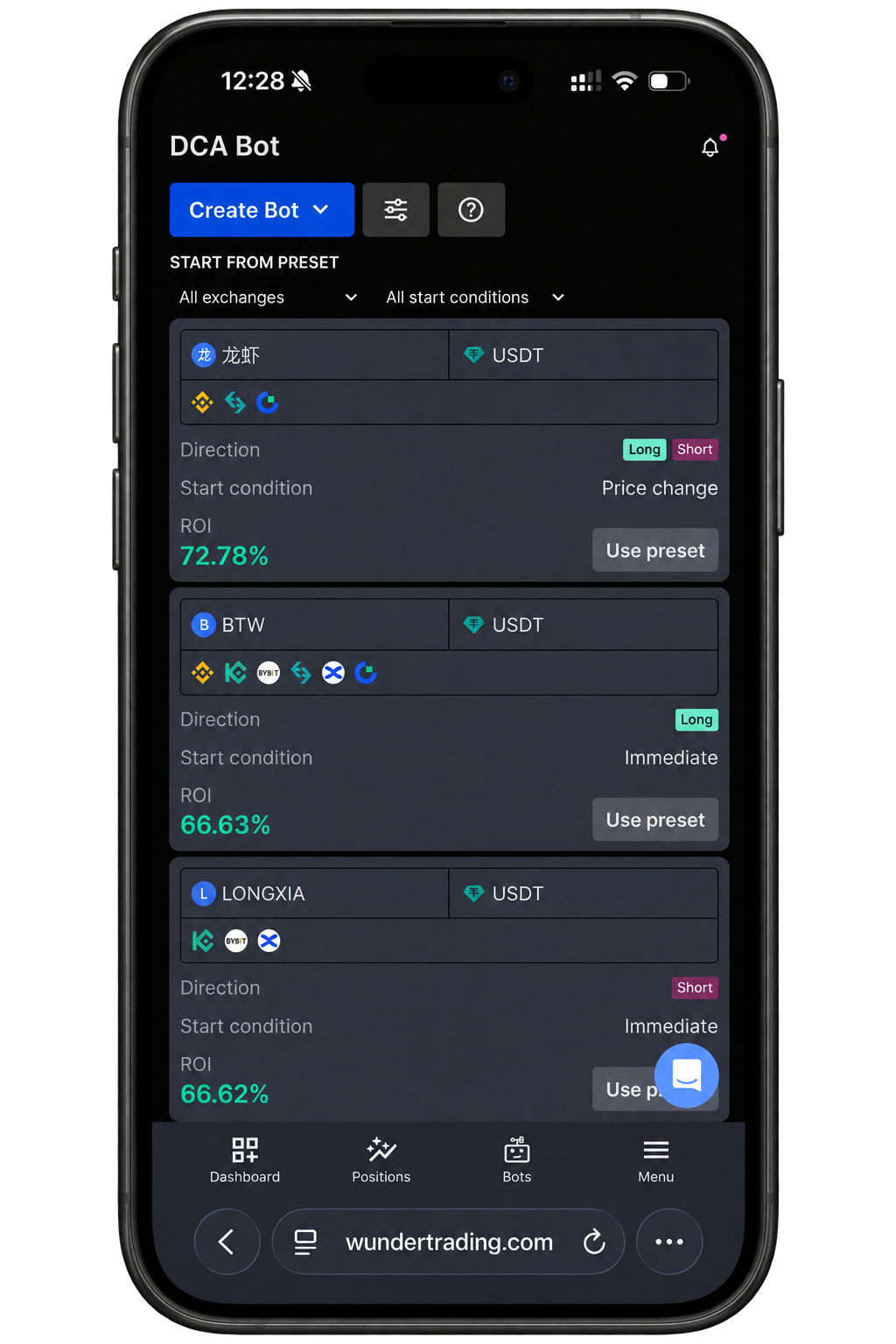
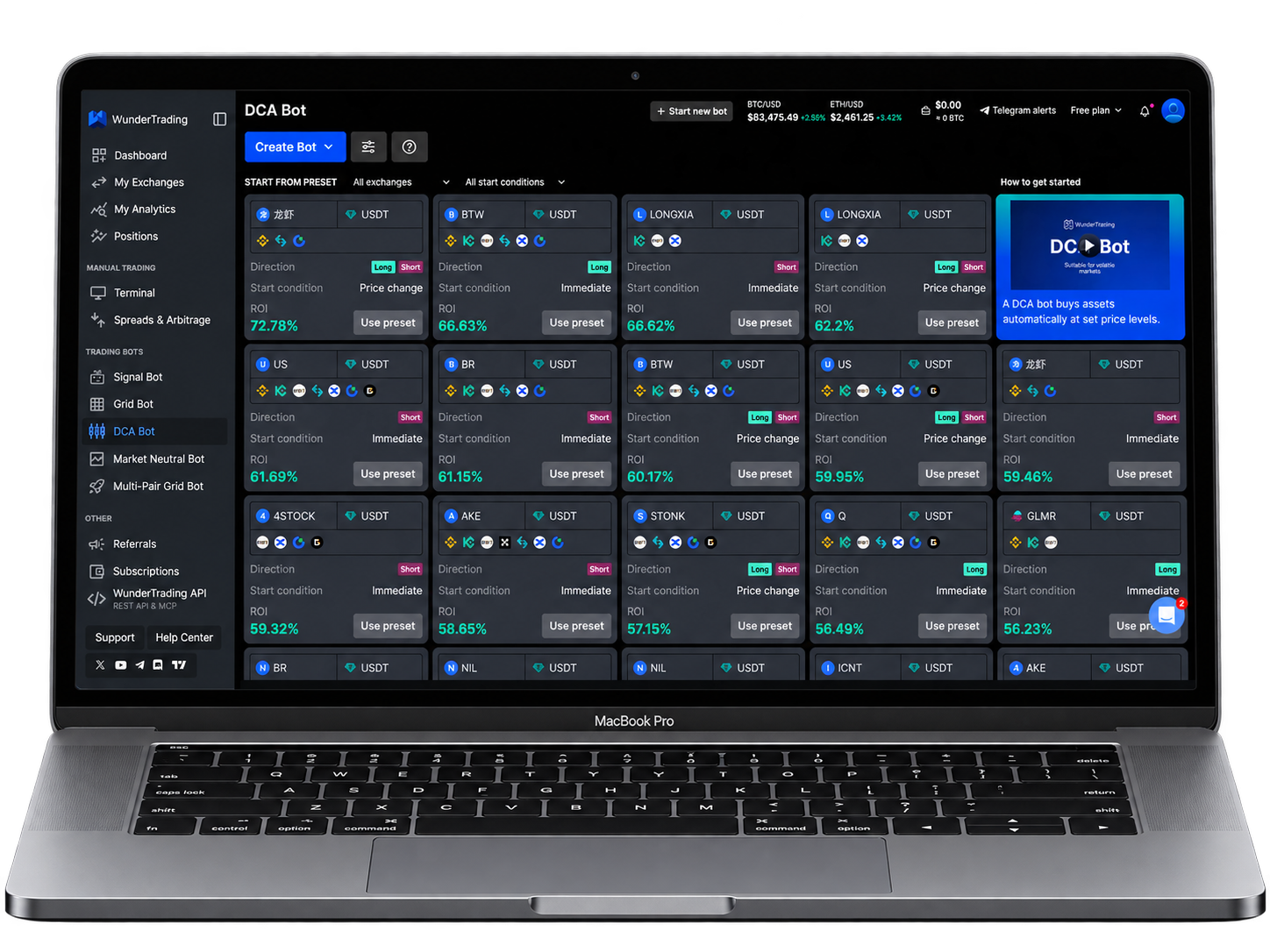
WunderTrading’s DCA Bot automates cryptocurrency entries and additional orders according to predefined price movements or technical conditions. Rather than committing all available capital at the initial entry, traders can configure a base order followed by additional purchases when specified conditions are reached. This changes the average entry price and allows positions to develop systematically without requiring constant manual intervention.
The bot supports immediate execution and indicator-based entries using tools such as RSI, MACD, Bollinger Bands, and percentage price changes. Traders can define safety-order quantities, price deviations, take-profit targets, stop-loss conditions, trailing exits, and maximum capital allocation. Preset configurations help simplify initial setup, while the DCA optimizer and historical backtesting tools allow users to examine how different parameters would have performed under previous market conditions.
DCA automation is particularly useful for traders following defined accumulation or mean-reversion strategies. However, its risk increases when additional orders become progressively larger during falling markets. A bot may reduce the average entry price while simultaneously committing more capital to an asset that continues depreciating. Aggressive safety-order multipliers can create substantial exposure before a recovery occurs, especially when the strategy is applied to leveraged futures positions.
The most important settings are therefore the maximum capital commitment, number of additional orders, price deviation between entries, and conditions for closing an unsuccessful position. Backtesting can help identify weaknesses in a configuration, but historical performance does not guarantee that the same price behavior or liquidity will persist.
Grid Trading Bots
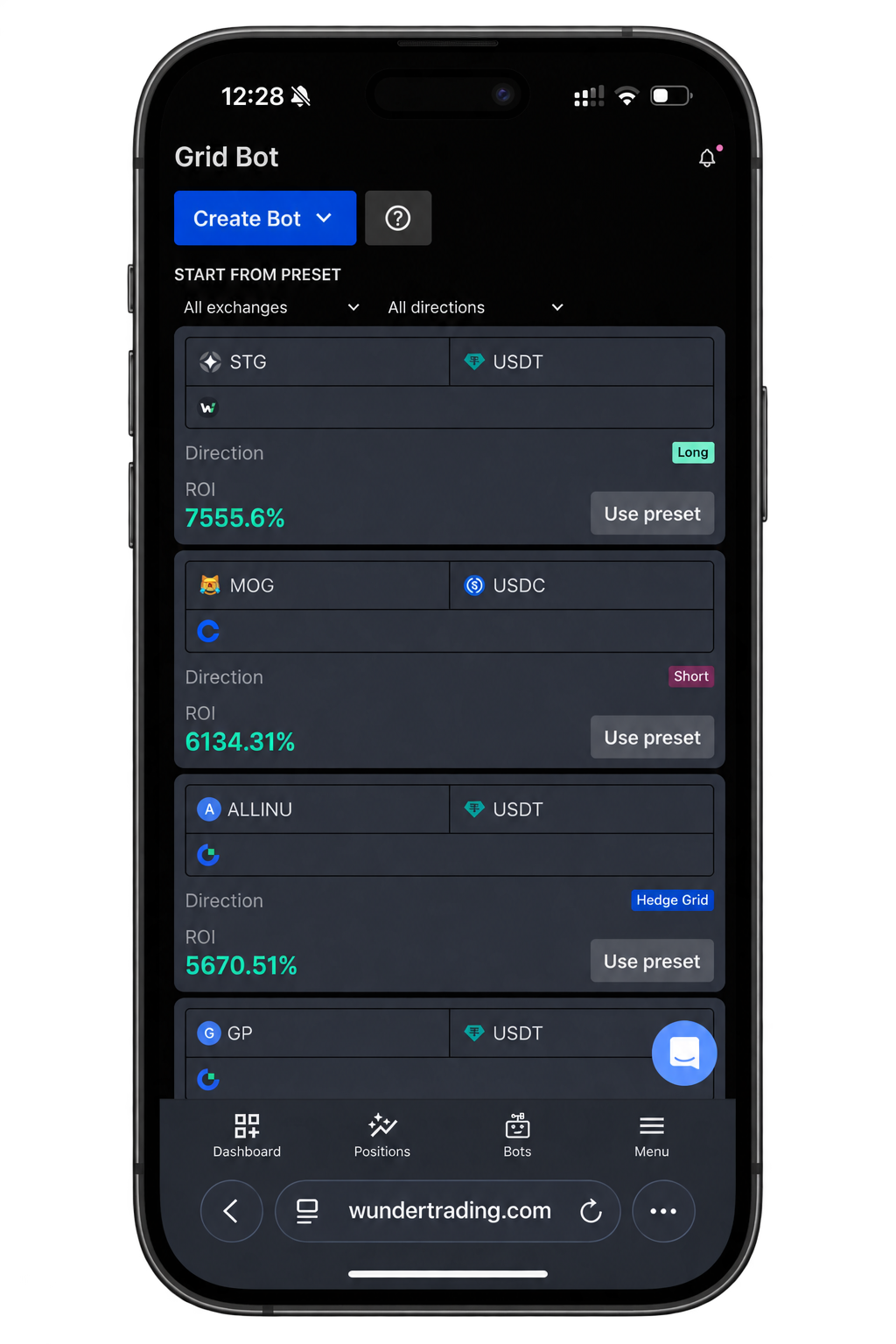
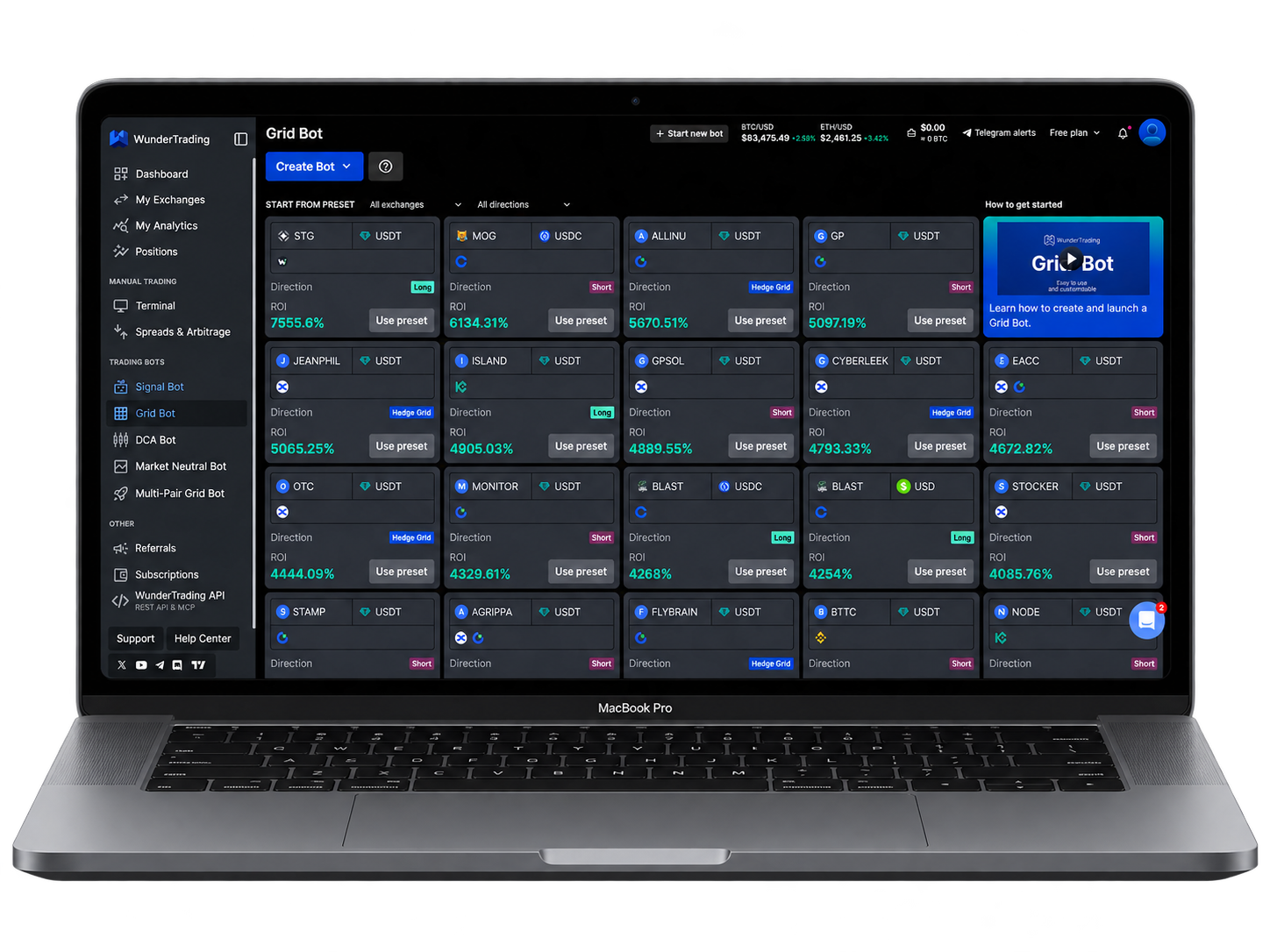
WunderTrading’s Grid Bot automates trading within predefined price levels, placing buy and sell orders as the market moves through a selected range. When an order executes at one level, the bot can place a corresponding order at another level to capture subsequent price movements. This approach is particularly relevant to markets that fluctuate repeatedly between support and resistance rather than following a sustained directional trend.
The platform supports several grid strategies designed for different market conditions. Neutral grids focus on trading within a relatively stable range, while long grids emphasize bullish opportunities and short grids target downward price movements. Hedge grids combine long and short positioning to manage exposure across both directions, subject to the connected exchange’s futures and position-mode capabilities.
WunderTrading also offers different grid configurations, including interval grids with predefined price spacing and infinity grids that can extend upward as prices rise. Spot grids trade the underlying cryptocurrency directly, while futures grids provide access to leveraged strategies on supported exchanges. Users can adjust grid spacing, investment size, entry conditions, protective exits, and other execution parameters according to their preferred strategy.
Backtesting and grid optimization tools allow traders to examine historical behavior before activating a configuration. These features are useful for comparing grid density, trading ranges, and capital requirements, but optimization can also produce overly favorable results when parameters are fitted too closely to historical price movements.
Grid trading performs best when price fluctuations generate enough completed transactions to offset trading commissions and other execution costs. A prolonged decline can leave a spot grid holding depreciating assets, while an extended rally may move beyond a fixed upper boundary and prevent further trading. Futures grids introduce additional risks through leverage, funding payments, and liquidation exposure. Their profitability must therefore be assessed using total portfolio performance rather than the number of completed grid transactions alone.
Multi-Pair Grid Bots
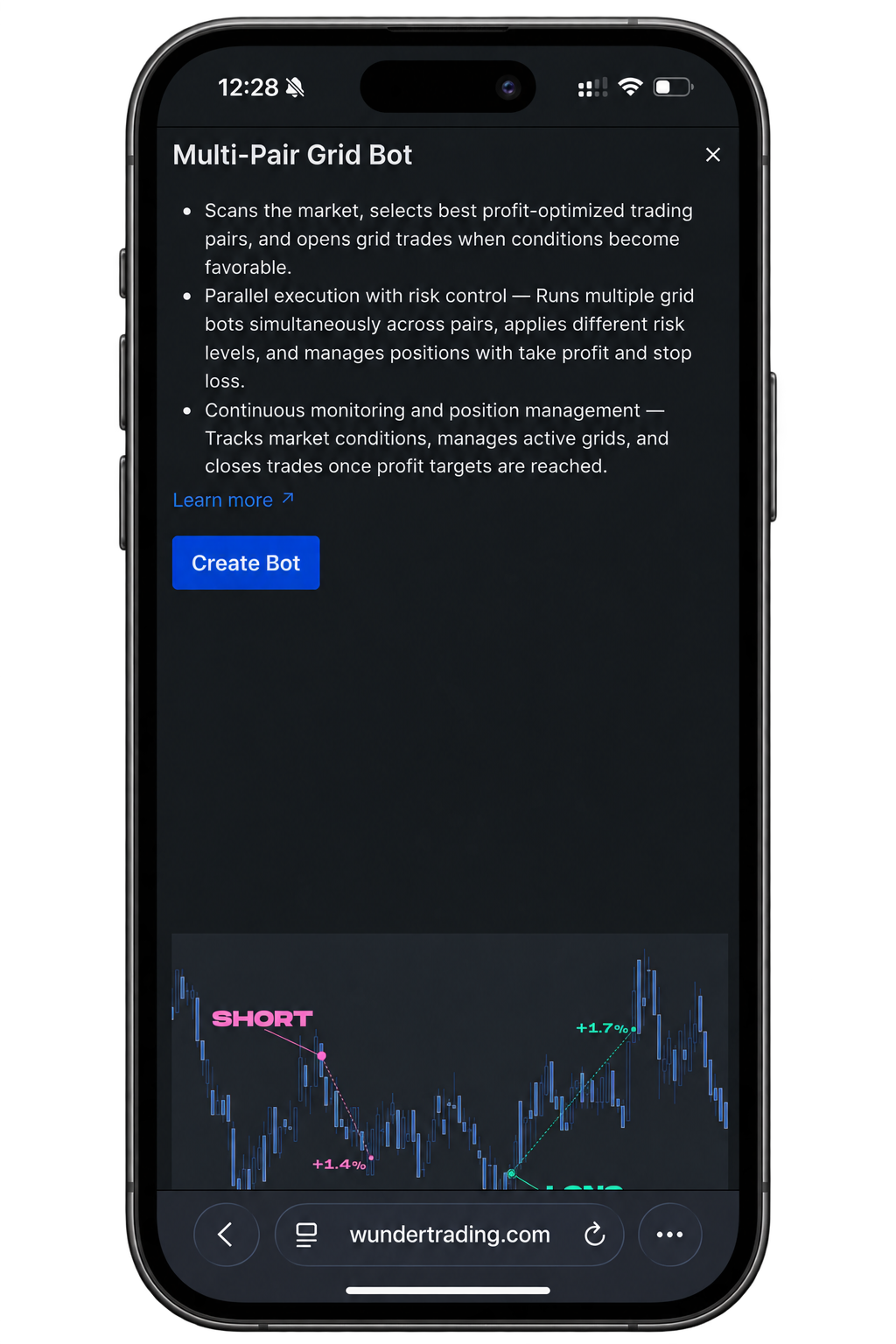
WunderTrading’s Multi-Pair Grid Bot extends automated range trading across several cryptocurrency markets through a coordinated strategy. Instead of requiring users to configure and manage each grid independently, the system can identify suitable trading opportunities, allocate capital, and initiate automated setups across selected assets.
The strategy focuses on long positions and uses market conditions to identify cryptocurrencies that may be approaching a potential recovery after sustained declines. It evaluates predefined entry conditions and can select suitable trading pairs according to the configured strategy, while allowing manual pair selection and risk adjustments. The system supports up to 10 simultaneous active setups within a Multi-Pair Grid Bot, helping distribute activity across several markets rather than concentrating every entry on a single asset.
Its position-management tools include predefined capital allocation, grid spacing, profit-taking rules, and trailing-profit functionality. These controls can make multi-asset trading more efficient, particularly for users who want to manage several potential recovery opportunities without continuously monitoring individual charts.
However, the strategy is not automatically diversified simply because it trades multiple cryptocurrencies. Altcoins frequently move together during broad market declines, potentially triggering several purchases within a short period. A strategy designed to enter after declining prices can therefore accumulate losses across multiple positions if bearish conditions persist.
Multi-Pair Grid Bots are available through WunderTrading’s Premium plan, which currently supports five active instances. Their value is strongest for experienced traders who want coordinated multi-asset automation and understand how correlated exposure affects portfolio risk.
Market Neutral Bot
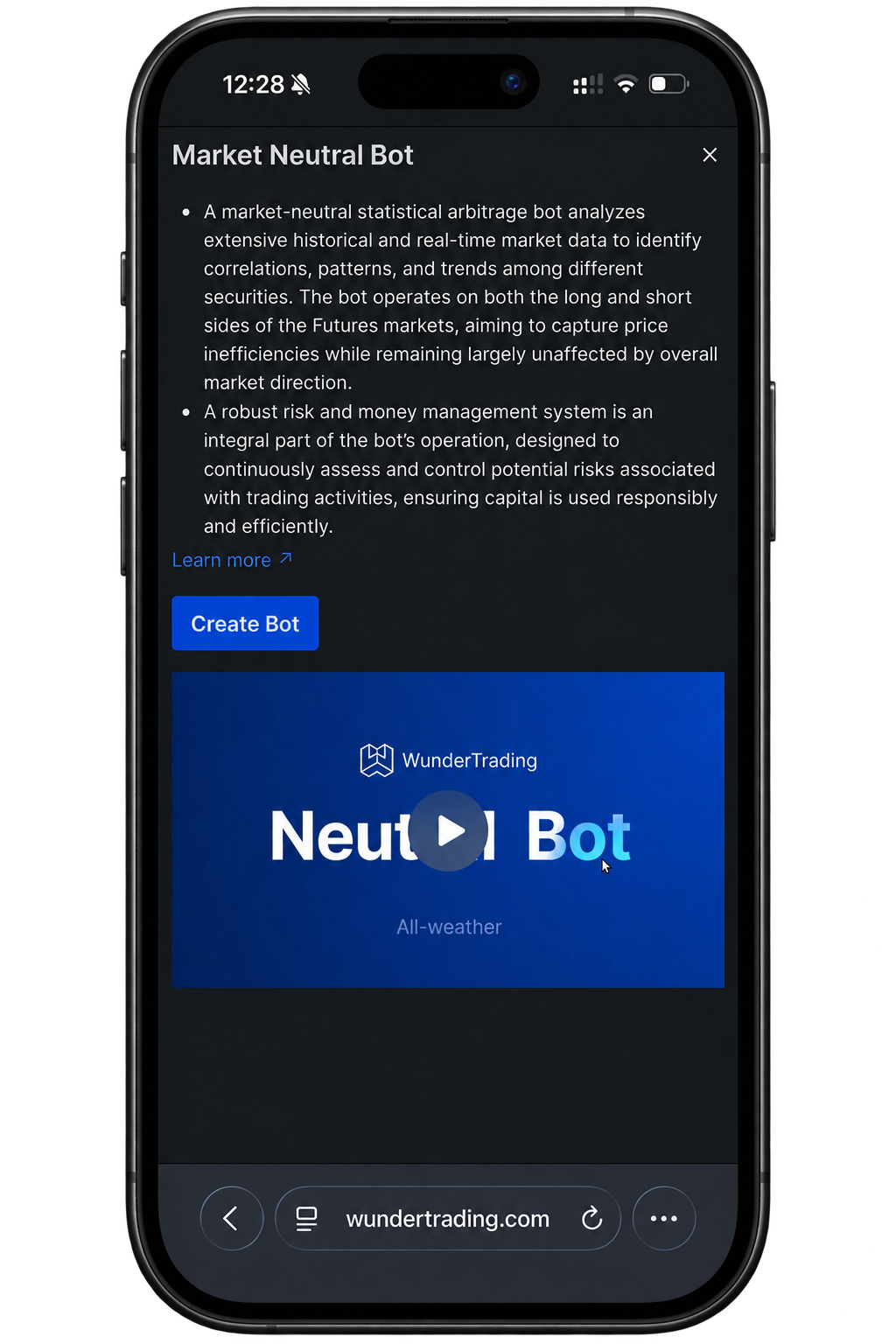
WunderTrading’s Market Neutral Bot is one of its more specialized products, providing automated futures strategies based on statistical relationships between cryptocurrencies. Instead of predicting whether Bitcoin or another asset will rise or fall independently, the bot examines how the prices of two related instruments move relative to one another and seeks opportunities when that relationship deviates from historical patterns.
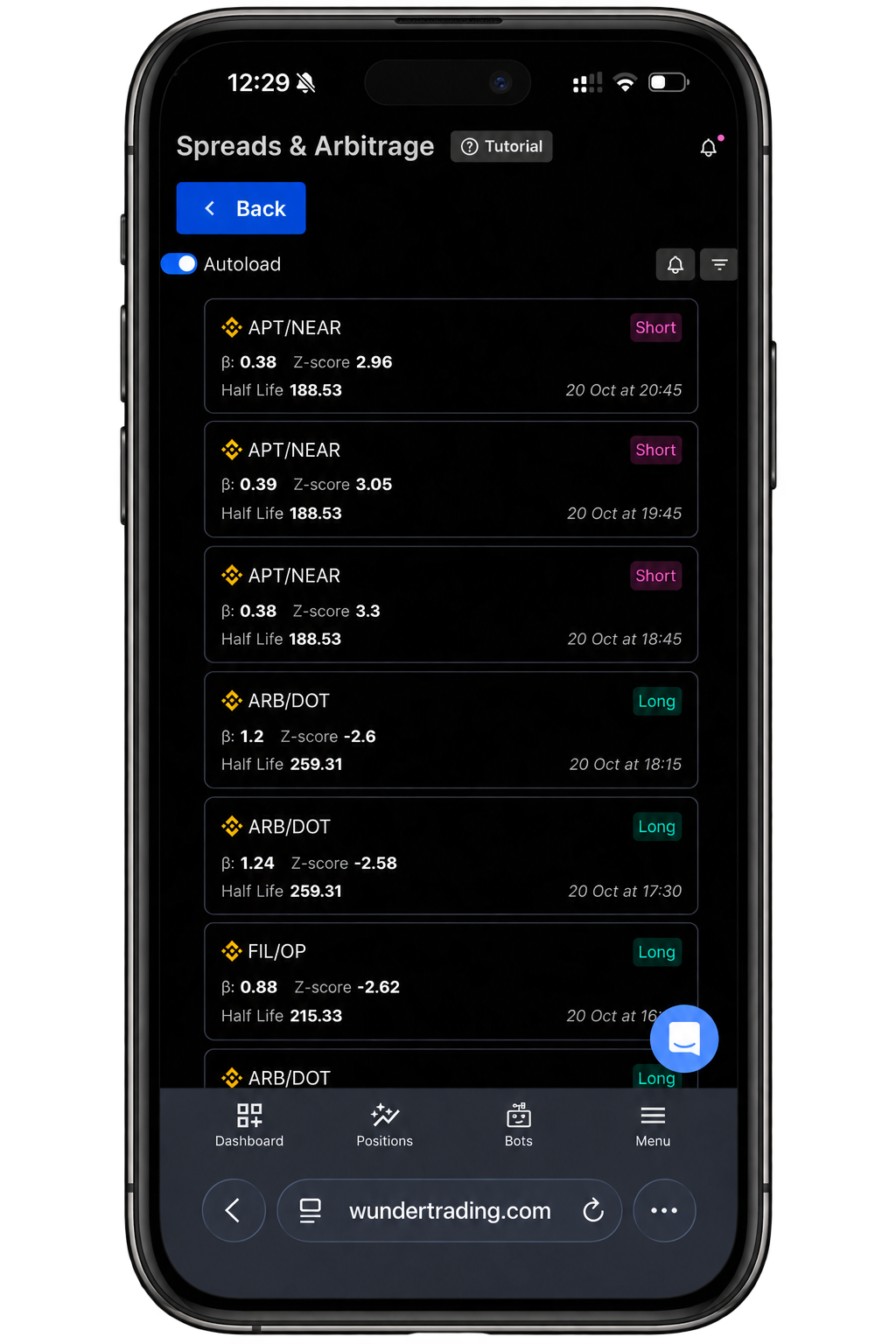
The system uses approximately three months of historical price data to group cryptocurrencies by volatility, identify potentially cointegrated pairs, and evaluate their relative price behavior. Cointegration testing helps identify assets that have maintained a statistically meaningful relationship over time, while standardized Z-scores measure deviations from the expected spread. The bot then uses configured entry conditions to determine when a long-short position should be established.
Traders can select mean-reversion or trend-based logic, adjust volatility and quantile groups, configure Z-score calculation windows, and establish take-profit and stop-loss conditions. Additional protection includes leg-specific stop losses, which can close the overall spread when one component of the trade breaches its configured risk threshold. These settings allow more detailed control over entry timing and position management than a conventional single-asset bot.
For example, two historically related cryptocurrencies may temporarily diverge as one experiences greater selling pressure than the other. A mean-reversion strategy could establish opposing futures positions intended to benefit if their relative pricing returns toward its historical relationship. The outcome depends on the movement of the spread rather than requiring both assets to rise in value.
Market-neutral positioning can reduce exposure to broad market direction, but it does not eliminate trading risk. Statistical relationships can break down permanently, particularly during major market events or changes in token fundamentals. Funding payments, uneven liquidity, leverage, and differences in execution timing can also undermine the expected spread return. If one leg executes and the other is delayed or rejected, the trader may temporarily hold an unintended directional position.
The Market Neutral Bot is therefore better suited to experienced futures traders familiar with statistical arbitrage, multi-leg execution, and collateral management. Live Market Neutral Bot trading is reserved for Premium subscribers, with up to five active bots, while lower subscription tiers provide demo access.
Trading Terminal, Spreads, and Arbitrage
Beyond its standalone bots, WunderTrading offers several tools for manual trading and more specialized execution. These include its Trading Terminal, Spreads and Arbitrage Terminal, multi-account management functionality, and Pump Screener.
Trading Terminal and Advanced Order Management
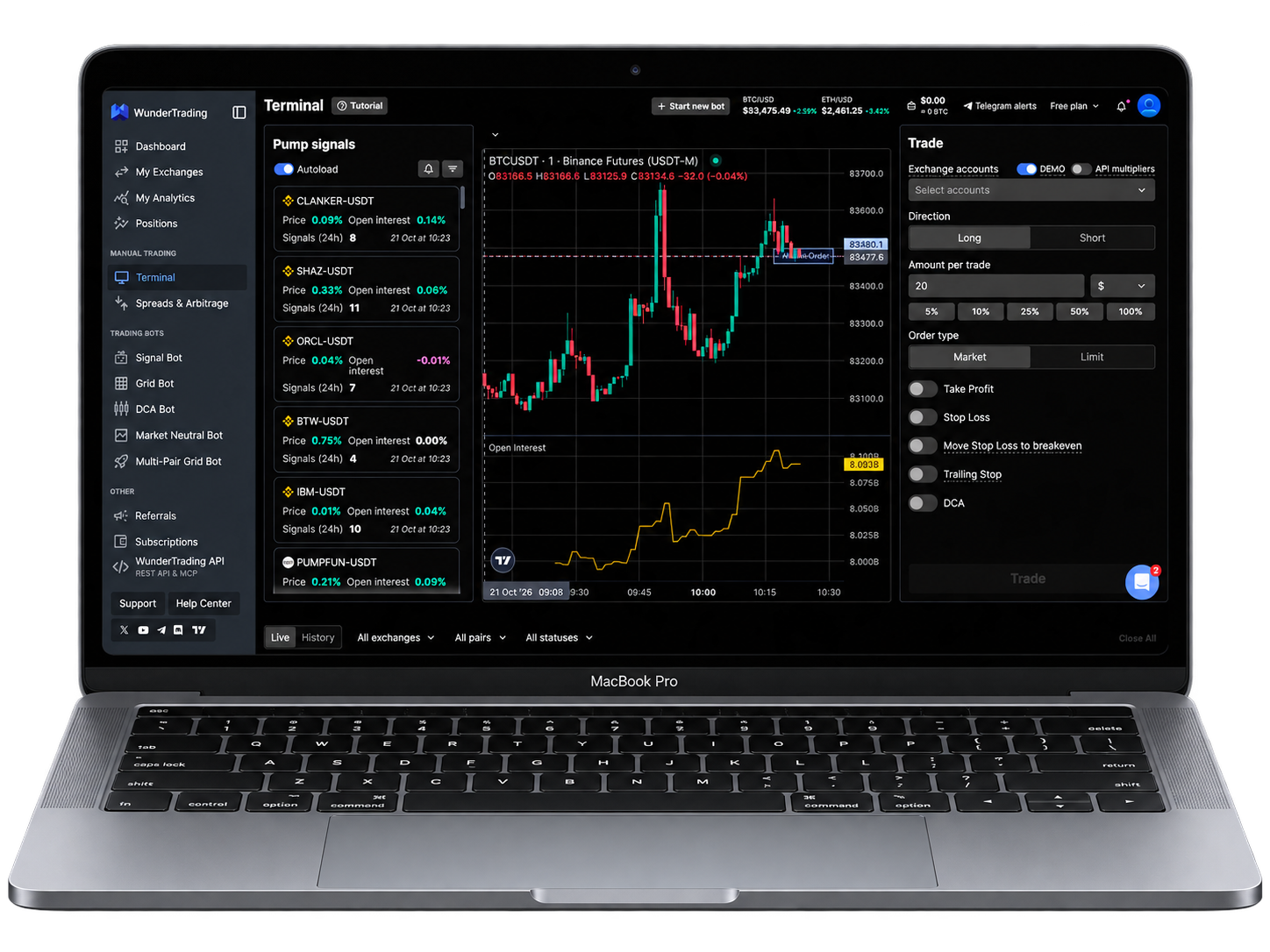
The WunderTrading Trading Terminal provides a consolidated workspace for managing cryptocurrency positions across supported exchanges. It includes market and limit orders, multiple take-profit targets, stop losses, trailing stops, break-even adjustments, and position averaging. Users can establish a trade manually and configure the associated risk-management instructions without repeatedly switching between exchange interfaces.
Multi-API trading allows supported orders to be distributed across several connected accounts, helping traders manage separate portfolios or execute similar strategies without submitting every transaction individually. The number of simultaneous API executions depends on the subscription tier, while supported order types and markets depend on the connected exchange.
The terminal is most useful for traders who want greater control over manual execution without building custom trading infrastructure. However, an external terminal cannot override the underlying exchange’s minimum order sizes, liquidity conditions, margin requirements, or order restrictions. Risk-management instructions should be checked against the final exchange order, particularly when several accounts or futures positions are involved.
Spreads and Arbitrage Terminal
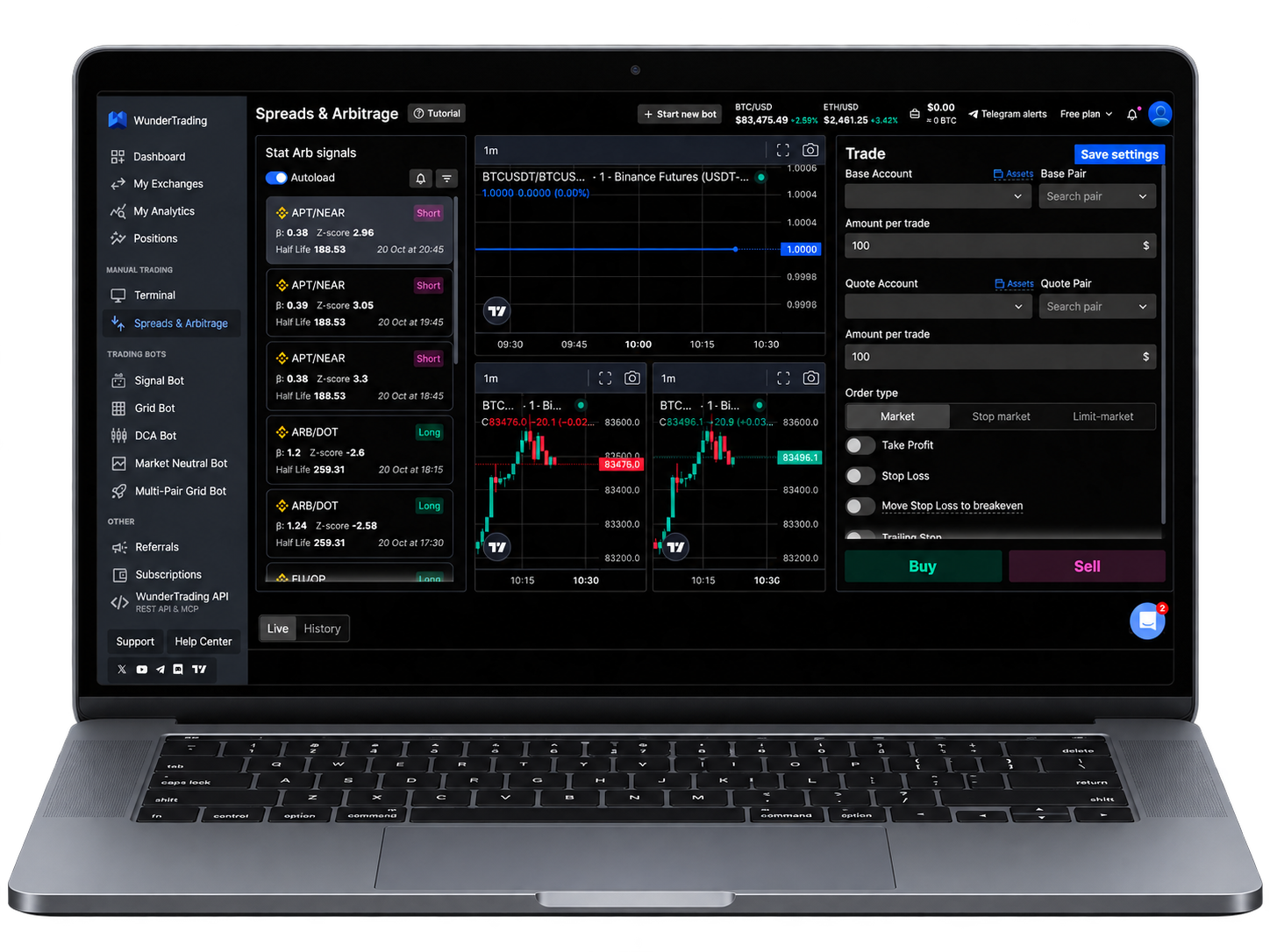
The Spreads and Arbitrage Terminal supports strategies involving two related instruments or price differences between exchanges. Its futures spread functionality allows users to construct positions using two assets or contracts, while cross-exchange arbitrage tools help identify and trade differences in the price of the same cryptocurrency across supported venues.
Traders can monitor spread charts, configure the allocation between position legs, and manage entries and exits through one interface. Supported execution tools include market orders, stop-market orders, limit-market entries, multiple take-profit targets, stop losses, and trailing stops. Built-in statistical arbitrage signals also help identify unusual spread movements that may warrant further analysis.
The terminal’s chart tracks the relative price movement between instruments rather than automatically representing the final profit or loss of the complete strategy. Actual returns depend on the quantities assigned to each leg, execution prices, financing costs, and exchange commissions.
Cross-exchange arbitrage introduces additional complexity because the two transactions may execute at different prices or times. An apparent price discrepancy can disappear before both positions are established, while exchange-specific spreads, fees, and funding payments may exceed the expected return. Traders also need sufficient collateral at the relevant venues because funds cannot always be transferred quickly enough to capture short-lived opportunities.
The Spreads and Arbitrage Terminal provides a useful environment for constructing these strategies, but advanced live execution capabilities depend on the subscription plan and supported exchanges. It is most appropriate for traders comfortable managing multi-leg positions rather than beginners seeking a simple automated trading strategy.
Pump Screener and Market Monitoring
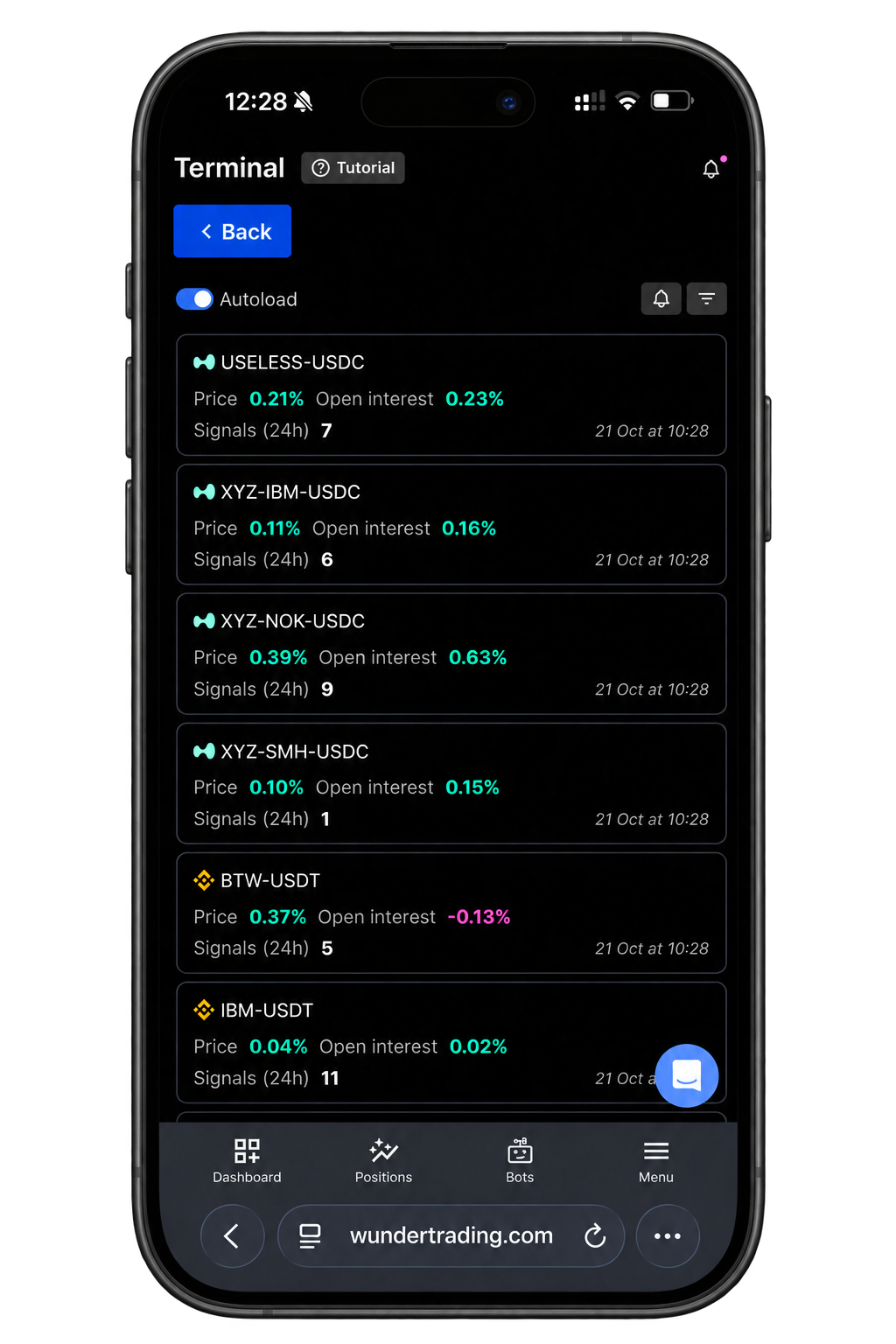
WunderTrading includes a Pump Screener designed to identify unusual short-term movements in cryptocurrency futures markets. The tool monitors supported Binance, Bybit, and Hyperliquid markets, examining rapid price changes and open-interest movements that may indicate increasing speculative activity.
Traders can configure filters using short intervals such as one, five, and fifteen minutes, alongside percentage thresholds for price movement and open interest. Alerts are available through the platform and supported Telegram notifications, allowing users to monitor unusual market conditions without manually checking every trading pair.
The screener integrates with WunderTrading’s broader trading workflow, making it possible to identify an opportunity and prepare a position through the terminal. It can also support externally defined strategies that use market-movement signals as part of their entry conditions.
However, unusual price acceleration or increasing open interest does not establish that a sustainable trend has begun. Rapid movements can result from liquidations, temporary liquidity shortages, coordinated speculation, or other events that reverse quickly. The screener is best treated as a market-monitoring tool rather than an independently reliable trading signal.
AI Trading, REST API, and MCP Integration
WunderTrading has expanded its developer functionality through REST API access and Model Context Protocol (MCP) integration. These interfaces allow external applications, custom trading systems, and AI agents to interact with WunderTrading’s execution infrastructure rather than requiring developers to build separate integrations for every supported exchange.
The REST API provides a programmable connection for trading workflows, while MCP allows compatible AI agents to access supported tools and submit structured trading instructions. Users can build systems that combine market data, technical indicators, external research, or other inputs to generate and manage trading decisions. Potential applications include portfolio rebalancing, automated signal execution, order-book analysis, sentiment-driven strategies, and customized position management.
This makes WunderTrading relevant to developers building their own AI-assisted trading systems, but it is important to distinguish the platform’s execution capabilities from independently validated trading intelligence. WunderTrading provides the infrastructure through which a model or external application can place orders. The quality of the strategy, reliability of the data, and accuracy of the model’s decisions remain separate considerations.
AI-assisted execution also introduces operational risks beyond conventional rule-based automation. An agent may misinterpret a market signal, issue an incorrect order quantity, repeatedly act on outdated information, or respond unpredictably to ambiguous instructions. When external services have live trading permissions, these failures can produce immediate financial consequences.
Appropriate safeguards include restricted exchange API credentials, maximum position sizes, defined trading permissions, isolated accounts, and procedures for disabling automated execution. AI-generated orders should also be logged and monitored so unexpected behavior can be identified before losses accumulate.
Live REST API and MCP trading access begins with the Pro plan, while Free and Basic subscribers receive more limited demo access. This makes the developer functionality most relevant to active traders and technical users who require programmable execution rather than investors seeking ready-made strategy presets.
Demo Trading, Backtesting, and Portfolio Management
WunderTrading provides demo trading across its supported exchange integrations, allowing users to test automated strategies without committing real cryptocurrency. The simulated environment is useful for learning bot configuration, checking execution rules, and identifying mistakes in order sizing or position management before activating live trading.
Historical backtesting and optimization are available for supported DCA and Grid Bot configurations. These tools allow users to examine previous strategy performance, compare alternative parameters, and evaluate how different entry and exit conditions might have behaved under earlier market conditions. Performance analytics and portfolio-monitoring functionality provide additional oversight once strategies are running.
However, demo results should not be interpreted as a forecast of live trading profitability. Paper trading cannot reproduce every aspect of real exchange execution, including liquidity shortages, slippage, rejected orders, funding changes, and interruptions to external webhook services. Historical optimization can also create misleading expectations when a configuration is excessively tailored to the data used during testing.
A sensible progression is to validate the strategy in historical data, test its order behavior through demo trading, and then monitor small live positions before increasing capital allocation. WunderTrading supplies the tools for that process, but the decision to activate, modify, or terminate a strategy remains with the trader.
Feature Availability and Subscription Limitations
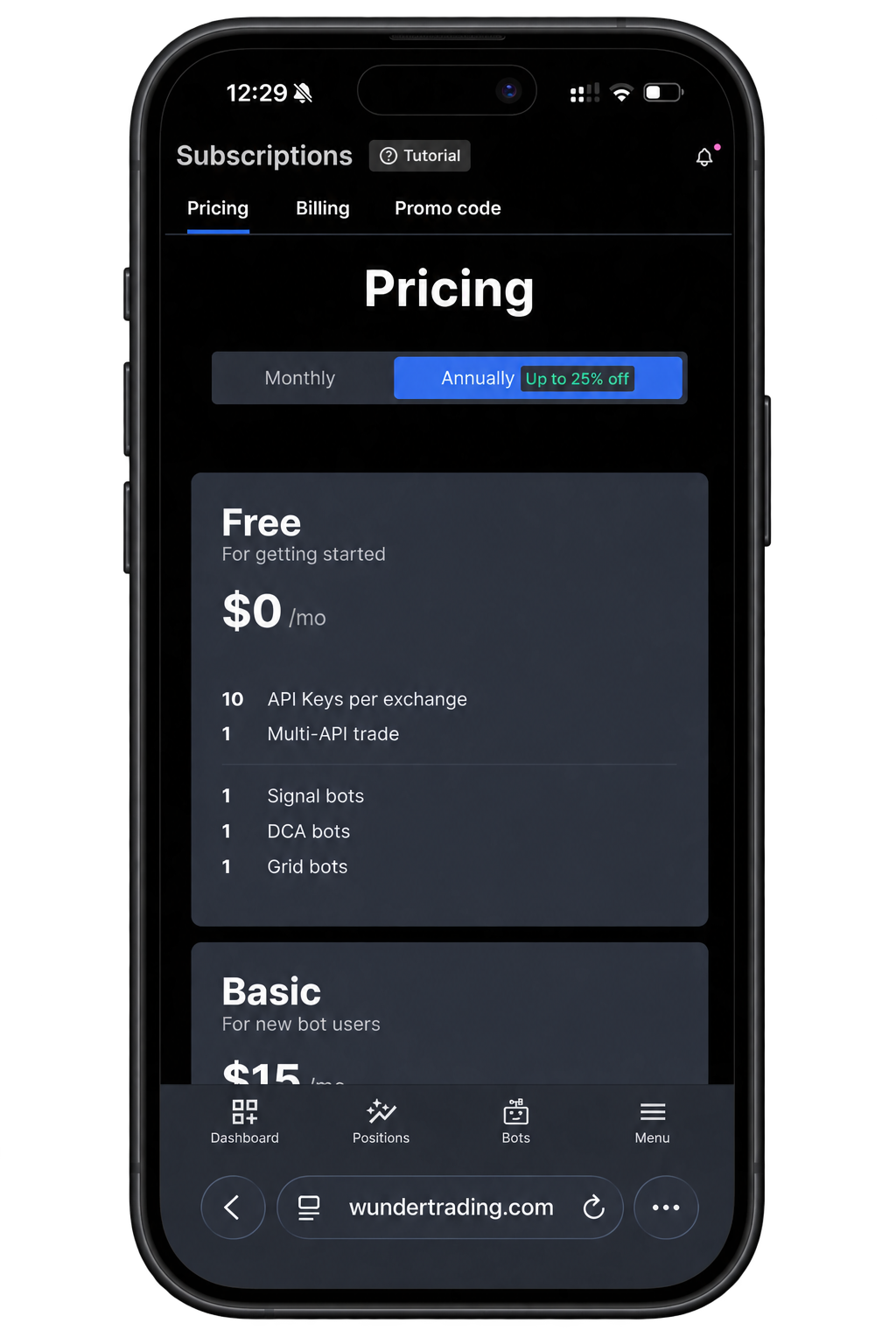
WunderTrading’s pricing structure determines how many bots and connected accounts users can operate simultaneously, as well as whether certain advanced tools are available for live trading. The platform offers Free, Basic, Pro, and Premium subscriptions, with a seven-day Pro trial and a permanent Free plan.
The Free plan includes one active Signal Bot, one DCA Bot, and one Grid Bot. Basic increases those allowances to five Signal Bots, twenty DCA Bots, and five Grid Bots, while Pro supports substantially larger deployments and live developer integrations.
Premium is intended for more complex strategies, including Multi-Pair Grid Bots and live Market Neutral Bots. Its published limits include five active instances of each specialized bot, alongside higher allowances for standard Grid and DCA automation.
WunderTrading also offers a distinct arrangement for Hyperliquid users, providing access to Premium functionality without a separate subscription when trading through the supported Hyperliquid integration. A 0.035% builder fee applies to qualifying trades, in addition to relevant exchange trading costs.
The practical value of each subscription depends on the number of strategies, accounts, and execution tools a trader actually needs. Users running one TradingView strategy or a small number of DCA bots may find the lower tiers sufficient, while Premium becomes more relevant for multi-pair automation and statistical futures trading. Traders should verify exchange compatibility and live-trading permissions before subscribing, since a bot’s availability within the platform does not guarantee support for every exchange, market, or account configuration.
Suported Exchanges
Supported Cryptocurrency Exchanges
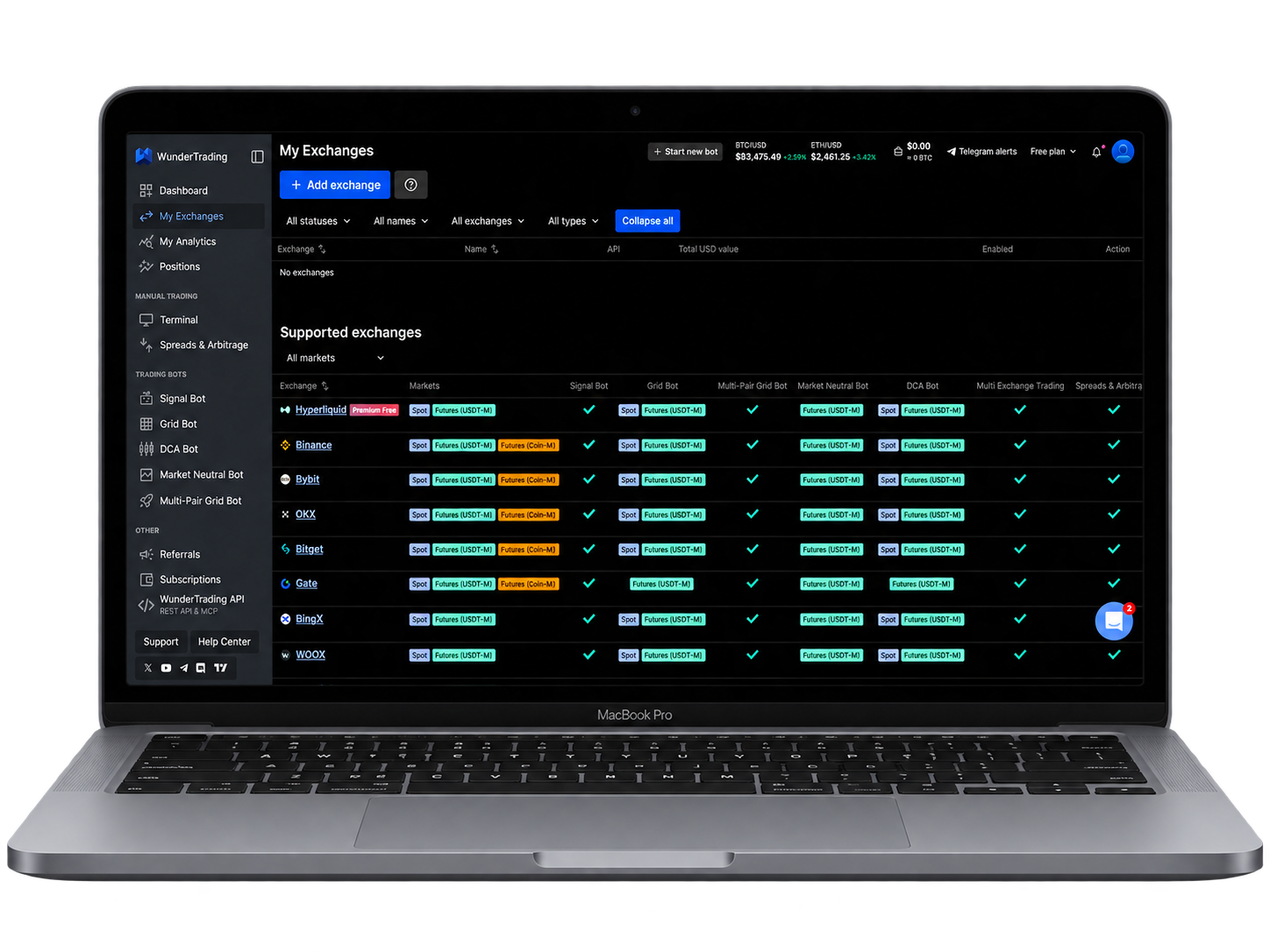
WunderTrading offers extensive cryptocurrency exchange connectivity, allowing traders to automate strategies and manage multiple accounts without transferring assets to a separate trading platform. Its integration network includes major centralized exchanges such as Binance, Bybit, OKX, Kraken, KuCoin, Bitget, Gate, Coinbase, BingX, and Phemex, alongside WOO X and the decentralized derivatives platform Hyperliquid. Additional integrations include Deribit, MEXC, Bitfinex, and BloFin, providing access to different spot and futures markets through a unified trading environment.
Although WunderTrading advertises support for more than 18 exchanges, however the integration depth differs considerably between platforms. Binance, Bybit, OKX, and Bitget support spot trading alongside USDT-margined and coin-margined futures, while Kraken, KuCoin, BingX, Coinbase, and several others provide selected spot and USDT-margined futures integrations. Deribit and BloFin are listed for derivatives trading, whereas MEXC and Bitfinex currently have spot-only coverage in the detailed matrix. These distinctions also apply to individual bots, since support for DCA, grid trading, market-neutral strategies, and advanced execution tools is not identical across exchanges.
Multi-account management is particularly valuable for traders operating several portfolios or executing systematic strategies through different API connections. WunderTrading supports consolidated monitoring and multi-account execution through its Trading Terminal and Signal Bot, reducing the need to configure orders separately in every exchange interface. However, simultaneous execution is subject to feature-specific restrictions, and certain batch-trading workflows operate across multiple accounts on the same exchange rather than every connected venue at once. Orders may also execute at different prices because each account has its own available balance, trading permissions, and market conditions.
Exchange availability remains subject to regional regulation and account eligibility. For example, an exchange connection offering futures functionality internationally may be limited to spot trading for customers in jurisdictions where derivatives are restricted. Traders should verify the supported markets and individual bot capabilities through WunderTrading’s exchange compatibility matrix before configuring live strategies. Its broad exchange coverage is a significant advantage for experienced users, but the practical value depends on reliable API connectivity, supported trading products, and the liquidity available on each venue.
Pricing & Plans
WunderTrading Pricing and Subscription Plans
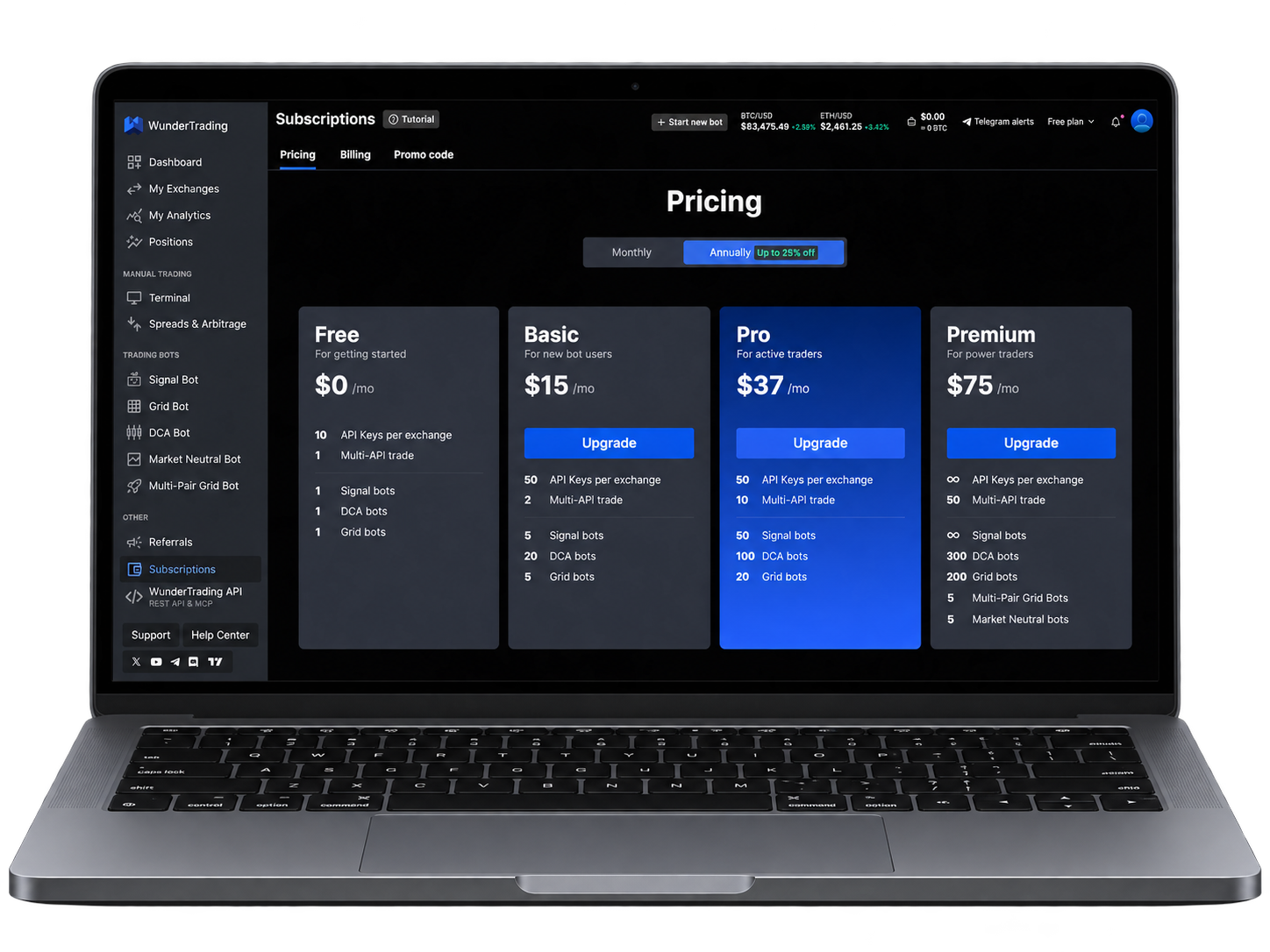
WunderTrading offers four subscription plans: Free, Basic, Pro, and Premium. Unlike many cryptocurrency trading bot platforms that restrict live automation to paid subscriptions, WunderTrading provides access to Signal Bots, DCA Bots, and Grid Bots through its permanent Free plan. Paid subscriptions increase the number of active strategies, connected exchange accounts, and simultaneous positions, while unlocking specialized tools for algorithmic trading and portfolio management.
Pricing starts at $19 per month for Basic, $49 for Pro, and $99 for Premium, with annual billing offering savings of up to 25%. The main differences concern bot capacity, multi-account execution, and access to advanced strategies rather than cryptocurrency trading volume. WunderTrading does not charge ordinary subscription users an additional commission on each automated trade, although exchange trading fees, spreads, funding payments, and other market-related costs still apply. Subscription prices can vary by country, currency, and billing arrangement.
WunderTrading Plans Compared
| Feature | Free | Basic | Pro | Premium |
|---|---|---|---|---|
| Monthly Price | $0 | $19 | $49 | $99 |
| Annual Plan (Monthly Equivalent) | $0 | $15 | $37 | $75 |
| Active Signal Bots | 1 | 5 | 50 | Unlimited |
| Active DCA Bots | 1 | 20 | 100 | 300 |
| Active Grid Bots | 1 | 5 | 20 | 200 |
| Multi-Pair Grid Bots | Not included | Not included | Not included | 5 |
| Market Neutral Bots (Live) | Demo only | Demo only | Demo only | 5 |
| Maximum Open Positions | 50 | 1,000 | 1,000 | 2,000 |
| API Accounts per Exchange | 10 | 50 | 50 | Unlimited |
| Multi-API Trade Limit | 1 | 2 | 10 | 50 |
| Live Developer API & MCP | Demo only | Demo only | Included | Included |
| Demo Trading | Included | Included | Included | Included |
| Best Suited For | Testing and small strategies | Individual bot users | Active automated traders | Advanced and multi-account traders |
Free Plan: Live Trading Without a Subscription
WunderTrading’s Free plan is one of its more attractive features, allowing users to operate one Signal Bot, one DCA Bot, and one Grid Bot without paying a subscription fee. It also supports up to 50 open positions and 10 API accounts per connected exchange, alongside demo trading, TradingView webhook execution, and access to the trading terminal. Unlike a limited trial, the Free plan has no expiration date, making it practical for traders who operate a small number of strategies or want to evaluate execution quality before upgrading.
Its limitations become apparent when traders begin expanding their automation. Only one bot of each main type can remain active, multi-account execution is restricted, and Open API and MCP connectivity are limited to demo use. Nevertheless, the ability to run real strategies without a recurring software subscription provides an accessible starting point for traders exploring cryptocurrency automation.
Basic Plan: $19 per Month
The Basic plan increases capacity to five Signal Bots, 20 DCA Bots, and five Grid Bots, with support for up to 1,000 open positions. Users can connect as many as 50 API accounts per exchange and execute trades across two selected API connections within the applicable multi-account limit. Annual billing reduces the advertised monthly equivalent to approximately $15, making Basic an economical upgrade for traders who have outgrown the Free plan but do not require extensive strategy portfolios.
Its strongest advantage is the increased flexibility to operate several automated strategies simultaneously. A trader can maintain different DCA configurations across selected markets, run independent grid strategies, and automate TradingView signals without constantly stopping existing bots to create new ones. However, live Open API and MCP execution remain unavailable, while Multi-Pair Grid and Market Neutral Bots are reserved for Premium. Basic is therefore best suited to traders concentrating on conventional automation rather than custom external execution systems.
Pro Plan: $49 per Month
Pro is the most balanced subscription for active users, supporting 50 Signal Bots, 100 DCA Bots, and 20 Grid Bots. It maintains the 1,000-position limit but expands simultaneous Multi-API execution capacity to 10 connections, making it considerably more practical for traders managing multiple exchange accounts or several independent strategies. The annual subscription reduces the monthly equivalent to approximately $37.
A significant advantage of Pro is access to live Open API and MCP connectivity, allowing external applications, algorithmic systems, and AI-powered trading agents to interact with WunderTrading’s execution infrastructure. Traders can automate signals from TradingView or custom software, coordinate activity across multiple accounts, and manage trading operations without maintaining separate exchange-specific execution systems. These capabilities make Pro particularly relevant to experienced traders who have developed their own strategies and need reliable automated order routing.
The main limitation is that Premium-only strategies remain unavailable for live trading. Pro users can experiment with Market Neutral Bots in demo mode, but deploying those strategies with actual funds requires the higher subscription. The plan is therefore most attractive to traders whose primary requirements involve Signal Bots, DCA automation, grid trading, and external strategy integration rather than specialized statistical arbitrage.
Premium Plan: $99 per Month
Premium provides the complete WunderTrading automation environment, with unlimited Signal Bots, 300 DCA Bots, 200 Grid Bots, and up to 2,000 open positions. It also removes the stated API-account limit per exchange and increases Multi-API execution capacity to 50 connections. Annual billing reduces the advertised monthly equivalent to approximately $75, although the subscription remains a considerable expense for smaller portfolios.
The most important additions are five live Multi-Pair Grid Bots and five Market Neutral Bots, which are unavailable for live execution on lower tiers. Multi-Pair Grid Bots allow traders to manage grid strategies across several cryptocurrency markets, while Market Neutral Bots support more sophisticated approaches based on statistical relationships between assets. These tools require a greater understanding of strategy design, futures exposure, funding costs, and execution risk than conventional DCA or single-pair grid automation.
Premium makes the most sense for experienced traders operating substantial automation portfolios, managing multiple exchange subaccounts, or deploying strategies that specifically depend on its exclusive features. Its higher limits are valuable when several strategies must remain active simultaneously, but traders running only a handful of bots are unlikely to benefit enough from the additional capacity to justify the subscription.
Free Premium Access for Hyperliquid Traders
WunderTrading offers an unusual alternative to its normal subscription model for users trading through Hyperliquid. Connecting a supported Hyperliquid account provides access to Premium features without paying the regular monthly subscription. Instead, WunderTrading charges a 0.035% builder fee per executed trade, creating a usage-based pricing arrangement rather than a fixed recurring software cost.
The fee is calculated on trading volume, meaning a $1,000 execution generates a $0.35 WunderTrading builder fee, while a $10,000 execution incurs $3.50. This structure can be attractive for traders who want access to advanced automation without committing to a monthly subscription, particularly when trading activity is relatively limited. However, costs scale directly with execution volume, so active strategies generating frequent entries, exits, and position adjustments can accumulate meaningful charges.
The Hyperliquid arrangement is also distinct from the standard multi-exchange subscription. Traders should assess the supported automation features and the total cost of their expected activity, including applicable venue trading costs, funding payments, and slippage, rather than assuming free Premium access makes execution entirely cost-free.
Free Trial, Payment Methods, and Cancellation
WunderTrading offers a seven-day Pro trial without requiring credit card details. During the trial, users can evaluate the higher bot limits and supported functionality before deciding whether a paid subscription is necessary. Once the trial expires, the account automatically returns to the permanent Free plan without generating a subscription charge.
Paid subscriptions can be purchased using Visa, Mastercard, Apple Pay, Google Pay, and supported cryptocurrencies, including Bitcoin, Ethereum, and USDC. Card-based subscriptions can renew automatically, while cryptocurrency payments require manual renewal. Annual billing offers savings of up to 25% compared with the corresponding monthly subscription, making it more economical for traders intending to use the platform over an extended period.
Users can upgrade, downgrade, or cancel their subscriptions through the billing interface. Unused subscription time is converted into credit when changing plans, although downgrades apply the lower plan limits immediately. Bots or API connections exceeding the new allowance may be disabled, while already open positions continue to be monitored until closure. WunderTrading also offers a seven-day refund window for paid subscriptions, providing additional flexibility for customers evaluating its services.
Which WunderTrading Plan Offers the Best Value?
The Free plan provides exceptional accessibility for a cryptocurrency automation platform because it supports live Signal, DCA, and Grid Bots without requiring payment. Basic is a reasonable upgrade for traders managing several conventional strategies, while Pro offers the strongest overall balance between pricing, automation capacity, and access to advanced developer integrations.
Premium is better suited to specialized use cases involving Market Neutral Bots, Multi-Pair Grid automation, or large numbers of connected accounts. Its advantages are substantial for traders who need those capabilities, but the higher subscription is difficult to justify solely for running ordinary DCA or grid strategies. Hyperliquid users should also evaluate the separate usage-based Premium arrangement, which can deliver considerable value depending on their execution volume.
Ultimately, WunderTrading’s pricing is competitive because its Free plan supports genuine live automation and its paid tiers scale with operational requirements. The right subscription depends on how many strategies must run simultaneously, whether external API integrations are necessary, and whether the additional functionality can realistically justify its recurring cost.
Seucurity & UX
WunderTrading Security: Is It Safe?
WunderTrading operates through a non-custodial trading model, allowing users to automate cryptocurrency transactions without transferring their assets to the platform. Funds remain on connected exchanges, while WunderTrading uses API credentials to place and manage orders according to the trader’s instructions. Exchange connections are designed to operate with trading permissions only, and users must disable withdrawal access when generating their API keys. This limits the platform’s ability to transfer cryptocurrency out of connected exchange accounts, although it does not eliminate the risks associated with automated trading or unauthorized order execution.
The platform uses encrypted API credential storage, encrypted data transmission, account-level two-factor authentication, and access controls to protect sensitive information. Users can also restrict API access to WunderTrading’s designated server IP addresses where their exchange supports allowlisting, reducing the likelihood of stolen credentials being used from an unauthorized location. Exchange API keys can be revoked directly through the relevant trading account, allowing users to terminate the connection independently of WunderTrading. These safeguards provide meaningful protection, but they depend on correct configuration and the security controls supported by each exchange.
Trade-only API access should not be confused with protection against financial losses. An attacker who gains access to trading credentials may still be able to open unauthorized positions, execute unfavorable trades, or expose an account to substantial liquidation risk without withdrawing funds. Similarly, a malfunctioning bot or incorrectly configured strategy can repeatedly execute orders that consume available capital. The consequences are particularly severe when automated systems operate with leverage or manage several correlated positions across different exchanges.
WunderTrading’s REST API and Model Context Protocol (MCP) integrations introduce additional security responsibilities for developers using external applications or AI agents. The platform uses HMAC authentication for its developer API, with API and secret keys displayed only once when created. Keys without an IP allowlist expire after three months, while allowlisted credentials can remain active until revoked. These credentials are separate from the exchange API keys used to establish trading connections and must be protected wherever external software stores or processes them. Granting an AI agent execution access also requires carefully defined permissions and position limits, since incorrect instructions can produce real market orders.
WunderTrading publicly documents its encryption practices, API restrictions, and authentication mechanisms, but these disclosures should not be treated as equivalent to a comprehensive independent audit of its entire infrastructure. Traders managing substantial portfolios should use dedicated exchange subaccounts, disable unnecessary API permissions, restrict access by IP where supported, and maintain conservative position limits. Regularly reviewing active connections and trading activity provides another safeguard against compromised credentials or unexpected bot behavior.
Ease of Use and User Experience
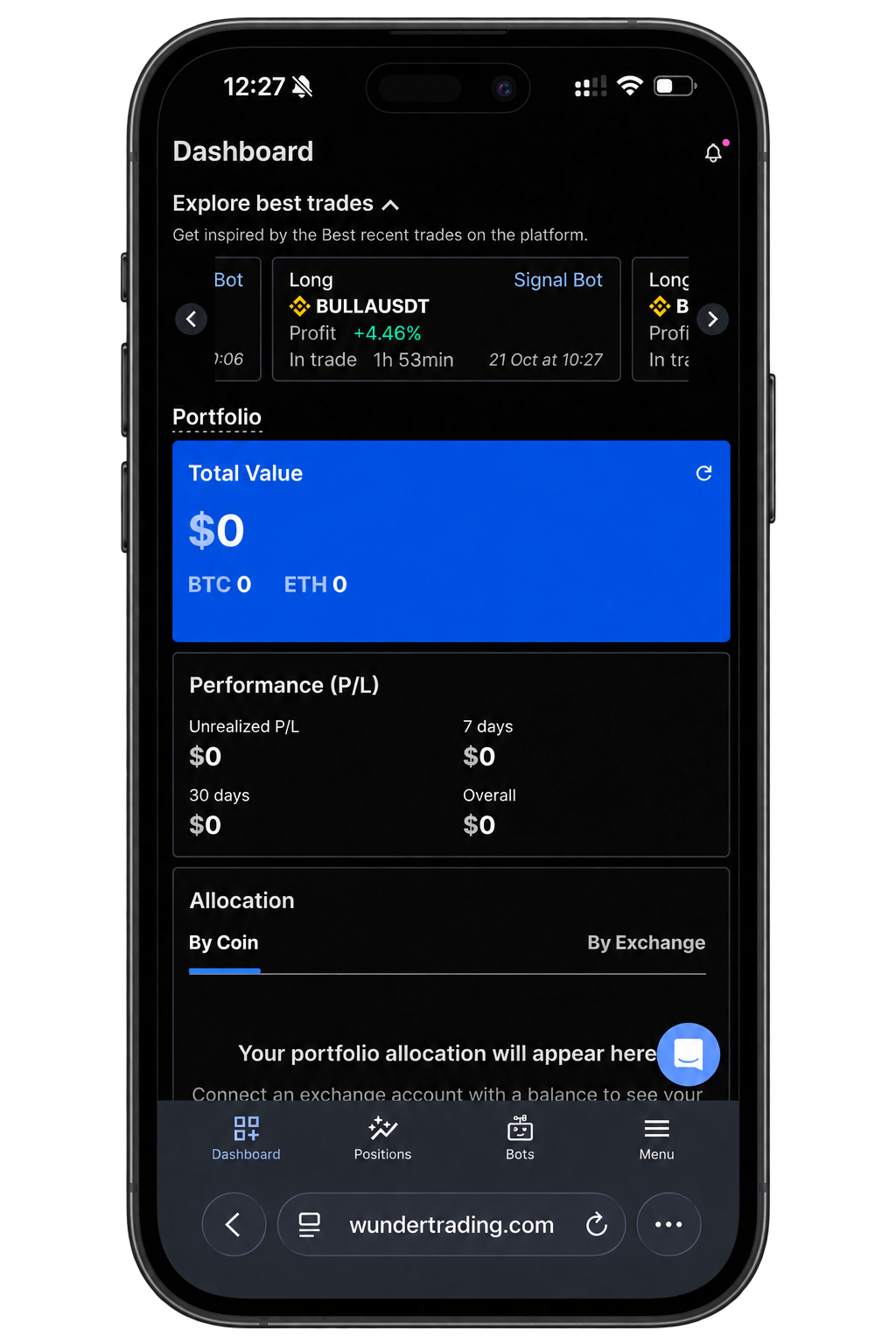
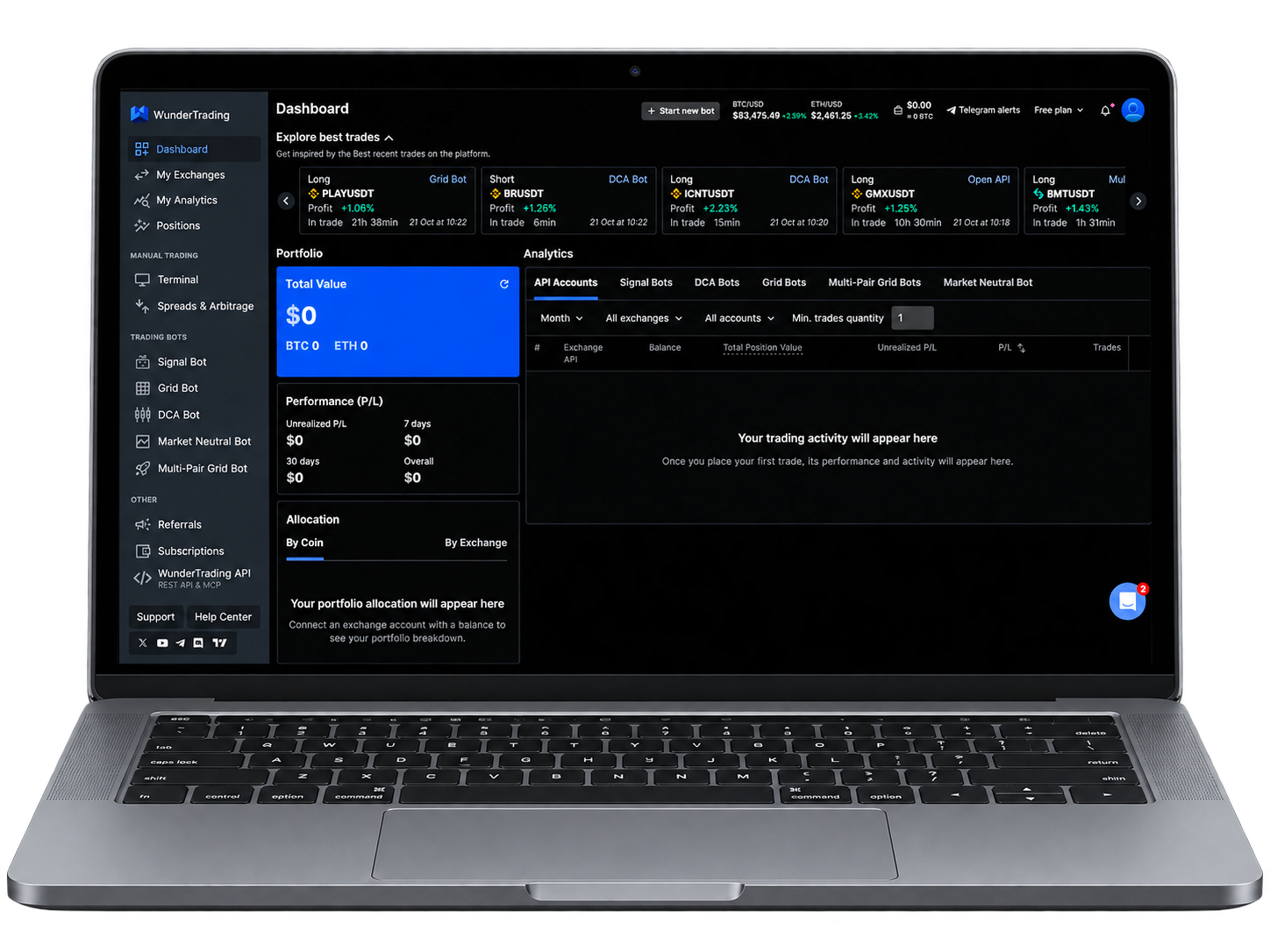
WunderTrading combines accessible bot configuration with a comprehensive trading environment designed for users managing multiple automated strategies. Its dashboard brings together connected exchanges, active bots, open positions, execution history, and performance information, reducing the need to monitor each trading account separately. Strategy presets and guided configuration help users establish basic DCA, grid, and Signal Bots, while more experienced traders can customize entry conditions, position sizing, protective exits, and execution rules according to their strategies.
The platform received a significant interface update in August 2026, introducing redesigned navigation, a centralized Notification Center, and improved Multi-Exchange Signal Bot functionality. The Notification Center consolidates bot activity, position changes, execution errors, daily profit and loss summaries, and bot logs, making it easier to identify strategies requiring attention. Multi-Exchange Signal Bots also allow a single TradingView alert to execute across several connected accounts and trading pairs, reducing repetitive configuration for users managing similar strategies on different venues. This improves operational efficiency, although synchronized execution can also increase exposure when several accounts follow the same unsuccessful signal.
Demo trading provides an important starting point for users unfamiliar with automated execution. WunderTrading offers paper trading with $10,000 in virtual capital, allowing traders to experiment with supported bots, TradingView webhooks, position management, and perpetual futures strategies using real-time market data. The environment is useful for identifying configuration errors, testing alert delivery, and evaluating trading rules before committing funds. However, simulated orders may not fully reproduce live slippage, partial fills, exchange fees, or liquidity constraints, so profitable demo results cannot be treated as reliable evidence of future trading performance.
WunderTrading’s main usability limitation is the complexity of its advanced functionality rather than the organization of its interface. Configuring custom TradingView alerts, multi-exchange execution, statistical arbitrage, and AI-assisted trading requires an understanding of order routing, market conditions, and capital allocation. Even relatively simple DCA and grid strategies can generate substantial losses when their averaging rules, trading ranges, or maximum exposure settings are poorly configured. Beginners can start with the Free plan and demo trading, while intermediate and experienced traders are better positioned to benefit from the platform’s extensive customization, advanced execution tools, and external strategy integrations.
Preview
WunderTrading vs Competitors
WunderTrading vs 3Commas, TradeSanta, Coinrule, and Cryptohopper
WunderTrading competes with several established cryptocurrency trading bot platforms, but their differences extend beyond the number of automated strategies available. 3Commas focuses on configurable execution and multi-account trading, TradeSanta simplifies DCA and grid automation, Coinrule emphasizes no-code strategy creation and AI agents, while Cryptohopper combines strategy development with a marketplace for trading signals and automated strategies.
WunderTrading distinguishes itself through TradingView integration, multi-exchange execution, statistical arbitrage tools, and a free plan that supports live automation. Its broader toolkit makes it particularly attractive to traders who already understand their strategies and want flexibility over how orders are executed, although some advanced features require higher subscription tiers.
| Platform | Best For | Main Advantage | Starting Price | Main Limitation |
|---|---|---|---|---|
| WunderTrading | TradingView signals, DCA, grid, and multi-exchange execution | Free live bots, extensive automation, and advanced spread strategies | Free; paid plans available | Advanced strategies and higher bot limits require paid tiers |
| 3Commas | Configurable bots and structured multi-account trading | Signal, DCA, and grid bots with extensive execution controls | $20/month | No live automation on the free plan; active account limits |
| TradeSanta | Beginner-friendly DCA and grid automation | Accessible configuration, templates, and high bot allowances | $25/month | Custom TradingView signals and futures require higher tiers |
| Coinrule | No-code strategies and AI-assisted automation | Visual rule builder, AI agents, and broad market integrations | Limited free access; paid plans vary | Usage limits, strategy complexity, and regional restrictions |
| Cryptohopper | Strategy development and marketplace-based automation | Strategy Designer, backtesting, paper trading, and signal marketplace | $29/month | Paid subscription required for live bots; marketplace costs can add up |
Prices reflect published monthly entry-level rates where available. Annual billing, promotional discounts, regional taxes, and plan-specific allowances can change the actual cost.
WunderTrading vs 3Commas
3Commas is WunderTrading’s closest competitor, particularly following the introduction of 3Commas v2 in September 2026. The current platform was developed in partnership with WunderTrading and shares much of its underlying automation functionality, including DCA bots, grid trading, signal execution, and multi-account management. The previous 3Commas platform has been discontinued, making comparisons based on its former bot system or subscription structure outdated.
Both platforms allow traders to automate exchange orders, connect external TradingView strategies, and manage positions through configurable entry and exit rules. WunderTrading also offers specialized tools for statistical arbitrage, market-neutral strategies, multi-pair grids, and external API integrations. These capabilities make it particularly suitable for experienced users who want to combine different approaches to automated execution rather than rely exclusively on conventional DCA and grid strategies.
Pricing creates a clearer distinction. WunderTrading’s free plan permits one active Signal Bot, one DCA Bot, and one Grid Bot, allowing users to operate basic strategies without a subscription. By comparison, 3Commas v2’s free account supports limited portfolio monitoring but does not include live trading. Its Starter plan begins at $20 per month with one active trading account, while Pro costs $50 monthly and supports three active accounts. Expert costs $140 per month and increases that allowance to 15 active trading accounts, alongside higher trading limits.
For traders testing their first live automation strategy, WunderTrading offers better entry-level value because its free plan supports actual trading. The decision becomes more nuanced at paid tiers, where bot allowances, account limits, exchange compatibility, and individual strategy requirements carry greater weight. Because the platforms share significant technology, traders should compare their subscription entitlements and supported execution features rather than expecting fundamentally different trading systems.
WunderTrading vs TradeSanta
TradeSanta focuses on making automated cryptocurrency trading accessible through predefined DCA and grid strategies. Its interface allows users to configure trading pairs, entry conditions, safety orders, take-profit levels, and additional execution parameters without developing custom scripts. This approach works particularly well for traders who want to automate relatively straightforward strategies while avoiding the complexity of extensive algorithmic trading infrastructure.
TradeSanta offers three paid subscriptions, beginning with Basic at $25 per month, Advanced at $45, and Maximum at $90. Basic supports up to 49 bots, while Advanced increases the allowance to 99 and introduces additional functionality, including trailing take-profit and TradingView Screener signals. Maximum removes the standard bot-count restriction and unlocks custom TradingView signals and supported futures bots. These limits make TradeSanta attractive to users who want to operate numerous conventional strategies, although more specialized automation requires the highest subscription tier.
WunderTrading provides a broader selection of trading methods, including TradingView webhook execution, market-neutral strategies, multi-exchange signal distribution, and spread trading. Its backtesting and optimization tools also support more detailed strategy configuration. Unlike TradeSanta’s subscription-based live automation, WunderTrading allows limited real trading through its free plan, making it easier to evaluate execution behavior before paying for additional capacity.
TradeSanta is generally better suited to investors prioritizing straightforward DCA or grid deployment across supported exchanges. WunderTrading offers greater flexibility for experienced traders developing custom signals, managing several accounts, or experimenting with statistical strategies. TradeSanta’s higher bot allowances can still provide value for users running many relatively simple configurations, while WunderTrading’s advantage becomes more apparent as execution requirements grow more sophisticated.
WunderTrading vs Coinrule
Coinrule approaches cryptocurrency automation through strategy creation rather than concentrating primarily on predefined bot categories. Its visual rule builder allows users to combine price movements, technical indicators, trading conditions, and execution instructions without writing code. A trader could, for example, configure a rule to buy Bitcoin following a particular RSI signal and close the position when a profit target or trend-reversal condition is reached.
Coinrule has expanded considerably beyond its original conditional-rule interface, introducing AI-assisted strategy development, agent-based automation, and integrations covering cryptocurrency exchanges, onchain markets, and selected stock brokers. Its AI Cloud environment supports strategies expressed through natural-language instructions, Pine Script, and other supported formats, while Model Context Protocol connectivity enables interaction with compatible AI assistants. Backtesting and paper trading allow users to evaluate strategies before deploying them with real capital. However, available functions, agent limits, trading volume allowances, and pricing depend on the specific Coinrule product and subscription.
WunderTrading is more directly focused on executing strategies through established bot configurations and external trading signals. Its Signal Bot can transform TradingView alerts into orders, while DCA and grid bots provide dedicated controls for averaging, range trading, and position management. Market Neutral Bot and spread-trading functionality extend its capabilities into more specialized futures strategies. Coinrule offers greater flexibility for users who prefer constructing custom conditional logic or experimenting with AI-generated systems, while WunderTrading provides a more specialized environment for traders already working with defined execution strategies.
Regional availability also deserves attention. Coinrule’s published terms restrict service to customers located in or resident in the EU and EEA under its current MiCA-related arrangements, making it unsuitable as a generally available alternative in those markets. For eligible users, the choice depends primarily on strategy development preferences. Coinrule is more attractive for visual rules and AI-assisted workflows, while WunderTrading offers a stronger fit for TradingView-based execution, specialized bots, and multi-exchange position management.
WunderTrading vs Cryptohopper
Cryptohopper combines cloud-based cryptocurrency automation with an extensive marketplace for trading strategies, templates, signals, and Copy Bots. Its Strategy Designer allows traders to create automated systems using technical indicators and configurable rules, while backtesting and paper trading provide environments for assessing historical performance and testing execution without committing real funds. This combination makes Cryptohopper particularly appealing to users who want to discover strategies, modify existing templates, or subscribe to external trading signals rather than develop every trading system independently.
Its current subscriptions begin with Explorer at $29 per month, followed by Adventurer at $69 and Hero at $129. Explorer includes access to core automation, Strategy Designer, backtesting, and paper trading, with limits on tradable coins, open positions, and strategy intervals. Higher tiers increase trading capacity and unlock additional capabilities, with Hero providing access to advanced AI strategy tools, market-making functionality, and arbitrage features. Automated live trading requires a paid subscription, although Cryptohopper offers a short free trial. Copy Bots and certain marketplace products can involve separate charges beyond the regular subscription.
WunderTrading provides a more execution-oriented alternative, particularly for users already developing their strategies through TradingView or other external systems. Its combination of Signal Bots, DCA, grid trading, multi-account execution, and statistical arbitrage avoids the need to rely on marketplace strategies. The free plan also allows live automation without the recurring subscription required by Cryptohopper, although WunderTrading’s more advanced strategies and higher bot allowances remain tied to paid plans.
Cryptohopper’s strongest advantage is its strategy ecosystem, where users can explore different methods, acquire signals, and refine automated systems using integrated research tools. WunderTrading is more compelling for traders who prefer developing their own strategies and controlling execution across multiple exchanges. Marketplace convenience also introduces additional considerations, since purchased strategies, historical returns, and signal-provider performance do not guarantee future profitability. Both platforms require careful position sizing, monitoring, and secure exchange API configurations.
Which Trading Bot Platform Is Better?
WunderTrading offers one of the more versatile combinations of free live automation, TradingView connectivity, and advanced execution tools, making it particularly appealing to intermediate and experienced cryptocurrency traders. Its advantages are strongest for users managing multiple exchange accounts, building custom signal-based strategies, or experimenting with market-neutral and spread-trading approaches.
3Commas is a close alternative with substantially overlapping technology but different subscription and account allowances. TradeSanta offers a simpler experience for conventional DCA and grid strategies, Coinrule specializes in customizable rules and AI-assisted automation, and Cryptohopper provides a richer marketplace for discovering trading signals and strategies.
The most suitable platform depends on how strategies are developed, how many exchange accounts need to be managed, and whether the available execution controls justify their subscription costs. None of these services eliminates market risk, and automated strategies remain dependent on liquidity, exchange connectivity, trading fees, and the quality of the rules controlling each position.
Pros & Cons
- Comprehensive strategy selection: DCA, grid, signal, market-neutral, and spread trading tools support several distinct trading approaches.
- Generous free plan: Users can operate one live DCA, Grid, and Signal Bot without purchasing a subscription.
- Strong multi-exchange functionality: TradingView automation, advanced order management, and multi-account execution provide considerable flexibility.
- Competitive advanced features: Backtesting, statistical arbitrage, and API/MCP integration extend its capabilities beyond standard retail trading bots.
- Advanced strategies require experience: Market-neutral trading, cross-exchange arbitrage, and leveraged grids involve considerable technical and financial risks.
- Feature availability varies: Certain exchanges, bot types, and professional API capabilities are restricted by subscription or jurisdiction.
- Third-party API dependence: Exchange outages, credential problems, and delayed signals can disrupt automated execution.
- No built-in strategy marketplace: Users cannot subscribe to other traders' strategies through a native copy-trading service.
Bottom Line
Is WunderTrading Worth Using in 2027?
WunderTrading is a compelling cryptocurrency trading automation platform for traders seeking flexible strategy execution, extensive exchange connectivity, and advanced tools without developing their own trading infrastructure. Its TradingView integration, configurable DCA and grid bots, multi-exchange Signal Bots, and statistical arbitrage features provide substantial flexibility, while API and AI-agent connectivity extend its appeal to more experienced algorithmic traders. The availability of free live automation is a significant advantage, with paid subscriptions offering additional capacity and specialized functionality at competitive prices. However, complex strategies require careful configuration, and granting trading permissions through exchange APIs introduces security and execution risks. WunderTrading offers particularly strong value for traders who already understand their strategies and want reliable tools to automate them, rather than expecting trading bots to generate profits independently.
FAQs
Is WunderTrading legitimate, and can it access or withdraw my cryptocurrency?
WunderTrading is operated by Latvia-registered Wunderbit SIA and provides trading automation software rather than cryptocurrency custody. Customer funds remain on connected exchanges. API credentials must have withdrawal permissions disabled, preventing the software from directly transferring funds out of the exchange through those credentials. However, trading permissions still allow positions to be opened and closed, creating potential financial exposure if credentials or strategies are compromised.
Can I use WunderTrading trading bots for free without entering payment details?
Yes. WunderTrading offers a lifetime Free plan supporting one live Signal Bot, one DCA Bot, and one Grid Bot. The platform also provides a seven-day Pro trial without requiring payment card details. Once the trial expires, access reverts to the Free plan unless a subscription is purchased. Exchange commissions and other trading costs still apply when executing live orders.
Does WunderTrading automatically copy profitable traders?
No. WunderTrading does not operate a native social copy-trading marketplace or provide subscriptions to other users' positions. Its current functionality focuses on strategies configured by account owners, including TradingView signals, DCA, grids, and external automation systems. Developers may build their own externally sourced signal integrations, but this is different from an integrated copy-trading service.
Can WunderTrading automate futures strategies across multiple exchanges simultaneously?
Yes, where supported by the connected exchanges and the user's subscription. Multi-exchange Signal Bots and Terminal features can coordinate execution across eligible accounts, while market-neutral and spread tools provide additional derivatives functionality. However, supported products, trading permissions, leverage settings, and regional restrictions differ between exchanges.
Does WunderTrading charge trading commissions in addition to subscription fees?
WunderTrading generally operates through subscriptions rather than charging conventional platform commissions on every exchange order. The connected exchange remains responsible for its trading commissions, spreads, funding payments, and other transaction costs. An important exception is the Hyperliquid arrangement, where eligible users receive Premium functionality without a subscription but pay a 0.035% builder fee per executed trade.
Can WunderTrading's AI trading bots guarantee profitable results?
No. WunderTrading provides API and MCP connectivity through which external AI systems can generate or execute trading instructions. These capabilities do not establish predictive accuracy or guarantee profits. AI-driven strategies remain exposed to incorrect signals, unreliable market assumptions, execution delays, and position-management errors. Traders should verify strategy behavior through historical and simulated testing before allowing automated systems to manage meaningful capital.