











 X
 Facebook
 LinkedIn
 Google News
 Telegram
 Instagram
 RSS Feed


Introduction
3Commas Review 2027: Trading Bots, Pricing, Security, and Verdict
3Commas is a cryptocurrency trading automation platform that enables traders to build, test, and execute strategies across multiple exchanges. Its V2 platform combines DCA bots, grid trading, TradingView-powered Signal Bots, advanced order management, and portfolio analytics within a unified trading environment. Rather than providing a marketplace for buying and selling cryptocurrency directly, 3Commas connects to external trading accounts and automates execution according to user-defined strategies.
Its strongest advantage is the flexibility to manage different trading approaches without developing custom exchange infrastructure. DCA bots support configurable entries, averaging orders, and technical indicators, while Grid Bots automate buying and selling within selected price ranges. Signal Bots extend these capabilities through TradingView alerts, Pine Script strategies, and custom API instructions, allowing experienced traders to automate more sophisticated entry and exit conditions. Multi-exchange execution, historical backtesting, and simulated trading further support strategy development and ongoing performance management.
However, 3Commas is not a substitute for a profitable trading strategy. Poorly configured averaging rules can increase exposure during sustained market declines, while grid strategies may struggle when prices move decisively outside their configured ranges. Subscription costs also deserve consideration, particularly for traders operating smaller accounts, and connecting an exchange through API credentials introduces security and execution dependencies. For users who understand these trade-offs, 3Commas provides a comprehensive environment for managing automated cryptocurrency trading across supported markets.
How Does 3Commas Work?
3Commas operates as cloud-based trading software that connects to supported cryptocurrency exchanges through API integrations. Users authorize the platform to submit and manage trades on their behalf, while their cryptocurrency and trading collateral remain within the connected exchange accounts. The service does not require transferring assets into a separate 3Commas wallet, and exchange API credentials should be configured without withdrawal permissions. Trading fees, available markets, order execution, and liquidity remain governed by the connected exchange.
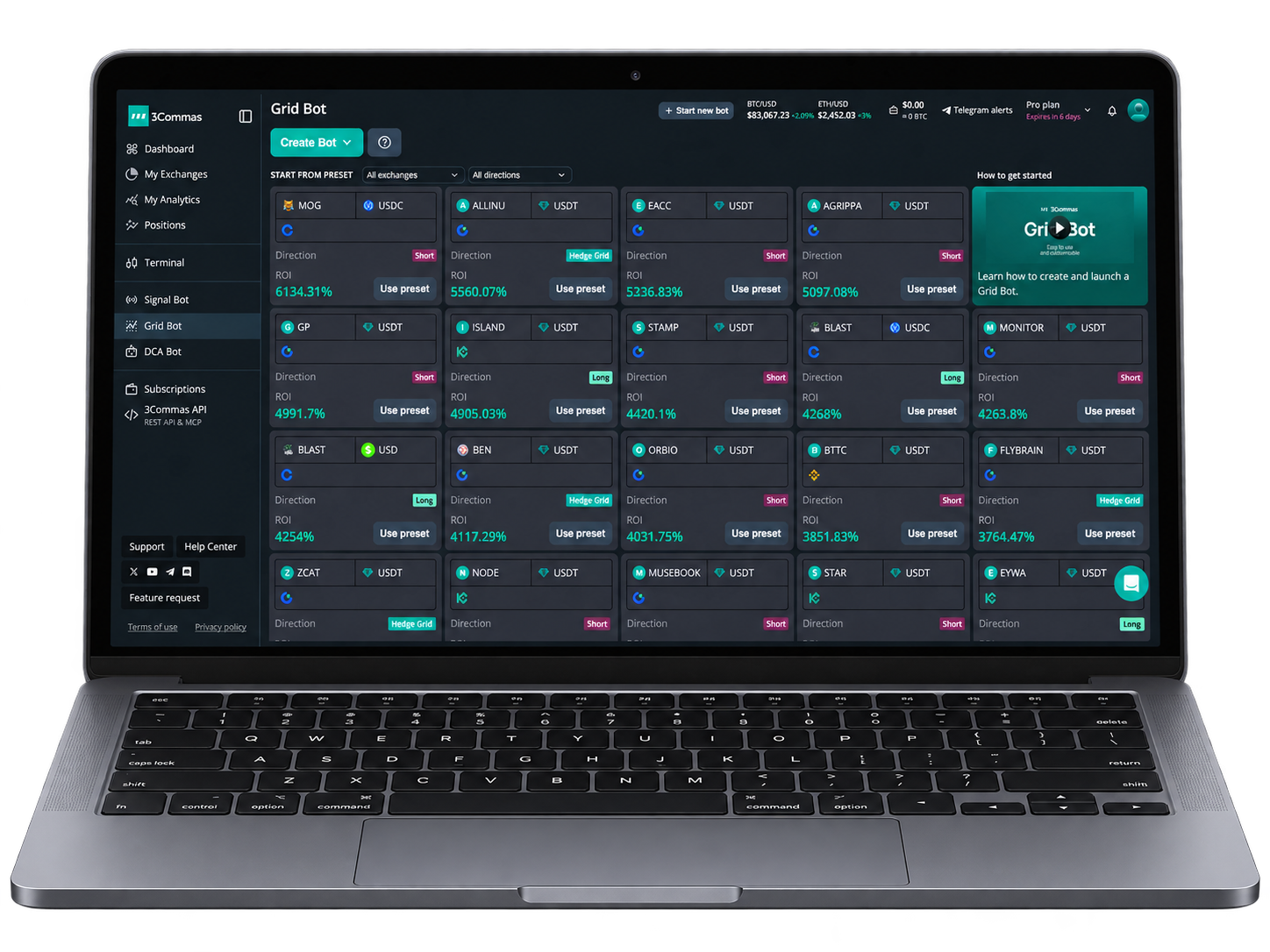
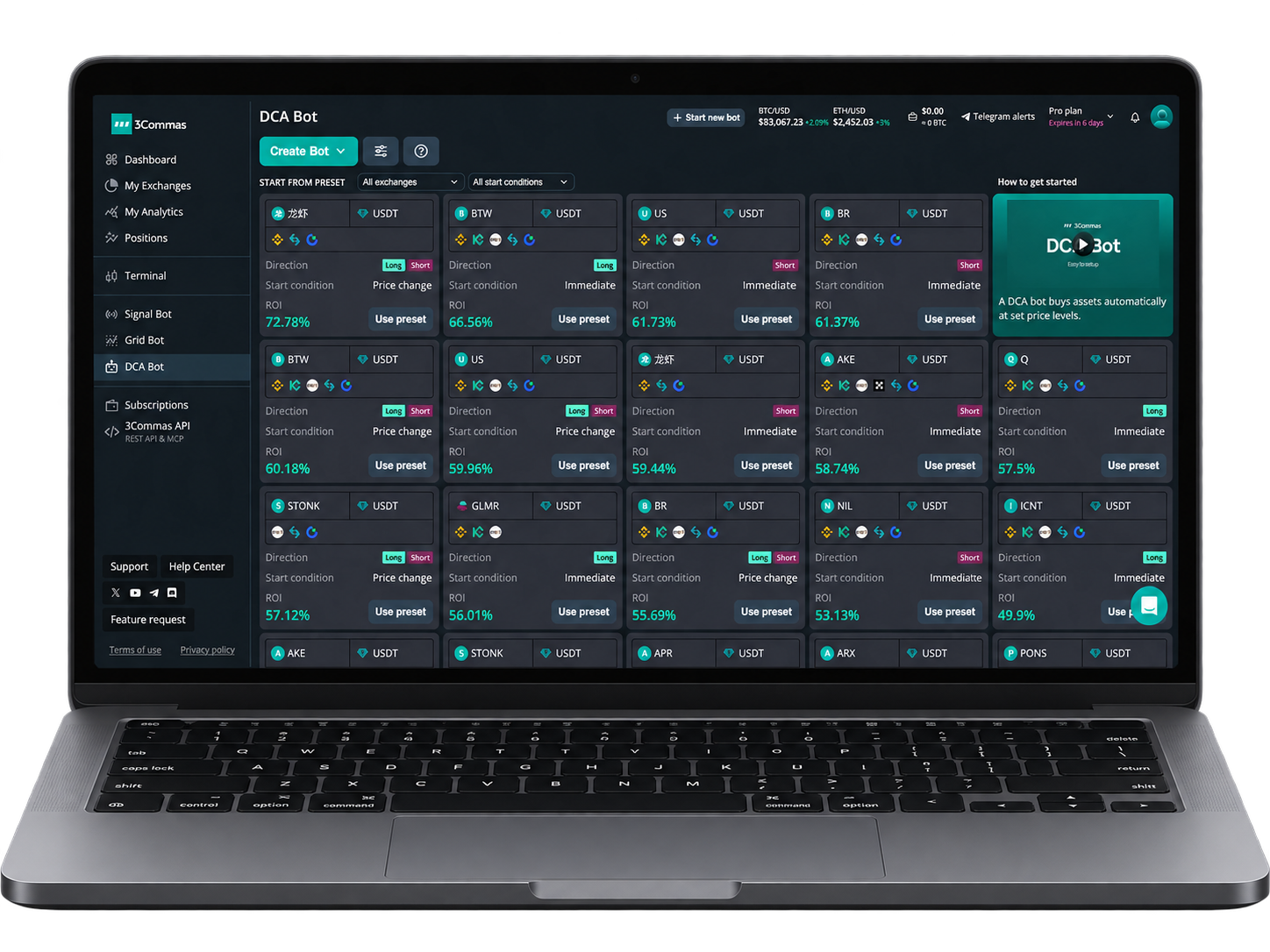
The V2 platform organizes automation around three principal bot categories. DCA Bots use configurable technical indicators and averaging rules to manage positions, Grid Bots execute orders across predetermined price intervals, and Signal Bots respond to external trading instructions from TradingView or supported API integrations. Traders can configure position sizes, take-profit targets, stop-loss conditions, trailing exits, and other risk controls according to the selected strategy and exchange capabilities.
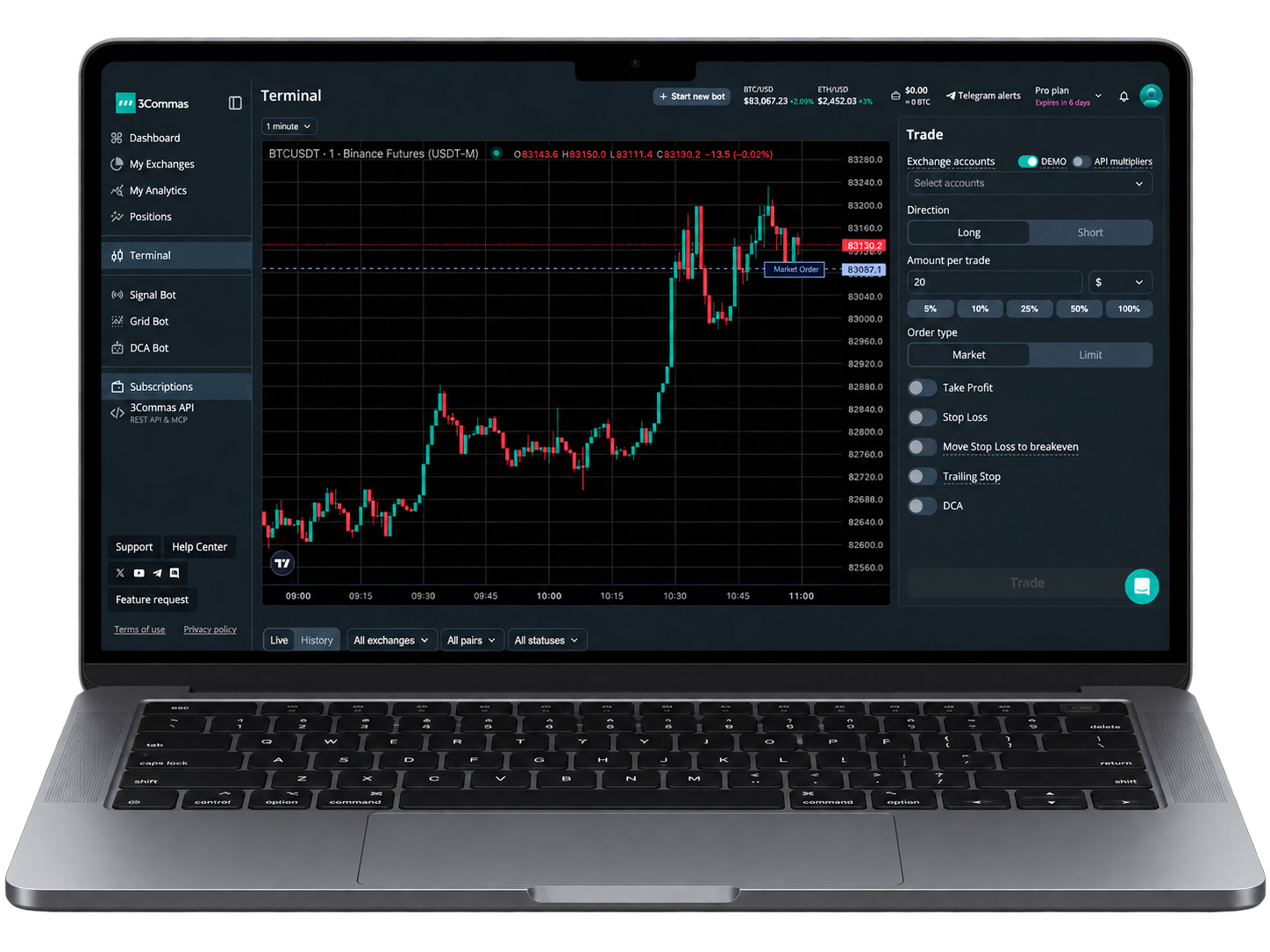
Manual trading is handled through the integrated Terminal, which combines TradingView charts with advanced order management. Its multi-API functionality allows traders to execute strategies across several connected exchange accounts and trading pairs without managing each position through a separate exchange interface. The platform also supports spot and eligible futures markets, including Hyperliquid integration, although supported instruments and advanced features depend on the connected exchange and subscription tier.
Strategy development is supported through historical backtesting for DCA and grid configurations, alongside demo trading using virtual funds and market data from supported exchanges. Backtesting helps evaluate how a strategy would have responded to previous market conditions, while demo trading provides an opportunity to examine execution behavior without risking actual capital. The current demo environment focuses on perpetual markets, and neither testing method can reproduce every liquidity condition, transaction cost, or execution delay encountered during live trading.
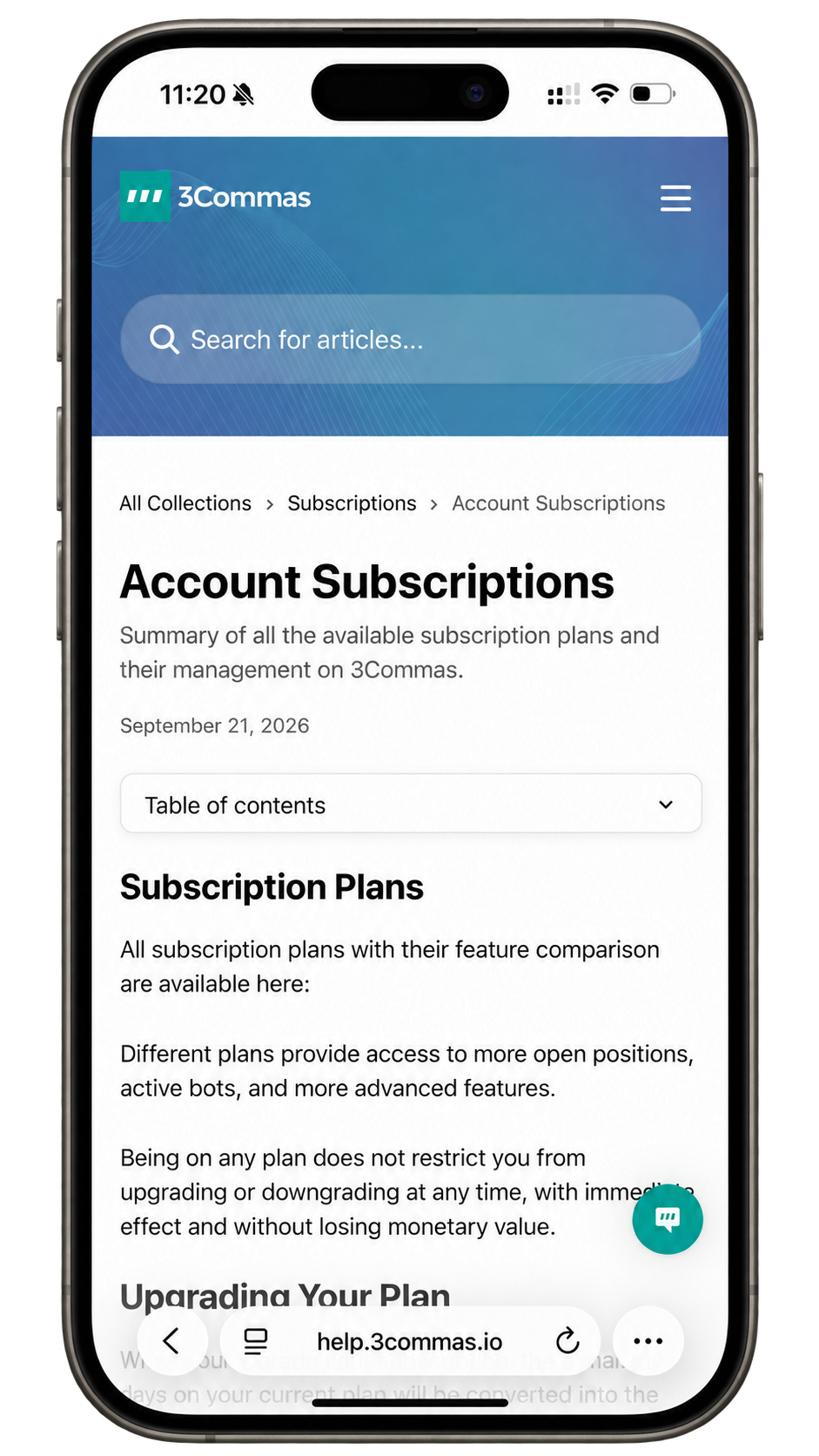
The platform is operated by Latvian company Wunderbit SIA under a license to use the 3Commas brand from 3Commas Technologies OÜ. Its subscription model includes Starter, Pro, and Expert plans with different limits on active trading accounts, bots, backtesting, and advanced functionality. The free account supports limited portfolio monitoring but does not provide live automated trading. These considerations make subscription selection an important part of evaluating the overall cost of automated cryptocurrency trading bots, particularly when exchange trading fees and potential strategy losses are considered separately.
Who Should Use 3Commas?
3Commas is best suited to intermediate and experienced cryptocurrency traders who want to automate established strategies, manage several exchange accounts, or execute TradingView signals without maintaining their own trading infrastructure. DCA traders benefit from configurable averaging and technical entry conditions, while grid traders can automate range-based execution and monitor results through historical analysis. More advanced users can combine external signals, multi-account execution, and detailed position controls to manage strategies across different markets.
Beginners can explore the platform through presets, backtesting, and demo trading, but effective automation still requires an understanding of position sizing, market liquidity, exchange fees, and risk management. The recurring subscription also makes 3Commas less attractive to investors who trade infrequently or hold small balances. Its greatest value comes from reducing the operational work involved in executing and monitoring strategies that traders already understand, rather than generating reliable profits through automation alone.
Trading Bots & Strategy
3Commas Trading Bots and Strategy Features
3Commas V2 combines DCA automation, grid trading, signal-based execution, and advanced order management within a unified trading environment. Each tool serves a different purpose, from accumulating positions during price declines to executing strategies built around technical indicators or external trading signals. The platform supports spot and eligible futures markets, with exchange compatibility, strategy limits, and available functionality determined by the connected account and subscription.
Its main advantage is the level of control available over strategy execution. Traders can configure entry conditions, position sizing, averaging orders, profit targets, and risk limits while monitoring activity across multiple connected exchanges. However, the flexibility also makes configuration important: a poorly designed averaging strategy or an incorrectly routed signal can create substantial exposure without requiring further manual confirmation.
DCA Bots: Automated Entries and Position Management
The 3Commas DCA Bot is designed to build and manage trading positions through an initial entry followed by additional orders under predefined conditions. Unlike conventional dollar-cost averaging, which usually involves investing fixed amounts at regular intervals, the platform’s trading-oriented DCA strategies can increase exposure when prices move against an existing position. Traders control the initial order size, maximum number of entries, price deviations, order-size multipliers, and exit conditions, allowing them to construct strategies for different market environments.
V2 supports two distinct averaging modes. Position Averaging uses an additional order equal to the initial entry before applying the configured order-size multiplier to subsequent entries. Order Averaging applies that multiplier beginning with the first additional order. Traders can also choose between Fixed Coin Amount, which maintains a specified quantity of the underlying asset, and Fixed Order Value, which allocates a defined amount of the quote currency. These settings influence how quickly capital is deployed and how aggressively the position grows during adverse price movements.
For example, a trader entering an ETH position at $3,000 could configure additional purchases at progressively lower prices. Each filled order increases the quantity held and reduces the average entry price, potentially allowing the position to reach its take-profit target after a smaller recovery. However, larger averaging orders also increase capital committed to a declining asset. A strategy using aggressive multipliers can consume its available balance much faster than the initial order size suggests, particularly during a sustained downtrend.
3Commas addresses this through a configuration summary showing the maximum price decline covered by the averaging structure, the estimated average-entry deviation, and the capital required if every configured order executes. These figures help traders assess whether a strategy can be funded without overcommitting their exchange balance. The maximum number of DCA orders also requires careful interpretation because the V2 setting includes the initial entry rather than counting only subsequent averaging orders.
Entry conditions can incorporate technical indicators such as RSI, MACD, Bollinger Bands, and price changes. V2 also supports combining up to five built-in indicators, with each condition evaluated according to its configured timeframe. Trades are initiated only when the selected conditions agree, allowing traders to construct more selective entries without developing a separate TradingView strategy. Multi-pair DCA bots can monitor up to 50 pairs under one configuration, with each market evaluated independently, although the same position-sizing and exit settings apply across the selected assets.
Exit management includes multiple take-profit targets, trailing exits, stop-loss controls, and breakeven adjustments. These options make the DCA Bot substantially more flexible than a simple recurring purchase tool, but they cannot compensate for an unsuitable strategy or insufficient capital. The risks associated with trading-oriented DCA strategies become especially significant when several correlated cryptocurrencies decline simultaneously and trigger additional orders across multiple positions.
Grid Trading Bots: Range-Based Spot and Futures Strategies
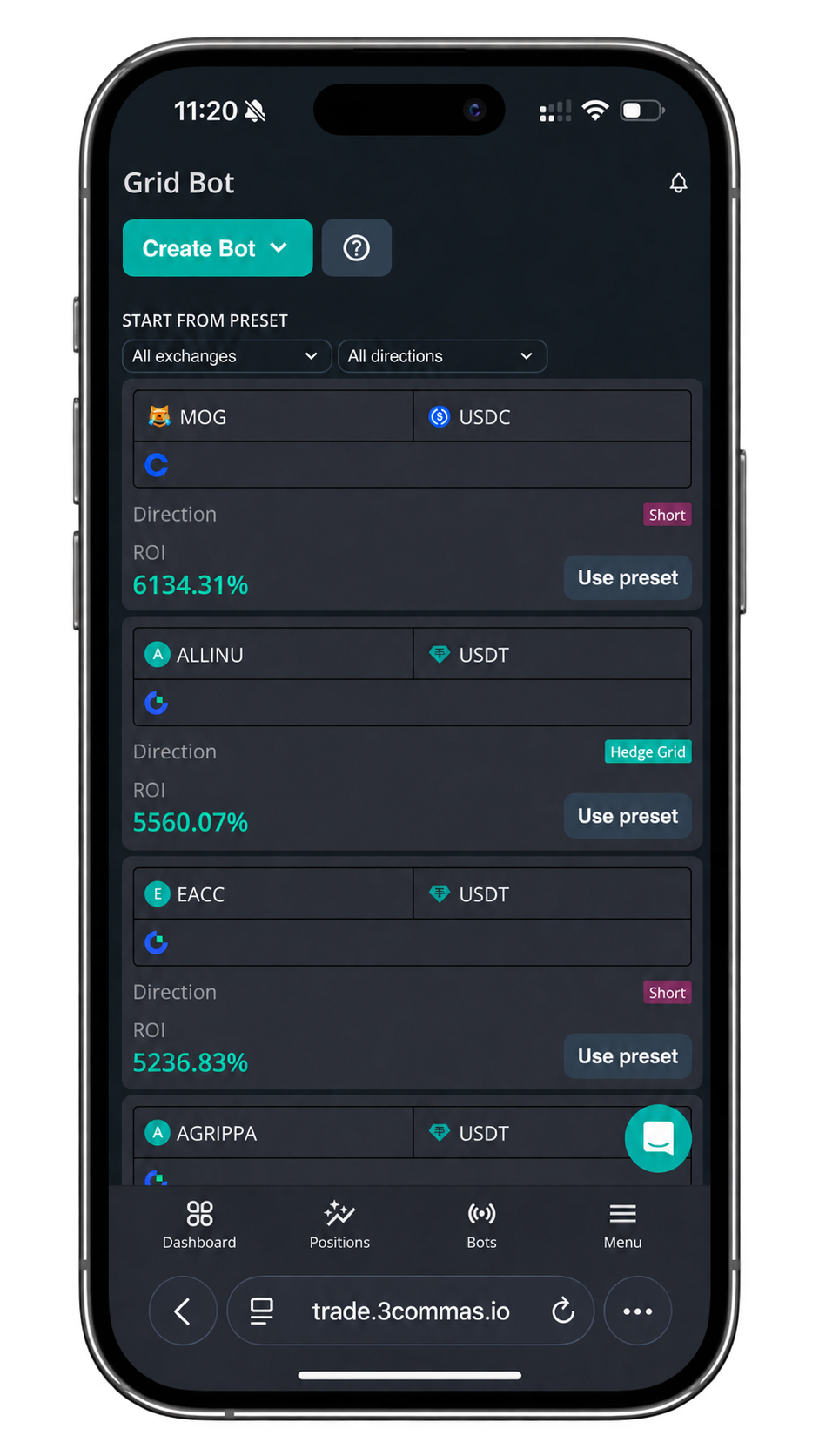
3Commas Grid Bots automate trading across predefined price intervals, placing orders as the market moves between selected levels. Traders establish a price range, determine the number and spacing of grid levels, and allocate capital to the strategy. Once active, the bot attempts to capture repeated price movements by opening and closing positions according to its configured structure, reducing the need to manually enter numerous smaller trades.
The platform supports spot and eligible futures grids, with different risk profiles. Spot strategies involve buying and selling the underlying cryptocurrency, making them suitable for traders who want to accumulate and distribute assets within an expected trading range. Futures grids operate through derivative positions and can introduce leverage, margin requirements, funding costs, and liquidation exposure. These differences become particularly important during sustained directional moves, when an otherwise profitable range strategy can accumulate substantial unrealized losses.
V2 provides multiple grid configurations, including long and neutral strategies, adjustable grid spacing, and tools for modifying the trading range as market conditions change. Trailing and expansion settings allow supported configurations to adjust their operating boundaries, while arithmetic and geometric spacing provide different ways to distribute orders. These features make grid automation more adaptable than a completely static collection of limit orders, although expanding a range does not guarantee that the strategy will remain profitable during a strong trend.
The Grid Bot also includes historical backtesting and parameter optimization. Traders can examine how a proposed configuration would have performed over recent market conditions, with visual information showing entries, exits, realized profits, and unrealized positions. The optimization feature compares alternative settings, including profit-per-grid parameters, and identifies configurations that performed favorably during the tested period.
Grid strategies are generally better suited to markets exhibiting repeated price fluctuations than assets moving persistently in one direction. A spot grid can continue holding depreciating cryptocurrency after prices move below its operating range, while a leveraged futures grid may face liquidation before a recovery occurs. Frequent execution also makes trading fees and spreads important. Small profits across many completed grid orders can be substantially reduced by costs, particularly when the selected market has limited liquidity.
Signal Bots and TradingView Integration
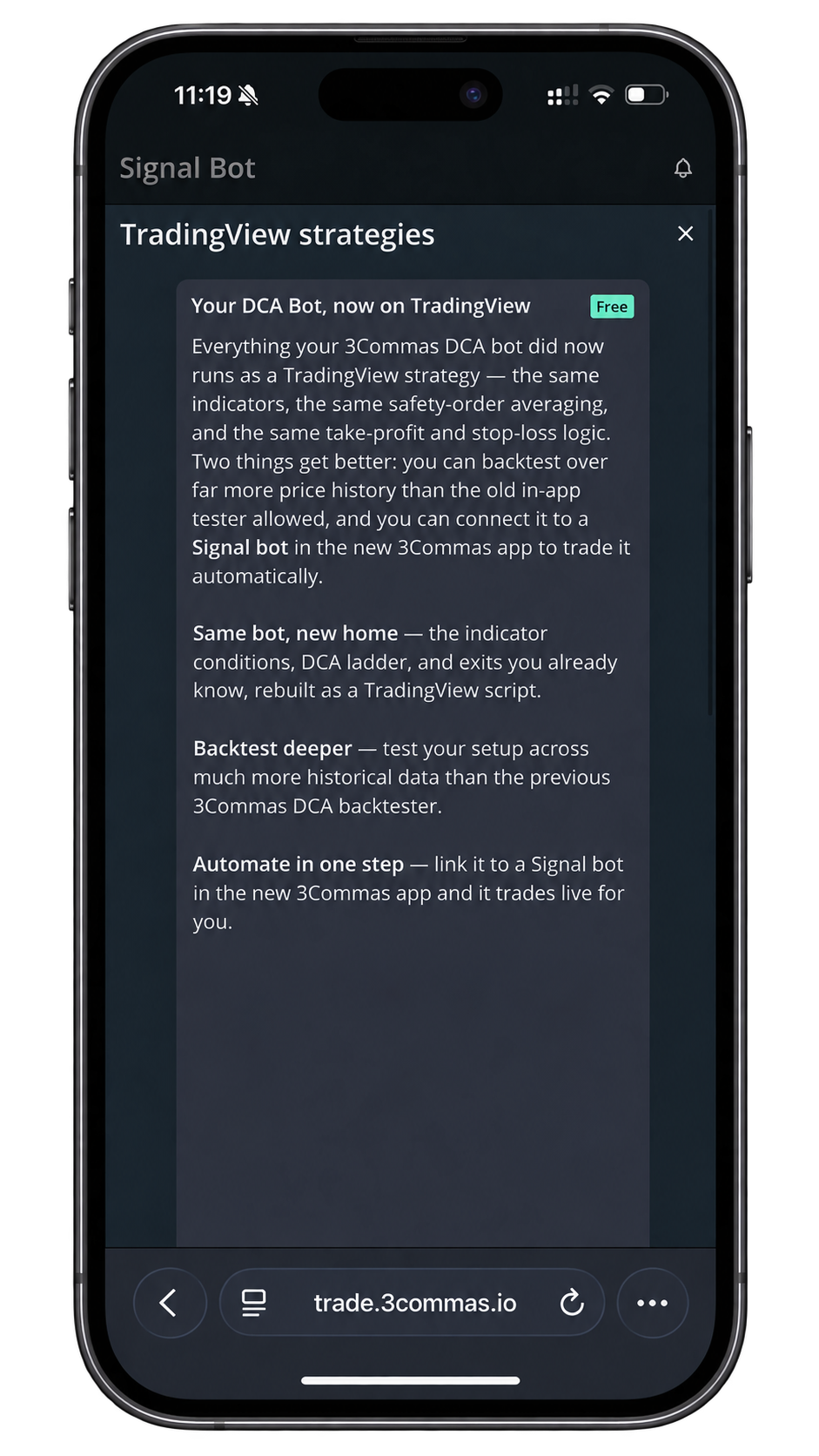
Signal Bots provide more advanced automation for traders who develop strategies through technical analysis, TradingView, or external systems. Instead of relying exclusively on built-in entry conditions, a Signal Bot receives instructions that can initiate positions, add exposure, reduce holdings, or close trades according to a predefined execution framework.
3Commas V2 supports signals from TradingView indicators, Pine Script strategies, API requests, and compatible third-party automation services. Traders can use standard configuration forms for common execution rules or enable JSON messaging to define more customized instructions. This makes it possible to connect external trading logic to exchange execution without developing a complete order-management system.
For example, a trader using a moving-average crossover strategy could configure a TradingView alert to trigger a long entry when a bullish condition occurs and a corresponding exit when the signal reverses. The analytical logic remains in TradingView, while 3Commas processes the received instruction and submits orders through the connected exchange API. Depending on the strategy, traders can also configure multiple entries, take-profit targets, stop losses, and futures-specific direction changes.
Multi-account execution is one of V2’s more substantial features. Signal Bots can distribute trading instructions across multiple connected exchange APIs, with individual account multipliers allowing position sizes to differ between accounts. The system supports configurations involving up to 50 APIs, subject to subscription limits and exchange compatibility, providing a way to coordinate strategies without recreating every trading instruction separately.
However, multi-pair Signal Bots require particular attention. Under the documented V2 configuration, an alert can trigger execution across all selected trading pairs simultaneously rather than independently targeting a single pair. Traders expecting separate BTC, ETH, and SOL signals must account for this behavior when designing their automation. It differs from the standalone DCA Bot’s multi-pair monitoring, where selected markets can independently satisfy indicator conditions.
Signal Bots are particularly useful for experienced traders with established strategies, although execution quality remains dependent on the signal source, exchange liquidity, API connectivity, and the accuracy of the configuration. A valid TradingView alert does not guarantee a profitable trade, and network delays or insufficient balances can produce results that differ from those expected by the underlying strategy.
Trading Terminal and Advanced Order Management
The 3Commas Trading Terminal provides manual trade execution with additional controls normally associated with more sophisticated trading interfaces. It integrates TradingView charts with order-entry functionality, allowing users to establish positions, configure exits, and monitor execution through one environment while retaining assets on their connected exchanges.
Traders can place market and limit orders, configure up to ten take-profit targets, and apply stop-loss instructions based on the original entry or average position price. Additional controls include trailing stops, breakeven adjustments, and optional DCA averaging. These features allow discretionary traders to structure position management before entering a trade rather than manually adding orders as market conditions change.
V2 also supports Multi-API, Multi-Exchange, and Multi-Pair execution through the Terminal. A trading instruction can be distributed across selected accounts, with position sizing adjusted through account-specific multipliers. The Terminal supports up to ten trading pairs within a configured execution workflow, enabling coordinated trading across several markets without entering every order separately.
This functionality is particularly useful for traders managing multiple exchange accounts or implementing a consistent strategy across several portfolios. However, account-specific balances, contract specifications, leverage restrictions, and available order types can affect execution. The same instruction may produce different fills or require different margin allocations across connected exchanges.
Risk controls also depend on where orders are maintained. For supported integrations, certain take-profit and stop-loss instructions can be submitted as exchange-side conditional orders, while other configurations rely on 3Commas continuing to manage the strategy. Traders should verify the execution method rather than assuming every protective instruction remains active independently of the platform. Stop orders are also exposed to slippage during sharp market movements, and reduce-only settings are important when managing leveraged positions to avoid unintentionally increasing or reversing exposure.
Backtesting, Optimization, and Demo Trading
3Commas provides historical testing and simulated trading tools designed to help users evaluate strategy configurations before deploying real capital. DCA backtesting examines how selected entry, averaging, and exit parameters would have performed against historical market data, while Grid Bot testing evaluates order execution and profitability within the chosen trading range. Available backtesting periods and monthly usage limits depend on the subscription, with higher tiers providing access to longer DCA histories and more testing runs.
DCA backtesting can report realized and unrealized profit and loss, completed trades, drawdowns, win rates, and risk-adjusted performance measures. These statistics provide useful context beyond the headline percentage return. A strategy showing frequent profitable exits may still carry substantial unrealized losses if averaging orders accumulate during adverse price movements. Maximum drawdown and capital utilization can therefore reveal risks that are less apparent from a high win rate.
Grid optimization offers another form of analysis by testing alternative parameters against historical price action. This can help identify whether a proposed trading range was wide enough to accommodate volatility or whether transaction frequency would have been excessive. However, settings optimized for recent conditions can deteriorate rapidly when the market enters a different trend or volatility regime.
Demo trading provides an opportunity to observe automated execution without putting real funds at risk. It is particularly useful for checking whether signals arrive correctly, orders follow the intended configuration, and stop-loss or take-profit instructions behave as expected. Nevertheless, simulated performance may not fully reproduce live spreads, partial fills, exchange delays, funding expenses, or liquidity shortages.
For serious strategy development, backtesting and demo trading are most useful when combined with realistic assumptions about execution costs and capital exposure. A successful historical test can demonstrate that a configuration performed well under particular conditions, but only disciplined live monitoring can establish whether those results remain achievable as market behavior changes.
Supported Exchanges
Supported Cryptocurrency Exchanges
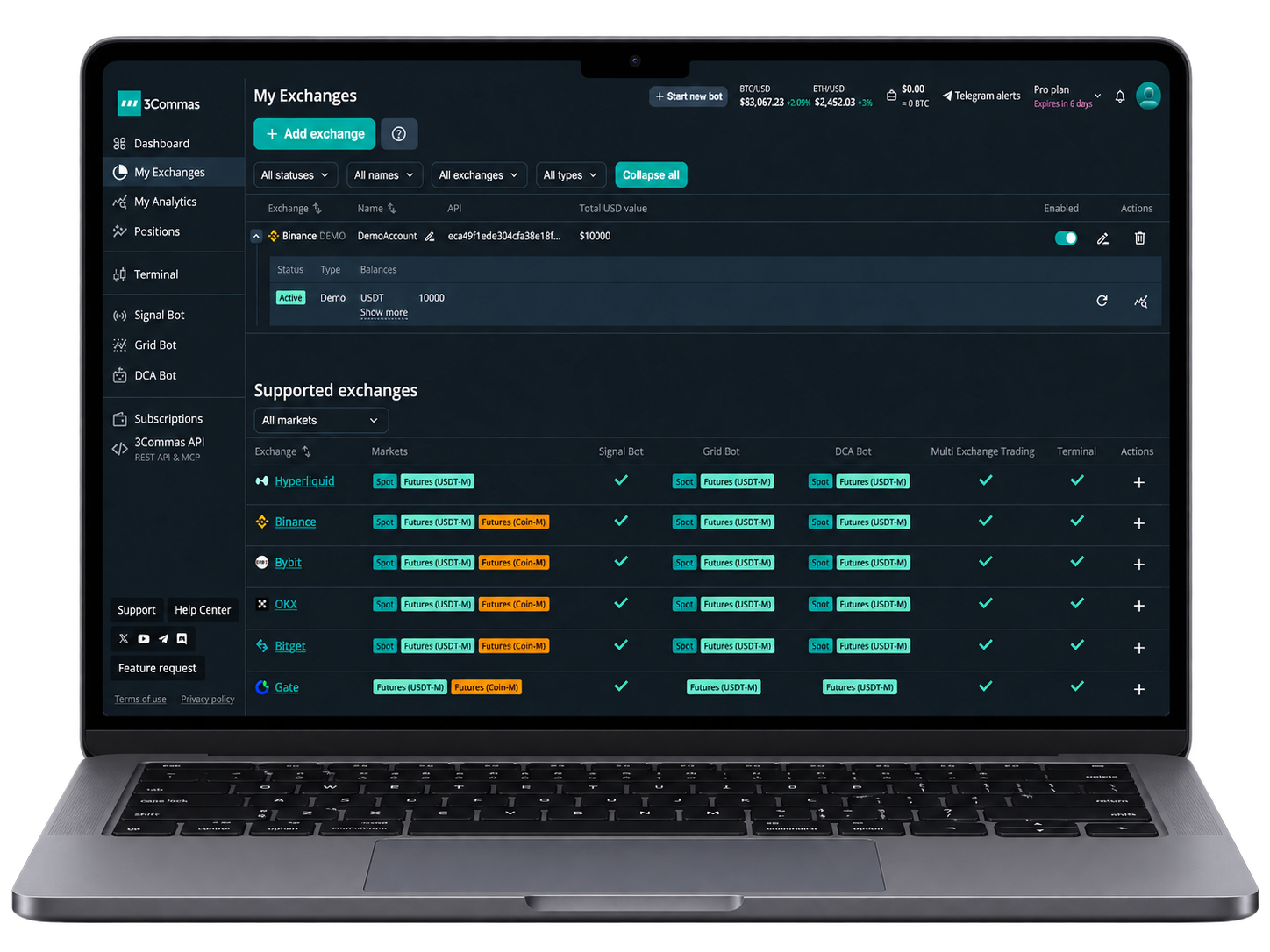
Multi-exchange connectivity is one of 3Commas V2’s strongest features, allowing traders to manage automated strategies across several trading platforms without maintaining separate bots for every account. Its current integrations include Binance, Bybit, OKX, Kraken, KuCoin, Coinbase, Bitget, Gate, and Hyperliquid. This selection covers major centralized spot and derivatives markets alongside decentralized trading through Hyperliquid, giving traders considerable flexibility when choosing where their strategies execute.
Exchange compatibility varies by market and trading tool. Certain integrations support both spot and futures trading, while others have restrictions affecting available contracts, order types, margin settings, or bot functionality. Hyperliquid also requires a different connection process, using wallet-based authorization rather than conventional centralized exchange API credentials. Regional restrictions can further limit functionality, particularly for European traders using regulated derivatives products. Traders should confirm that their intended market and strategy are supported before connecting an account, since exchange integration does not guarantee access to every feature.
A particularly useful addition in V2 is Multi-Exchange and Multi-API trading, which allows a single Signal Bot to execute instructions across multiple connected accounts. The documented configuration supports up to 50 API connections, 10 exchanges, and 10 exchange-specific trading-pair slots within a single Signal Bot or Terminal. Trading pairs are counted once per exchange, even when several API accounts use the same market. This makes it possible to distribute a TradingView strategy across different portfolios or exchange accounts without duplicating the entire configuration.
The flexibility is valuable for traders managing multiple strategies, although identical signals can produce different execution prices, fees, and position exposures across exchanges. Running one leveraged strategy through several accounts can also magnify losses rather than provide diversification. Proper API permissions, exchange-specific position sizing, and regular monitoring remain essential when automating trades across multiple venues.
Pricing & Plans
3Commas Pricing and Subscription Plans
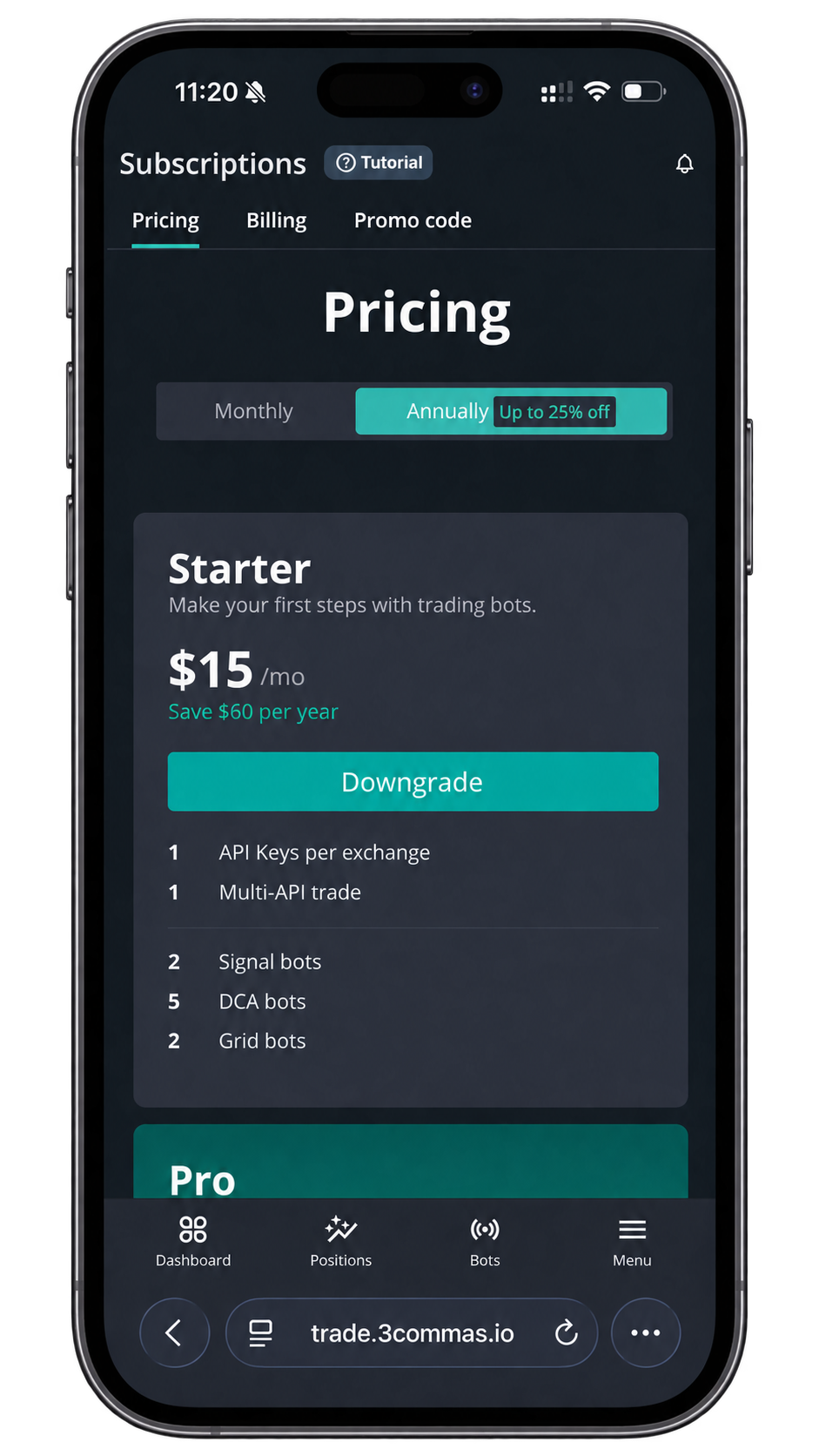
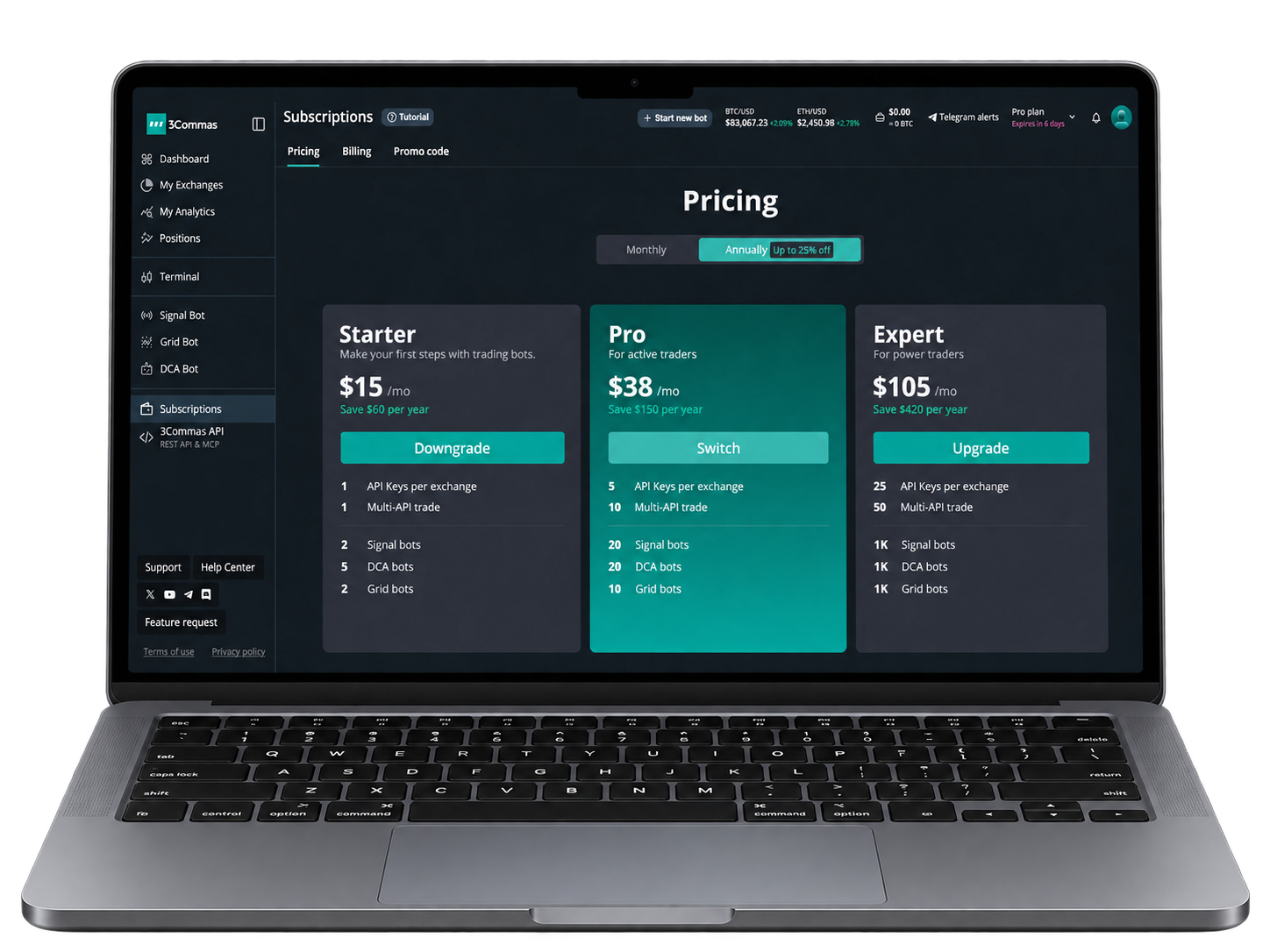
3Commas offers three paid subscriptions: Starter, Pro, and Expert, with prices ranging from $20 to $140 per month. Each plan includes access to DCA, Grid, and Signal Bots, TradingView webhook execution, backtesting, and demo trading. The main differences are the number of strategies users can operate simultaneously, active exchange API connections, and access to futures trading and developer tools.
Annual billing reduces subscription costs, although trading commissions charged by connected exchanges remain separate. Traders should also consider strategy-related expenses such as derivatives funding, slippage, and any paid external signal services.
3Commas Pricing Comparison
| Plan | Monthly Price | Annual Billing (Monthly Equivalent) | Active Trading Accounts | Active DCA / Signal / Grid Bots |
|---|---|---|---|---|
| Starter | $20 | $15 | 1 | 5 / 2 / 2 |
| Pro | $50 | $38 | 3 | 20 / 20 / 10 |
| Expert | $140 | $105 | 15 | 1,000 / 1,000 / 1,000 |
💡 Prices are advertised in USD. Annual rates represent monthly equivalents when paying for a full year upfront. Taxes, regional currencies, promotional discounts, and final subscription terms may differ. Published active-account allowances have not been entirely consistent across 3Commas materials, so the limits displayed at checkout should be confirmed before subscribing.
Starter Plan: $20/Month
Starter is intended for traders automating spot strategies through a single active exchange account. It supports five DCA Bots, two Signal Bots, and two Grid Bots, alongside up to 10 active SmartTrades. Users also receive access to TradingView webhook execution, technical indicators, trailing exits, and strategy backtesting, making it possible to configure more sophisticated trading rules without upgrading immediately.
The main restrictions concern trading capacity rather than the availability of core bot functionality. Starter does not support futures automation, and its single active API connection limits users who trade through multiple exchange accounts. For an individual operating a handful of spot strategies, however, the plan provides most of the essential execution features at a relatively accessible subscription price.
Pro Plan: $50/Month
Pro expands 3Commas into multi-account automation and supported futures trading. It increases capacity to 20 DCA Bots, 20 Signal Bots, and 10 Grid Bots, with up to 100 simultaneous active DCA trades and 100 Signal Bot trades. Traders also receive increased backtesting allowances, 50 active SmartTrades, and access to advanced futures execution functionality.
The additional capacity is particularly useful for investors running multiple strategies across different markets or maintaining separate spot and derivatives accounts. Pro also supports more extensive position management, allowing users to distribute strategies without immediately exhausting their bot allocations. However, exchange connectivity and available order types remain dependent on the integrations supported by 3Commas and the exchanges themselves.
At $50 per month, Pro represents the most practical subscription for experienced individual traders who actively use futures automation or need several strategies running simultaneously. Its value is considerably weaker for someone operating only one or two basic spot bots, where Starter may already provide sufficient functionality.
Expert Plan: $140/Month
Expert is designed for traders operating large numbers of automated strategies or integrating 3Commas into more sophisticated trading infrastructure. It supports up to 1,000 active bots in each of the DCA, Signal, and Grid categories, alongside substantially higher concurrent-trade and backtesting allowances. The plan also provides expanded exchange-account capacity and priority live chat support.
A significant difference is read-and-write developer API access, which allows supported external applications to perform trading-related actions through 3Commas. Starter and Pro provide read-only developer API access, making Expert more suitable for technically advanced users who need to integrate custom software with the platform’s execution infrastructure.
The $140 monthly cost is difficult to justify for ordinary retail strategies. Expert makes considerably more sense for traders managing numerous accounts, substantial automation workloads, or software integrations that require higher execution capacity. Users whose requirements exceed its published limits can request a custom subscription, although pricing and availability depend on individual arrangements.
Free Access, Trials, and Billing Conditions
3Commas provides a free account for limited portfolio monitoring, but live automated trading requires a paid subscription. The Free plan supports up to two exchange connections for tracking purposes and includes limited AI Assistant access. New customers can also access a seven-day trial of Starter, Pro, or Expert, subject to providing valid payment details and the applicable trial conditions.
Monthly subscriptions generally renew automatically when purchased through supported card or payment services, unless recurring billing is canceled. Cryptocurrency-paid subscriptions follow different renewal arrangements. European users may see prices quoted in euros with VAT included, while promotional discounts and payment options vary by location.
Before subscribing, traders should verify the number of active exchange API connections included in their plan, particularly when operating multiple exchange subaccounts. Connected accounts used only for portfolio tracking do not necessarily consume active trading slots, while separate API credentials used for executing orders generally count individually.
Is 3Commas Worth the Money?
3Commas offers considerable value for traders who already have defined strategies and need reliable automation across supported exchanges. Its DCA, Grid, and Signal Bots can reduce repetitive order management, while TradingView integration, backtesting, and centralized position controls make it easier to operate multiple strategies without developing proprietary execution software.
However, subscription costs represent a recurring expense regardless of whether trading strategies generate profits. Pro costs $600 annually when paid monthly, before exchange trading fees, funding charges, and other execution expenses. For a trader managing a $2,000 account, that is a substantial operating cost relative to the capital deployed. Larger portfolios or traders running several well-defined strategies may find the expense easier to justify, particularly when automation meaningfully reduces manual intervention.
Higher subscription tiers should be selected according to actual execution requirements rather than advertised bot capacity. Futures access, active API connections, concurrent positions, and developer permissions are the most important differences between plans. Paying for hundreds of unused bots provides no advantage, and increasing the number of automated strategies can amplify losses when their market exposures overlap.
Pro offers the strongest balance of functionality and cost for experienced traders using multiple strategies or futures markets, while Starter is sufficient for smaller spot-trading setups. Expert is primarily justified by extensive automation requirements or external software integration. In every case, the subscription is worthwhile only when the operational benefits and trading results justify the full cost, including fees charged by the connected exchanges.
Security & UX
3Commas Security: Is It Safe?
3Commas operates through a non-custodial trading model, allowing users to automate cryptocurrency transactions without transferring assets directly to the platform. Funds remain on connected exchanges, while 3Commas uses API credentials to submit orders according to the trader’s configured strategies. The current service, operated by Wunderbit SIA, is designed to function with trading permissions and without withdrawal access. API credentials are stored in encrypted form, limiting their exposure during storage and transmission.
This arrangement reduces direct custody risk but does not eliminate the consequences of compromised API credentials. An attacker with unauthorized trading access could potentially open unfavorable positions, execute trades against thin order books, or expose a derivatives account to liquidation without withdrawing cryptocurrency directly. Exchange-level controls are therefore particularly important. Users should enable two-factor authentication, restrict API permissions to the required trading functions, and apply IP allowlisting wherever the exchange supports it. Dedicated subaccounts provide another useful safeguard by separating automated strategies from the trader’s primary holdings and limiting the capital exposed to a compromised connection or malfunctioning bot.
The platform’s historical security record also deserves consideration. In December 2022, the original 3Commas business confirmed the exposure of customer API credentials, including API keys, secrets, and passphrases. The incident created opportunities for unauthorized trading on connected exchange accounts and resulted in recommendations to revoke affected credentials. Although the current 3Commas V2 service operates under Wunderbit SIA and follows its own security and contractual arrangements, the earlier disclosure remains relevant when assessing the brand’s history. It should not, however, be presented as evidence that the current platform has experienced the same compromise.
Effective security also depends on how automated strategies are configured and monitored. A correctly secured API connection cannot prevent excessive leverage, poorly designed averaging rules, or repeated orders during unfavorable market conditions. Traders should establish position limits, define conditions for stopping automation, and review exchange permissions regularly. Separating API credentials across strategies and revoking unused connections can further reduce unnecessary exposure. These precautions form the foundation of a secure crypto trading bot deployment, particularly when managing substantial balances or several exchange accounts.
Overall, 3Commas V2 provides a practical security model for third-party trading automation through non-custodial execution, encrypted credentials, and exchange-controlled API permissions. Its protection ultimately depends on the strength of the connected exchange accounts, careful credential management, and the financial limits applied to automated strategies. Traders should regard API security and trading risk as separate responsibilities rather than assuming that disabling withdrawals makes an automated account immune to losses.
Ease of Use and Trading Experience
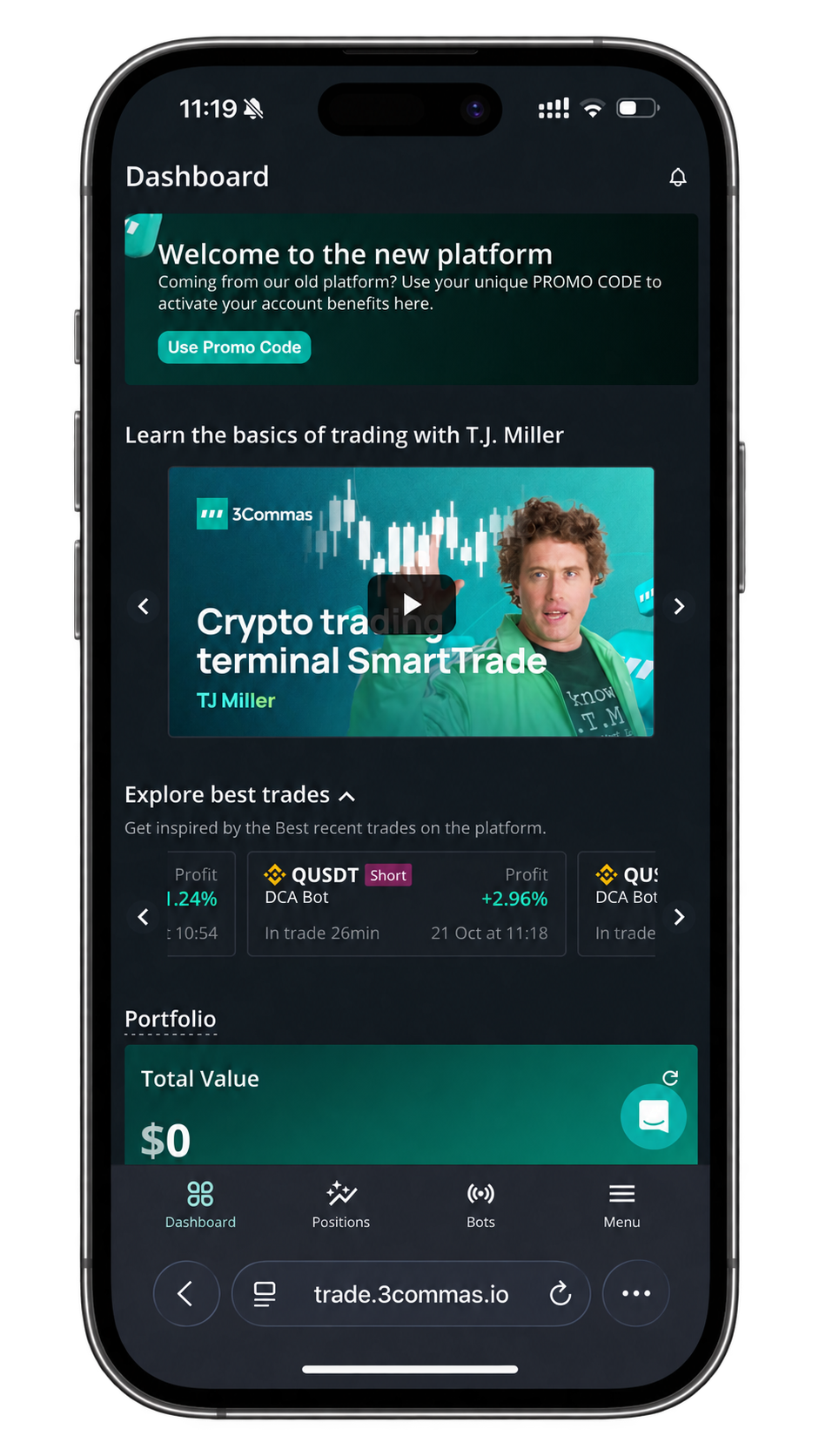
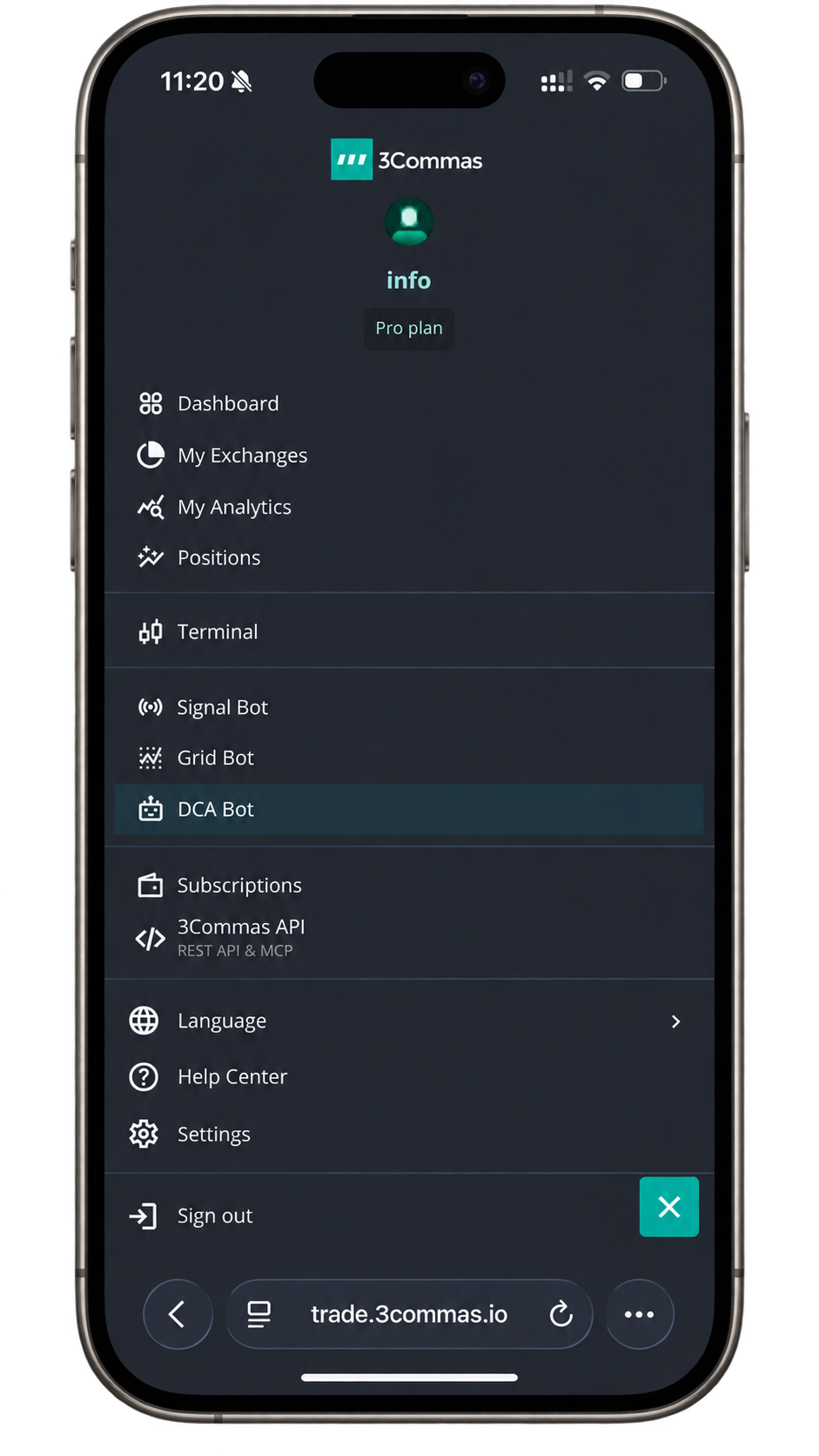
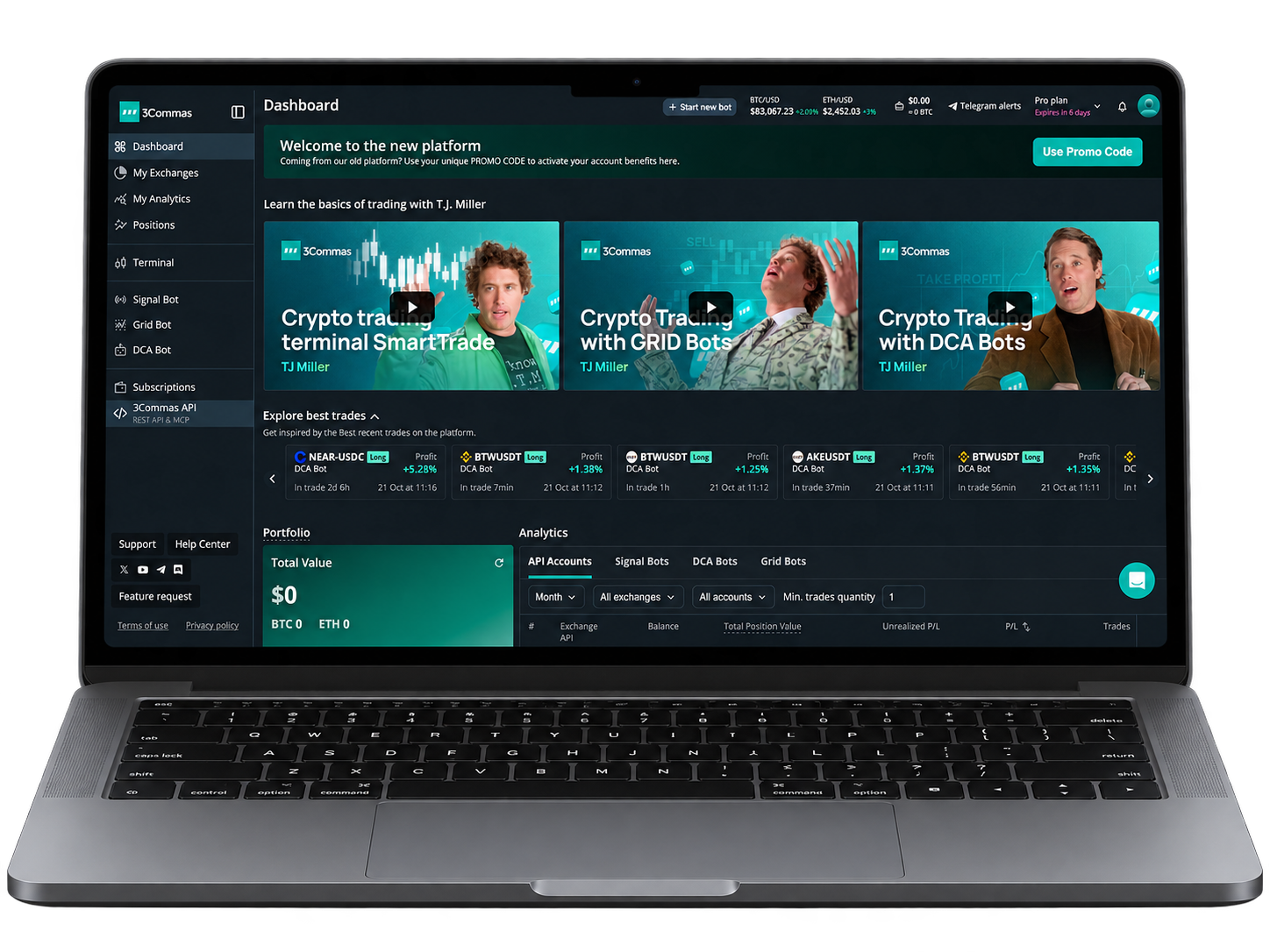
3Commas V2 combines several advanced automation tools within a relatively accessible interface, allowing traders to manage DCA bots, grid strategies, TradingView signals, and exchange accounts from one platform. The dashboard provides an overview of connected balances and trading activity, while dedicated bot-management sections make it possible to configure strategies, monitor positions, and adjust automation without navigating separate exchange terminals. Its integrated TradingView charts and trading terminal are particularly useful for users who want technical analysis and order execution within the same workflow.
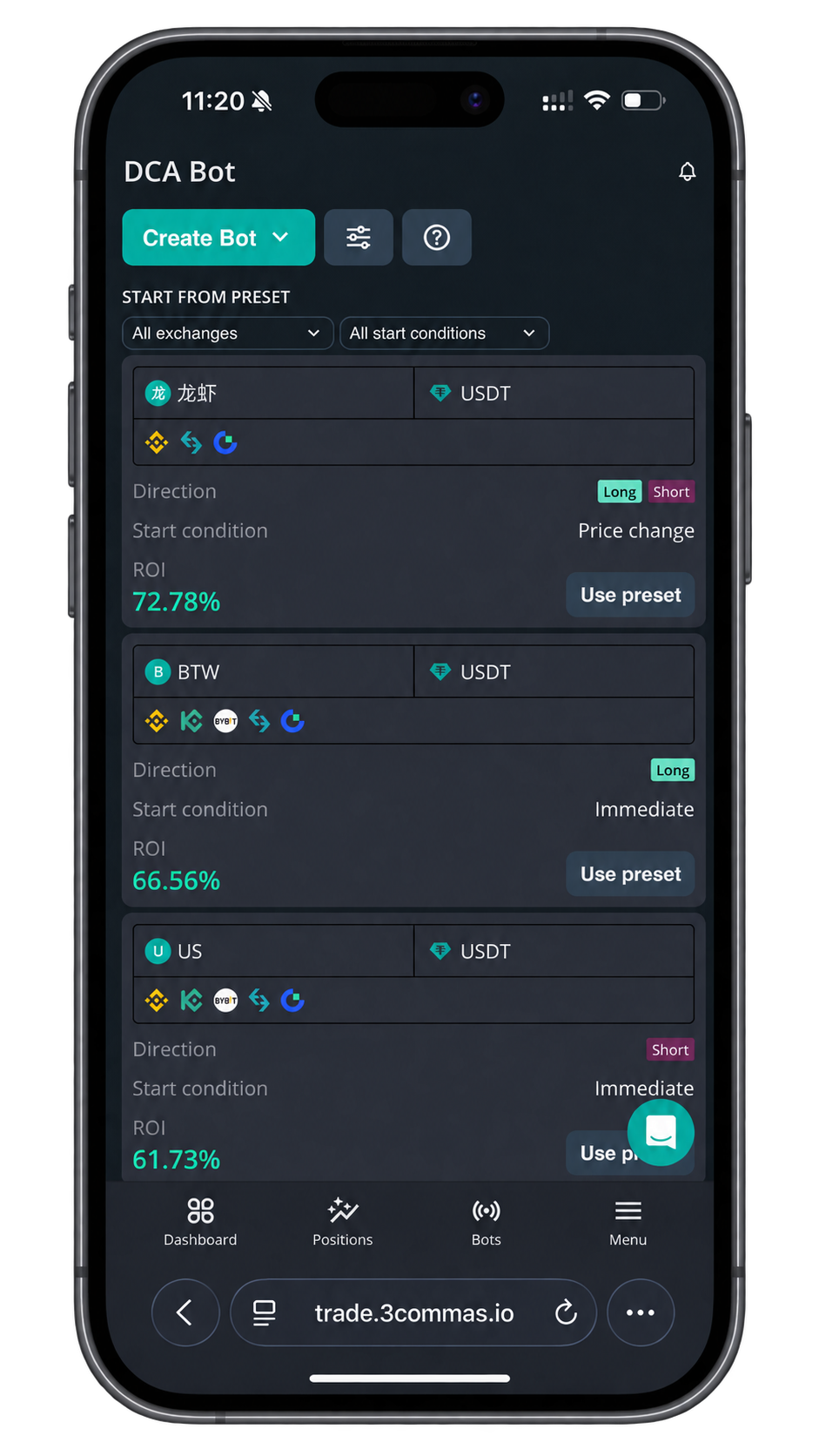
Initial setup involves connecting a supported exchange, configuring the appropriate API permissions, and choosing a trading strategy. DCA Bot presets simplify configuration by providing predefined parameters that users can review and modify before activation. Traders can also examine historical backtesting metrics, including returns, annualized performance estimates, and maximum drawdown, to understand how a particular configuration behaved under earlier market conditions. However, strong historical results do not establish future profitability, particularly when a strategy depends on price ranges, volatility, or liquidity conditions that may not persist.
The platform also supports demo trading with virtual funds and market data from selected exchanges. This provides an opportunity to explore bot settings, test entry and exit conditions, and understand how strategies respond to changing prices before committing real capital. Demo execution remains a simulation, however, and may not reproduce the exact slippage, partial fills, liquidity constraints, and execution delays encountered in live markets. My Analytics complements these tools by consolidating performance information across connected APIs, DCA bots, Grid Bots, and Signal Bots, helping traders examine results and identify strategies that require adjustment.
More experienced users can configure Signal Bots to respond to TradingView indicators, trading strategies, API requests, and supported external automation services. The platform also allows supported Signal Bot and Terminal configurations to operate across multiple exchange connections, with individual account multipliers and trading parameters. This functionality is valuable for traders managing several portfolios, although coordinating multiple automated accounts requires careful attention to capital allocation, exchange differences, and correlated positions. An incorrect signal or position-sizing rule can affect several accounts simultaneously when the same strategy is distributed across them.
The principal usability limitation is the complexity of strategy configuration rather than basic navigation. DCA multipliers, additional entry orders, stop-loss conditions, leverage, and simultaneous positions can interact in ways that substantially change a strategy’s risk. Presets and demo trading reduce the initial learning curve, but users still need to understand the rules governing each bot before enabling live execution. 3Commas V2 is most effective for traders who already have a defined strategy and want to automate its execution, rather than beginners expecting the software to determine when and how to trade profitably.
Preview
3Commas vs Competitors
3Commas vs Cryptohopper, WunderTrading, QuadTerminal, and HaasOnline
3Commas competes with cryptocurrency trading automation platforms that differ considerably in strategy development, execution controls, exchange connectivity, and pricing. Its current v2 platform focuses on configurable DCA, grid, and Signal Bots, allowing traders to automate established strategies without developing custom trading software. Cryptohopper offers a marketplace-driven approach to strategy creation, WunderTrading provides similar automation with a free live-trading tier, QuadTerminal combines portfolio management with AI-assisted strategy development, and HaasOnline emphasizes advanced algorithmic trading through its HaasScript environment.
The most relevant differences concern how strategies are created, how many bots and exchange accounts can operate simultaneously, and which tools are included in each subscription. All five platforms support exchange-connected automation, but their configuration requirements and operating costs make them suitable for different types of traders.
| Platform | Main Strength | Starting Price | Best Suited For |
|---|---|---|---|
| 3Commas v2 | DCA, grid, Signal Bots, and multi-account execution | $20/month; $15/month with annual billing | Traders automating established strategies across supported exchanges |
| Cryptohopper | Strategy Designer, marketplace signals, Copy Bots, and backtesting | $29/month; $24.16/month with annual billing | Traders interested in marketplace strategies and no-code automation |
| WunderTrading | DCA, grid, signal automation, and extensive exchange integrations | Free live-trading plan; paid upgrades | Budget-conscious traders and users managing multiple API connections |
| QuadTerminal | Unified trading terminal, portfolio monitoring, and Cody AI | Free and paid subscriptions | Traders combining manual execution, portfolio oversight, and AI-assisted automation |
| HaasOnline | HaasScript, advanced backtesting, and self-hosted execution | From $11.99/month equivalent with qualifying annual crypto payment | Experienced algorithmic traders and strategy developers |
Prices reflect published October 2026 offerings. Annual-equivalent prices require prepaid subscriptions, and exchange trading fees remain separate. The QuadTerminal pricing structure should be confirmed at checkout.
3Commas vs Cryptohopper
Cryptohopper offers a broader strategy-discovery environment, combining automated trading with a marketplace for templates, technical strategies, trading signals, and Copy Bots. Its Strategy Designer allows users to build rule-based systems without programming, while backtesting and paper trading provide opportunities to evaluate configurations before committing capital. The platform is particularly attractive to traders who want to experiment with different indicator combinations or explore externally developed strategies rather than configure every entry and exit rule independently.
Cryptohopper’s subscriptions start at $29 per month for Explorer, increasing to $69 for Adventurer and $129 for Hero. Higher tiers expand the number of tradable assets, simultaneous positions, and strategy-checking frequency. Hero also adds more advanced capabilities, including AI-assisted strategies, market making, and arbitrage tools. However, each standard trading-bot subscription includes one live bot and one paper-trading bot, meaning users who want several independently configured live bots may need additional subscriptions. Marketplace purchases and Copy Bot subscriptions can also introduce costs beyond the main plan.
3Commas v2 takes a more execution-oriented approach, with dedicated DCA, grid, and Signal Bots that can operate simultaneously within the limits of the selected subscription. Its Starter plan provides five active DCA Bots, two Signal Bots, and two Grid Bots on a single active exchange API connection, while the Pro and Expert tiers expand bot capacity and support additional connections and futures trading where available. Traders who already have defined strategies may find this structure more practical than purchasing marketplace content or maintaining separate subscriptions for individual bots.
Cryptohopper is particularly compelling for strategy exploration, marketplace signals, and no-code development. 3Commas is better suited to traders who want to deploy and manage multiple predefined automation strategies through a structured bot environment, especially when their requirements involve DCA execution, grid trading, and TradingView-generated signals.
3Commas vs WunderTrading
WunderTrading is the closest alternative to 3Commas v2 because the platforms share underlying technology through the current service arrangement. The new 3Commas trading platform was developed in partnership with WunderTrading and is operated by Wunderbit SIA, the Latvian company responsible for providing the v2 service under the 3Commas brand. Consequently, both platforms offer similar foundations for DCA strategies, grid trading, signal-based execution, and multi-account trading, making the differences in subscription allowances and supported integrations especially important.
WunderTrading’s strongest pricing advantage is its free live-trading plan, which includes one DCA Bot, one Grid Bot, and one Signal Bot. It also permits multiple exchange API connections and provides access to its trading terminal, demo environment, and supported TradingView automation features. The platform advertises more than 18 exchange integrations, with paid subscriptions offering substantially larger bot allowances, Multi-API execution, and additional strategy tools. Its Premium benefits are also available without a separate subscription for eligible users trading on Hyperliquid through WunderTrading, subject to the platform’s applicable conditions.
3Commas v2 organizes its automation offering around three paid tiers. Starter costs $20 monthly, while Pro and Expert are priced at $50 and $140 per month before annual discounts. The Pro tier expands access to spot and futures automation and supports several active API connections, while Expert provides significantly higher bot limits and additional developer functionality. These subscription limits matter more than the shared technology foundation because they determine how many strategies can run simultaneously and how much exchange activity can be managed under one account.
For traders experimenting with a small number of live strategies, WunderTrading offers a clear cost advantage through its free plan. Its broader advertised exchange coverage also deserves consideration when a trader uses several venues. 3Commas v2 remains attractive for users who prefer its subscription structure, configuration environment, and available strategy-management tools, but buyers should compare the current plan allowances directly rather than assuming the two brands provide fundamentally different trading engines.
3Commas vs QuadTerminal
QuadTerminal approaches cryptocurrency automation from the perspective of a unified trading workstation. Its platform combines multi-exchange portfolio monitoring, manual order execution, TradingView signal automation, and configurable trading bots within one interface. This structure is particularly useful for traders who regularly monitor several exchange accounts and want their charts, balances, open positions, and automated strategies available without switching between separate trading applications.
Its most distinctive feature is Cody AI, an assistant designed to translate natural-language trading ideas into structured automation rules. Traders can describe entry conditions, exits, position sizing, and risk parameters without manually writing the complete strategy logic. This can accelerate development for users unfamiliar with scripting languages, although an AI-generated configuration still requires careful testing. A technically valid strategy may perform poorly when exposed to transaction fees, changing volatility, limited liquidity, or market conditions that differ from its original assumptions.
3Commas v2 is more focused on established bot categories, giving traders dedicated tools for DCA execution, grid strategies, and signal-driven orders. Its configuration process is better suited to users who already know the conditions under which they want trades to open, accumulate, or close. QuadTerminal places greater emphasis on combining analysis, discretionary trading, and automation within the same workspace, while Cody AI provides an additional route for developing new strategies.
QuadTerminal is more appealing to traders who want portfolio oversight and AI-assisted strategy creation alongside manual trading. 3Commas offers a more specialized environment for configuring and operating multiple DCA, grid, and signal-based strategies, particularly when users prefer to work with defined execution rules rather than generate new logic through an AI assistant.
3Commas vs HaasOnline
HaasOnline is the most technically demanding alternative in this comparison, providing advanced strategy development, algorithmic execution, backtesting, and research tools. Its HaasScript language allows traders to define custom trading logic, including technical conditions, position management, risk controls, and automated responses to market behavior. Visual editing and strategy-development tools make the environment more accessible than conventional software development, but users still need a solid understanding of how trading algorithms operate.
HaasOnline also offers greater deployment flexibility through TradeServer Cloud and a self-hosted TradeServer option. Cloud subscriptions provide managed execution infrastructure with different limits on active bots, orders, and backtesting history. The Starter plan begins at $11.99 per month equivalent when paid annually in cryptocurrency, followed by Standard and Pro tiers with greater capacity. Traders requiring greater infrastructure control can use the self-hosted TradeServer product, which is priced separately and costs substantially more. This arrangement appeals to users who want direct control over execution infrastructure or more sophisticated strategy development than conventional bot presets allow.
The difference in customization is significant. A 3Commas user can configure DCA orders, grid boundaries, technical triggers, and trade-management rules without writing custom code. HaasOnline allows developers to build more specialized algorithms that combine multiple indicators, conditional logic, portfolio rules, and execution constraints. That flexibility creates opportunities for complex strategies but also increases development time, testing requirements, and the potential for configuration mistakes.
For traders using conventional averaging, range-trading, and TradingView signal strategies, 3Commas is generally easier to configure and maintain. HaasOnline is better suited to experienced algorithmic traders who need deeper strategy customization, extensive backtesting, and control over their execution environment. Its advantages become more relevant as trading requirements move beyond predefined bot behavior into custom systematic strategies.
Which 3Commas Alternative Is Best?
The strongest alternative depends on the trader’s strategy and technical requirements. Cryptohopper offers a more developed environment for discovering and experimenting with marketplace strategies, while WunderTrading provides the closest functional overlap with 3Commas v2 and a meaningful advantage for users seeking free live automation. QuadTerminal is more suitable for combining portfolio monitoring, discretionary trading, and AI-assisted strategy creation, whereas HaasOnline provides the flexibility required for sophisticated custom algorithms.
3Commas v2 remains competitive for traders who want to automate DCA, grid, and signal-based strategies across supported exchanges without building their own trading infrastructure. Its value depends on whether the selected subscription provides sufficient active bots, API connections, and market access for the intended strategies. Traders should also account for exchange fees, execution slippage, and the risks associated with automated orders, since subscription pricing alone does not determine the profitability or reliability of a trading setup.
Pro & Cons
- Comprehensive trading automation: DCA, grid, and signal bots accommodate multiple trading styles with extensive configuration options.
- Multi-exchange execution: Traders can manage several exchange accounts and execute strategies through a consolidated Terminal.
- Strong TradingView integration: Pine Script strategies, webhooks, and custom signals support sophisticated automated trading.
- Useful strategy testing: Backtesting, demo trading, and portfolio analytics help evaluate configurations before deploying substantial capital.
- Subscription costs increase quickly: Futures trading, additional active exchange accounts, and higher automation limits require more expensive plans.
- Steep learning curve for advanced setups: Position sizing, averaging rules, and signal management require substantial trading knowledge.
- API-based security exposure: Connecting third-party software introduces risks that account protection and restricted permissions cannot completely eliminate.
- No guaranteed execution quality: Network interruptions, exchange restrictions, illiquid markets, and signal delays can affect trading outcomes.
Bottom Line
Is 3Commas Worth Using in 2027?
3Commas v2 is a compelling trading automation platform for intermediate and experienced traders seeking greater control over strategy execution across multiple cryptocurrency exchanges. Its customizable DCA and Grid Bots, TradingView-powered Signal Bots, advanced Terminal, and backtesting capabilities provide considerable flexibility for managing complex trading strategies without constant manual intervention. The redesigned platform also improves multi-account management, making it particularly valuable for traders operating across several markets.
However, its subscription fees, configuration complexity, and dependence on third-party exchange APIs make it harder to justify for beginners or investors with smaller portfolios. Automated execution can improve consistency but cannot compensate for ineffective strategies, poor risk management, or unfavorable market conditions. 3Commas is worth considering for traders who already have a defined strategy and want reliable tools to execute it systematically, rather than those expecting trading bots to generate profits independently.
FAQ
Is 3Commas a legitimate trading platform, and does it hold customer funds?
3Commas is a trading automation software service, not a cryptocurrency exchange. It connects to supported trading venues through API credentials and executes orders within users’ existing exchange accounts. Customer assets remain with the selected exchanges. This reduces direct custody exposure but introduces dependence on API security, service availability, and the exchange’s own infrastructure.
Can 3Commas trading bots lose more money than manual trading?
Yes. Automated strategies can increase losses when their parameters encourage excessive position accumulation, leverage, or repeated entries during adverse market conditions. A DCA bot may commit substantial capital to a falling asset, while leveraged strategies can face liquidation. Automation removes manual execution requirements but does not prevent incorrect trading decisions.
Can I run 3Commas on Binance, Bybit, OKX, and Kraken simultaneously?
Yes, subject to the exchange integrations, eligible trading markets, and active API connection limits included in the subscription. The platform supports multi-exchange Signal Bots and Terminal execution, allowing strategies to coordinate orders across connected accounts. Users should confirm the supported market types and available order controls for each exchange before enabling live trading.
Does 3Commas offer free trading bots or a free trial?
3Commas provides free account access for limited functionality, including portfolio monitoring, but its free tier does not include unrestricted live bot trading. Eligible users can access a seven-day trial of a paid plan, subject to the published registration and payment requirements. Ongoing live automation generally requires a Starter, Pro, or Expert subscription.
Are 3Commas trading fees included in the subscription price?
No. The subscription covers access to the automation software. Trading commissions, spreads, slippage, borrowing costs, and derivatives funding payments are determined by the connected exchange and the specific trading activity. Frequent grid strategies can generate substantial transaction costs even when individual orders appear inexpensive.
Which is better for automated crypto trading: 3Commas or WunderTrading?
Both platforms provide comparable core automation functionality, including DCA, grid, and signal-driven strategies. WunderTrading has an advantage for traders seeking a free live automation tier and broad exchange integration. 3Commas remains attractive for users whose requirements align with its subscription capacity, consolidated Terminal, and advanced trading configurations. The stronger choice depends on the number of active bots, exchange accounts, and trading markets required rather than the brand alone.